
9781560009030 - crosscutting social circles: testing a macrostructural theory of intergroup relations de schwartz, joseph (13 resultados)

- Tapa blanda
Librería: GreatBookPrices, Columbia, MD, Estados Unidos de AmericaGreatBookPrices
Contactar con el vendedorVendedor de 5 estrellasCondición: Nuevo
EUR 58,55
Envío por EUR 2,31Se envía dentro de Estados Unidos de AmericaCantidad disponible: 10 disponibles
Condición: New.

- Tapa blanda
Librería: GreatBookPrices, Columbia, MD, Estados Unidos de AmericaGreatBookPrices
Contactar con el vendedorVendedor de 5 estrellasCondición: Usado - Como Nuevo
EUR 66,76
Envío por EUR 2,31Se envía dentro de Estados Unidos de AmericaCantidad disponible: 10 disponibles
Condición: As New. Unread book in perfect condition.
- Tapa blanda
Librería: Books Puddle, New York, NY, Estados Unidos de AmericaBooks Puddle
Contactar con el vendedorVendedor de 4 estrellasCondición: Nuevo
EUR 75,76
Envío por EUR 3,49Se envía dentro de Estados Unidos de AmericaCantidad disponible: 4 disponibles
Condición: New. pp. 257.

- Tapa blanda
Librería: GreatBookPricesUK, Woodford Green, Reino UnidoGreatBookPricesUK
Contactar con el vendedorVendedor de 5 estrellasCondición: Usado - Como Nuevo
EUR 68,40
Envío por EUR 17,64Se envía de Reino Unido a Estados Unidos de AmericaCantidad disponible: 10 disponibles
Condición: As New. Unread book in perfect condition.
- Tapa blanda
Librería: THE SAINT BOOKSTORE, Southport, Reino UnidoTHE SAINT BOOKSTORE
Contactar con el vendedorVendedor de 5 estrellasCondición: Nuevo
EUR 71,49
Envío por EUR 16,73Se envía de Reino Unido a Estados Unidos de AmericaCantidad disponible: 1 disponibles
Paperback / softback. Condición: New. New copy - Usually dispatched within 4 working days.
- Tapa blanda
Librería: GreatBookPricesUK, Woodford Green, Reino UnidoGreatBookPricesUK
Contactar con el vendedorVendedor de 5 estrellasCondición: Nuevo
EUR 71,48
Envío por EUR 17,64Se envía de Reino Unido a Estados Unidos de AmericaCantidad disponible: 10 disponibles
Condición: New.

- Tapa blanda
Librería: moluna, Greven, Alemaniamoluna
Contactar con el vendedorVendedor de 5 estrellasCondición: Nuevo
EUR 70,11
Envío por EUR 48,99Se envía de Alemania a Estados Unidos de AmericaCantidad disponible: Más de 20 disponibles
Kartoniert / Broschiert. Condición: New. Peter Blau, Joseph SchwartzCrosscutting Social Circles describes a theory of groups relations to each other, and tests the theory in the 125 largest metropolitan areas In the United States. The focus is on the Influence social structure exerts on inter.

- Tapa blanda
Librería: preigu, Osnabrück, Alemaniapreigu
Contactar con el vendedorVendedor de 5 estrellasCondición: Nuevo
EUR 59,60
Envío por EUR 70,00Se envía de Alemania a Estados Unidos de AmericaCantidad disponible: 5 disponibles
Taschenbuch. Condición: Neu. Crosscutting Social Circles | Testing a Macrostructural Theory of Intergroup Relations | Joseph Schwartz | Taschenbuch | Einband - flex.(Paperback) | Englisch | 2021 | Routledge | EAN 9781560009030 | Verantwortliche Person für die EU: preigu GmbH & Co. KG, Lengericher Landstr. 19, 49078 Osnabrück, ma…il[at]preigu[dot]de | Anbieter: preigu.
- Tapa blanda
- Impresión bajo demanda
Librería: Basi6 International, Irving, TX, Estados Unidos de AmericaBasi6 International
Contactar con el vendedorVendedor de 5 estrellasCondición: Nuevo
EUR 60,94
Gastos de envío gratisSe envía dentro de Estados Unidos de AmericaCantidad disponible: Más de 20 disponibles
Condición: Brand New. New. US edition. Print on demand title. Delivery takes 20-25 days.
- Tapa blanda
- Impresión bajo demanda
Librería: Majestic Books, Hounslow, Reino UnidoMajestic Books
Contactar con el vendedorVendedor de 4 estrellasCondición: Nuevo
EUR 71,42
Envío por EUR 7,64Se envía de Reino Unido a Estados Unidos de AmericaCantidad disponible: 3 disponibles
Condición: New. pp. 257 This item is printed on demand.

- Tapa blanda
- Impresión bajo demanda
Librería: BuchWeltWeit Ludwig Meier e.K., Bergisch Gladbach, AlemaniaBuchWeltWeit Ludwig Meier e.K.
Contactar con el vendedorVendedor de 5 estrellasCondición: Nuevo
EUR 61,20
Envío por EUR 23,00Se envía de Alemania a Estados Unidos de AmericaCantidad disponible: 2 disponibles
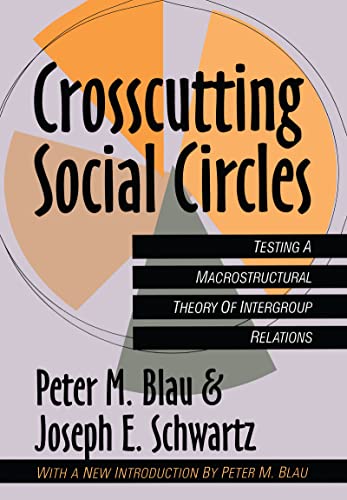
Taschenbuch. Condición: Neu. This item is printed on demand - it takes 3-4 days longer - Neuware -Crosscutting Social Circles describes a theory of groups' relations to each other, and tests the theory in the 125 largest metropolitan areas In the United States. The focus is on the Influence social structure exerts on intergroup…relations. Blau and Schwartz show how role relations are influenced by how people are distributed among social positions. Examples are a community's racial composition, division of labor, ethnic heterogeneity, income Inequality, or the extent to which educational differences are related to income differences. Blau and Schwartz test their theory by considering its impact on such structural conditions as intermarriage, an important form of intergroup relations.The authors derive the main principles of previously formulated theories of intergroup relations and present them in simpler and clearer form. They empirically test the power of the theory by analyzing its ability to predict how social structure affects intermarriage in the largest American cities, where three-fifths of the American population live. They selected cities because population distribution of a small neighborhood might be affected by casual associations among neighbors; it is much more sociologically interesting if population distribution also affects mate selection in a city of millions.Unlike most theories that emphasize the implications of such cultural orientations as shared values and common norms, this volume focuses on the significance of various forms of inequality and heterogeneity. As one of the few books that supplies a large-scale empirical test of implications of a theory, Crosscutting Social Circles serves as a model. The new introduction by Peter Blau reviews the origins and impact of the book. It will be of immense value to sociologists, psychologists, and group relations specialists. 286 pp. Englisch.
- Tapa blanda
- Impresión bajo demanda
Librería: Biblios, frankfurt am main, HESSE, AlemaniaBiblios
Contactar con el vendedorVendedor de 4 estrellasCondición: Nuevo
EUR 76,31
Envío por EUR 9,95Se envía de Alemania a Estados Unidos de AmericaCantidad disponible: 4 disponibles
Condición: New. PRINT ON DEMAND pp. 257.

- Tapa blanda
- Impresión bajo demanda
Librería: AHA-BUCH GmbH, Einbeck, AlemaniaAHA-BUCH GmbH
Contactar con el vendedorVendedor de 5 estrellasCondición: Nuevo
EUR 71,05
Envío por EUR 62,80Se envía de Alemania a Estados Unidos de AmericaCantidad disponible: 2 disponibles
Taschenbuch. Condición: Neu. nach der Bestellung gedruckt Neuware - Printed after ordering - Crosscutting Social Circles describes a theory of groups' relations to each other, and tests the theory in the 125 largest metropolitan areas In the United States. The focus is on the Influence social structure exerts on intergroup relat…ions. Blau and Schwartz show how role relations are influenced by how people are distributed among social positions. Examples are a community's racial composition, division of labor, ethnic heterogeneity, income Inequality, or the extent to which educational differences are related to income differences. Blau and Schwartz test their theory by considering its impact on such structural conditions as intermarriage, an important form of intergroup relations.The authors derive the main principles of previously formulated theories of intergroup relations and present them in simpler and clearer form. They empirically test the power of the theory by analyzing its ability to predict how social structure affects intermarriage in the largest American cities, where three-fifths of the American population live. They selected cities because population distribution of a small neighborhood might be affected by casual associations among neighbors; it is much more sociologically interesting if population distribution also affects mate selection in a city of millions.Unlike most theories that emphasize the implications of such cultural orientations as shared values and common norms, this volume focuses on the significance of various forms of inequality and heterogeneity. As one of the few books that supplies a large-scale empirical test of implications of a theory, Crosscutting Social Circles serves as a model. The new introduction by Peter Blau reviews the origins and impact of the book. It will be of immense value to sociologists, psychologists, and group relations specialists.


