

Importe total (1 artículo artículos):
Destino del pedido:

jongryn barry weingast (10 resultados)
Ir a los resultados principales
Filtros de búsqueda
Tipo de artículo
- Todos los tipos de productos
- Libros (10)
- Revistas y publicaciones (No hay ningún otro resultado que coincida con este filtro.)
- Cómics (No hay ningún otro resultado que coincida con este filtro.)
- Partituras (No hay ningún otro resultado que coincida con este filtro.)
- Arte, grabados y pósters (No hay ningún otro resultado que coincida con este filtro.)
- Fotografías (No hay ningún otro resultado que coincida con este filtro.)
- Mapas (No hay ningún otro resultado que coincida con este filtro.)
- Manuscritos y coleccionismo de papel (No hay ningún otro resultado que coincida con este filtro.)
Condición Más información
- Nuevo (8)
- Como nuevo, Excelente o Muy bueno (2)
- Bueno o Aceptable (No hay ningún otro resultado que coincida con este filtro.)
- Regular o Pobre (No hay ningún otro resultado que coincida con este filtro.)
- Tal como se indica (No hay ningún otro resultado que coincida con este filtro.)
Encuadernación
- Todas
- Tapa dura (10)
- Tapa blanda (No hay ningún otro resultado que coincida con este filtro.)
Más atributos
- Primera edición (No hay ningún otro resultado que coincida con este filtro.)
- Firmado (No hay ningún otro resultado que coincida con este filtro.)
- Sobrecubierta (No hay ningún otro resultado que coincida con este filtro.)
- Con imágenes (2)
- No impresión bajo demanda (10)
Idioma (1)
Precio
- Cualquier precio
- Menos de EUR 20 (No hay ningún otro resultado que coincida con este filtro.)
- EUR 20 a EUR 45
- Más de EUR 45
Gastos de envío gratis
Ubicación del vendedor
Valoración de los vendedores
-
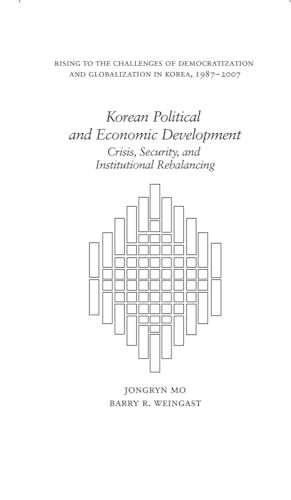
Korean Political and Economic Development : Crisis, Security, and Institutional Rebalancing
Idioma: Inglés
Publicado por Harvard University Asia Center, 2013
ISBN 10: 067472674X ISBN 13: 9780674726741
Librería: GreatBookPrices, Columbia, MD, Estados Unidos de America
Calificación del vendedor: 5 de 5 estrellas

EUR 39,96
Envío por EUR 2,29
Se envía dentro de Estados Unidos de AmericaCantidad disponible: 14 disponibles
Añadir al carritoCondición: As New. Unread book in perfect condition.
-

Korean Political and Economic Development
Idioma: Inglés
Publicado por Harvard University, Asia Center, US, 2013
ISBN 10: 067472674X ISBN 13: 9780674726741
Librería: Rarewaves.com USA, London, LONDO, Reino Unido
Calificación del vendedor: 5 de 5 estrellas
EUR 42,33
Gastos de envío gratis
Se envía de Reino Unido a Estados Unidos de AmericaCantidad disponible: 7 disponibles
Añadir al carritoHardback. Condición: New. How do poor nations become rich, industrialized, and democratic? And what role does democracy play in this transition? To address these questions, Jongryn Mo and Barry R. Weingast study South Korea's remarkable transformation since 1960. The authors concentrate on three critical turning points: Park Chung Hee's creation of the development state beginning in the early 1960s, democratization in 1987, and the genesis of and reaction to the 1997 economic crisis. At each turning point, Korea took a significant step toward creating an open access social order.The dynamics of this transition hinge on the inclusion of a wide array of citizens, rather than just a narrow elite, in economic and political activities and organizations. The political economy systems that followed each of the first two turning points lacked balance in the degree of political and economic openness and did not last. The Korean experience, therefore, suggests that a society lacking balance cannot sustain development. Korean Political and Economic Development offers a new view of how Korea was able to maintain a pro-development state with sustained growth by resolving repeated crises in favor of rebalancing and greater political and economic openness.
-
Korean Political and Economic Development : Crisis, Security, and Institutional Rebalancing
Idioma: Inglés
Publicado por Harvard University Asia Center, 2013
ISBN 10: 067472674X ISBN 13: 9780674726741
Librería: GreatBookPrices, Columbia, MD, Estados Unidos de America
Calificación del vendedor: 5 de 5 estrellas
EUR 39,98
Envío por EUR 2,29
Se envía dentro de Estados Unidos de AmericaCantidad disponible: 14 disponibles
Añadir al carritoCondición: New.
-
Korean Political and Economic Development : Crisis, Security, and Institutional Rebalancing
Idioma: Inglés
Publicado por Harvard University Asia Center, 2013
ISBN 10: 067472674X ISBN 13: 9780674726741
Librería: GreatBookPricesUK, Woodford Green, Reino Unido
Calificación del vendedor: 5 de 5 estrellas
EUR 37,75
Envío por EUR 17,38
Se envía de Reino Unido a Estados Unidos de AmericaCantidad disponible: 14 disponibles
Añadir al carritoCondición: New.
-
Korean Political and Economic Development
Idioma: Inglés
Publicado por Harvard University Press, 2013
ISBN 10: 067472674X ISBN 13: 9780674726741
Librería: Majestic Books, Hounslow, Reino Unido
Calificación del vendedor: 4 de 5 estrellas

EUR 49,18
Envío por EUR 7,53
Se envía de Reino Unido a Estados Unidos de AmericaCantidad disponible: 3 disponibles
Añadir al carritoCondición: New. pp. 232.
-
Korean Political and Economic Development : Crisis, Security, and Institutional Rebalancing
Idioma: Inglés
Publicado por Harvard University Asia Center, 2013
ISBN 10: 067472674X ISBN 13: 9780674726741
Librería: GreatBookPricesUK, Woodford Green, Reino Unido
Calificación del vendedor: 5 de 5 estrellas
EUR 42,45
Envío por EUR 17,38
Se envía de Reino Unido a Estados Unidos de AmericaCantidad disponible: 14 disponibles
Añadir al carritoCondición: As New. Unread book in perfect condition.
-
Korean Political and Economic Development: Crisis, Security, and Institutional Rebalancing (Harvard East Asian Monographs (Hardcover))
Idioma: Inglés
Publicado por Harvard University Asia Center 2014-01-20, 2014
ISBN 10: 067472674X ISBN 13: 9780674726741
Librería: Chiron Media, Wallingford, Reino Unido
Calificación del vendedor: 5 de 5 estrellas
EUR 43,28
Envío por EUR 17,94
Se envía de Reino Unido a Estados Unidos de AmericaCantidad disponible: 14 disponibles
Añadir al carritoHardcover. Condición: New.
-
Korean Political and Economic Development Crisis, Security, and Institutional Rebalancing
Idioma: Inglés
Publicado por Harvard Univ Council on East Asian, 2013
ISBN 10: 067472674X ISBN 13: 9780674726741
Librería: Revaluation Books, Exeter, Reino Unido
Calificación del vendedor: 5 de 5 estrellas
EUR 50,17
Envío por EUR 11,58
Se envía de Reino Unido a Estados Unidos de AmericaCantidad disponible: 2 disponibles
Añadir al carritoHardcover. Condición: Brand New. 218 pages. 9.00x6.25x1.00 inches. In Stock.
-
Korean Political and Economic Development
Idioma: Inglés
Publicado por Harvard University Press, 2013
ISBN 10: 067472674X ISBN 13: 9780674726741
Librería: Books Puddle, New York, NY, Estados Unidos de America
Calificación del vendedor: 4 de 5 estrellas
EUR 59,23
Envío por EUR 3,46
Se envía dentro de Estados Unidos de AmericaCantidad disponible: 3 disponibles
Añadir al carritoCondición: New. pp. 232.
-

Korean Political and Economic Development
Idioma: Inglés
Publicado por Harvard University, Asia Center, US, 2013
ISBN 10: 067472674X ISBN 13: 9780674726741
Librería: Rarewaves.com UK, London, Reino Unido
Calificación del vendedor: 5 de 5 estrellas
EUR 37,74
Envío por EUR 75,29
Se envía de Reino Unido a Estados Unidos de AmericaCantidad disponible: 7 disponibles
Añadir al carritoHardback. Condición: New. How do poor nations become rich, industrialized, and democratic? And what role does democracy play in this transition? To address these questions, Jongryn Mo and Barry R. Weingast study South Korea's remarkable transformation since 1960. The authors concentrate on three critical turning points: Park Chung Hee's creation of the development state beginning in the early 1960s, democratization in 1987, and the genesis of and reaction to the 1997 economic crisis. At each turning point, Korea took a significant step toward creating an open access social order.The dynamics of this transition hinge on the inclusion of a wide array of citizens, rather than just a narrow elite, in economic and political activities and organizations. The political economy systems that followed each of the first two turning points lacked balance in the degree of political and economic openness and did not last. The Korean experience, therefore, suggests that a society lacking balance cannot sustain development. Korean Political and Economic Development offers a new view of how Korea was able to maintain a pro-development state with sustained growth by resolving repeated crises in favor of rebalancing and greater political and economic openness.

