Importe total (1 artículo artículos):
Destino del pedido:

frolov g (49 resultados)
Ir a los resultados principales
Filtros de búsqueda
Tipo de artículo
- Todos los tipos de productos
- Libros (49)
- Revistas y publicaciones (No hay ningún otro resultado que coincida con este filtro.)
- Cómics (No hay ningún otro resultado que coincida con este filtro.)
- Partituras (No hay ningún otro resultado que coincida con este filtro.)
- Arte, grabados y pósters (No hay ningún otro resultado que coincida con este filtro.)
- Fotografías (No hay ningún otro resultado que coincida con este filtro.)
- Mapas (No hay ningún otro resultado que coincida con este filtro.)
- Manuscritos y coleccionismo de papel (No hay ningún otro resultado que coincida con este filtro.)
Condición Más información
Encuadernación
Más atributos
- Primera edición (1)
- Firmado (No hay ningún otro resultado que coincida con este filtro.)
- Sobrecubierta (4)
- Con imágenes (23)
- No impresión bajo demanda (42)
Idioma (6)
Gastos de envío gratis
Ubicación del vendedor
Valoración de los vendedores
-

Etika nauki. Problemy i diskussii.
Publicado por Politizdat, Moskva, 1986
Librería: Antiquariat D. Gorodin, Freiburg, Alemania
Calificación del vendedor: 4 de 5 estrellas

EUR 8,00
Envío por EUR 10,00
Se envía de Alemania a Estados Unidos de AmericaCantidad disponible: 1 disponibles
Añadir al carritoSoftcover. Condición: Sehr gut. 398 S. Buch.
-

Elementos de Informática
Idioma: Español
ISBN 10: 5030020632 ISBN 13: 9785030020631
Librería: Hamelyn, Madrid, M, España
Calificación del vendedor: 5 de 5 estrellas

EUR 7,88
Envío por EUR 12,99
Se envía de España a Estados Unidos de AmericaCantidad disponible: 1 disponibles
Añadir al carritoCondición: Bueno. : Elementos de Informática es un libro escrito por G. Frolov y E. Kuznetsov, publicado en 1991 por la editorial Mir de Moscú. Este libro de tapa dura aborda temas relacionados con la informática y la tecnología. Es una traducción de G. Lozhkin. EAN: 9785030020631 Tipo: Libros Categoría: Tecnología Título: Elementos de Informática Autor: G. Frolov| E. Kuznetsov Editorial: Mir. Idioma: es Páginas: 328 Formato: tapa dura.
-

Metallogenesis and Tectonics of the Russian Far East, Alaska, and the Canadian Cordillera Professional Paper 1697
Publicado por USGS, 2005
ISBN 10: 0607984074 ISBN 13: 9780607984071
Librería: Crossroads Books, Reno, NV, Estados Unidos de America
Miembro de asociación: IOBA
Calificación del vendedor: 5 de 5 estrellas
EUR 27,46
Envío por EUR 4,38
Se envía dentro de Estados Unidos de AmericaCantidad disponible: 3 disponibles
Añadir al carritoCondición: new. "The Proterozoic and Phanerozoic metallogenic and tectonic evolution of the Russian Far East, Alaska, and the Canadian Cordillera is recorded in the cratons, craton margins, and orogenic collages of the Circum-North Pacific mountain belts that separate the North Pacific from the eastern North Asian and western North American Cratons. The collages consist of tectonostratigraphic terranes and contained metallogenic belts, which are composed of fragments of igneous arcs, accretionary-wedge and subduction-zone complexes, passive continental margins, and cratons. The terranes are overlapped by continental-margin-arc and sedimentary-basin assemblages and contained metallogenic belts. The metallogenic and geologic history of terranes, overlap assemblages, cratons, and craton margins has been complicated by postaccretion dismemberment and translation during strike-slip faulting that occurred subparallel to continental margins. Seven processes overlapping in time were responsible for most of metallogenic and geologic complexities of the region (1) In the Early and Middle Proterozoic, marine sedimentary basins developed on major cratons and were the loci for ironstone (Superior Fe) deposits and sediment-hosted Cu deposits that occur along both the North Asia Craton and North American Craton Margin. (2) In the Late Proterozoic, Late Devonian, and Early Carboniferous, major periods of rifting occurred along the ancestral margins of present-day Northeast Asia and northwestern North America. The rifting resulted in fragmentation of each continent, and formation of cratonal and passive continental-margin terranes that eventually migrated and accreted to other sites along the evolving margins of the original or adjacent continents. The rifting also resulted in formation of various massive-sulfide metallogenic belts. (3) From about the late Paleozoic through the mid-Cretaceous, a succession of island arcs and contained igneous-arc-related metallogenic belts and tectonically paired subduction zones formed near continental margins. (4) From about mainly the mid-Cretaceous through the present, a succession of continental-margin igneous arcs (some extending offshore into island arcs) and contained metallogenic belts, and tectonically paired subduction zones formed along the continental margins. (5) From about the Jurassic to the present, oblique convergence and rotations caused orogen-parallel sinistral, and then dextral displacements within the plate margins of the Northeast Asian and North American Cratons. The oblique convergences and rotations resulted in the fragmentation, displacement, and duplication of formerly more continuous arcs, subduction zones, passive continental margins, and contained metallogenic belts. These fragments were subsequently accreted along the margins of the expanding continental margins. (6) From the Early Jurassic through Tertiary, movement of the upper continental plates toward subduction zones resulted in strong plate coupling and accretion of the former island arcs, subduction zones, and contained metallogenic belts to continental margins. In this region, the multiple arc accretions were accompanied and followed by crustal thickening, anatexis, metamorphism, formation of collision-related metallogenic belts, and uplift; this resulted in the substantial growth of the North Asian and North American continents. (7) In the middle and late Cenozoic, oblique to orthogonal convergence of the Pacific Plate with present-day Alaska and Northeast Asia resulted in formation of the present ring of volcanoes and contained metallogenic belts around the Circum-North Pacific. Oblique convergence between the Pacific Plate and Alaska also resulted in major dextral-slip faulting in interior and southern Alaska and along the western part of the Aleutian- Wrangell arc. Associated with dextral-slip faulting was crustal extrusion of terranes from western Alaska into the Bering Sea. " DV2. softcover, wrapped in shrink wrap, tight, crisp, 429 pages.
-

Metallogenesis and Tectonics of the Russian Far East, Alaska, and the Canadian Cordillera Professional Paper 1697
Publicado por USGS, 2005
ISBN 10: 0607984074 ISBN 13: 9780607984071
Librería: Crossroads Books, Reno, NV, Estados Unidos de America
Miembro de asociación: IOBA
Calificación del vendedor: 5 de 5 estrellas
EUR 27,46
Envío por EUR 4,38
Se envía dentro de Estados Unidos de AmericaCantidad disponible: 2 disponibles
Añadir al carritoCondición: new. "The Proterozoic and Phanerozoic metallogenic and tectonic evolution of the Russian Far East, Alaska, and the Canadian Cordillera is recorded in the cratons, craton margins, and orogenic collages of the Circum-North Pacific mountain belts that separate the North Pacific from the eastern North Asian and western North American Cratons. The collages consist of tectonostratigraphic terranes and contained metallogenic belts, which are composed of fragments of igneous arcs, accretionary-wedge and subduction-zone complexes, passive continental margins, and cratons. The terranes are overlapped by continental-margin-arc and sedimentary-basin assemblages and contained metallogenic belts. The metallogenic and geologic history of terranes, overlap assemblages, cratons, and craton margins has been complicated by postaccretion dismemberment and translation during strike-slip faulting that occurred subparallel to continental margins. Seven processes overlapping in time were responsible for most of metallogenic and geologic complexities of the region (1) In the Early and Middle Proterozoic, marine sedimentary basins developed on major cratons and were the loci for ironstone (Superior Fe) deposits and sediment-hosted Cu deposits that occur along both the North Asia Craton and North American Craton Margin. (2) In the Late Proterozoic, Late Devonian, and Early Carboniferous, major periods of rifting occurred along the ancestral margins of present-day Northeast Asia and northwestern North America. The rifting resulted in fragmentation of each continent, and formation of cratonal and passive continental-margin terranes that eventually migrated and accreted to other sites along the evolving margins of the original or adjacent continents. The rifting also resulted in formation of various massive-sulfide metallogenic belts. (3) From about the late Paleozoic through the mid-Cretaceous, a succession of island arcs and contained igneous-arc-related metallogenic belts and tectonically paired subduction zones formed near continental margins. (4) From about mainly the mid-Cretaceous through the present, a succession of continental-margin igneous arcs (some extending offshore into island arcs) and contained metallogenic belts, and tectonically paired subduction zones formed along the continental margins. (5) From about the Jurassic to the present, oblique convergence and rotations caused orogen-parallel sinistral, and then dextral displacements within the plate margins of the Northeast Asian and North American Cratons. The oblique convergences and rotations resulted in the fragmentation, displacement, and duplication of formerly more continuous arcs, subduction zones, passive continental margins, and contained metallogenic belts. These fragments were subsequently accreted along the margins of the expanding continental margins. (6) From the Early Jurassic through Tertiary, movement of the upper continental plates toward subduction zones resulted in strong plate coupling and accretion of the former island arcs, subduction zones, and contained metallogenic belts to continental margins. In this region, the multiple arc accretions were accompanied and followed by crustal thickening, anatexis, metamorphism, formation of collision-related metallogenic belts, and uplift; this resulted in the substantial growth of the North Asian and North American continents. (7) In the middle and late Cenozoic, oblique to orthogonal convergence of the Pacific Plate with present-day Alaska and Northeast Asia resulted in formation of the present ring of volcanoes and contained metallogenic belts around the Circum-North Pacific. Oblique convergence between the Pacific Plate and Alaska also resulted in major dextral-slip faulting in interior and southern Alaska and along the western part of the Aleutian- Wrangell arc. Associated with dextral-slip faulting was crustal extrusion of terranes from western Alaska into the Bering Sea. " DV1. softcover, wrapped in shrink wrap, tight, crisp, 429 pages.
-

Metallogenesis and Tectonics of the Russian Far East, Alaska, and the Canadian Cordillera Professional Paper 1697
Publicado por USGS, 2005
ISBN 10: 0607984074 ISBN 13: 9780607984071
Librería: Crossroads Books, Reno, NV, Estados Unidos de America
Miembro de asociación: IOBA
Calificación del vendedor: 5 de 5 estrellas
EUR 27,46
Envío por EUR 4,38
Se envía dentro de Estados Unidos de AmericaCantidad disponible: 3 disponibles
Añadir al carritoCondición: new. "The Proterozoic and Phanerozoic metallogenic and tectonic evolution of the Russian Far East, Alaska, and the Canadian Cordillera is recorded in the cratons, craton margins, and orogenic collages of the Circum-North Pacific mountain belts that separate the North Pacific from the eastern North Asian and western North American Cratons. The collages consist of tectonostratigraphic terranes and contained metallogenic belts, which are composed of fragments of igneous arcs, accretionary-wedge and subduction-zone complexes, passive continental margins, and cratons. The terranes are overlapped by continental-margin-arc and sedimentary-basin assemblages and contained metallogenic belts. The metallogenic and geologic history of terranes, overlap assemblages, cratons, and craton margins has been complicated by postaccretion dismemberment and translation during strike-slip faulting that occurred subparallel to continental margins. Seven processes overlapping in time were responsible for most of metallogenic and geologic complexities of the region (1) In the Early and Middle Proterozoic, marine sedimentary basins developed on major cratons and were the loci for ironstone (Superior Fe) deposits and sediment-hosted Cu deposits that occur along both the North Asia Craton and North American Craton Margin. (2) In the Late Proterozoic, Late Devonian, and Early Carboniferous, major periods of rifting occurred along the ancestral margins of present-day Northeast Asia and northwestern North America. The rifting resulted in fragmentation of each continent, and formation of cratonal and passive continental-margin terranes that eventually migrated and accreted to other sites along the evolving margins of the original or adjacent continents. The rifting also resulted in formation of various massive-sulfide metallogenic belts. (3) From about the late Paleozoic through the mid-Cretaceous, a succession of island arcs and contained igneous-arc-related metallogenic belts and tectonically paired subduction zones formed near continental margins. (4) From about mainly the mid-Cretaceous through the present, a succession of continental-margin igneous arcs (some extending offshore into island arcs) and contained metallogenic belts, and tectonically paired subduction zones formed along the continental margins. (5) From about the Jurassic to the present, oblique convergence and rotations caused orogen-parallel sinistral, and then dextral displacements within the plate margins of the Northeast Asian and North American Cratons. The oblique convergences and rotations resulted in the fragmentation, displacement, and duplication of formerly more continuous arcs, subduction zones, passive continental margins, and contained metallogenic belts. These fragments were subsequently accreted along the margins of the expanding continental margins. (6) From the Early Jurassic through Tertiary, movement of the upper continental plates toward subduction zones resulted in strong plate coupling and accretion of the former island arcs, subduction zones, and contained metallogenic belts to continental margins. In this region, the multiple arc accretions were accompanied and followed by crustal thickening, anatexis, metamorphism, formation of collision-related metallogenic belts, and uplift; this resulted in the substantial growth of the North Asian and North American continents. (7) In the middle and late Cenozoic, oblique to orthogonal convergence of the Pacific Plate with present-day Alaska and Northeast Asia resulted in formation of the present ring of volcanoes and contained metallogenic belts around the Circum-North Pacific. Oblique convergence between the Pacific Plate and Alaska also resulted in major dextral-slip faulting in interior and southern Alaska and along the western part of the Aleutian- Wrangell arc. Associated with dextral-slip faulting was crustal extrusion of terranes from western Alaska into the Bering Sea." DV4. softcover, wrapped in shrink wrap, tight, crisp, 429 pages.
-

Metallogenesis and Tectonics of the Russian Far East, Alaska, and the Canadian Cordillera Professional Paper 1697
Publicado por USGS, 2005
ISBN 10: 0607984074 ISBN 13: 9780607984071
Librería: Crossroads Books, Reno, NV, Estados Unidos de America
Miembro de asociación: IOBA
Calificación del vendedor: 5 de 5 estrellas
EUR 27,46
Envío por EUR 4,38
Se envía dentro de Estados Unidos de AmericaCantidad disponible: 7 disponibles
Añadir al carritoCondición: new. The Proterozoic and Phanerozoic metallogenic and tectonic evolution of the Russian Far East, Alaska, and the Canadian Cordillera is recorded in the cratons, craton margins, and orogenic collages of the Circum-North Pacific mountain belts that separate the North Pacific from the eastern North Asian and western North American Cratons. The collages consist of tectonostratigraphic terranes and contained metallogenic belts, which are composed of fragments of igneous arcs, accretionary-wedge and subduction-zone complexes, passive continental margins, and cratons. The terranes are overlapped by continental-margin-arc and sedimentary-basin assemblages and contained metallogenic belts. The metallogenic and geologic history of terranes, overlap assemblages, cratons, and craton margins has been complicated by postaccretion dismemberment and translation during strike-slip faulting that occurred subparallel to continental margins. Seven processes overlapping in time were responsible for most of metallogenic and geologic complexities of the region (1) In the Early and Middle Proterozoic, marine sedimentary basins developed on major cratons and were the loci for ironstone (Superior Fe) deposits and sediment-hosted Cu deposits that occur along both the North Asia Craton and North American Craton Margin. (2) In the Late Proterozoic, Late Devonian, and Early Carboniferous, major periods of rifting occurred along the ancestral margins of present-day Northeast Asia and northwestern North America. The rifting resulted in fragmentation of each continent, and formation of cratonal and passive continental-margin terranes that eventually migrated and accreted to other sites along the evolving margins of the original or adjacent continents. The rifting also resulted in formation of various massive-sulfide metallogenic belts. (3) From about the late Paleozoic through the mid-Cretaceous, a succession of island arcs and contained igneous-arc-related metallogenic belts and tectonically paired subduction zones formed near continental margins. (4) From about mainly the mid-Cretaceous through the present, a succession of continental-margin igneous arcs (some extending offshore into island arcs) and contained metallogenic belts, and tectonically paired subduction zones formed along the continental margins. (5) From about the Jurassic to the present, oblique convergence and rotations caused orogen-parallel sinistral, and then dextral displacements within the plate margins of the Northeast Asian and North American Cratons. The oblique convergences and rotations resulted in the fragmentation, displacement, and duplication of formerly more continuous arcs, subduction zones, passive continental margins, and contained metallogenic belts. These fragments were subsequently accreted along the margins of the expanding continental margins. (6) From the Early Jurassic through Tertiary, movement of the upper continental plates toward subduction zones resulted in strong plate coupling and accretion of the former island arcs, subduction zones, and contained metallogenic belts to continental margins. In this region, the multiple arc accretions were accompanied and followed by crustal thickening, anatexis, metamorphism, formation of collision-related metallogenic belts, and uplift; this resulted in the substantial growth of the North Asian and North American continents. (7) In the middle and late Cenozoic, oblique to orthogonal convergence of the Pacific Plate with present-day Alaska and Northeast Asia resulted in formation of the present ring of volcanoes and contained metallogenic belts around the Circum-North Pacific. Oblique convergence between the Pacific Plate and Alaska also resulted in major dextral-slip faulting in interior and southern Alaska and along the western part of the Aleutian- Wrangell arc. Associated with dextral-slip faulting was crustal extrusion of terranes from western Alaska into the Bering Sea. DX1. softcover, wrapped in shrink wrap, tight, crisp, 429 pages.
-
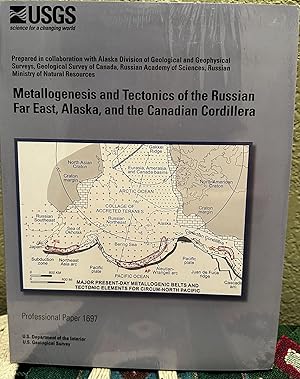
Metallogenesis and Tectonics of the Russian Far East, Alaska, and the Canadian Cordillera Professional Paper 1697
Publicado por USGS, 2005
ISBN 10: 0607984074 ISBN 13: 9780607984071
Librería: Crossroads Books, Reno, NV, Estados Unidos de America
Miembro de asociación: IOBA
Calificación del vendedor: 5 de 5 estrellas
EUR 27,46
Envío por EUR 4,38
Se envía dentro de Estados Unidos de AmericaCantidad disponible: 2 disponibles
Añadir al carritoCondición: new. The Proterozoic and Phanerozoic metallogenic and tectonic evolution of the Russian Far East, Alaska, and the Canadian Cordillera is recorded in the cratons, craton margins, and orogenic collages of the Circum-North Pacific mountain belts that separate the North Pacific from the eastern North Asian and western North American Cratons. The collages consist of tectonostratigraphic terranes and contained metallogenic belts, which are composed of fragments of igneous arcs, accretionary-wedge and subduction-zone complexes, passive continental margins, and cratons. The terranes are overlapped by continental-margin-arc and sedimentary-basin assemblages and contained metallogenic belts. The metallogenic and geologic history of terranes, overlap assemblages, cratons, and craton margins has been complicated by postaccretion dismemberment and translation during strike-slip faulting that occurred subparallel to continental margins. Seven processes overlapping in time were responsible for most of metallogenic and geologic complexities of the region (1) In the Early and Middle Proterozoic, marine sedimentary basins developed on major cratons and were the loci for ironstone (Superior Fe) deposits and sediment-hosted Cu deposits that occur along both the North Asia Craton and North American Craton Margin. (2) In the Late Proterozoic, Late Devonian, and Early Carboniferous, major periods of rifting occurred along the ancestral margins of present-day Northeast Asia and northwestern North America. The rifting resulted in fragmentation of each continent, and formation of cratonal and passive continental-margin terranes that eventually migrated and accreted to other sites along the evolving margins of the original or adjacent continents. The rifting also resulted in formation of various massive-sulfide metallogenic belts. (3) From about the late Paleozoic through the mid-Cretaceous, a succession of island arcs and contained igneous-arc-related metallogenic belts and tectonically paired subduction zones formed near continental margins. (4) From about mainly the mid-Cretaceous through the present, a succession of continental-margin igneous arcs (some extending offshore into island arcs) and contained metallogenic belts, and tectonically paired subduction zones formed along the continental margins. (5) From about the Jurassic to the present, oblique convergence and rotations caused orogen-parallel sinistral, and then dextral displacements within the plate margins of the Northeast Asian and North American Cratons. The oblique convergences and rotations resulted in the fragmentation, displacement, and duplication of formerly more continuous arcs, subduction zones, passive continental margins, and contained metallogenic belts. These fragments were subsequently accreted along the margins of the expanding continental margins. (6) From the Early Jurassic through Tertiary, movement of the upper continental plates toward subduction zones resulted in strong plate coupling and accretion of the former island arcs, subduction zones, and contained metallogenic belts to continental margins. In this region, the multiple arc accretions were accompanied and followed by crustal thickening, anatexis, metamorphism, formation of collision-related metallogenic belts, and uplift; this resulted in the substantial growth of the North Asian and North American continents. (7) In the middle and late Cenozoic, oblique to orthogonal convergence of the Pacific Plate with present-day Alaska and Northeast Asia resulted in formation of the present ring of volcanoes and contained metallogenic belts around the Circum-North Pacific. Oblique convergence between the Pacific Plate and Alaska also resulted in major dextral-slip faulting in interior and southern Alaska and along the western part of the Aleutian- Wrangell arc. Associated with dextral-slip faulting was crustal extrusion of terranes from western Alaska into the Bering Sea. softcover, wrapped in shrink wrap, tight, crisp, 429 pages.
-

Recueil d'exercices et de problèmes d'analyse mathématique
Publicado por Editions de la paix, MOscou - sd, traduit du russe par H. Damadian, in-8, relié, 562 pages
Librería: Sylvain Paré, Montolieu, Francia
Calificación del vendedor: 5 de 5 estrellas
EUR 18,00
Envío por EUR 15,20
Se envía de Francia a Estados Unidos de AmericaCantidad disponible: 1 disponibles
Añadir al carritoEditions de la paix, MOscou - sd, traduit du russe par H. Damadian, in-8, relié, 562 pages Etat satisfaisant, sans jaquette - Pour les envois hors de France, la tafication «livre & brochure» pour les frais de port a disparue.Les frais de port annoncés correspondent à une moyenne. Ils seront calculés au plus juste en fonction du poids de votre article.
-

Sbornik zadach po programmirovaniyu na algoritmicheskikh yazykakh
Publicado por Nauka, 1978
ISBN 10: 2222040825 ISBN 13: 9782222040828
Librería: ISIA Media Verlag UG | Bukinist, Leipzig, Alemania
Calificación del vendedor: 5 de 5 estrellas
EUR 6,84
Envío por EUR 36,50
Se envía de Alemania a Estados Unidos de AmericaCantidad disponible: 1 disponibles
Añadir al carritoSoftcover/Paperback. Condición: Fair. V sbornike privodyatsya zadachi po programmirovaniyu na algoritmicheskikh yazykakh FORTRAN-IV i ALGOL-60 - yazykakh, orientirovannykh na sovremennyj park vychislitelnykh mashin. Struktura zadachnika takova, chto pered kazhdym razdelom privoditsya teoreticheskaya spravka po yazyku vse neobkhodimye svedeniya dlya dannogo razdela.
-

Resursosberegajuschie tekhnologii proizvodstva produktsii APK. Uchebnoe posobie dlja vuzov
Librería: Ruslania, Helsinki, Finlandia
Calificación del vendedor: 5 de 5 estrellas
EUR 24,00
Envío por EUR 15,00
Se envía de Finlandia a Estados Unidos de AmericaCantidad disponible: 10 disponibles
Añadir al carritoCondición: new. Pages: 84 Language: Russian. V uchebnom posobii rassmotreny osobennosti soderzhanija, gigieny kormlenija i poenija krupnogo rogatogo skota i svinej.Izdanie prednaznacheno dlja obuchajuschikhsja vysshikh uchebnykh zavedenij po napravleniju podgotovki "Agroinzhenerija". 9785811495351.
-

ELEMENTOS DE INFORMÁTICA Trad. G. Lozhkin.
Publicado por Mir., Moscú., 1991
ISBN 10: 5030020632 ISBN 13: 9785030020631
Librería: angeles sancha libros, Logroño, LO, España
Calificación del vendedor: 4 de 5 estrellas
EUR 20,00
Envío por EUR 30,10
Se envía de España a Estados Unidos de AmericaCantidad disponible: 1 disponibles
Añadir al carrito22 x 14. Tela ed. estamp. Firma ant. prop. 327 págs.
-
Pavlov e la sua scuola.
Publicado por , Giunti Barbèra, 1977
Librería: librisaggi, SAN VITO ROMANO, Italia
Calificación del vendedor: 4 de 5 estrellas
EUR 9,90
Envío por EUR 40,00
Se envía de Italia a Estados Unidos de AmericaCantidad disponible: 1 disponibles
Añadir al carritobrossura. Condición: Good. Libro in buono stato. Copertina deteriorata dal tempo. Rarissime sottolineature. Fisiologicamente ingiallito. Supplemento n.24 al fascicolo di Psicologia Contemporanea 265 Buono (Good) . Book.
-
PROGRAMMATION ET LANGAGES SYMBOLIQUES
Año de publicación: 1978
Librería: Librairie Philosophique J. Vrin, Paris, Francia
Calificación del vendedor: 4 de 5 estrellas
EUR 20,00
Envío por EUR 21,96
Se envía de Francia a Estados Unidos de AmericaCantidad disponible: 1 disponibles
Añadir al carritoCouverture rigide. Condición: Bon. Jaquette. KRINITSKI (N.), MIRONOV (G.) et FROLOV (G.). Programmation et langages symboliques.Sous la direction de A. Dorodnitsyne; trad. du russe par V. Kharine.Moscou, 1978, fort vol., in-8°, cart. pl. toile ss. jaq. 700 gr.
-
G. Frolov. Vera Voloshina. Yurij Dvuzhilnyj. Dokumentalnye povesti
Año de publicación: 1977
Librería: ISIA Media Verlag UG | Bukinist, Leipzig, Alemania
Calificación del vendedor: 5 de 5 estrellas
EUR 7,10
Envío por EUR 36,50
Se envía de Alemania a Estados Unidos de AmericaCantidad disponible: 1 disponibles
Añadir al carritoHardcover/Hardback. Condición: Fair. V knigu vklyucheny dve dokumentalnye povesti zhurnalista Georgiya Frolova. V osnovu pervoj polozheny podlinnye sobytiya iz zhizni razvedchitsy komsomolki Very Voloshinoj. Vtoraya povest rasskazyvaet o zhizni i podvige Geroya Sovetskogo Soyuza Yuriya Dvuzhilnogo, druga i odnoklassnika Very Voloshinoj.
-

Advanced Computation & Analysis of Combustion
Librería: Alplaus Books, Alplaus, NY, Estados Unidos de America
Calificación del vendedor: 5 de 5 estrellas
EUR 111,57
Envío por EUR 6,07
Se envía dentro de Estados Unidos de AmericaCantidad disponible: 1 disponibles
Añadir al carritoHardcover. Condición: Very Good. Hardbound without dust jacket. No text markings noted, modest usage wear.
-

Climate Change in Eurasian Arctic Shelf Seas : Centennial Observations of Ice Cover
Libro 170 de 408: Springer Praxis BooksLibrería: GreatBookPrices, Columbia, MD, Estados Unidos de America
Calificación del vendedor: 5 de 5 estrellas
EUR 115,50
Envío por EUR 2,29
Se envía dentro de Estados Unidos de AmericaCantidad disponible: Más de 20 disponibles
Añadir al carritoCondición: New.
-

Climate Change in Eurasian Arctic Shelf Seas: Centennial Ice Cover Observations (Springer Praxis Books)
Libro 170 de 408: Springer Praxis BooksLibrería: California Books, Miami, FL, Estados Unidos de America
Calificación del vendedor: 4 de 5 estrellas
EUR 117,87
Gastos de envío gratis
Se envía dentro de Estados Unidos de AmericaCantidad disponible: Más de 20 disponibles
Añadir al carritoCondición: New.
-
Advanced Computation & Analysis of Combustion
Librería: ThriftBooks-Atlanta, AUSTELL, GA, Estados Unidos de America
Calificación del vendedor: 5 de 5 estrellas
EUR 119,10
Gastos de envío gratis
Se envía dentro de Estados Unidos de AmericaCantidad disponible: 1 disponibles
Añadir al carritoHardcover. Condición: Good. No Jacket. Pages can have notes/highlighting. Spine may show signs of wear. ~ ThriftBooks: Read More, Spend Less.
-

Programmation et langages symboliques
Publicado por Moscou - 1978, 1978
Librería: Sylvain Paré, Montolieu, Francia
Calificación del vendedor: 5 de 5 estrellas
EUR 45,00
Envío por EUR 15,20
Se envía de Francia a Estados Unidos de AmericaCantidad disponible: 1 disponibles
Añadir al carritoEditions Mir, Moscou - 1978, in-8 relié avec jaquette, 510 pages Bon état du livre, jaquette légèrement abîmée - Pour les envois hors de France, la tafication «livre & brochure» pour les frais de port a disparue.Les frais de port annoncés correspondent à une moyenne. Ils seront calculés au plus juste en fonction du poids de votre article.
-

Magnetic Resonance And Its Applications
Librería: Romtrade Corp., STERLING HEIGHTS, MI, Estados Unidos de America
Calificación del vendedor: 5 de 5 estrellas
EUR 129,35
Gastos de envío gratis
Se envía dentro de Estados Unidos de AmericaCantidad disponible: 1 disponibles
Añadir al carritoCondición: New. This is a Brand-new US Edition. This Item may be shipped from US or any other country as we have multiple locations worldwide.
-
Climate Change in Eurasian Arctic Shelf Seas : Centennial Observations of Ice Cover
Libro 170 de 408: Springer Praxis BooksLibrería: GreatBookPricesUK, Woodford Green, Reino Unido
Calificación del vendedor: 5 de 5 estrellas
EUR 124,73
Envío por EUR 17,38
Se envía de Reino Unido a Estados Unidos de AmericaCantidad disponible: Más de 20 disponibles
Añadir al carritoCondición: New.
-

Climate Change in Eurasian Arctic Shelf Seas: Centennial Ice Cover Observations (Springer Praxis Books)
Libro 170 de 408: Springer Praxis BooksLibrería: Ria Christie Collections, Uxbridge, Reino Unido
Calificación del vendedor: 5 de 5 estrellas
EUR 140,02
Envío por EUR 13,88
Se envía de Reino Unido a Estados Unidos de AmericaCantidad disponible: Más de 20 disponibles
Añadir al carritoCondición: New. In.
-
Climate Change in Eurasian Arctic Shelf Seas: Centennial Ice Cover Observations
Libro 170 de 408: Springer Praxis BooksLibrería: Revaluation Books, Exeter, Reino Unido
Calificación del vendedor: 5 de 5 estrellas
EUR 151,78
Envío por EUR 11,58
Se envía de Reino Unido a Estados Unidos de AmericaCantidad disponible: 2 disponibles
Añadir al carritoPaperback. Condición: Brand New. 2009 edition. 166 pages. 9.53x0.46x6.69 inches. In Stock.
-

Programmation et langages symboliques
Idioma: Francés
Publicado por Mir, Moscou, 1978
Librería: L'ivre d'Histoires, Merbes Sainte Marie, Belgica
Calificación del vendedor: 5 de 5 estrellas
EUR 42,00
Envío por EUR 37,70
Se envía de Belgica a Estados Unidos de AmericaCantidad disponible: 1 disponibles
Añadir al carritoCouverture Toilée d'origine. Condición: Bon. Estado de la sobrecubierta: Moyen.
-
Climate Change in Eurasian Arctic Shelf Seas: Centennial Ice Cover Observations (Springer Praxis Books)
Libro 170 de 408: Springer Praxis BooksLibrería: Ria Christie Collections, Uxbridge, Reino Unido
Calificación del vendedor: 5 de 5 estrellas
EUR 164,46
Envío por EUR 13,88
Se envía de Reino Unido a Estados Unidos de AmericaCantidad disponible: Más de 20 disponibles
Añadir al carritoCondición: New. In.
-

Remote Sensing Of Sea Ice In The Northern Sea Route
Libro 92 de 408: Springer Praxis BooksLibrería: Romtrade Corp., STERLING HEIGHTS, MI, Estados Unidos de America
Calificación del vendedor: 5 de 5 estrellas
EUR 182,31
Gastos de envío gratis
Se envía dentro de Estados Unidos de AmericaCantidad disponible: 1 disponibles
Añadir al carritoCondición: New. This is a Brand-new US Edition. This Item may be shipped from US or any other country as we have multiple locations worldwide.
-
Remote Sensing Of Sea Ice In The Northern Sea Route
Libro 92 de 408: Springer Praxis BooksLibrería: Basi6 International, Irving, TX, Estados Unidos de America
Calificación del vendedor: 5 de 5 estrellas
EUR 182,31
Gastos de envío gratis
Se envía dentro de Estados Unidos de AmericaCantidad disponible: 1 disponibles
Añadir al carritoCondición: Brand New. New. US edition. Expediting shipping for all USA and Europe orders excluding PO Box. Excellent Customer Service.
-

Climate Change in Eurasian Arctic Shelf Seas : Centennial Observations of Ice Cover
Libro 170 de 408: Springer Praxis BooksLibrería: GreatBookPricesUK, Woodford Green, Reino Unido
Calificación del vendedor: 5 de 5 estrellas
EUR 226,68
Envío por EUR 17,38
Se envía de Reino Unido a Estados Unidos de AmericaCantidad disponible: Más de 20 disponibles
Añadir al carritoCondición: As New. Unread book in perfect condition.
-
Climate Change in Eurasian Arctic Shelf Seas : Centennial Observations of Ice Cover
Libro 170 de 408: Springer Praxis BooksLibrería: GreatBookPrices, Columbia, MD, Estados Unidos de America
Calificación del vendedor: 5 de 5 estrellas
EUR 250,58
Envío por EUR 2,29
Se envía dentro de Estados Unidos de AmericaCantidad disponible: Más de 20 disponibles
Añadir al carritoCondición: As New. Unread book in perfect condition.
-
Remote Sensing of Sea Ice in the Northern Sea Route: Studies and Applications (Springer Praxis Books)
Libro 92 de 408: Springer Praxis BooksLibrería: Books Puddle, New York, NY, Estados Unidos de America
Calificación del vendedor: 4 de 5 estrellas
EUR 266,78
Envío por EUR 3,46
Se envía dentro de Estados Unidos de AmericaCantidad disponible: 1 disponibles
Añadir al carritoCondición: New. pp. xli + 472, Maps 1st Edition.