
Artículos relacionados a Symbolizing, Modeling and Tool Use in Mathematics Education:...
Symbolizing, Modeling and Tool Use in Mathematics Education: 30 (Mathematics Education Library, 30) - Tapa dura
Libro 40 de 48: Mathematics Education Library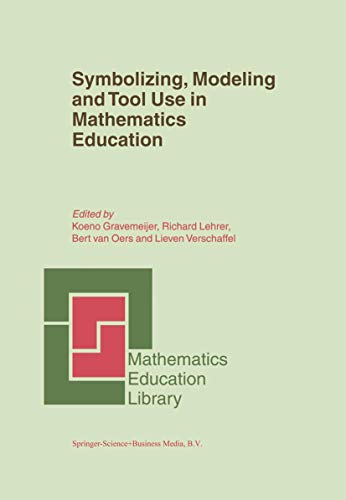
Sinopsis
The almost universal rejection of the notion of symbols as `carriers of meaning' has created the need to find an alternative for the use of models as embodiments of mathematical concepts. By taking its point of departure as a concern for the way students actually use tools and symbols, and for what these signify for them, this book explores the option of building on symbolizing, modelling and tool use as personally meaningful activities of students. This theme is approached from different angles and different perspectives. One dimension is that of setting, varying from the study of informal, spontaneous activity of students, to an explicit focus on instructional design, and goals and effects of instruction. Another dimension is the theoretical framework of the researcher, varying from constructivism, to activity theory, cognitive-psychology and instructional-design theory. This book will appeal to a wide audience, varying from researchers, instructional designers, educators, and graduate students.
"Sinopsis" puede pertenecer a otra edición de este libro.
Reseña del editor
This book explores the option of building on symbolizing, modeling and tool use as personally meaningful activities of students. It discusses the dimension of setting: varying from the study of informal, spontaneous activity of students, to an explicit focus on instructional design, and goals and effects of instruction; and the dimension of the theoretical framework of the researcher: varying from constructivism, to activity theory, cognitive psychology and instructional-design theory.
Reseña del editor
The almost universal rejection of the notion of symbols as 'carriers of meaning' has created the need to find an alternative for the use of models as embodiments of mathematical concepts. By taking its point of departure as a concern for the way students actually use tools and symbols, and for what these signify for them, this book explores the option of building on symbolizing, modelling and tool use as personally meaningful activities of students. This theme is approached from different angles and different perspectives. One dimension is that of setting, varying from the study of informal, spontaneous activity of students, to an explicit focus on instructional design, and goals and effects of instruction. Another dimension is the theoretical framework of the researcher, varying from constructivism, to activity theory, cognitive-psychology and instructional-design theory. This book will appeal to a wide audience, varying from researchers, instructional designers, educators, and graduate students.
"Sobre este título" puede pertenecer a otra edición de este libro.
Resultados de la búsqueda para Symbolizing, Modeling and Tool Use in Mathematics Education:...

Imagen de archivo
(eds.) Symbolizing, Modeling and Tool Use in Mathematics Education.
Publicado por
Kluwer, Dordrecht, 2002
ISBN 10: 140201032X
ISBN 13: 9781402010323
Antiguo o usado
Tapa dura
Librería: Antiquariat Renner OHG, Albstadt, Alemania
Calificación del vendedor: 5 de 5 estrellas

Hardcover. Condición: Sehr gut. Dordrecht, Kluwer (2002). gr.8°. Some figs. IV, 306 p. Hardbound. Mathematics Education Library, volume 30.- 4 pages with highlightings, otherwise in very good condition. Nº de ref. del artículo: 95500
Comprar usado
EUR 40,00
Envío por EUR 45,00
Se envía de Alemania a Estados Unidos de America
Se envía de Alemania a Estados Unidos de America
Cantidad disponible: 1 disponibles
Imagen de archivo
Symbolizing, Modeling and Tool Use in Mathematics Education (Mathematics Education Library, 30)
Librería: Phatpocket Limited, Waltham Abbey, HERTS, Reino Unido
Calificación del vendedor: 5 de 5 estrellas
Condición: Good. Your purchase helps support Sri Lankan Children's Charity 'The Rainbow Centre'. Ex-library, so some stamps and wear, but in good overall condition. Our donations to The Rainbow Centre have helped provide an education and a safe haven to hundreds of children who live in appalling conditions. Nº de ref. del artículo: Z1-R-023-02316
Comprar usado
EUR 134,13
Envío por EUR 12,57
Se envía de Reino Unido a Estados Unidos de America
Se envía de Reino Unido a Estados Unidos de America
Cantidad disponible: 1 disponibles
Imagen del vendedor
Symbolizing, Modeling and Tool Use in Mathematics Education
Publicado por
Springer Netherlands Dez 2002, 2002
ISBN 10: 140201032X
ISBN 13: 9781402010323
Nuevo
Tapa dura
Librería: BuchWeltWeit Ludwig Meier e.K., Bergisch Gladbach, Alemania
Calificación del vendedor: 5 de 5 estrellas
Buch. Condición: Neu. This item is printed on demand - it takes 3-4 days longer - Neuware -This book explores the option of building on symbolizing, modeling and tool use as personally meaningful activities of students. It discusses the dimension of setting: varying from the study of informal, spontaneous activity of students, to an explicit focus on instructional design, and goals and effects of instruction; and the dimension of the theoretical framework of the researcher: varying from constructivism, to activity theory, cognitive psychology and instructional-design theory. 320 pp. Englisch. Nº de ref. del artículo: 9781402010323
Comprar nuevo
EUR 160,49
Envío por EUR 23,00
Se envía de Alemania a Estados Unidos de America
Se envía de Alemania a Estados Unidos de America
Cantidad disponible: 2 disponibles
Imagen del vendedor
Symbolizing, Modeling and Tool Use in Mathematics Education
Publicado por
Springer Netherlands, Springer Netherlands Dez 2002, 2002
ISBN 10: 140201032X
ISBN 13: 9781402010323
Nuevo
Tapa dura
Librería: buchversandmimpf2000, Emtmannsberg, BAYE, Alemania
Calificación del vendedor: 5 de 5 estrellas
Buch. Condición: Neu. This item is printed on demand - Print on Demand Titel. Neuware -The almost universal rejection of the notion of symbols as `carriers of meaning' has created the need to find an alternative for the use of models as embodiments of mathematical concepts. By taking its point of departure as a concern for the way students actually use tools and symbols, and for what these signify for them, this book explores the option of building on symbolizing, modelling and tool use as personally meaningful activities of students. This theme is approached from different angles and different perspectives. One dimension is that of setting, varying from the study of informal, spontaneous activity of students, to an explicit focus on instructional design, and goals and effects of instruction. Another dimension is the theoretical framework of the researcher, varying from constructivism, to activity theory, cognitive-psychology and instructional-design theory. This book will appeal to a wide audience, varying from researchers, instructional designers, educators, and graduate students.Springer-Verlag GmbH, Tiergartenstr. 17, 69121 Heidelberg 320 pp. Englisch. Nº de ref. del artículo: 9781402010323
Comprar nuevo
EUR 160,49
Envío por EUR 60,00
Se envía de Alemania a Estados Unidos de America
Se envía de Alemania a Estados Unidos de America
Cantidad disponible: 1 disponibles
Imagen del vendedor
Symbolizing, Modeling and Tool Use in Mathematics Education
Librería: AHA-BUCH GmbH, Einbeck, Alemania
Calificación del vendedor: 5 de 5 estrellas
Buch. Condición: Neu. Druck auf Anfrage Neuware - Printed after ordering - The almost universal rejection of the notion of symbols as `carriers of meaning' has created the need to find an alternative for the use of models as embodiments of mathematical concepts. By taking its point of departure as a concern for the way students actually use tools and symbols, and for what these signify for them, this book explores the option of building on symbolizing, modelling and tool use as personally meaningful activities of students. This theme is approached from different angles and different perspectives. One dimension is that of setting, varying from the study of informal, spontaneous activity of students, to an explicit focus on instructional design, and goals and effects of instruction. Another dimension is the theoretical framework of the researcher, varying from constructivism, to activity theory, cognitive-psychology and instructional-design theory. This book will appeal to a wide audience, varying from researchers, instructional designers, educators, and graduate students. Nº de ref. del artículo: 9781402010323
Comprar nuevo
EUR 183,45
Envío por EUR 42,71
Se envía de Alemania a Estados Unidos de America
Se envía de Alemania a Estados Unidos de America
Cantidad disponible: 1 disponibles
Imagen de archivo
Symbolizing, Modeling and Tool Use in Mathematics Education
Librería: Books Puddle, Woodside, NY, Estados Unidos de America
Calificación del vendedor: 4 de 5 estrellas

Condición: New. pp. iv + 306 1st Edition. Nº de ref. del artículo: 26319800
Comprar nuevo
EUR 235,28
Envío por EUR 3,56
Se envía dentro de Estados Unidos de America
Se envía dentro de Estados Unidos de America
Cantidad disponible: 4 disponibles
Imagen de archivo
Symbolizing, Modeling and Tool Use in Mathematics Education
Impresión bajo demandaLibrería: Majestic Books, Hounslow, Reino Unido
Calificación del vendedor: 4 de 5 estrellas
Condición: New. Print on Demand pp. iv + 306 Illus. Nº de ref. del artículo: 7560935
Comprar nuevo
EUR 249,09
Envío por EUR 7,68
Se envía de Reino Unido a Estados Unidos de America
Se envía de Reino Unido a Estados Unidos de America
Cantidad disponible: 4 disponibles
Imagen de archivo
Symbolizing, Modeling and Tool Use in Mathematics Education
Impresión bajo demandaLibrería: Biblios, Frankfurt am main, HESSE, Alemania
Calificación del vendedor: 4 de 5 estrellas
Condición: New. PRINT ON DEMAND pp. iv + 306. Nº de ref. del artículo: 18319794
Comprar nuevo
EUR 247,65
Envío por EUR 9,95
Se envía de Alemania a Estados Unidos de America
Se envía de Alemania a Estados Unidos de America
Cantidad disponible: 4 disponibles