

Importe total (1 artículo artículos):
Destino del pedido:

9783319128191 - Beyond GDP: National Accounting in the Age of Resource Depletion: 26 (Lecture Notes in Energy, 26) de Haney, Becky Roselius; Heun, Matthew Kuperus; Carbajales-Dale,... (16 resultados)
Ir a los resultados principales
Filtros de búsqueda
Tipo de artículo
- Todos los tipos de productos
- Libros (16)
- Revistas y publicaciones (No hay ningún otro resultado que coincida con este filtro.)
- Cómics (No hay ningún otro resultado que coincida con este filtro.)
- Partituras (No hay ningún otro resultado que coincida con este filtro.)
- Arte, grabados y pósters (No hay ningún otro resultado que coincida con este filtro.)
- Fotografías (No hay ningún otro resultado que coincida con este filtro.)
- Mapas (No hay ningún otro resultado que coincida con este filtro.)
- Manuscritos y coleccionismo de papel (No hay ningún otro resultado que coincida con este filtro.)
Condición Más información
- Nuevo (13)
- Como nuevo, Excelente o Muy bueno (2)
- Bueno o Aceptable (No hay ningún otro resultado que coincida con este filtro.)
- Regular o Pobre (No hay ningún otro resultado que coincida con este filtro.)
- Tal como se indica (1)
Encuadernación
- Todas
- Tapa dura (16)
- Tapa blanda (No hay ningún otro resultado que coincida con este filtro.)
Más atributos
- Primera edición (No hay ningún otro resultado que coincida con este filtro.)
- Firmado (No hay ningún otro resultado que coincida con este filtro.)
- Sobrecubierta (No hay ningún otro resultado que coincida con este filtro.)
- Con imágenes (5)
- No impresión bajo demanda (10)
Idioma (1)
Precio
- Cualquier precio
- Menos de EUR 20 (No hay ningún otro resultado que coincida con este filtro.)
- EUR 20 a EUR 45
- Más de EUR 45
Gastos de envío gratis
- Envío gratis a Estados Unidos de America (No hay ningún otro resultado que coincida con este filtro.)
Ubicación del vendedor
Valoración de los vendedores
-

Beyond GDP: National Accounting in the Age of Resource Depletion
Libro 35 de 81: Lecture Notes in EnergyLibrería: Book Dispensary, Concord, ON, Canada
Calificación del vendedor: 5 de 5 estrellas

EUR 44,70
Envío por EUR 6,07
Se envía de Canada a Estados Unidos de AmericaCantidad disponible: 1 disponibles
Añadir al carritoHardcover. Condición: New. BRAND NEW hardcover. Book.
-
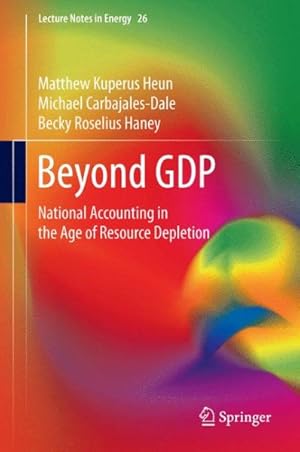
Beyond GDP : National Accounting in the Age of Resource Depletion
Libro 35 de 81: Lecture Notes in EnergyLibrería: GreatBookPrices, Columbia, MD, Estados Unidos de America
Calificación del vendedor: 5 de 5 estrellas
EUR 60,60
Envío por EUR 2,29
Se envía dentro de Estados Unidos de AmericaCantidad disponible: Más de 20 disponibles
Añadir al carritoCondición: As New. Unread book in perfect condition.
-
Beyond GDP: National Accounting in the Age of Resource Depletion (Lecture Notes in Energy, 26)
Libro 35 de 81: Lecture Notes in EnergyLibrería: Ria Christie Collections, Uxbridge, Reino Unido
Calificación del vendedor: 5 de 5 estrellas
EUR 60,58
Envío por EUR 13,87
Se envía de Reino Unido a Estados Unidos de AmericaCantidad disponible: Más de 20 disponibles
Añadir al carritoCondición: New. In.
-
Beyond GDP : National Accounting in the Age of Resource Depletion
Libro 35 de 81: Lecture Notes in EnergyLibrería: GreatBookPricesUK, Woodford Green, Reino Unido
Calificación del vendedor: 5 de 5 estrellas
EUR 57,74
Envío por EUR 17,37
Se envía de Reino Unido a Estados Unidos de AmericaCantidad disponible: Más de 20 disponibles
Añadir al carritoCondición: New.
-
Beyond GDP : National Accounting in the Age of Resource Depletion
Libro 35 de 81: Lecture Notes in EnergyLibrería: GreatBookPrices, Columbia, MD, Estados Unidos de America
Calificación del vendedor: 5 de 5 estrellas
EUR 74,31
Envío por EUR 2,29
Se envía dentro de Estados Unidos de AmericaCantidad disponible: Más de 20 disponibles
Añadir al carritoCondición: New.
-
Beyond GDP: National Accounting in the Age of Resource Depletion (Lecture Notes in Energy)
Libro 35 de 81: Lecture Notes in EnergyLibrería: Books Puddle, New York, NY, Estados Unidos de America
Calificación del vendedor: 4 de 5 estrellas

EUR 73,54
Envío por EUR 3,46
Se envía dentro de Estados Unidos de AmericaCantidad disponible: 4 disponibles
Añadir al carritoCondición: New. 201.
-
Beyond GDP : National Accounting in the Age of Resource Depletion
Libro 35 de 81: Lecture Notes in EnergyLibrería: GreatBookPricesUK, Woodford Green, Reino Unido
Calificación del vendedor: 5 de 5 estrellas
EUR 66,69
Envío por EUR 17,37
Se envía de Reino Unido a Estados Unidos de AmericaCantidad disponible: Más de 20 disponibles
Añadir al carritoCondición: As New. Unread book in perfect condition.
-
Beyond Gdp: National Accounting in the Age of Resource Depletion
Libro 35 de 81: Lecture Notes in EnergyLibrería: Revaluation Books, Exeter, Reino Unido
Calificación del vendedor: 5 de 5 estrellas
EUR 79,57
Envío por EUR 11,58
Se envía de Reino Unido a Estados Unidos de AmericaCantidad disponible: 2 disponibles
Añadir al carritoHardcover. Condición: Brand New. 2015 edition. 201 pages. 9.25x6.25x0.75 inches. In Stock.
-

Beyond GDP : National Accounting in the Age of Resource Depletion
Libro 35 de 81: Lecture Notes in EnergyIdioma: Inglés
Publicado por Springer International Publishing, 2015
ISBN 10: 3319128191 ISBN 13: 9783319128191
Librería: AHA-BUCH GmbH, Einbeck, Alemania
Calificación del vendedor: 5 de 5 estrellas
EUR 53,49
Envío por EUR 62,59
Se envía de Alemania a Estados Unidos de AmericaCantidad disponible: 1 disponibles
Añadir al carritoBuch. Condición: Neu. Druck auf Anfrage Neuware - Printed after ordering - This book uses the metaphor 'The economy is society's metabolism' as a springboard to develop a rigorous theoretical framework for a better system of national accounts which goes 'Beyond GDP' and is relevant to the age of resource depletion. Society is entering a new era in which biophysical limits related to natural resource extraction rates and the biosphere's waste assimilation capacity are becoming binding constraints on mature economies. Unfortunately, the data needed for policy-makers to understand and manage economic growth in this new era are not universally available. All stakeholders need a new way to understand our economy in the context of the biosphere's ability to provide essential natural capital, and we suggest that detailed information about materials, energy, embodied energy, and energy intensity should be routinely gathered, analyzed, and disseminated from a centralized location to provide markets and policymakers with a more comprehensive understanding of the biophysical economy. However, a firm theoretical foundation is needed before proceeding along this new path, which this book is intended to provide.After arguing that the stock of manufactured capital is an important driver of material and energy demands imposed upon the biosphere, a new accounting framework is derived from the laws of thermodynamics to reflect the fact that material and embodied energy accumulate within the capital stock of economic sectors. This framework extends the Energy Input-Output (EI-O) techniques first developed by Bullard, Herendeen, and others to estimate energy intensity of economic products. Implications from the new framework are discussed, including the value of economic metrics for policy-making, the need for physically-based rather than product-based EI-O formulations, a re-assessment of the concept of economic 'growth,' and an evaluation of recycling, reuse, and dematerialization. The framework also provides anopportunity to assess an array of definitions for Daly's 'steady-state economy' in relation to the ideal of a sustainable economy.The book ends with a list of steps to be taken in creating a more comprehensive system of national accounts:National accounting agencies worldwide should develop and maintain balance sheets of both natural and manufactured capital in addition to national income statementsAll stocks and inter-sector flows should be provided in physical as well as financial unitsIn the US, the Bureau for Economic Analysis (BEA) should restart detailed Capital, Labor, Energy, Material, and Services (KLEMS) reportingNational accounting agencies should routinely estimate the energy intensity of economic products, and all of the above should be estimated and disseminated on an annual basis.
-
Beyond GDP : National Accounting in the Age of Resource Depletion
Libro 35 de 81: Lecture Notes in EnergyLibrería: Buchpark, Trebbin, Alemania
Calificación del vendedor: 5 de 5 estrellas
EUR 40,98
Envío por EUR 105,00
Se envía de Alemania a Estados Unidos de AmericaCantidad disponible: 1 disponibles
Añadir al carritoCondición: Hervorragend. Zustand: Hervorragend | Sprache: Englisch | Produktart: Bücher | This book uses the metaphor ¿The economy is society's metabolism¿ as a springboard to develop a rigorous theoretical framework for a better system of national accounts which goes ¿Beyond GDP¿ and is relevant to the age of resource depletion. Society is entering a new era in which biophysical limits related to natural resource extraction rates and the biosphere's waste assimilation capacity are becoming binding constraints on mature economies. Unfortunately, the data needed for policy-makers to understand and manage economic growth in this new era are not universally available. All stakeholders need a new way to understand our economy in the context of the biosphere¿s ability to provide essential natural capital, and we suggest that detailed information about materials, energy, embodied energy, and energy intensity should be routinely gathered, analyzed, and disseminated from a centralized location to provide markets and policymakers with a more comprehensive understanding of the biophysical economy. However, a firm theoretical foundation is needed before proceeding along this new path, which this book is intended to provide.After arguing that the stock of manufactured capital is an important driver of material and energy demands imposed upon the biosphere, a new accounting framework is derived from the laws of thermodynamics to reflect the fact that material and embodied energy accumulate within the capital stock of economic sectors. This framework extends the Energy Input-Output (EI-O) techniques first developed by Bullard, Herendeen, and others to estimate energy intensity of economic products. Implications from the new framework are discussed, including the value of economic metrics for policy-making, the need for physically-based rather than product-based EI-O formulations, a re-assessment of the concept of economic ¿growth,¿ and an evaluation of recycling, reuse, and dematerialization. The framework also provides anopportunity to assess an array of definitions for Daly's ¿steady-state economy¿ in relation to the ideal of a sustainable economy.The book ends with a list of steps to be taken in creating a more comprehensive system of national accounts:National accounting agencies worldwide should develop and maintain balance sheets of both natural and manufactured capital in addition to national income statementsAll stocks and inter-sector flows should be provided in physical as well as financial unitsIn the US, the Bureau for Economic Analysis (BEA) should restart detailed Capital, Labor, Energy, Material, and Services (KLEMS) reportingNational accounting agencies should routinely estimate the energy intensity of economic products, and all of the above should be estimated and disseminated on an annual basis.
-
Heun:Beyond GDP (eng)
Libro 35 de 81: Lecture Notes in EnergyLibrería: Brook Bookstore On Demand, Napoli, NA, Italia
Calificación del vendedor: 3 de 5 estrellas

EUR 46,22
Envío por EUR 30,00
Se envía de Italia a Estados Unidos de AmericaCantidad disponible: Más de 20 disponibles
Añadir al carritoCondición: new. Questo è un articolo print on demand.
-

Beyond GDP
Libro 35 de 81: Lecture Notes in EnergyIdioma: Inglés
Publicado por Springer International Publishing Mai 2015, 2015
ISBN 10: 3319128191 ISBN 13: 9783319128191
Librería: BuchWeltWeit Ludwig Meier e.K., Bergisch Gladbach, Alemania
Calificación del vendedor: 5 de 5 estrellas
EUR 53,49
Envío por EUR 23,00
Se envía de Alemania a Estados Unidos de AmericaCantidad disponible: 2 disponibles
Añadir al carritoBuch. Condición: Neu. This item is printed on demand - it takes 3-4 days longer - Neuware -This book uses the metaphor 'The economy is society's metabolism' as a springboard to develop a rigorous theoretical framework for a better system of national accounts which goes 'Beyond GDP' and is relevant to the age of resource depletion. Society is entering a new era in which biophysical limits related to natural resource extraction rates and the biosphere's waste assimilation capacity are becoming binding constraints on mature economies. Unfortunately, the data needed for policy-makers to understand and manage economic growth in this new era are not universally available. All stakeholders need a new way to understand our economy in the context of the biosphere's ability to provide essential natural capital, and we suggest that detailed information about materials, energy, embodied energy, and energy intensity should be routinely gathered, analyzed, and disseminated from a centralized location to provide markets and policymakers with a more comprehensive understanding of the biophysical economy. However, a firm theoretical foundation is needed before proceeding along this new path, which this book is intended to provide.After arguing that the stock of manufactured capital is an important driver of material and energy demands imposed upon the biosphere, a new accounting framework is derived from the laws of thermodynamics to reflect the fact that material and embodied energy accumulate within the capital stock of economic sectors. This framework extends the Energy Input-Output (EI-O) techniques first developed by Bullard, Herendeen, and others to estimate energy intensity of economic products. Implications from the new framework are discussed, including the value of economic metrics for policy-making, the need for physically-based rather than product-based EI-O formulations, a re-assessment of the concept of economic 'growth,' and an evaluation of recycling, reuse, and dematerialization. The framework also provides an opportunity to assess an array of definitions for Daly's 'steady-state economy' in relation to the ideal of a sustainable economy.The book ends with a list of steps to be taken in creating a more comprehensive system of national accounts:National accounting agencies worldwide should develop and maintain balance sheets of both natural and manufactured capital in addition to national income statementsAll stocks and inter-sector flows should be provided in physical as well as financial unitsIn the US, the Bureau for Economic Analysis (BEA) should restart detailed Capital, Labor, Energy, Material, and Services (KLEMS) reportingNational accounting agencies should routinely estimate the energy intensity of economic products, and all of the above should be estimated and disseminated on an annual basis. 232 pp. Englisch.
-
Beyond GDP: National Accounting in the Age of Resource Depletion (Lecture Notes in Energy)
Libro 35 de 81: Lecture Notes in EnergyLibrería: Majestic Books, Hounslow, Reino Unido
Calificación del vendedor: 4 de 5 estrellas
EUR 76,67
Envío por EUR 7,53
Se envía de Reino Unido a Estados Unidos de AmericaCantidad disponible: 4 disponibles
Añadir al carritoCondición: New. Print on Demand 201.
-
Beyond GDP: National Accounting in the Age of Resource Depletion (Lecture Notes in Energy)
Libro 35 de 81: Lecture Notes in EnergyLibrería: Biblios, Frankfurt am main, HESSE, Alemania
Calificación del vendedor: 4 de 5 estrellas
EUR 76,94
Envío por EUR 9,95
Se envía de Alemania a Estados Unidos de AmericaCantidad disponible: 4 disponibles
Añadir al carritoCondición: New. PRINT ON DEMAND 201.
-
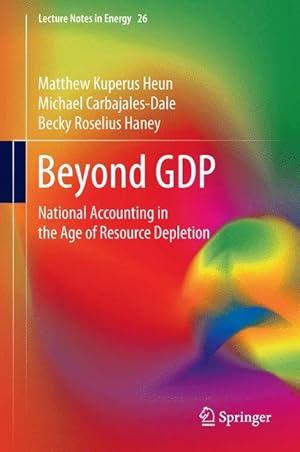
Beyond GDP
Libro 35 de 81: Lecture Notes in EnergyIdioma: Inglés
Publicado por Springer International Publishing, 2015
ISBN 10: 3319128191 ISBN 13: 9783319128191
Librería: moluna, Greven, Alemania
Calificación del vendedor: 5 de 5 estrellas
EUR 48,37
Envío por EUR 48,99
Se envía de Alemania a Estados Unidos de AmericaCantidad disponible: Más de 20 disponibles
Añadir al carritoGebunden. Condición: New. Dieser Artikel ist ein Print on Demand Artikel und wird nach Ihrer Bestellung fuer Sie gedruckt. Presents an improved methodology for input-output modeling, which is the current basis of national accounting used by the U.S. Bureau of Economic Analysis (BEA)Provides a concrete linkage between energy input-output modeling and BEA national accou.
-

Beyond GDP
Libro 35 de 81: Lecture Notes in EnergyIdioma: Inglés
Publicado por Springer, Springer Mai 2015, 2015
ISBN 10: 3319128191 ISBN 13: 9783319128191
Librería: buchversandmimpf2000, Emtmannsberg, BAYE, Alemania
Calificación del vendedor: 5 de 5 estrellas
EUR 53,49
Envío por EUR 60,00
Se envía de Alemania a Estados Unidos de AmericaCantidad disponible: 1 disponibles
Añadir al carritoBuch. Condición: Neu. This item is printed on demand - Print on Demand Titel. Neuware -This book uses the metaphor ¿The economy is society's metabolism¿ as a springboard to develop a rigorous theoretical framework for a better system of national accounts which goes ¿Beyond GDP¿ and is relevant to the age of resource depletion. Society is entering a new era in which biophysical limits related to natural resource extraction rates and the biosphere's waste assimilation capacity are becoming binding constraints on mature economies. Unfortunately, the data needed for policy-makers to understand and manage economic growth in this new era are not universally available. All stakeholders need a new way to understand our economy in the context of the biosphere¿s ability to provide essential natural capital, and we suggest that detailed information about materials, energy, embodied energy, and energy intensity should be routinely gathered, analyzed, and disseminated from a centralized location to provide markets and policymakers with a more comprehensive understanding of the biophysical economy. However, a firm theoretical foundation is needed before proceeding along this new path, which this book is intended to provide.After arguing that the stock of manufactured capital is an important driver of material and energy demands imposed upon the biosphere, a new accounting framework is derived from the laws of thermodynamics to reflect the fact that material and embodied energy accumulate within the capital stock of economic sectors. This framework extends the Energy Input-Output (EI-O) techniques first developed by Bullard, Herendeen, and others to estimate energy intensity of economic products. Implications from the new framework are discussed, including the value of economic metrics for policy-making, the need for physically-based rather than product-based EI-O formulations, a re-assessment of the concept of economic ¿growth,¿ and an evaluation of recycling, reuse, and dematerialization. The framework also provides anopportunity to assess an array of definitions for Daly's ¿steady-state economy¿ in relation to the ideal of a sustainable economy.The book ends with a list of steps to be taken in creating a more comprehensive system of national accounts:National accounting agencies worldwide should develop and maintain balance sheets of both natural and manufactured capital in addition to national income statementsAll stocks and inter-sector flows should be provided in physical as well as financial unitsIn the US, the Bureau for Economic Analysis (BEA) should restart detailed Capital, Labor, Energy, Material, and Services (KLEMS) reportingNational accounting agencies should routinely estimate the energy intensity of economic products, and all of the above should be estimated and disseminated on an annual basis.Springer-Verlag KG, Sachsenplatz 4-6, 1201 Wien 232 pp. Englisch.


