

Importe total (1 artículo artículos):
Destino del pedido:

9781461284284 - Industrial Drying of Foods de J. Baker, Christopher G. (10 resultados)
Ir a los resultados principales
Filtros de búsqueda
Tipo de artículo
- Todos los tipos de productos
- Libros (10)
- Revistas y publicaciones (No hay ningún otro resultado que coincida con este filtro.)
- Cómics (No hay ningún otro resultado que coincida con este filtro.)
- Partituras (No hay ningún otro resultado que coincida con este filtro.)
- Arte, grabados y pósters (No hay ningún otro resultado que coincida con este filtro.)
- Fotografías (No hay ningún otro resultado que coincida con este filtro.)
- Mapas (No hay ningún otro resultado que coincida con este filtro.)
- Manuscritos y coleccionismo de papel (No hay ningún otro resultado que coincida con este filtro.)
Condición Más información
- Nuevo (10)
- Como nuevo, Excelente o Muy bueno (No hay ningún otro resultado que coincida con este filtro.)
- Bueno o Aceptable (No hay ningún otro resultado que coincida con este filtro.)
- Regular o Pobre (No hay ningún otro resultado que coincida con este filtro.)
- Tal como se indica (No hay ningún otro resultado que coincida con este filtro.)
Encuadernación
- Todas
- Tapa dura (No hay ningún otro resultado que coincida con este filtro.)
- Tapa blanda (10)
Más atributos
- Primera edición (No hay ningún otro resultado que coincida con este filtro.)
- Firmado (No hay ningún otro resultado que coincida con este filtro.)
- Sobrecubierta (No hay ningún otro resultado que coincida con este filtro.)
- Con imágenes (5)
- No impresión bajo demanda (4)
Idioma (1)
Precio
- Cualquier precio
- Menos de EUR 20 (No hay ningún otro resultado que coincida con este filtro.)
- EUR 20 a EUR 45 (No hay ningún otro resultado que coincida con este filtro.)
- Más de EUR 45
Gastos de envío gratis
- Envío gratis a Estados Unidos de America (No hay ningún otro resultado que coincida con este filtro.)
Ubicación del vendedor
Valoración de los vendedores
-

Industrial Drying of Foods
Librería: Ria Christie Collections, Uxbridge, Reino Unido
Calificación del vendedor: 5 de 5 estrellas

EUR 165,74
Envío por EUR 13,98
Se envía de Reino Unido a Estados Unidos de AmericaCantidad disponible: Más de 20 disponibles
Añadir al carritoCondición: New. In.
-
Industrial Drying of Foods
Librería: preigu, Osnabrück, Alemania
Calificación del vendedor: 5 de 5 estrellas
EUR 140,10
Envío por EUR 70,00
Se envía de Alemania a Estados Unidos de AmericaCantidad disponible: 5 disponibles
Añadir al carritoTaschenbuch. Condición: Neu. Industrial Drying of Foods | Christopher G. J. Baker | Taschenbuch | xxii | Englisch | 2011 | Springer US | EAN 9781461284284 | Verantwortliche Person für die EU: Springer Verlag GmbH, Tiergartenstr. 17, 69121 Heidelberg, juergen[dot]hartmann[at]springer[dot]com | Anbieter: preigu.
-
Industrial Drying of Foods
Librería: Books Puddle, New York, NY, Estados Unidos de America
Calificación del vendedor: 4 de 5 estrellas

EUR 215,89
Envío por EUR 3,49
Se envía dentro de Estados Unidos de AmericaCantidad disponible: 4 disponibles
Añadir al carritoCondición: New. pp. 336.
-
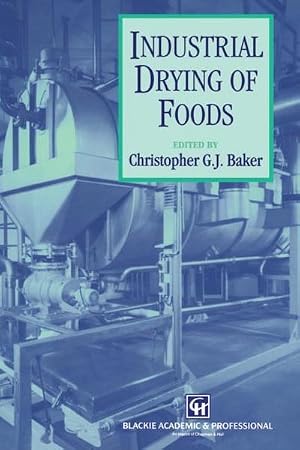
Industrial Drying of Foods
Idioma: Inglés
Publicado por Springer US, Springer US, 2011
ISBN 10: 1461284287 ISBN 13: 9781461284284
Librería: AHA-BUCH GmbH, Einbeck, Alemania
Calificación del vendedor: 5 de 5 estrellas
EUR 168,73
Envío por EUR 62,56
Se envía de Alemania a Estados Unidos de AmericaCantidad disponible: 1 disponibles
Añadir al carritoTaschenbuch. Condición: Neu. Druck auf Anfrage Neuware - Printed after ordering - Drying is traditionally defined as that unit operation which converts a liquid, solid or semi-solid feed material into a solid product of significantly lower moisture content. In most, although not all, cases it involves the application of thermal energy, which causes water to evaporate into the vapour phase. In practice, this definition encompasses a number of technologies which differ markedly in, for example, the manner in which energy is supplied to the foodstuff and in which product is transported through the dryer. Depending on the dryer type, the residence time may vary from a few seconds to several hours. Dryers designed to handle liquid feedstocks are naturally quite different from those intended to process moist solids. Even within these two broad categories, however, many distinct varieties of dryer have evolved to meet specific process ing needs. The dryer is frequently the last processing stage in the manufacture of a dehydrated food product. As such, it may not only bring about the desired reduction in moisture content but may also have a significant effect on a number of other properties, such as flavour, colour, texture, viability, and nutrient retention, for example. These properties, which are generally considered to affect the perceived quality of the end product, are often influenced by the temperature- moisture content-time profiles experienced by the foodstuff as it moves through the dryer. The underlying chemistry and physics are highly complex and, broadly speaking, only poorly understood.
-
Industrial Drying of Foods (eng)
Librería: Brook Bookstore On Demand, Napoli, NA, Italia
Calificación del vendedor: 5 de 5 estrellas
EUR 126,26
Envío por EUR 6,80
Se envía de Italia a Estados Unidos de AmericaCantidad disponible: Más de 20 disponibles
Añadir al carritoCondición: new. Questo è un articolo print on demand.
-

Industrial Drying of Foods
Librería: BuchWeltWeit Ludwig Meier e.K., Bergisch Gladbach, Alemania
Calificación del vendedor: 5 de 5 estrellas
EUR 160,49
Envío por EUR 23,00
Se envía de Alemania a Estados Unidos de AmericaCantidad disponible: 2 disponibles
Añadir al carritoTaschenbuch. Condición: Neu. This item is printed on demand - it takes 3-4 days longer - Neuware -Drying is traditionally defined as that unit operation which converts a liquid, solid or semi-solid feed material into a solid product of significantly lower moisture content. In most, although not all, cases it involves the application of thermal energy, which causes water to evaporate into the vapour phase. In practice, this definition encompasses a number of technologies which differ markedly in, for example, the manner in which energy is supplied to the foodstuff and in which product is transported through the dryer. Depending on the dryer type, the residence time may vary from a few seconds to several hours. Dryers designed to handle liquid feedstocks are naturally quite different from those intended to process moist solids. Even within these two broad categories, however, many distinct varieties of dryer have evolved to meet specific process ing needs. The dryer is frequently the last processing stage in the manufacture of a dehydrated food product. As such, it may not only bring about the desired reduction in moisture content but may also have a significant effect on a number of other properties, such as flavour, colour, texture, viability, and nutrient retention, for example. These properties, which are generally considered to affect the perceived quality of the end product, are often influenced by the temperature- moisture content-time profiles experienced by the foodstuff as it moves through the dryer. The underlying chemistry and physics are highly complex and, broadly speaking, only poorly understood. 336 pp. Englisch.
-

Industrial Drying of Foods
Librería: moluna, Greven, Alemania
Calificación del vendedor: 5 de 5 estrellas
EUR 136,16
Envío por EUR 48,99
Se envía de Alemania a Estados Unidos de AmericaCantidad disponible: Más de 20 disponibles
Añadir al carritoCondición: New. Dieser Artikel ist ein Print on Demand Artikel und wird nach Ihrer Bestellung fuer Sie gedruckt. Drying is traditionally defined as that unit operation which converts a liquid, solid or semi-solid feed material into a solid product of significantly lower moisture content. In most, although not all, cases it involves the application of thermal energy, w.
-

Industrial Drying of Foods
Idioma: Inglés
Publicado por Springer US, Springer US Sep 2011, 2011
ISBN 10: 1461284287 ISBN 13: 9781461284284
Librería: buchversandmimpf2000, Emtmannsberg, BAYE, Alemania
Calificación del vendedor: 5 de 5 estrellas
EUR 160,49
Envío por EUR 60,00
Se envía de Alemania a Estados Unidos de AmericaCantidad disponible: 1 disponibles
Añadir al carritoTaschenbuch. Condición: Neu. This item is printed on demand - Print on Demand Titel. Neuware -Drying is traditionally defined as that unit operation which converts a liquid, solid or semi-solid feed material into a solid product of significantly lower moisture content. In most, although not all, cases it involves the application of thermal energy, which causes water to evaporate into the vapour phase. In practice, this definition encompasses a number of technologies which differ markedly in, for example, the manner in which energy is supplied to the foodstuff and in which product is transported through the dryer. Depending on the dryer type, the residence time may vary from a few seconds to several hours. Dryers designed to handle liquid feedstocks are naturally quite different from those intended to process moist solids. Even within these two broad categories, however, many distinct varieties of dryer have evolved to meet specific process ing needs. The dryer is frequently the last processing stage in the manufacture of a dehydrated food product. As such, it may not only bring about the desired reduction in moisture content but may also have a significant effect on a number of other properties, such as flavour, colour, texture, viability, and nutrient retention, for example. These properties, which are generally considered to affect the perceived quality of the end product, are often influenced by the temperature- moisture content-time profiles experienced by the foodstuff as it moves through the dryer. The underlying chemistry and physics are highly complex and, broadly speaking, only poorly understood.Springer-Verlag GmbH, Tiergartenstr. 17, 69121 Heidelberg 336 pp. Englisch.
-
Industrial Drying of Foods
Librería: Majestic Books, Hounslow, Reino Unido
Calificación del vendedor: 4 de 5 estrellas
EUR 228,96
Envío por EUR 7,59
Se envía de Reino Unido a Estados Unidos de AmericaCantidad disponible: 4 disponibles
Añadir al carritoCondición: New. Print on Demand pp. 336 49:B&W 6.14 x 9.21 in or 234 x 156 mm (Royal 8vo) Perfect Bound on White w/Gloss Lam.
-
Industrial Drying of Foods
Librería: Biblios, Frankfurt am main, HESSE, Alemania
Calificación del vendedor: 4 de 5 estrellas
EUR 229,44
Envío por EUR 9,95
Se envía de Alemania a Estados Unidos de AmericaCantidad disponible: 4 disponibles
Añadir al carritoCondición: New. PRINT ON DEMAND pp. 336.


