

Importe total (1 artículo artículos):
Destino del pedido:

9780792376880 - Complexity of Lattice Problems: A Cryptographic Perspective: 671 (The Springer International Series in Engineering and Computer Science, 671) de Micciancio, Daniele... (10 resultados)
Ir a los resultados principales
Filtros de búsqueda
Tipo de artículo
- Todos los tipos de productos
- Libros (10)
- Revistas y publicaciones (No hay ningún otro resultado que coincida con este filtro.)
- Cómics (No hay ningún otro resultado que coincida con este filtro.)
- Partituras (No hay ningún otro resultado que coincida con este filtro.)
- Arte, grabados y pósters (No hay ningún otro resultado que coincida con este filtro.)
- Fotografías (No hay ningún otro resultado que coincida con este filtro.)
- Mapas (No hay ningún otro resultado que coincida con este filtro.)
- Manuscritos y coleccionismo de papel (No hay ningún otro resultado que coincida con este filtro.)
Condición Más información
- Nuevo (8)
- Como nuevo, Excelente o Muy bueno (2)
- Bueno o Aceptable (No hay ningún otro resultado que coincida con este filtro.)
- Regular o Pobre (No hay ningún otro resultado que coincida con este filtro.)
- Tal como se indica (No hay ningún otro resultado que coincida con este filtro.)
Encuadernación
- Todas
- Tapa dura (10)
- Tapa blanda (No hay ningún otro resultado que coincida con este filtro.)
Más atributos
- Primera edición (No hay ningún otro resultado que coincida con este filtro.)
- Firmado (No hay ningún otro resultado que coincida con este filtro.)
- Sobrecubierta (No hay ningún otro resultado que coincida con este filtro.)
- Con imágenes (9)
- No impresión bajo demanda (7)
Idioma (1)
Precio
- Cualquier precio
- Menos de EUR 20 (No hay ningún otro resultado que coincida con este filtro.)
- EUR 20 a EUR 45 (No hay ningún otro resultado que coincida con este filtro.)
- Más de EUR 45
Gastos de envío gratis
- Envío gratis a Estados Unidos de America (No hay ningún otro resultado que coincida con este filtro.)
Ubicación del vendedor
Valoración de los vendedores
-

Complexity of Lattice Problems : A Cryptographic Perspective
Libro 119 de 260: The Springer International Series in Engineering and Computer ScienceLibrería: GreatBookPrices, Columbia, MD, Estados Unidos de America
Calificación del vendedor: 5 de 5 estrellas

EUR 251,64
Envío por EUR 2,29
Se envía dentro de Estados Unidos de AmericaCantidad disponible: Más de 20 disponibles
Añadir al carritoCondición: New.
-

Complexity of Lattice Problems: A Cryptographic Perspective (The Springer International Series in Engineering and Computer Science, 671)
Libro 119 de 260: The Springer International Series in Engineering and Computer ScienceLibrería: BennettBooksLtd, Los Angeles, CA, Estados Unidos de America
Calificación del vendedor: 5 de 5 estrellas
EUR 247,80
Envío por EUR 6,03
Se envía dentro de Estados Unidos de AmericaCantidad disponible: 1 disponibles
Añadir al carritohardcover. Condición: New. In shrink wrap. Looks like an interesting title!
-

Complexity of Lattice Problems : A Cryptographic Perspective
Libro 119 de 260: The Springer International Series in Engineering and Computer ScienceLibrería: GreatBookPrices, Columbia, MD, Estados Unidos de America
Calificación del vendedor: 5 de 5 estrellas
EUR 274,14
Envío por EUR 2,29
Se envía dentro de Estados Unidos de AmericaCantidad disponible: Más de 20 disponibles
Añadir al carritoCondición: As New. Unread book in perfect condition.
-

Complexity of Lattice Problems : A Cryptographic Perspective
Libro 119 de 260: The Springer International Series in Engineering and Computer ScienceLibrería: GreatBookPricesUK, Woodford Green, Reino Unido
Calificación del vendedor: 5 de 5 estrellas
EUR 274,64
Envío por EUR 17,19
Se envía de Reino Unido a Estados Unidos de AmericaCantidad disponible: Más de 20 disponibles
Añadir al carritoCondición: As New. Unread book in perfect condition.
-

Complexity of Lattice Problems : A Cryptographic Perspective
Libro 119 de 260: The Springer International Series in Engineering and Computer ScienceLibrería: GreatBookPricesUK, Woodford Green, Reino Unido
Calificación del vendedor: 5 de 5 estrellas
EUR 291,35
Envío por EUR 17,19
Se envía de Reino Unido a Estados Unidos de AmericaCantidad disponible: Más de 20 disponibles
Añadir al carritoCondición: New.
-

Complexity of Lattice Problems
Libro 119 de 260: The Springer International Series in Engineering and Computer ScienceLibrería: moluna, Greven, Alemania
Calificación del vendedor: 4 de 5 estrellas

EUR 250,30
Envío por EUR 48,99
Se envía de Alemania a Estados Unidos de AmericaCantidad disponible: Más de 20 disponibles
Añadir al carritoCondición: New.
-

Complexity of Lattice Problems : A Cryptographic Perspective
Libro 119 de 260: The Springer International Series in Engineering and Computer ScienceLibrería: AHA-BUCH GmbH, Einbeck, Alemania
Calificación del vendedor: 5 de 5 estrellas
EUR 310,11
Envío por EUR 62,61
Se envía de Alemania a Estados Unidos de AmericaCantidad disponible: 1 disponibles
Añadir al carritoBuch. Condición: Neu. Druck auf Anfrage Neuware - Printed after ordering - Lattices are geometric objects that can be pictorially described as the set of intersection points of an infinite, regular n-dimensional grid. De spite their apparent simplicity, lattices hide a rich combinatorial struc ture, which has attracted the attention of great mathematicians over the last two centuries. Not surprisingly, lattices have found numerous ap plications in mathematics and computer science, ranging from number theory and Diophantine approximation, to combinatorial optimization and cryptography. The study of lattices, specifically from a computational point of view, was marked by two major breakthroughs: the development of the LLL lattice reduction algorithm by Lenstra, Lenstra and Lovasz in the early 80's, and Ajtai's discovery of a connection between the worst-case and average-case hardness of certain lattice problems in the late 90's. The LLL algorithm, despite the relatively poor quality of the solution it gives in the worst case, allowed to devise polynomial time solutions to many classical problems in computer science. These include, solving integer programs in a fixed number of variables, factoring polynomials over the rationals, breaking knapsack based cryptosystems, and finding solutions to many other Diophantine and cryptanalysis problems.
-
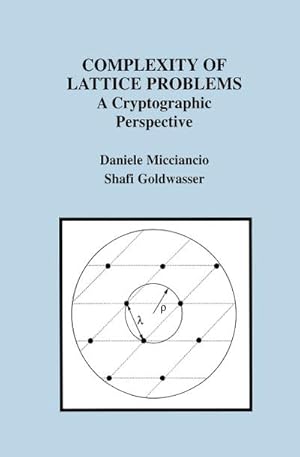
Complexity of Lattice Problems
Libro 119 de 260: The Springer International Series in Engineering and Computer ScienceIdioma: Inglés
Publicado por Springer, Humana Mär 2002, 2002
ISBN 10: 0792376889 ISBN 13: 9780792376880
Librería: BuchWeltWeit Ludwig Meier e.K., Bergisch Gladbach, Alemania
Calificación del vendedor: 5 de 5 estrellas
EUR 299,59
Envío por EUR 23,00
Se envía de Alemania a Estados Unidos de AmericaCantidad disponible: 2 disponibles
Añadir al carritoBuch. Condición: Neu. This item is printed on demand - it takes 3-4 days longer - Neuware -Lattices are geometric objects that can be pictorially described as the set of intersection points of an infinite, regular n-dimensional grid. De spite their apparent simplicity, lattices hide a rich combinatorial struc ture, which has attracted the attention of great mathematicians over the last two centuries. Not surprisingly, lattices have found numerous ap plications in mathematics and computer science, ranging from number theory and Diophantine approximation, to combinatorial optimization and cryptography. The study of lattices, specifically from a computational point of view, was marked by two major breakthroughs: the development of the LLL lattice reduction algorithm by Lenstra, Lenstra and Lovasz in the early 80's, and Ajtai's discovery of a connection between the worst-case and average-case hardness of certain lattice problems in the late 90's. The LLL algorithm, despite the relatively poor quality of the solution it gives in the worst case, allowed to devise polynomial time solutions to many classical problems in computer science. These include, solving integer programs in a fixed number of variables, factoring polynomials over the rationals, breaking knapsack based cryptosystems, and finding solutions to many other Diophantine and cryptanalysis problems. 234 pp. Englisch.
-
Complexity of Lattice Problems | A Cryptographic Perspective
Libro 119 de 260: The Springer International Series in Engineering and Computer ScienceLibrería: preigu, Osnabrück, Alemania
Calificación del vendedor: 5 de 5 estrellas
EUR 259,45
Envío por EUR 70,00
Se envía de Alemania a Estados Unidos de AmericaCantidad disponible: 5 disponibles
Añadir al carritoBuch. Condición: Neu. Complexity of Lattice Problems | A Cryptographic Perspective | Daniele Micciancio (u. a.) | Buch | The Springer International Series in Engineering and Computer Science | x | Englisch | 2002 | Humana | EAN 9780792376880 | Verantwortliche Person für die EU: Springer Verlag GmbH, Tiergartenstr. 17, 69121 Heidelberg, juergen[dot]hartmann[at]springer[dot]com | Anbieter: preigu Print on Demand.
-

Complexity of Lattice Problems
Libro 119 de 260: The Springer International Series in Engineering and Computer ScienceIdioma: Inglés
Publicado por Springer, Humana Mär 2002, 2002
ISBN 10: 0792376889 ISBN 13: 9780792376880
Librería: buchversandmimpf2000, Emtmannsberg, BAYE, Alemania
Calificación del vendedor: 5 de 5 estrellas
EUR 299,59
Envío por EUR 60,00
Se envía de Alemania a Estados Unidos de AmericaCantidad disponible: 1 disponibles
Añadir al carritoBuch. Condición: Neu. This item is printed on demand - Print on Demand Titel. Neuware -Lattices are geometric objects that can be pictorially described as the set of intersection points of an infinite, regular n-dimensional grid. De spite their apparent simplicity, lattices hide a rich combinatorial struc ture, which has attracted the attention of great mathematicians over the last two centuries. Not surprisingly, lattices have found numerous ap plications in mathematics and computer science, ranging from number theory and Diophantine approximation, to combinatorial optimization and cryptography. The study of lattices, specifically from a computational point of view, was marked by two major breakthroughs: the development of the LLL lattice reduction algorithm by Lenstra, Lenstra and Lovasz in the early 80's, and Ajtai's discovery of a connection between the worst-case and average-case hardness of certain lattice problems in the late 90's. The LLL algorithm, despite the relatively poor quality of the solution it gives in the worst case, allowed to devise polynomial time solutions to many classical problems in computer science. These include, solving integer programs in a fixed number of variables, factoring polynomials over the rationals, breaking knapsack based cryptosystems, and finding solutions to many other Diophantine and cryptanalysis problems.Springer-Verlag KG, Sachsenplatz 4-6, 1201 Wien 234 pp. Englisch.


