
9780268036003 - discussions and arguments on various subjects (works of cardinal newman: birmingham oratory millennium edition) de newman, john henry cardinal (9 resultados)

- Tapa dura
Librería: California Books, Miami, FL, Estados Unidos de AmericaCalifornia Books
Contactar con el vendedorVendedor de 4 estrellasCondición: Nuevo
EUR 37,82
Gastos de envío gratisSe envía dentro de Estados Unidos de AmericaCantidad disponible: Más de 20 disponibles
Condición: New.

- Tapa dura
Librería: GreatBookPrices, Columbia, MD, Estados Unidos de AmericaGreatBookPrices
Contactar con el vendedorVendedor de 5 estrellasCondición: Usado - Como Nuevo
EUR 63,32
Envío por EUR 2,31Se envía dentro de Estados Unidos de AmericaCantidad disponible: Más de 20 disponibles
Condición: As New. Unread book in perfect condition.

- Tapa dura
Librería: GreatBookPricesUK, Woodford Green, Reino UnidoGreatBookPricesUK
Contactar con el vendedorVendedor de 5 estrellasCondición: Usado - Como Nuevo
EUR 70,11
Envío por EUR 17,64Se envía de Reino Unido a Estados Unidos de AmericaCantidad disponible: Más de 20 disponibles
Condición: As New. Unread book in perfect condition.
- Tapa dura
Librería: Revaluation Books, Exeter, Reino UnidoRevaluation Books
Contactar con el vendedorVendedor de 5 estrellasCondición: Nuevo
EUR 78,61
Envío por EUR 14,70Se envía de Reino Unido a Estados Unidos de AmericaCantidad disponible: 2 disponibles
Hardcover. Condición: Brand New. 624 pages. 7.50x5.00x1.25 inches. In Stock.

- Tapa dura
Librería: GreatBookPrices, Columbia, MD, Estados Unidos de AmericaGreatBookPrices
Contactar con el vendedorVendedor de 5 estrellasCondición: Nuevo
EUR 93,72
Envío por EUR 2,31Se envía dentro de Estados Unidos de AmericaCantidad disponible: Más de 20 disponibles
Condición: New.
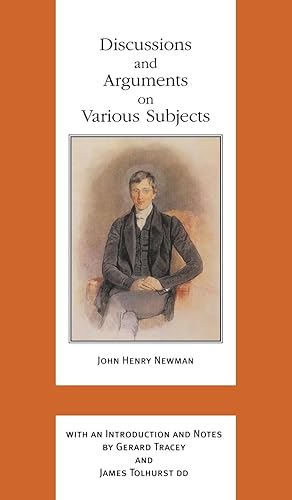
Discussions and Arguments on Various Subjects (Works of Cardinal Newman: Birmingham Oratory Millennium Edition)
Newman, John Henry Cardinal; Tracey, Gerard [Editor]; Tolhurst, James [Introduction];
- Tapa dura
Librería: BennettBooksLtd, Los Angeles, CA, Estados Unidos de AmericaBennettBooksLtd
Contactar con el vendedorVendedor de 5 estrellasCondición: Nuevo
EUR 94,25
Envío por EUR 6,08Se envía dentro de Estados Unidos de AmericaCantidad disponible: 1 disponibles
hardcover. Condición: New. In shrink wrap. Looks like an interesting title.

- Tapa dura
Librería: GreatBookPricesUK, Woodford Green, Reino UnidoGreatBookPricesUK
Contactar con el vendedorVendedor de 5 estrellasCondición: Nuevo
EUR 84,71
Envío por EUR 17,64Se envía de Reino Unido a Estados Unidos de AmericaCantidad disponible: Más de 20 disponibles
Condición: New.
- Tapa dura
Librería: moluna, Greven, Alemaniamoluna
Contactar con el vendedorVendedor de 5 estrellasCondición: Nuevo
EUR 61,64
Envío por EUR 48,99Se envía de Alemania a Estados Unidos de AmericaCantidad disponible: Más de 20 disponibles
Condición: New. Klappentextrnrn This is an excellent work that will lay just claim to being a major treatment of the most significant themes in the work of Leo Strauss. Sorensen s persuasive and original linking of Strauss s critical study of Machiavelli with S.

- Tapa dura
Librería: AHA-BUCH GmbH, Einbeck, AlemaniaAHA-BUCH GmbH
Contactar con el vendedorVendedor de 5 estrellasCondición: Nuevo
EUR 86,02
Envío por EUR 63,66Se envía de Alemania a Estados Unidos de AmericaCantidad disponible: 2 disponibles
Buch. Condición: Neu. Neuware - 'This is an excellent work that will lay just claim to being a major treatment of the most significant themes in the work of Leo Strauss. Sorensen's persuasive and original linking of Strauss's critical study of Machiavelli with Strauss on reason/revelation illuminates a new dimension of the philo…sopher's thought.' -Walter Nicgorski, University of Notre Dame Leo Strauss has perhaps been more cited-and alternately vilified or revered-in the last ten years than during the productive years of his scholarly life. He has been blamed (or credited) for providing the intellectual underpinnings of a generation of neoconservatives in political philosophy and foreign policy. But though he may be cast as a conservative thinker who critiques modernity, to interpret him exclusively in this light is to reduce him in ways that his self-definition, as a political theorist open to both religion and philosophy, does not justify. Kim A. Sorensen clearly lays out the debate surrounding Strauss by reviewing his published work and legacy since his death in 1973. He then turns to a key distinction in Strauss's thought-between revelation and reason, or religion and philosophy-and maintains that Strauss used their mutual opposition to modernity as a central theme in his oeuvre. For Sorensen, Strauss considered revelation and reason both as fundamentally different worldviews and as alternate ways of understanding the good life. Sorensen explores Strauss's views on the revelation/reason distinction through a close examination of the final chapter in Strauss's Thoughts on Machiavelli. Here Strauss weighs Machiavelli's critique of religion in general and Christianity in particular, and Machiavelli's departure from the classical tradition of political philosophy dating from Socrates, Plato, and Aristotle. For Strauss, the 'crisis of our time' has its point of origin in Machiavelli's rejection of both biblical and classical morality as guides to the efficacy of political virtue. For Strauss, Sorensen claims, a recovery of the ancient virtues of classical political philosophy is essential. Sorensen also shows that while Strauss is accepting of reason, he is also open to revelation. In the end, he is a philosopher both of Athens and of Jerusalem.


