

Importe total (1 artículo artículos):
Destino del pedido:

zipf karin lorene (9 resultados)
Ir a los resultados principales
Filtros de búsqueda
Tipo de artículo
- Todos los tipos de productos
- Libros (9)
- Revistas y publicaciones (No hay ningún otro resultado que coincida con este filtro.)
- Cómics (No hay ningún otro resultado que coincida con este filtro.)
- Partituras (No hay ningún otro resultado que coincida con este filtro.)
- Arte, grabados y pósters (No hay ningún otro resultado que coincida con este filtro.)
- Fotografías (No hay ningún otro resultado que coincida con este filtro.)
- Mapas (No hay ningún otro resultado que coincida con este filtro.)
- Manuscritos y coleccionismo de papel (No hay ningún otro resultado que coincida con este filtro.)
Condición Más información
- Nuevo (5)
- Como nuevo, Excelente o Muy bueno (1)
- Bueno o Aceptable (3)
- Regular o Pobre (No hay ningún otro resultado que coincida con este filtro.)
- Tal como se indica (No hay ningún otro resultado que coincida con este filtro.)
Encuadernación
- Todas
- Tapa dura (9)
- Tapa blanda (No hay ningún otro resultado que coincida con este filtro.)
Más atributos
Idioma (1)
Gastos de envío gratis
Ubicación del vendedor
Valoración de los vendedores
-

Labor of Innocents: Forced Apprenticeship in North Carolina, 1715--1919
Librería: Midtown Scholar Bookstore, Harrisburg, PA, Estados Unidos de America
Calificación del vendedor: 5 de 5 estrellas

EUR 8,86
Envío por EUR 5,09
Se envía dentro de Estados Unidos de AmericaCantidad disponible: Más de 20 disponibles
Añadir al carritoHardcover. Condición: Very Good. Very Good - Crisp, clean, unread book with some shelfwear/edgewear, may have a remainder mark - NICE Standard-sized.
-

Bad Girls at Samarcand: Sexuality and Sterilization in a Southern Juvenile Reformatory (Jules and Frances Landry Award)
Librería: Greenworld Books, Arlington, TX, Estados Unidos de America
Calificación del vendedor: 5 de 5 estrellas
EUR 18,36
Gastos de envío gratis
Se envía dentro de Estados Unidos de AmericaCantidad disponible: 1 disponibles
Añadir al carritoCondición: very_good. Fast Free Shipping â" Very Good condition book with a firm cover and clean pages. Shows normal use and some light wear or limited notes markings. A solid, nice copy to enjoy.
-

Bad Girls at Samarcand: Sexuality and Sterilization in a Southern Juvenile Reformatory (Jules and Frances Landry Award)
Librería: HPB-Ruby, Dallas, TX, Estados Unidos de America
Calificación del vendedor: 5 de 5 estrellas
EUR 19,64
Envío por EUR 3,18
Se envía dentro de Estados Unidos de AmericaCantidad disponible: 1 disponibles
Añadir al carritohardcover. Condición: Very Good. Connecting readers with great books since 1972! Used books may not include companion materials, and may have some shelf wear or limited writing. We ship orders daily and Customer Service is our top priority!
-
Bad Girls at Samarcand: Sexuality and Sterilization in a Southern Juvenile Reformatory
Librería: Reader's Corner, Inc., Raleigh, NC, Estados Unidos de America
Calificación del vendedor: 5 de 5 estrellas
Original o primera edición Ejemplar firmado
EUR 31,02
Envío por EUR 4,67
Se envía dentro de Estados Unidos de AmericaCantidad disponible: 1 disponibles
Añadir al carritoHardcover. Condición: As New. Estado de la sobrecubierta: As New. 1st Edition. This is a fine, as new, hardcover first edition, first printing copy in a fine, as new, mylar protected DJ, brown spine. Inscribed by the author on the half title page. Inscribed by Author(s).
-
Bad Girls at Samarcand (Hardcover)
Idioma: Inglés
Publicado por Louisiana State University Press, Baton Rouge, 2016
ISBN 10: 0807162493 ISBN 13: 9780807162491
Librería: Grand Eagle Retail, Bensenville, IL, Estados Unidos de America
Calificación del vendedor: 5 de 5 estrellas
EUR 48,92
Gastos de envío gratis
Se envía dentro de Estados Unidos de AmericaCantidad disponible: 1 disponibles
Añadir al carritoHardcover. Condición: new. Hardcover. Of the many consequences advanced by the rise of the eugenics movement in the early twentieth century, North Carolina forcibly sterilized more than 2,000 women and girls in between 1929 and 1950. This extreme measure reflects how pseudoscience justified widespread gender, race, and class discrimination in the Jim Crow South. In Bad Girls at Samarcand Karin L. Zipf dissects a dark episode in North Carolina's eugenics campaign through a detailed study of the State Home and Industrial School in Eagle Springs, referred to as Samarcand Manor, and the school's infamous 1931 arson case. The people and events surrounding both the institution and the court case sparked a public debate about the expectations of white womanhood, the nature of contemporary science and medicine, and the role of the juvenile justice system that resonated throughout the succeeding decades. Designed to reform and educate unwed poor white girls who were suspected of deviant behavior or victims of sexual abuse, Samarcand Manor allowed for strict disciplinary measures -- including corporal punishment -- in an attempt to instill Victorian ideals of female purity. The harsh treatment fostered a hostile environment and tensions boiled over when several girls set Samarcand on fire, destroying two residence halls. Zipf argues that the subsequent arson trial, which carried the possibility of the death penalty, represented an important turning point in the public characterizations of poor white women; aided by the lobbying efforts of eugenics advocates, the trial helped usher in dramatic policy changes, including the forced sterilization of female juvenile delinquents. In addition to the interplay between gender ideals and the eugenics movement, Zipf also investigates the girls who were housed at Samarcand and those specifically charged in the 1931 trial. She explores their negotiation of Jazz Age stereotypes, their strategies of resistance, and their relationship with defense attorney Nell Battle Lewis during the trial. The resultant policy changes -- intelligence testing, sterilization, and parole -- are also explored, providing further insight into why these young women preferred prison to reformatories.A fascinating story that grapples with gender bias, sexuality, science, and the justice system all within the context of the Great Depression--era South, Bad Girls at Samarcand makes a compelling contribution to multiple fields of study. Of the many consequences advanced by the rise of the eugenics movement in the early twentieth century, North Carolina forcibly sterilized more than 2,000 women and girls in between 1929 and 1950. Karin Zipf dissects a dark episode in North Carolina's eugenics campaign through a study of the State Home and Industrial School in Eagle Springs. Shipping may be from multiple locations in the US or from the UK, depending on stock availability.
-
Bad Girls at Samarcand: Sexuality and Sterilization in a Southern Juvenile Reformatory (Jules and Frances Landry Award)
Librería: California Books, Miami, FL, Estados Unidos de America
Calificación del vendedor: 4 de 5 estrellas

EUR 48,92
Gastos de envío gratis
Se envía dentro de Estados Unidos de AmericaCantidad disponible: 8 disponibles
Añadir al carritoCondición: New.
-
Bad Girls at Samarcand Sexuality and Sterilization in a Southern Juvenile Reformatory
Idioma: Inglés
Publicado por Louisiana State Univ Pr, 2016
ISBN 10: 0807162493 ISBN 13: 9780807162491
Librería: Revaluation Books, Exeter, Reino Unido
Calificación del vendedor: 5 de 5 estrellas
EUR 65,79
Envío por EUR 14,45
Se envía de Reino Unido a Estados Unidos de AmericaCantidad disponible: 2 disponibles
Añadir al carritoHardcover. Condición: Brand New. 280 pages. 9.25x6.25x1.25 inches. In Stock.
-
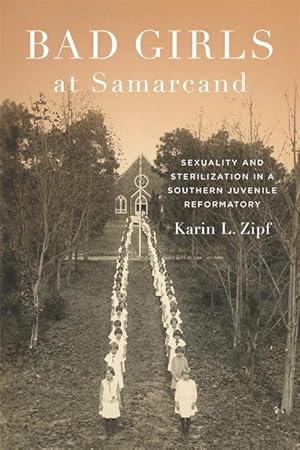
Bad Girls at Samarcand
Librería: moluna, Greven, Alemania
Calificación del vendedor: 5 de 5 estrellas
EUR 52,20
Envío por EUR 48,99
Se envía de Alemania a Estados Unidos de AmericaCantidad disponible: 5 disponibles
Añadir al carritoGebunden. Condición: New. Of the many consequences advanced by the rise of the eugenics movement in the early twentieth century, North Carolina forcibly sterilized more than 2,000 women and girls in between 1929 and 1950. Karin Zipf dissects a dark episode in North Carolina s eugeni.
-

Bad Girls at Samarcand : Sexuality and Sterilization in a Southern Juvenile Reformatory
Librería: AHA-BUCH GmbH, Einbeck, Alemania
Calificación del vendedor: 5 de 5 estrellas
EUR 68,82
Envío por EUR 62,84
Se envía de Alemania a Estados Unidos de AmericaCantidad disponible: 2 disponibles
Añadir al carritoBuch. Condición: Neu. Neuware - Of the many consequences advanced by the rise of the eugenics movement in the early twentieth century, North Carolina forcibly sterilized more than 2,000 women and girls in between 1929 and 1950. This extreme measure reflects how pseudoscience justified widespread gender, race, and class discrimination in the Jim Crow South. In Bad Girls at Samarcand Karin L. Zipf dissects a dark episode in North Carolina's eugenics campaign through a detailed study of the State Home and Industrial School in Eagle Springs, referred to as Samarcand Manor, and the school's infamous 1931 arson case. The people and events surrounding both the institution and the court case sparked a public debate about the expectations of white womanhood, the nature of contemporary science and medicine, and the role of the juvenile justice system that resonated throughout the succeeding decades. Designed to reform and educate unwed poor white girls who were suspected of deviant behavior or victims of sexual abuse, Samarcand Manor allowed for strict disciplinary measures -- including corporal punishment -- in an attempt to instill Victorian ideals of female purity. The harsh treatment fostered a hostile environment and tensions boiled over when several girls set Samarcand on fire, destroying two residence halls. Zipf argues that the subsequent arson trial, which carried the possibility of the death penalty, represented an important turning point in the public characterizations of poor white women; aided by the lobbying efforts of eugenics advocates, the trial helped usher in dramatic policy changes, including the forced sterilization of female juvenile delinquents. In addition to the interplay between gender ideals and the eugenics movement, Zipf also investigates the girls who were housed at Samarcand and those specifically charged in the 1931 trial. She explores their negotiation of Jazz Age stereotypes, their strategies of resistance, and their relationship with defense attorney Nell Battle Lewis during the trial. The resultant policy changes -- intelligence testing, sterilization, and parole -- are also explored, providing further insight into why these young women preferred prison to reformatories.A fascinating story that grapples with gender bias, sexuality, science, and the justice system all within the context of the Great Depression--era South, Bad Girls at Samarcand makes a compelling contribution to multiple fields of study.

