

Importe total (1 artículo artículos):
Destino del pedido:

yaavetz zeev (8 resultados)
Ir a los resultados principales
Filtros de búsqueda
Tipo de artículo
- Todos los tipos de productos
- Libros (8)
- Revistas y publicaciones (No hay ningún otro resultado que coincida con este filtro.)
- Cómics (No hay ningún otro resultado que coincida con este filtro.)
- Partituras (No hay ningún otro resultado que coincida con este filtro.)
- Arte, grabados y pósters (No hay ningún otro resultado que coincida con este filtro.)
- Fotografías (No hay ningún otro resultado que coincida con este filtro.)
- Mapas (No hay ningún otro resultado que coincida con este filtro.)
- Manuscritos y coleccionismo de papel (No hay ningún otro resultado que coincida con este filtro.)
Condición Más información
- Nuevo (No hay ningún otro resultado que coincida con este filtro.)
- Como nuevo, Excelente o Muy bueno (No hay ningún otro resultado que coincida con este filtro.)
- Bueno o Aceptable (7)
- Regular o Pobre (1)
- Tal como se indica (No hay ningún otro resultado que coincida con este filtro.)
Encuadernación
- Todas
- Tapa dura (8)
- Tapa blanda (No hay ningún otro resultado que coincida con este filtro.)
Más atributos
- Primera edición (1)
- Firmado (No hay ningún otro resultado que coincida con este filtro.)
- Sobrecubierta (No hay ningún otro resultado que coincida con este filtro.)
- Con imágenes (8)
- No impresión bajo demanda (8)
Idioma (1)
Gastos de envío gratis
- Envío gratis a Estados Unidos de America (No hay ningún otro resultado que coincida con este filtro.)
Ubicación del vendedor
Valoración de los vendedores
-
Sikhot Mini Kedem
Idioma: Hebreo
Publicado por Am Oved, Tel Aviv, Eretz Israel, 1947
Librería: Meir Turner, New York, NY, Estados Unidos de America
Calificación del vendedor: 5 de 5 estrellas

EUR 9,02
Envío por EUR 7,01
Se envía dentro de Estados Unidos de AmericaCantidad disponible: 1 disponibles
Añadir al carritoHardcover. Condición: Acceptable. No Jacket. Ben Uri, Meir Ilustrador. In Hebrew, vowelized. 145, (2) pages. 185 x 135 mm. Paper yellowed and fragile. Boards chipped at edges.
-
Sefer Toldot Israel metukan al pi hamekorot harishonim biyedey Yaavetz zikhroni liverakha Khelek Asiri [=Part 10 = volume 10] miyemey hageonim hatikoniim ad yeme rabeinnu Yttzkhak Alfasi veRashi. (mishnat 4545 ad shnat 4830 liyemot olam) uvesofo tosefet ma'amar : "Makhlefet hashita". nidpas mikhtav yad hamekhaber, zikrono liverakh umuge al yedey Dr. B.M. Levin.
Idioma: Hebreo
Publicado por Achiever Akiever, Tel Aviv, Eretz Israel, 1932
Librería: Meir Turner, New York, NY, Estados Unidos de America
Calificación del vendedor: 5 de 5 estrellas
EUR 9,02
Envío por EUR 7,01
Se envía dentro de Estados Unidos de AmericaCantidad disponible: 1 disponibles
Añadir al carritoHardcover. Condición: Good. No Jacket. In Hebrew. viii, 251, (1), 56 pages. 233 x 164 mm. Ze'ev Jawitz (Zeev Yaavetz) (1847-1924), writer and historian, was born in Kolno to a wealthy family distinguished in lineage, scholarship, and piety. After an unsuccessful attempt at business, he devoted all his time to writing and scholarship. He contributed to Smolenskin's Ha-Shahar (in no. 11 (1882), 41-48). Jawitz won public recognition with his article "Migdal ha-me'ah " ("Tower of the century," in S.P. Rabinowitz (ed.), Keneset Yisrael, 1 (1887); repr. in his Toledot Yisrael, 13 (1937), 189-250), a survey of Jewish history from the death of Mendelssohn in 1786 to the death of Montefiore in 1886. The work's originality lay in the author's command of sources in Hebrew and other languages; in the inner integrity of his approach, which was a mixture of Eastern European Judaism, the romanticism of ?ibbat Zion, and the Judaism of Frankfurt Orthodoxy (often characterized by the phrase Torah im derekh ere?, in the sense of "Torah and secular learning"); and in his writing style, a combination of biblical and scholarly Hebrew. Settling in Erez Israel in 1888, Jawitz taught in Zikhron Ya'akov. His writings were widely published in Erez Israel in such periodicals as Haaretz, Peri ha-Arez (1892), and Ge'on ha-Arez (2 vols., 1893-94). He also wrote several textbooks, including Tal Yaldut (1891), Ha-Moriyyah (1894), Divrei ha-Yamim le-Am Benei-Yisrael (1894), Divrei Yemei ha-Ammim (1893-94), and books in which he attempted to relate legends in biblical style, as in Sihot minni Kedem (1887, 19272). His popular work Neginot minni Kedem (1892) appeared in several editions. In Ere? Israel, Jawitz was active on the Va'ad ha-Lashon, the committee responsible for developing Hebrew as a modern language. He and his brother-in-law, J.M. Pines, contributed to the development of modern Hebrew by introducing linguistic elements from the literature of the Mishnah, Talmud, and Midrash, e.g., tarbut ("culture") and kevish ("road"). Jawitz left Eretz Israel in 1894, moving to Vilna, to Germany, and later to London. For a short while he was active in the foundation of Mizrachi in Russia and edited the monthly journal Ha-Mizrah (1903-04). Simultaneously, Jawitz continued his major work, Toledot Yisrael. . . (14 vols., 1895-1940; the first part appeared in Warsaw, and the last five parts were published by B.M. Lewin in Tel Aviv, 1932-40). The first six parts (comprising the first section) deal with the Jews in their land, from the Patriarchal Age to the end of the period of R. Judah ha-Nasi; the next eight parts deal with the Jews among the nations of the world, from the period of the amoraim to Hibbat Zion. Although Jawitz was not a modern historian, his contribution to Jewish historiography is distinctive and valuable in that he infused his historical account with commitment to Orthodoxy and love for Erez Israel.
-
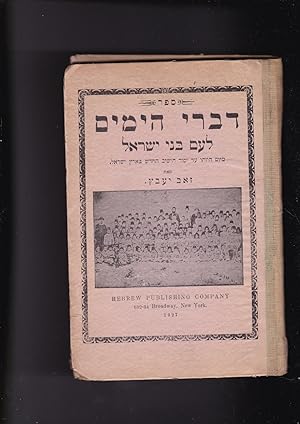
Sefer Divre ha-Yamim le-am ben Yisrael: mi-yom heyoto ad yesod ha-yishuv he-hadash be-Eretz Yisrael
Idioma: Hebreo
Publicado por Hebrew Publishing Company, 632-634 Broadway, New York, New York, 1922
Librería: Meir Turner, New York, NY, Estados Unidos de America
Calificación del vendedor: 5 de 5 estrellas
EUR 12,63
Envío por EUR 7,01
Se envía dentro de Estados Unidos de AmericaCantidad disponible: 1 disponibles
Añadir al carritoHardcover. Condición: Good. No Jacket. In Hebrew. 95 pages. 22 x 15 cm. Book block detached from boards. Ze'ev Jawitz (1847-1924), writer and historian, was born in Kolno to a wealthy family distinguished in lineage, scholarship, and piety. After an unsuccessful attempt at business, he devoted all his time to writing and scholarship. He contributed to Smolenskin's Ha-Shahar (in no. 11 (1882), 41-48). Jawitz won public recognition with his article "Migdal ha-me'ah " ("Tower of the century," in S.P. Rabinowitz (ed.), Keneset Yisrael, 1 (1887); repr. in his Toledot Yisrael, 13 (1937), 189-250), a survey of Jewish history from the death of Mendelssohn in 1786 to the death of Montefiore in 1886. The work's originality lay in the author's command of sources in Hebrew and other languages; in the inner integrity of his approach, which was a mixture of Eastern European Judaism, the romanticism of ?ibbat Zion, and the Judaism of Frankfurt Orthodoxy (often characterized by the phrase Torah im derekh ere?, in the sense of "Torah and secular learning"); and in his writing style, a combination of biblical and scholarly Hebrew. Settling in Erez Israel in 1888, Jawitz taught in Zikhron Ya'akov. His writings were widely published in Erez Israel in such periodicals as Haaretz, Peri ha-Arez (1892), and Ge'on ha-Arez (2 vols., 1893-94). He also wrote several textbooks, including Tal Yaldut (1891), Ha-Moriyyah (1894), Divrei ha-Yamim le-Am Benei-Yisrael (1894), Divrei Yemei ha-Ammim (1893-94), and books in which he attempted to relate legends in biblical style, as in Sihot minni Kedem (1887, 19272). His popular work Neginot minni Kedem (1892) appeared in several editions. In Ere? Israel, Jawitz was active on the Va'ad ha-Lashon, the committee responsible for developing Hebrew as a modern language. He and his brother-in-law, J.M. Pines, contributed to the development of modern Hebrew by introducing linguistic elements from the literature of the Mishnah, Talmud, and Midrash, e.g., tarbut ("culture") and kevish ("road"). Jawitz left Eretz Israel in 1894, moving to Vilna, to Germany, and later to London. For a short while he was active in the foundation of Mizrachi in Russia and edited the monthly journal Ha-Mizrah (1903-04). Simultaneously, Jawitz continued his major work, Toledot Yisrael. . . (14 vols., 1895-1940; the first part appeared in Warsaw, and the last five parts were published by B.M. Lewin in Tel Aviv, 1932-40). The first six parts (comprising the first section) deal with the Jews in their land, from the Patriarchal Age to the end of the period of R. Judah ha-Nasi; the next eight parts deal with the Jews among the nations of the world, from the period of the amoraim to Hibbat Zion. Although Jawitz was not a modern historian, his contribution to Jewish historiography is distinctive and valuable in that he infused his historical account with commitment to Orthodoxy and love for Erez Israel.
-
Sefer Toldot Israel metukan al pi hamekorot harishonim biyedey Ze'ev Yaavetz Khelek Sheni [=Part 2 = volume 2] mireshit malkhut beit David ad mot Hezkiyahu, [4th corrected and expanded edition with many additions from the manuscript of the author of blessed memory] mikhtav yad hamekhaber, zikrono liverakha baarikhat Dr. B.M. Levin
Idioma: Hebreo
Publicado por Achiever Akiever, Jerusalem -Tel Aviv, Eretz Israel, 1933
Librería: Meir Turner, New York, NY, Estados Unidos de America
Calificación del vendedor: 5 de 5 estrellas
EUR 17,14
Envío por EUR 7,01
Se envía dentro de Estados Unidos de AmericaCantidad disponible: 1 disponibles
Añadir al carritoHardcover. Condición: Very Good. No Jacket. In Hebrew. 236 pages. 238 x 164 mm. Ze'ev Jawitz (Zeev Yaavetz) (1847-1924), writer and historian, was born in Kolno to a wealthy family distinguished in lineage, scholarship, and piety. After an unsuccessful attempt at business, he devoted all his time to writing and scholarship. He contributed to Smolenskin's Ha-Shahar (in no. 11 (1882), 41-48). Jawitz won public recognition with his article "Migdal ha-me'ah " ("Tower of the century," in S.P. Rabinowitz (ed.), Keneset Yisrael, 1 (1887); repr. in his Toledot Yisrael, 13 (1937), 189-250), a survey of Jewish history from the death of Mendelssohn in 1786 to the death of Montefiore in 1886. The work's originality lay in the author's command of sources in Hebrew and other languages; in the inner integrity of his approach, which was a mixture of Eastern European Judaism, the romanticism of ?ibbat Zion, and the Judaism of Frankfurt Orthodoxy (often characterized by the phrase Torah im derekh ere?, in the sense of "Torah and secular learning"); and in his writing style, a combination of biblical and scholarly Hebrew. Settling in Erez Israel in 1888, Jawitz taught in Zikhron Ya'akov. His writings were widely published in Erez Israel in such periodicals as Haaretz, Peri ha-Arez (1892), and Ge'on ha-Arez (2 vols., 1893-94). He also wrote several textbooks, including Tal Yaldut (1891), Ha-Moriyyah (1894), Divrei ha-Yamim le-Am Benei-Yisrael (1894), Divrei Yemei ha-Ammim (1893-94), and books in which he attempted to relate legends in biblical style, as in Sihot minni Kedem (1887, 19272). His popular work Neginot minni Kedem (1892) appeared in several editions. In Ere? Israel, Jawitz was active on the Va'ad ha-Lashon, the committee responsible for developing Hebrew as a modern language. He and his brother-in-law, J.M. Pines, contributed to the development of modern Hebrew by introducing linguistic elements from the literature of the Mishnah, Talmud, and Midrash, e.g., tarbut ("culture") and kevish ("road"). Jawitz left Eretz Israel in 1894, moving to Vilna, to Germany, and later to London. For a short while he was active in the foundation of Mizrachi in Russia and edited the monthly journal Ha-Mizrah (1903-04). Simultaneously, Jawitz continued his major work, Toledot Yisrael. . . (14 vols., 1895-1940; the first part appeared in Warsaw, and the last five parts were published by B.M. Lewin in Tel Aviv, 1932-40). The first six parts (comprising the first section) deal with the Jews in their land, from the Patriarchal Age to the end of the period of R. Judah ha-Nasi; the next eight parts deal with the Jews among the nations of the world, from the period of the amoraim to Hibbat Zion. Although Jawitz was not a modern historian, his contribution to Jewish historiography is distinctive and valuable in that he infused his historical account with commitment to Orthodoxy and love for Erez Israel.
-
Sefer Toldot Israel metukan al pi hamekorot harishonim biyedey Yaavetz zikhroni liverakha Khelek 13 [=Part 13 = volume 13] meakharey gerush sefarad ad akharit dor harambn (mishnat 5252 ad shnat 5580 liyemot olam) uvesofo tosefet ma'amar : "migdal hame'a". nidpas mikhtav yad hamekhaber, zikrono liverakh umuge al yedey Dr. B.M. Levin.
Idioma: Hebreo
Publicado por Achiever Akiever, Tel Aviv, Eretz Israel, 1937
Librería: Meir Turner, New York, NY, Estados Unidos de America
Calificación del vendedor: 5 de 5 estrellas
EUR 17,14
Envío por EUR 7,01
Se envía dentro de Estados Unidos de AmericaCantidad disponible: 1 disponibles
Añadir al carritoHardcover. Condición: Good. No Jacket. In Hebrew. (4), 265 pages. 233 x 164 mm. Ze'ev Jawitz (Zeev Yaavetz) (1847-1924), writer and historian, was born in Kolno to a wealthy family distinguished in lineage, scholarship, and piety. After an unsuccessful attempt at business, he devoted all his time to writing and scholarship. He contributed to Smolenskin's Ha-Shahar (in no. 11 (1882), 41-8). Jawitz won public recognition with his article "Migdal ha-me'ah " ("Tower of the century," in S.P. Rabinowitz (ed.), Keneset Yisrael, 1 (1887); repr. in his Toledot Yisrael, 13 (1937), 189-250), a survey of Jewish history from the death of Mendelssohn in 1786 to the death of Montefiore in 1886. The work's originality lay in the author's command of sources in Hebrew and other languages; in the inner integrity of his approach, which was a mixture of Eastern European Judaism, the romanticism of ?ibbat Zion, and the Judaism of Frankfurt Orthodoxy (often characterized by the phrase Torah im derekh ere?, in the sense of "Torah and secular learning"); and in his writing style, a combination of biblical and scholarly Hebrew. Settling in Erez Israel in 1888, Jawitz taught in Zikhron Ya'akov. His writings were widely published in Erez Israel in such periodicals as Haaretz, Peri ha-Arez (1892), and Ge'on ha-Arez (2 vols., 1893-94). He also wrote several textbooks, including Tal Yaldut (1891), Ha-Moriyyah (1894), Divrei ha-Yamim le-Am Benei-Yisrael (1894), Divrei Yemei ha-Ammim (1893-94), and books in which he attempted to relate legends in biblical style, as in Sihot minni Kedem (1887, 19272). His popular work Neginot minni Kedem (1892) appeared in several editions. In Ere? Israel, Jawitz was active on the Va'ad ha-Lashon, the committee responsible for developing Hebrew as a modern language. He and his brother-in-law, J.M. Pines, contributed to the development of modern Hebrew by introducing linguistic elements from the literature of the Mishnah, Talmud, and Midrash, e.g., tarbut ("culture") and kevish ("road"). Jawitz left Eretz Israel in 1894, moving to Vilna, to Germany, and later to London. For a short while he was active in the foundation of Mizrachi in Russia and edited the monthly journal Ha-Mizrah (1903-04). Simultaneously, Jawitz continued his major work, Toledot Yisrael. . . (14 vols., 1895-1940; the first part appeared in Warsaw, and the last five parts were published by B.M. Lewin in Tel Aviv, 1932-40). The first six parts (comprising the first section) deal with the Jews in their land, from the Patriarchal Age to the end of the period of R. Judah ha-Nasi; the next eight parts deal with the Jews among the nations of the world, from the period of the amoraim to Hibbat Zion. Although Jawitz was not a modern historian, his contribution to Jewish historiography is distinctive and valuable in that he infused his historical account with commitment to Orthodoxy and love for Erez Israel.
-
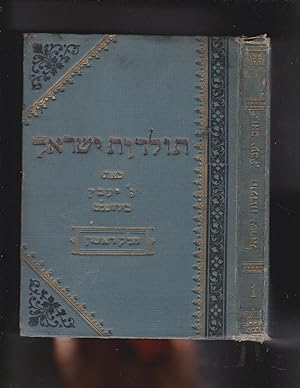
Sefer Toldot Israel metukan al pi hamekorot harishonim biyedey Yaavetz Khelek 3 [=Part 3 = volume 3] mereshit yemey menashe ad yemey shilton alexander mokdon mishnat 3067 ad shnat 3426 liyemot olam mahadura sheniya metukenet umegudelet betosefet maamar Totsaot hakhatitot vehakhakikot
Idioma: Hebreo
Publicado por [publisher not identified], Berlin, 1910
Librería: Meir Turner, New York, NY, Estados Unidos de America
Calificación del vendedor: 5 de 5 estrellas
EUR 79,39
Envío por EUR 7,01
Se envía dentro de Estados Unidos de AmericaCantidad disponible: 1 disponibles
Añadir al carritoHardcover. Condición: Good. No Jacket. Second Edition. In Hebrew. (2), 174. 56, 32, (2) pages. 224 x 158 mm. Ex library with de-accession stamp. Ze'ev Jawitz (Zeev Yaavetz) (1847-1924), writer and historian, was born in Kolno to a wealthy family distinguished in lineage, scholarship, and piety. After an unsuccessful attempt at business, he devoted all his time to writing and scholarship. He contributed to Smolenskin's Ha-Shahar (in no. 11 (1882), 41-8). Jawitz won public recognition with his article "Migdal ha-me'ah " ("Tower of the century," in S.P. Rabinowitz (ed.), Keneset Yisrael, 1 (1887); repr. in his Toledot Yisrael, 13 (1937), 189-250), a survey of Jewish history from the death of Mendelssohn in 1786 to the death of Montefiore in 1886. The work's originality lay in the author's command of sources in Hebrew and other languages; in the inner integrity of his approach, which was a mixture of Eastern European Judaism, the romanticism of ?ibbat Zion, and the Judaism of Frankfurt Orthodoxy (often characterized by the phrase Torah im derekh ere?, in the sense of "Torah and secular learning"); and in his writing style, a combination of biblical and scholarly Hebrew. Settling in Erez Israel in 1888, Jawitz taught in Zikhron Ya'akov. His writings were widely published in Erez Israel in such periodicals as Haaretz, Peri ha-Arez (1892), and Ge'on ha-Arez (2 vols., 1893-94). He also wrote several textbooks, including Tal Yaldut (1891), Ha-Moriyyah (1894), Divrei ha-Yamim le-Am Benei-Yisrael (1894), Divrei Yemei ha-Ammim (1893-94), and books in which he attempted to relate legends in biblical style, as in Sihot minni Kedem (1887, 19272). His popular work Neginot minni Kedem (1892) appeared in several editions. In Ere? Israel, Jawitz was active on the Va'ad ha-Lashon, the committee responsible for developing Hebrew as a modern language. He and his brother-in-law, J.M. Pines, contributed to the development of modern Hebrew by introducing linguistic elements from the literature of the Mishnah, Talmud, and Midrash, e.g., tarbut ("culture") and kevish ("road"). Jawitz left Eretz Israel in 1894, moving to Vilna, to Germany, and later to London. For a short while he was active in the foundation of Mizrachi in Russia and edited the monthly journal Ha-Mizrah (1903-04). Simultaneously, Jawitz continued his major work, Toledot Yisrael. . . (14 vols., 1895-1940; the first part appeared in Warsaw, and the last five parts were published by B.M. Lewin in Tel Aviv, 1932-40). The first six parts (comprising the first section) deal with the Jews in their land, from the Patriarchal Age to the end of the period of R. Judah ha-Nasi; the next eight parts deal with the Jews among the nations of the world, from the period of the amoraim to Hibbat Zion. Although Jawitz was not a modern historian, his contribution to Jewish historiography is distinctive and valuable in that he infused his historical account with commitment to Orthodoxy and love for Erez Israel.
-
Sefer Divre ha-Yamim le-am ben Yisrael: mi-yom heyoto ad yesod ha-yishuv he-hadash be-Eretz Yisrael
Idioma: Hebreo
Publicado por Schuldberg Brothers, Warsaw Warszawa, 1895
Librería: Meir Turner, New York, NY, Estados Unidos de America
Calificación del vendedor: 5 de 5 estrellas
Original o primera edición
EUR 79,39
Envío por EUR 7,01
Se envía dentro de Estados Unidos de AmericaCantidad disponible: 1 disponibles
Añadir al carritoHardcover. Condición: Good. No Jacket. 1st Edition. In Hebrew. 153 pages plus 10 foldout charts at end. 22 x 15.5 cm. Last foldout detached. Hinges exposed. Ze'ev Jawitz (Zeev Yaavetz) (1847-1924), writer and historian, was born in Kolno to a wealthy family distinguished in lineage, scholarship, and piety. After an unsuccessful attempt at business, he devoted all his time to writing and scholarship. He contributed to Smolenskin's Ha-Shahar (in no. 11 (1882), 41-48). Jawitz won public recognition with his article "Migdal ha-me'ah " ("Tower of the century," in S.P. Rabinowitz (ed.), Keneset Yisrael, 1 (1887); repr. in his Toledot Yisrael, 13 (1937), 189-250), a survey of Jewish history from the death of Mendelssohn in 1786 to the death of Montefiore in 1886. The work's originality lay in the author's command of sources in Hebrew and other languages; in the inner integrity of his approach, which was a mixture of Eastern European Judaism, the romanticism of ?ibbat Zion, and the Judaism of Frankfurt Orthodoxy (often characterized by the phrase Torah im derekh ere?, in the sense of "Torah and secular learning"); and in his writing style, a combination of biblical and scholarly Hebrew. Settling in Erez Israel in 1888, Jawitz taught in Zikhron Ya'akov. His writings were widely published in Erez Israel in such periodicals as Haaretz, Peri ha-Arez (1892), and Ge'on ha-Arez (2 vols., 1893-94). He also wrote several textbooks, including Tal Yaldut (1891), Ha-Moriyyah (1894), Divrei ha-Yamim le-Am Benei-Yisrael (1894), Divrei Yemei ha-Ammim (1893-94), and books in which he attempted to relate legends in biblical style, as in Sihot minni Kedem (1887, 19272). His popular work Neginot minni Kedem (1892) appeared in several editions. In Ere? Israel, Jawitz was active on the Va'ad ha-Lashon, the committee responsible for developing Hebrew as a modern language. He and his brother-in-law, J.M. Pines, contributed to the development of modern Hebrew by introducing linguistic elements from the literature of the Mishnah, Talmud, and Midrash, e.g., tarbut ("culture") and kevish ("road"). Jawitz left Eretz Israel in 1894, moving to Vilna, to Germany, and later to London. For a short while he was active in the foundation of Mizrachi in Russia and edited the monthly journal Ha-Mizrah (1903-04). Simultaneously, Jawitz continued his major work, Toledot Yisrael. . . (14 vols., 1895-1940; the first part appeared in Warsaw, and the last five parts were published by B.M. Lewin in Tel Aviv, 1932-40). The first six parts (comprising the first section) deal with the Jews in their land, from the Patriarchal Age to the end of the period of R. Judah ha-Nasi; the next eight parts deal with the Jews among the nations of the world, from the period of the amoraim to Hibbat Zion. Although Jawitz was not a modern historian, his contribution to Jewish historiography is distinctive and valuable in that he infused his historical account with commitment to Orthodoxy and love for Erez Israel.
-
Sefer Toldot Israel metukan al pi hamekorot harishonim biyedey Yaavetz Khelek 3 [=Part 3 = volume 3] mereshit yemey menashe ad yemey shilton alexander mokdon mishnat 3067 ad shnat 3426 liyemot olam mahadura sheniya metukenet umegudelet betosefet maamar Totsaot hakhatitot vehakhakikot
Idioma: Hebreo
Publicado por [publisher not identified], Berlin, 1910
Librería: Meir Turner, New York, NY, Estados Unidos de America
Calificación del vendedor: 5 de 5 estrellas
EUR 108,26
Envío por EUR 7,01
Se envía dentro de Estados Unidos de AmericaCantidad disponible: 1 disponibles
Añadir al carritoHardcover. Condición: Good. No Jacket. Second Edition. In Hebrew. (2), 174. 56, 32, (2) pages. 224 x 158 mm. Original wrappers bound in hard cover. Ze'ev Jawitz (Zeev Yaavetz) (1847-1924), writer and historian, was born in Kolno to a wealthy family distinguished in lineage, scholarship, and piety. After an unsuccessful attempt at business, he devoted all his time to writing and scholarship. He contributed to Smolenskin's Ha-Shahar (in no. 11 (1882), 41-8). Jawitz won public recognition with his article "Migdal ha-me'ah " ("Tower of the century," in S.P. Rabinowitz (ed.), Keneset Yisrael, 1 (1887); repr. in his Toledot Yisrael, 13 (1937), 189-250), a survey of Jewish history from the death of Mendelssohn in 1786 to the death of Montefiore in 1886. The work's originality lay in the author's command of sources in Hebrew and other languages; in the inner integrity of his approach, which was a mixture of Eastern European Judaism, the romanticism of ?ibbat Zion, and the Judaism of Frankfurt Orthodoxy (often characterized by the phrase Torah im derekh ere?, in the sense of "Torah and secular learning"); and in his writing style, a combination of biblical and scholarly Hebrew. Settling in Erez Israel in 1888, Jawitz taught in Zikhron Ya'akov. His writings were widely published in Erez Israel in such periodicals as Haaretz, Peri ha-Arez (1892), and Ge'on ha-Arez (2 vols., 1893-94). He also wrote several textbooks, including Tal Yaldut (1891), Ha-Moriyyah (1894), Divrei ha-Yamim le-Am Benei-Yisrael (1894), Divrei Yemei ha-Ammim (1893-94), and books in which he attempted to relate legends in biblical style, as in Sihot minni Kedem (1887, 19272). His popular work Neginot minni Kedem (1892) appeared in several editions. In Ere? Israel, Jawitz was active on the Va'ad ha-Lashon, the committee responsible for developing Hebrew as a modern language. He and his brother-in-law, J.M. Pines, contributed to the development of modern Hebrew by introducing linguistic elements from the literature of the Mishnah, Talmud, and Midrash, e.g., tarbut ("culture") and kevish ("road"). Jawitz left Eretz Israel in 1894, moving to Vilna, to Germany, and later to London. For a short while he was active in the foundation of Mizrachi in Russia and edited the monthly journal Ha-Mizrah (1903-04). Simultaneously, Jawitz continued his major work, Toledot Yisrael. . . (14 vols., 1895-1940; the first part appeared in Warsaw, and the last five parts were published by B.M. Lewin in Tel Aviv, 1932-40). The first six parts (comprising the first section) deal with the Jews in their land, from the Patriarchal Age to the end of the period of R. Judah ha-Nasi; the next eight parts deal with the Jews among the nations of the world, from the period of the amoraim to Hibbat Zion. Although Jawitz was not a modern historian, his contribution to Jewish historiography is distinctive and valuable in that he infused his historical account with commitment to Orthodoxy and love for Erez Israel.


![Imagen del vendedor de Sefer Toldot Israel metukan al pi hamekorot harishonim biyedey Yaavetz zikhroni liverakha Khelek Asiri [=Part 10 = volume 10] miyemey hageonim hatikoniim ad yeme rabeinnu Yttzkhak Alfasi veRashi. (mishnat 4545 ad shnat 4830 liyemot olam) uvesofo tosefet ma'amar : "Makhlefet hashita". nidpas mikhtav yad hamekhaber, zikrono liverakh umuge al yedey Dr. B.M. Levin. a la venta por Meir Turner](https://pictures.abebooks.com/inventory/md/md30471141847.jpg)
![Imagen del vendedor de Sefer Toldot Israel metukan al pi hamekorot harishonim biyedey Ze'ev Yaavetz Khelek Sheni [=Part 2 = volume 2] mireshit malkhut beit David ad mot Hezkiyahu, [4th corrected and expanded edition with many additions from the manuscript of the author of blessed memory] mikhtav yad hamekhaber, zikrono liverakha baarikhat Dr. B.M. Levin a la venta por Meir Turner](https://pictures.abebooks.com/inventory/md/md30472572824.jpg)
![Imagen del vendedor de Sefer Toldot Israel metukan al pi hamekorot harishonim biyedey Yaavetz zikhroni liverakha Khelek 13 [=Part 13 = volume 13] meakharey gerush sefarad ad akharit dor harambn (mishnat 5252 ad shnat 5580 liyemot olam) uvesofo tosefet ma'amar : "migdal hame'a". nidpas mikhtav yad hamekhaber, zikrono liverakh umuge al yedey Dr. B.M. Levin. a la venta por Meir Turner](https://pictures.abebooks.com/inventory/md/md30471143711.jpg)
![Imagen del vendedor de Sefer Toldot Israel metukan al pi hamekorot harishonim biyedey Yaavetz Khelek 3 [=Part 3 = volume 3] mereshit yemey menashe ad yemey shilton alexander mokdon mishnat 3067 ad shnat 3426 liyemot olam mahadura sheniya metukenet umegudelet betosefet maamar Totsaot hakhatitot vehakhakikot a la venta por Meir Turner](https://pictures.abebooks.com/inventory/md/md30471997997.jpg)
![Imagen del vendedor de Sefer Toldot Israel metukan al pi hamekorot harishonim biyedey Yaavetz Khelek 3 [=Part 3 = volume 3] mereshit yemey menashe ad yemey shilton alexander mokdon mishnat 3067 ad shnat 3426 liyemot olam mahadura sheniya metukenet umegudelet betosefet maamar Totsaot hakhatitot vehakhakikot a la venta por Meir Turner](https://pictures.abebooks.com/inventory/md/md30471996011.jpg)