

Importe total (1 artículo artículos):
Destino del pedido:

turing newman (4 resultados)
Ir a los resultados principales
Filtros de búsqueda
Tipo de artículo
- Todos los tipos de productos
- Libros (4)
- Revistas y publicaciones (No hay ningún otro resultado que coincida con este filtro.)
- Cómics (No hay ningún otro resultado que coincida con este filtro.)
- Partituras (No hay ningún otro resultado que coincida con este filtro.)
- Arte, grabados y pósters (No hay ningún otro resultado que coincida con este filtro.)
- Fotografías (No hay ningún otro resultado que coincida con este filtro.)
- Mapas (No hay ningún otro resultado que coincida con este filtro.)
- Manuscritos y coleccionismo de papel (No hay ningún otro resultado que coincida con este filtro.)
Condición Más información
- Nuevo (No hay ningún otro resultado que coincida con este filtro.)
- Como nuevo, Excelente o Muy bueno (1)
- Bueno o Aceptable (No hay ningún otro resultado que coincida con este filtro.)
- Regular o Pobre (No hay ningún otro resultado que coincida con este filtro.)
- Tal como se indica (3)
Encuadernación
- Todas
- Tapa dura (No hay ningún otro resultado que coincida con este filtro.)
- Tapa blanda (3)
Más atributos
- Primera edición (3)
- Firmado (No hay ningún otro resultado que coincida con este filtro.)
- Sobrecubierta (No hay ningún otro resultado que coincida con este filtro.)
- Con imágenes (2)
- No impresión bajo demanda (4)
Idioma (2)
Gastos de envío gratis
- Envío gratis a Estados Unidos de America (No hay ningún otro resultado que coincida con este filtro.)
Ubicación del vendedor
Valoración de los vendedores
-
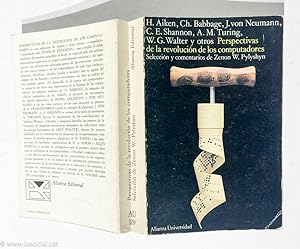
Perspectivas de la Revolucion de los Computadores
Librería: La Social. Galería y Libros, Barcelona, B, España
Calificación del vendedor: 5 de 5 estrellas

Original o primera edición
EUR 17,99
Envío por EUR 25,50
Se envía de España a Estados Unidos de AmericaCantidad disponible: 1 disponibles
Añadir al carritoEncuadernación de tapa blanda. Condición: Muy bien. 1ª Edición. Título Original: "Perspectives on the Computer Revolution" Traducción de Luis García Llorente. Colección: "Alianza Universidad" Núm. 119. MUY BUEN ejemplar. 700pp + 2h.
-

A formal theorem in Church s theory of types (+) The use of dots as brackets in Church's system. (In: "The Journal Of Symbolic Logic"). - [TURING ON CHURCH'S TYPE THEORY]
Librería: Herman H. J. Lynge & Søn ILAB-ABF, Copenhagen, Dinamarca
Miembro de asociación: ABF ILAB
Calificación del vendedor: 4 de 5 estrellas

EUR 385,95
Envío por EUR 42,00
Se envía de Dinamarca a Estados Unidos de AmericaCantidad disponible: 1 disponibles
Añadir al carrito(No place), The Association for Symbolic Logic, 1942. Large 8vo. Bound in blue half cloth with silver lettering to spine. In "Journal of Symbolic Logic", Volume 7. Small paper label to lower part of spine and upper inner margin of front board. Stamp to title-page and last leaf, otherwise internally fine. Pp. 28-33" 146-156 (Entire copy: (4), 180 pp.). First appearance of these two paper's by Turing.Turing's paper "A Formal Theorem in Church's Theory of Types" is a significant contribution to the fields of computer science and mathematical logic. By providing a formal proof within Church's theory, Turing expanded our understanding of computation and its relationship to logic. His work on computability and the theory of types laid the foundation for the development of theoretical computer science, proof theory, and automated reasoning. Turing's paper continues to be a landmark in the study of computation, inspiring further research and practical applications in diverse areas of science and technology. In "The Use of Dots as Brackets in Church's System", introducing the dot parentheses notation, Turing simplified the representation and manipulation of lambda calculus expressions, making them more intuitive and manageable. His work highlighted the relationship between syntax and semantics, laying the foundation for further research in formal semantics and the development of programming languages. Turing's paper continues to be influential, shaping the way complex expressions are represented and reasoned about in the fields of computation, formal systems, and logic.
-
A Formal Theorem in Church's Theory of Types (+) Practical forms of type theory
Librería: Herman H. J. Lynge & Søn ILAB-ABF, Copenhagen, Dinamarca
Miembro de asociación: ABF ILAB
Calificación del vendedor: 4 de 5 estrellas
Original o primera edición
EUR 385,95
Envío por EUR 42,00
Se envía de Dinamarca a Estados Unidos de AmericaCantidad disponible: 1 disponibles
Añadir al carrito(No place), The Association for Symbolic Logic, 1942, 1943 &1948. Lev8vo. Bound in two uniform red half cloth with gilt lettering to spine. In "Journal of Symbolic Logic", Volume 7, 8 [Bound together] & 13. Barcode label pasted on to back board. Small library stamp to lower part of 6 pages. Minor scratches to extremities of volume 13. A fine set. Pp. 28-33" Pp. 80-94. [Entire volumes: IV, 164 pp." IV, 236 pp.). First printing of the two important - but often overlooked - papers by Turing which provide "information about Turing's thoughts on the logical foundations of mathematics which is not to be found elsewhere in his writings". (Copeland, The Essential Turing, P. 206).
-
A Formal Theorem in Church's Theory of Types. Offprint from The Journal of Symbolic Logic, vol. 7, no. 1, March 1942, pp. 28-33.
Publicado por The Association for Symbolic Logic, 1942, 1942
Librería: Peter Harrington. ABA/ ILAB., London, Reino Unido
Miembro de asociación: ABA ILAB PBFA
Calificación del vendedor: 5 de 5 estrellas
Original o primera edición
EUR 20.839,36
Envío por EUR 25,44
Se envía de Reino Unido a Estados Unidos de AmericaCantidad disponible: 1 disponibles
Añadir al carritoFirst edition, offprint issue, Alan Turing's copy, presented by his mother to his close friend and colleague Norman Routledge after her son's death. During his limited free time at Bletchley Park, Turing studied mathematical logic and corresponded on the topic with Max Newman, then still at Cambridge. The resulting co-authored paper extended and simplified Alonzo Church's work. When Turing's library was dispersed following his death, his mother Sara sent 13 different offprints of his articles to Routledge, including the present. Their presentation testifies to the close relationship that Routledge had with both mother and son. In a letter dated 16 May 1956, Sara wrote "I am very glad you should have the off-prints & hope they will be useful". Like Turing, Routledge was a mathematical fellow at King's College, Cambridge. Turing's letters to Routledge are among his most candid, particularly about his sexuality, which he knew Routledge would understand - Routledge himself later lived openly as a gay man. In a 1952 letter, Turing addressed to Routledge his now-famous syllogism: "Turing believes machines think / Turing lies with men / Therefore machines do not think / Yours in distress, Alan" (Hodges, p. xxx). Turing and Newman (1897-1984) first met in mid-1930s Cambridge, when Turing attended the lectures of Newman's Foundation of Mathematics course. Turing's seminal 1936 On Computable Numbers began as a paper on the Entscheidungsproblem that he first showed to Newman, who helped him to publish the work. Turing later studied with Alonzo Church at Princeton on Newman's advice. In early 1940, when Turing was employed as a codebreaker at Bletchley Park, he received a letter from Newman, by now his colleague and friend. His response began: "'Dear Newman, Very glad to get your letter, as I needed some stimulus to make me start thinking about logic.'" (Copeland, p. 205). Their resulting correspondence discussed conversion calculus, often referencing a manuscript of Church's titled Mathematical Logic. Ultimately, they produced this paper, which they submitted to Church's Journal of Symbolic Logic in May 1941. Newman joined Turing at Bletchley Park in late August 1942. The offprint is accompanied by a contemporary photostatic copy of a later Turing article, "The Use of Dots as Brackets in Church's System", published in the same journal in December 1942. It is signed by Routledge on the first page. Provenance: Alan Turing (1912-1954); Ethel Sara Turing (1881-1976); Norman Arthur Routledge (1928-2013); by descent in the Routledge family. AMT/B/29; J. Copeland, ed., The Essential Turing, 2004; Andrew Hodges, Alan Turing: The Enigma, 1983. Octavo. Original beige wrappers lettered in black, wire-stitched. Covers very peripherally toned, corners a little creased, extending into contents; a near-fine copy of a fragile publication.


