Importe total (1 artículo artículos):
Destino del pedido:

samuel madras (3 resultados)
Ir a los resultados principales
Filtros de búsqueda
Tipo de artículo
- Todos los tipos de productos
- Libros (3)
- Revistas y publicaciones (No hay ningún otro resultado que coincida con este filtro.)
- Cómics (No hay ningún otro resultado que coincida con este filtro.)
- Partituras (No hay ningún otro resultado que coincida con este filtro.)
- Arte, grabados y pósters (No hay ningún otro resultado que coincida con este filtro.)
- Fotografías (No hay ningún otro resultado que coincida con este filtro.)
- Mapas (No hay ningún otro resultado que coincida con este filtro.)
- Manuscritos y coleccionismo de papel (No hay ningún otro resultado que coincida con este filtro.)
Condición Más información
- Nuevo (1)
- Como nuevo, Excelente o Muy bueno (1)
- Bueno o Aceptable (No hay ningún otro resultado que coincida con este filtro.)
- Regular o Pobre (No hay ningún otro resultado que coincida con este filtro.)
- Tal como se indica (1)
Encuadernación
- Todas
- Tapa dura (No hay ningún otro resultado que coincida con este filtro.)
- Tapa blanda (1)
Más atributos
- Primera edición (No hay ningún otro resultado que coincida con este filtro.)
- Firmado (No hay ningún otro resultado que coincida con este filtro.)
- Sobrecubierta (No hay ningún otro resultado que coincida con este filtro.)
- Con imágenes (1)
- No impresión bajo demanda (3)
Idioma (3)
Gastos de envío gratis
- Envío gratis a Estados Unidos de America (No hay ningún otro resultado que coincida con este filtro.)
Ubicación del vendedor
Valoración de los vendedores
-

QUIMICA CURSO PREUNIVERSITARIO
Librería: Libreria El Dia, Tijuana, BCN, México
Calificación del vendedor: 5 de 5 estrellas

EUR 7,15
Envío por EUR 5,16
Se envía de México a Estados Unidos de AmericaCantidad disponible: 3 disponibles
Añadir al carritoCondición: New. QUIMICA CURSO PREUNIVERSITARIO.
-
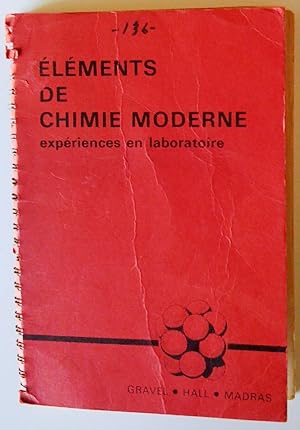
Éléments de chimie moderne. Expériences en laboratoire
Idioma: Francés
Librería: Claudine Bouvier, Gatineau, QC, Canada
Calificación del vendedor: 5 de 5 estrellas
EUR 8,98
Envío por EUR 31,24
Se envía de Canada a Estados Unidos de AmericaCantidad disponible: 1 disponibles
Añadir al carritoCouverture souple. Condición: Bon. Montréal, McGraw-Hill, 1970, 150 p. Ill. Couverture défraîchie et chiffres inscrits sur la couverture et la page de titre. code 1911.
-

A Treatise on the Law of Tithes.
Publicado por London, Printed by A. Strahan for Joseph Butterworth and Son., 1808
Librería: Vico Verlag und Antiquariat Dr. Otto, Frankfurt am Main, Alemania
Calificación del vendedor: 3 de 5 estrellas

EUR 320,00
Envío por EUR 23,10
Se envía de Alemania a Estados Unidos de AmericaCantidad disponible: 1 disponibles
Añadir al carritoThe third edition corrected with additions. Oktav. VIII, 312 S. Zeitgenössischer, originale Verlagsbroschur. Unbeschnittenes Exemplar. Sir Samuel Toller (17641821)[1] was an English advocate-general of Madras and legal writer. He was son of Thomas Toller (17321795), who succeeded his father-in-law, Samuel Lawrence, as preacher to the Presbyterian congregation in Monkwell Street, London. He was educated at Charterhouse School.[1] Toller was admitted to Lincoln's Inn 27 March 1781, was called to the bar, and in March 1812 was appointed Advocate-General of Madras. He was subsequently knighted, and died in India on his way to Bangalore on 19 November 1821.[2] Treatise of the Law of Tithes: compiled in Part from some Notes of Richard Wooddeson, London, 1808; 3rd ed. 1822. A tithe (/ta?ð/; from Old English: teogoþa "tenth") is a one-tenth part of something, paid as a contribution to a religious organization or compulsory tax to government.[1] Today, tithes are normally voluntary and paid in cash or cheques, whereas historically tithes were required and paid in kind, such as agricultural produce. After the separation of church and state, church tax linked to the tax system are instead used in many countries to support their national church. Many Christian denominations hold Jesus taught that tithing must be done in conjunction with a deep concern for "justice, mercy and faithfulness" (cf. Matthew 23:23).[2][3][4] Tithing was taught at early Christian church councils, including the Council of Tours in 567, as well as the Third Council of Mâcon in 585. Tithing remains an important doctrine in many Christian denominations, such as the Congregationalist Churches, Methodist Churches and Seventh-day Adventist Church.[2] Some Christian Churches, such as those in the Methodist tradition, teach the concept of Storehouse Tithing, which emphasizes that tithes must be prioritized and given to the local church, before offerings can be made to apostolates or charities.[5][6] Traditional Jewish law and practice has included various forms of tithing since ancient times. Orthodox Jews commonly practice ma'aser kesafim (tithing 10% of their income to charity). In modern Israel, some religious Jews continue to follow the laws of agricultural tithing, e.g., ma'aser rishon, terumat ma'aser, and ma'aser sheni. England and Wales The right to receive tithes was granted to the English churches by King Ethelwulf in 855. The Saladin tithe was a royal tax, but assessed using ecclesiastical boundaries, in 1188. The legal validity of the tithe system was affirmed under the Statute of Westminster of 1285. The Dissolution of the Monasteries led to the transfer of many rights to tithe to secular landowners and the Crown and tithes could be extinguished until 1577 under an Act of the 37th year of Henry VIII's reign.[36] Adam Smith criticized the system in The Wealth of Nations (1776), arguing that a fixed rent would encourage peasants to work far more efficiently. See below for a fuller description and history, until the reforms of the 19th century, written by Sir William Blackstone and edited by other learned lawyers of the period.[37] The system gradually ended with the Tithe Commutation Act 1836, whose long-lasting Tithe Commission replaced them with a commutation payment, land award and/or rentcharges to those paying the commutation payment and took the opportunity to map out (apportion) residual chancel repair liability where the rectory had been appropriated during the medieval period by a religious house or college. Its records give a snapshot of land ownership in most parishes, the Tithe Files, are a socio-economic history resource. The rolled-up payment of several years' tithe would be divided between the tithe-owners as at the date of their extinction.[38] This commutation reduced problems to the ultimate payers by effectively folding tithes in with rents however, it could cause transitional money supply problems by raising the transaction demand for mo.