

Importe total (1 artículo artículos):
Destino del pedido:

samson mason (6 resultados)
Ir a los resultados principales
Filtros de búsqueda
Tipo de artículo
- Todos los tipos de productos
- Libros (6)
- Revistas y publicaciones (No hay ningún otro resultado que coincida con este filtro.)
- Cómics (No hay ningún otro resultado que coincida con este filtro.)
- Partituras (No hay ningún otro resultado que coincida con este filtro.)
- Arte, grabados y pósters (No hay ningún otro resultado que coincida con este filtro.)
- Fotografías (No hay ningún otro resultado que coincida con este filtro.)
- Mapas (No hay ningún otro resultado que coincida con este filtro.)
- Manuscritos y coleccionismo de papel (No hay ningún otro resultado que coincida con este filtro.)
Condición Más información
- Nuevo (2)
- Como nuevo, Excelente o Muy bueno (1)
- Bueno o Aceptable (1)
- Regular o Pobre (No hay ningún otro resultado que coincida con este filtro.)
- Tal como se indica (2)
Encuadernación
Más atributos
- Primera edición (1)
- Firmado (No hay ningún otro resultado que coincida con este filtro.)
- Sobrecubierta (No hay ningún otro resultado que coincida con este filtro.)
- Con imágenes (5)
- No impresión bajo demanda (4)
Idioma (2)
Gastos de envío gratis
Ubicación del vendedor
Valoración de los vendedores
-

The Crystal Structure of Dimethyl-phenylsulphonium Perchlorate AND . Monoterpene Iridomyrmecin at -150C AND X-Ray Studies.Bis-N-Alkylsalicyladiminates of Bivalvent Metals III.Bis-N-butylsalicylaldinmine-palladium AND Zur Strukturanalyse zweidimensional fehlgeordneter OD-Strukturen: . Natriumtetrametaphosphate. AND Method for Determ. of Complex Cubic Metal Structures and Application to Solution of Structure NaCD2 AND Structure 3-Indolylacetic Acid AND Structure 7,7'-Dihydro-B-carotene AND Least-Squares Refinement.Tricaesium Pentachlorocobalt(II) AND Use of Germanium Dendrites for Monochromatization of X-Rays (Acta Crystallographica, Vol. 17, Part 5).
Publicado por International Union of Crystallography / Munksgaard., 1964
Librería: Eryops Books, Stephenville, TX, Estados Unidos de America
Calificación del vendedor: 5 de 5 estrellas

EUR 2,20
Envío por EUR 5,12
Se envía dentro de Estados Unidos de AmericaCantidad disponible: 1 disponibles
Añadir al carritoNo Binding. Condición: Very Good. ORIGINAL articles; disbound from journal; no covers; in very good condition. Journal.
-
![Imagen del vendedor de Charge against General Harrison for voting to sell white men for debt 1840 [LeatherBound] a la venta por S N Books World](https://pictures.abebooks.com/inventory/md/md30637322067.jpg)
Charge against General Harrison for voting to sell white men for debt 1840 [LeatherBound]
Idioma: Inglés
Año de publicación: 2025
Librería: S N Books World, Delhi, India
Calificación del vendedor: 5 de 5 estrellas
EUR 21,09
Gastos de envío gratis
Se envía de India a Estados Unidos de AmericaCantidad disponible: 18 disponibles
Añadir al carritoLeatherbound. Condición: NEW. BOOKS ARE EXEMPT FROM IMPORT DUTIES AND TARIFFS; NO EXTRA CHARGES APPLY. Leather Binding on Spine and Corners with Golden leaf printing on spine. Bound in genuine leather with Satin ribbon page markers and Spine with raised gilt bands. A perfect gift for your loved ones. Reprinted from 1840 edition. NO changes have been made to the original text. This is NOT a retyped or an ocr'd reprint. Illustrations, Index, if any, are included in black and white. Each page is checked manually before printing. As this print on demand book is reprinted from a very old book, there could be some missing or flawed pages, but we always try to make the book as complete as possible. Fold-outs, if any, are not part of the book. If the original book was published in multiple volumes then this reprint is of only one volume, not the whole set and contains approximately 16 pages. IF YOU WISH TO ORDER PARTICULAR VOLUME OR ALL THE VOLUMES YOU CAN CONTACT US. Resized as per current standards. Sewing binding for longer life, where the book block is actually sewn (smythe sewn/section sewn) with thread before binding which results in a more durable type of binding. Language: English.
-
![Imagen del vendedor de Charge against General Harrison for voting to sell white men for debt . [LeatherBound] a la venta por True World of Books](https://pictures.abebooks.com/inventory/md/md31534152547.jpg)
Charge against General Harrison for voting to sell white men for debt . [LeatherBound]
Año de publicación: 2025
Librería: True World of Books, Delhi, India
Calificación del vendedor: 5 de 5 estrellas
EUR 21,09
Gastos de envío gratis
Se envía de India a Estados Unidos de AmericaCantidad disponible: 18 disponibles
Añadir al carritoLeatherBound. Condición: New. BOOKS ARE EXEMPT FROM IMPORT DUTIES AND TARIFFS; NO EXTRA CHARGES APPLY. Leather Binding on Spine and Corners with Golden leaf printing on spine. Bound in genuine leather with Satin ribbon page markers and Spine with raised gilt bands. A perfect gift for your loved ones. Reprinted from edition. NO changes have been made to the original text. This is NOT a retyped or an ocr'd reprint. Illustrations, Index, if any, are included in black and white. Each page is checked manually before printing. As this print on demand book is reprinted from a very old book, there could be some missing or flawed pages, but we always try to make the book as complete as possible. Fold-outs, if any, are not part of the book. If the original book was published in multiple volumes then this reprint is of only one volume, not the whole set and contains approximately 24 pages. IF YOU WISH TO ORDER PARTICULAR VOLUME OR ALL THE VOLUMES YOU CAN CONTACT US. Resized as per current standards. Sewing binding for longer life, where the book block is actually sewn (smythe sewn/section sewn) with thread before binding which results in a more durable type of binding. Language: English.
-
Speech of Mr. Mason, Of Ohio, on The General Appropriation Bill; Delivered in Committee of the Whole in the House of Representatives, April 24, 1840
Publicado por [House of Representatives], [Washington], 1840
Librería: The First Edition Rare Books, LLC, Cincinnati, OH, Estados Unidos de America
Miembro de asociación: ABAA ILAB IOBA MWABA
Calificación del vendedor: 5 de 5 estrellas
Original o primera edición
EUR 131,87
Envío por EUR 5,12
Se envía dentro de Estados Unidos de AmericaCantidad disponible: 1 disponibles
Añadir al carritoPamphlet. Condición: Near fine. Pamphlet of the Speech of Mr. Mason, of Ohio, on the General Appropriation Bill as delivered on April 24, 1840. Ilustrador. First Edition. Octavo, 8pp. Bound along spine, two punch holes along left border. A touch of creasing along spine, faint toning to bottom edge. Not found in Sabin. A near fine example of a speech given in response to the charges against William Henry Harrison for "voting to sell white men for debt.".
-
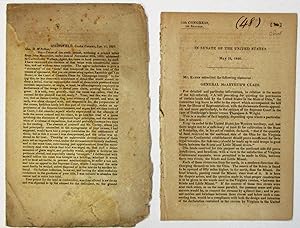
SPRINGFIELD, CLARK COUNTY, JAN. 11, 1827. GEN. D. M'ARTHUR.
Publicado por [Springfield, Ohio?, 1827
Librería: David M. Lesser, ABAA, Woodbridge, CT, Estados Unidos de America
Miembro de asociación: ABAA ESA ILAB SNEAB
Calificación del vendedor: 5 de 5 estrellas
EUR 439,57
Envío por EUR 8,54
Se envía dentro de Estados Unidos de AmericaCantidad disponible: 1 disponibles
Añadir al carrito7, [1 blank] pp. Caption title [as issued]. Untrimmed, uncut, and generously margined. Spotted, Good+. Mason, a lawyer, would be elected to the Ohio State Senate in 1829, and then to Congress in 1834, where he served several terms as an anti-Jackson Whig. In this rare pamphlet he addresses General Duncan McArthur, who had brought an action of ejectment "against Reynolds and Van Meter, in the Court of Common Pleas for Champaign county." McArthur claimed ownership of land between the Scioto and Little Miami Rivers, pursuant to military warrants granted him by the State of Virginia. Mason represented McArthur at trial. Mason defends himself against McArthur's criticisms of his trial conduct. McArthur's case was important. The U.S. Supreme Court decided it in 1829. See, Reynolds vs. McArthur, 27 U.S. 417 [1829] [opinion by Chief Justice Marshall]. When Virginia ceded lands to the United States in 1784, it had reserved to itself the area between the Scioto and Little Miami to distribute military bounties. McArthur held title to land pursuant to such a Virginia military land warrant. The Supreme Court held that McArthur's claim of ownership was superior to the purported title of persons holding under a sale made by the United States. We accompany this pamphlet with a government report, IN SENATE OF THE UNITED STATES. MAY 12, 1826. MR. EATON SUBMITTED THE FOLLOWING STATEMENT. GENERAL McARTHUR'S CLAIM. 19th Cong., 1st Sess. Doc. 96. 8pp. It is a detailed discussion of the land cessions and McArthur's claim. OCLC 492252493 [1- W. Res. Hist. Soc.] as of August 2024. Not in American Imprints, Sabin, Eberstadt, Thomson, Decker, Cohen.
-

The Reverend Samson Occom,
Año de publicación: 1768
Librería: Maggs Bros. Ltd ABA, ILAB, PBFA, London, Reino Unido
Miembro de asociación: ABA ILAB PBFA
Calificación del vendedor: 5 de 5 estrellas
EUR 29.729,39
Envío por EUR 31,17
Se envía de Reino Unido a Estados Unidos de AmericaCantidad disponible: 1 disponibles
Añadir al carritoThe First Indian Minister that ever was in Europe, & who accompanied the Revs Nathanl Whitaker D.D. in an application to Great Britain for charities to support ye Revd Dr Wheelock's Indian Academy, & Missionaries among ye Native Savages of N. America. Mezzotint measuring 365 by 260mm. A very good copy, trimmed close to the plate, a little toned with some minor creases. London, Published according to the Act of Parliament, Henry Parker, at No. 82 in Cornhill, 20 September, A rare and important mezzotint of Mohegan writer, minister, and teacher Samson Occom (1723-92). This print is after Mason Chamberlin?s (1727-1787) portrait of Occom, which was painted during his visit to the British Isles in 1766 as part of a fund-raising tour at the behest of his mentor Eleazar Wheelock. Occom (also Occum) had studied under Wheelock for four years before being ordained into the Presbyterian church, and besides his understanding of scripture and theology, he had significant knowledge of Latin, Greek and Hebrew. He was accompanied on his trip to Britain by the Rev. Nathaniel Whitaker, a white American minister who served as both companion and chaperone. Occom believed that his efforts abroad were to benefit the Indian Charity School in Lebanon, Connecticut, and this makes him the earliest recorded Indigenous missionary to travel from America to Great Britain. Chamberlin was a founding member of the Royal Academy, most famous for his 1762 depiction of Benjamin Franklin, now in the Philadelphia Museum of Art. The original painting of Samson Occom is lost. The mezzotint by John Spillsbury was produced a few months after Occom?s return to America in 1768. Occom fits into a long lineage of Indigenous people, particularly Americans, who travelled against the tide of colonisation in the years before the American Revolution. Often diplomatic emissaries sent to seek audience with the regent, or captives exhibited as curiosities, Occom's status as a minister and preacher set him apart as a new type of visitor. "Unlike so many of his predecessors who crossed the Atlantic to see Great Britain's famous places and mingle with its eminent officials, Occom was of humble background - not from a prominent family in a major tribe, not a noted warrior or noted spokesman for his people. This impoverished schoolmaster and itinerant preacher had served equally impoverished northeastern American natives. Yet despite modest beginnings, chronic poor health, and recurrent penury, Occom's visit to England, Scotland, and Ireland was remarkable for its duration - about six times the length of most eighteenth-century Indian sojourns - and its financial success. Between February 1766 and April 1768, Occom's efforts, combined with those of his Anglo-American companions, brought Wheelock's school nearly £12,000. Wheelock would spend much of that windfall on the education of young Indians, but to Occom's profound dismay, he spent more of it to establish Dartmouth College, which almost exclusively enrolled students of English descent" (Vaughan, 191). The image shows Occom bridging two cultures, dressed in the clothes of a colonial American minster, gesturing to the word of God in the open Bible on a lectern before him. Mounted on the wall above are the bow and arrow, a symbol of his Native identity, notably positioned behind Occom, as if to nod to a past that his salvation (and education) has enabled him to move beyond. This idea of civilisation and redemption through scripture ties into the Great Awakening teachings of figures like George Whitefield, with whom Occom lodged during his stay in London. Benjamin Franklin also stayed with Whitefield and the two may have overlapped. Occom's representation differs significantly from other contemporary portraiture of Indigenous subjects. Perhaps the two most famous examples are George Romney's painting of Mohawk diplomat Joseph Brant, and Joshua Reynolds's portrait of Mai, the Ra'itean voyager who travelled to England from Tahiti with Captain Cook. Both painted c. 1776, the portrait of Brant shows him in striking "Indian Dress", a combination of Native and European garb including a long white shirt and feathered headdress, which emphasised his intercultural position, whilst simultaneously exoticising his difference. Indeed, contemporary reports suggest that whilst in Britain, Brant mostly wore European attire, and as such it was an active choice for him to be depicted in this way. Mai on the other hand (known as Omai in contemporary sources) was situated by Reynolds in an idealized exotic landscape, his flowing robes, bare feet and classic gesture all suggesting strong links with antiquity: ?a thoroughly neo-classical version of the noble savage? (Smith). In contrast, the portrait of Occom "reveals the visual manifestation of his politesse. This transformation from savagery to civilization is reinforced by the ease with which Occom's appearance conforms to the conventions of ministerial portraiture of the colonies, as can be seen through a comparison with a printed portrait of the Reverend Cotton Mather by Peter Pelham from a generation earlier . The Occom print reminds us of an important aspect of colonial relations that has been analyzed at length by Frantz Fanon: the ideology of racial difference upon which colonial domination is based is essentially visual, based on recognizable stereotypes. This fact helps explain the proliferation of images of Native people in the eighteenth and especially nineteenth centuries that work to document their essential otherness" (Hutchinson, 217-218). One of the reasons Occom's visit could span such a duration, and that in spite of ongoing health issues he was able to return home, was the fact that he was inoculated against smallpox shortly after his arrival. This acquired immunity allowed him to travel widely, delivering over 300 sermons in every corner of the British Isles, without succumbing to the infectious disease that killed so many of h.


