

Importe total (1 artículo artículos):
Destino del pedido:

richard pennington printer (6 resultados)
Ir a los resultados principales
Filtros de búsqueda
Tipo de artículo
- Todos los tipos de productos
- Libros (No hay ningún otro resultado que coincida con este filtro.)
- Revistas y publicaciones (No hay ningún otro resultado que coincida con este filtro.)
- Cómics (No hay ningún otro resultado que coincida con este filtro.)
- Partituras (No hay ningún otro resultado que coincida con este filtro.)
- Arte, grabados y pósters (No hay ningún otro resultado que coincida con este filtro.)
- Fotografías (No hay ningún otro resultado que coincida con este filtro.)
- Mapas (No hay ningún otro resultado que coincida con este filtro.)
- Manuscritos y coleccionismo de papel (6)
Condición Más información
- Nuevo (No hay ningún otro resultado que coincida con este filtro.)
- Como nuevo, Excelente o Muy bueno (No hay ningún otro resultado que coincida con este filtro.)
- Bueno o Aceptable (6)
- Regular o Pobre (No hay ningún otro resultado que coincida con este filtro.)
- Tal como se indica (No hay ningún otro resultado que coincida con este filtro.)
Encuadernación
- Todas
- Tapa dura (No hay ningún otro resultado que coincida con este filtro.)
- Tapa blanda (No hay ningún otro resultado que coincida con este filtro.)
Más atributos
- Primera edición (No hay ningún otro resultado que coincida con este filtro.)
- Firmado (No hay ningún otro resultado que coincida con este filtro.)
- Sobrecubierta (No hay ningún otro resultado que coincida con este filtro.)
- Con imágenes (6)
- No impresión bajo demanda (6)
Idioma (1)
Precio
- Cualquier precio
- Menos de EUR 20 (No hay ningún otro resultado que coincida con este filtro.)
- EUR 20 a EUR 45 (No hay ningún otro resultado que coincida con este filtro.)
- Más de EUR 45
Gastos de envío gratis
- Envío gratis a Estados Unidos de America (No hay ningún otro resultado que coincida con este filtro.)
Ubicación del vendedor
Valoración de los vendedores
-
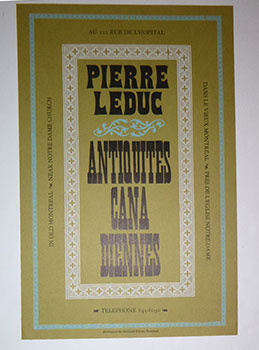
Pierre Luduc. Antiquites Canadiennes in Old Montreal. Dans le vieux Montreal. First edition of the poster.
Publicado por Montreal: Pierre Luduc, circa 1960s, 1960
Librería: Wittenborn Art Books, San Francisco, CA, Estados Unidos de America
Calificación del vendedor: 5 de 5 estrellas

Manuscrito
EUR 132,90
Envío por EUR 8,60
Se envía dentro de Estados Unidos de AmericaCantidad disponible: 1 disponibles
Añadir al carritoCondición: Good. Letterpress and silkscreen on green paper. 48.5 x 31.2 cm. Luduc was located at 222 rue de l'hopital dans le vieux Montreal .Richard Pennington established Redpath Press while he was working at McGill University in Montreal. He started the press 'partly for pleasure and partly to demonstrate the practices of hand-printing to students in the school of librarianship where he annually lectured on the history of the book and printing'.(Source: Peter Biskup 'Richard Pennington, University of Queensland's First James Forsyth Librarian, 1939-1946.' Australian Academic and Research Libraries 27.4 December 1996.)Provenance: from the estate of Raymond Gid who died Sunday November 12, 2000 in Paris. Born on November 25, 1905, Raymond Gid became first known through his posters, after having studied at les Beaux-Arts. As a film enthusiast, he designed many movie posters, for example Vampyr de Dreyer (photomontage, 1932), Le Silence de la mer by Melville (1949), Les Diaboliques by Clouzot (1955). But a meeting with Guy Levis Mano (editions GLM), editor and typographer, soon directed Gid towards the book. In 1935, he publishes, together with the photographer Pierre Jahan Devot Christ de Perpignan and Chats, Chiens by Ylla. It is an intensive period of his life period: he meets Dufy, Corbusier, Hake, Lurcat and receives the gold medal for a poster at the International exhibition of Paris (1937). He reacts to the Civil War in Spain with a poster " Help to the civil populations ". Together With Father Carre, « bete-a-bon-Dieu » of the Resistance, Raymond Gid began to design liturgical texts. Apocalypse Six (an extract of the biblical text of Saint John) appeard after the war. It is one of his major works, composed in the Peignot typeface, which was designed by Cassandre in 1937. He designs several post-war period posters, for example Week of absent, a simple Lorraine cross surrounded by barbed wire on a dark background. Right from the beginning of the symposiums in Lure (Provence) in 1954, Raymond Gid participates in discussions on typography, particularly with Maximilen Vox, Charles Peignot, Roger Excoffon. Raymond Gid puts on page and illustrates the Dialogues of the Carmelite nuns by Bernanos (1954), then some pages in Caractere Noel 1955, dedicated to his friend Jan van Krimpen, the creator of dutch type faces. He plays with the breathing of the text, in the manner of Mallarme, as in his Book of hours (1959) or his Apocalypse (1964), adapting medieval text to present day tastes. He also designs posters like those for the Club Mediterranee (1961), Bally (1976) or, heavier fare, like that of Amnesty International (1973). During his whole life, Raymond Gid remained attached to the typographical arts. He liked to try out new characters in his compositions, mixing them with his very free drawings, as for example in Messidor published by the Imprimerie nationale (1989). Jean-Francois Porchez, type designer; translated from french by Babelfish and cleaned up a bit. Links Art and Poster Bally posters Chicago Center for the Print Bally posters Poster Auctions International, New York Catalogue from the personal exhibition at the Bibliotheque Forney, Paris, in 1992.
-
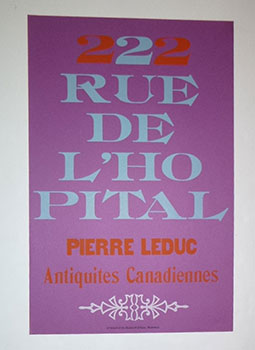
222 Rue de L'Hopital. Pierre Luduc. Antiquites Canadiennes. First edition of the poster.
Publicado por Montreal: Pierre Luduc, circa 1960s, 1960
Librería: Wittenborn Art Books, San Francisco, CA, Estados Unidos de America
Calificación del vendedor: 5 de 5 estrellas
Manuscrito
EUR 132,90
Envío por EUR 8,60
Se envía dentro de Estados Unidos de AmericaCantidad disponible: 1 disponibles
Añadir al carritoCondición: Good. Letterpress and silkscreen on mauve paper. 48.5 x 31.2 cm. Luduc was located at 222 rue de l'hopital dans le vieux Montreal .Richard Pennington established Redpath Press while he was working at McGill University in Montreal. He started the press 'partly for pleasure and partly to demonstrate the practices of hand-printing to students in the school of librarianship where he annually lectured on the history of the book and printing'.(Source: Peter Biskup 'Richard Pennington, University of Queensland's First James Forsyth Librarian, 1939-1946.' Australian Academic and Research Libraries 27.4 December 1996.)Provenance: from the estate of Raymond Gid who died Sunday November 12, 2000 in Paris. Born on November 25, 1905, Raymond Gid became first known through his posters, after having studied at les Beaux-Arts. As a film enthusiast, he designed many movie posters, for example Vampyr de Dreyer (photomontage, 1932), Le Silence de la mer by Melville (1949), Les Diaboliques by Clouzot (1955). But a meeting with Guy Levis Mano (editions GLM), editor and typographer, soon directed Gid towards the book. In 1935, he publishes, together with the photographer Pierre Jahan Devot Christ de Perpignan and Chats, Chiens by Ylla. It is an intensive period of his life period: he meets Dufy, Corbusier, Hake, Lurcat and receives the gold medal for a poster at the International exhibition of Paris (1937). He reacts to the Civil War in Spain with a poster " Help to the civil populations ". Together With Father Carre, « bete-a-bon-Dieu » of the Resistance, Raymond Gid began to design liturgical texts. Apocalypse Six (an extract of the biblical text of Saint John) appeard after the war. It is one of his major works, composed in the Peignot typeface, which was designed by Cassandre in 1937. He designs several post-war period posters, for example Week of absent, a simple Lorraine cross surrounded by barbed wire on a dark background. Right from the beginning of the symposiums in Lure (Provence) in 1954, Raymond Gid participates in discussions on typography, particularly with Maximilen Vox, Charles Peignot, Roger Excoffon. Raymond Gid puts on page and illustrates the Dialogues of the Carmelite nuns by Bernanos (1954), then some pages in Caractere Noel 1955, dedicated to his friend Jan van Krimpen, the creator of dutch type faces. He plays with the breathing of the text, in the manner of Mallarme, as in his Book of hours (1959) or his Apocalypse (1964), adapting medieval text to present day tastes. He also designs posters like those for the Club Mediterranee (1961), Bally (1976) or, heavier fare, like that of Amnesty International (1973). During his whole life, Raymond Gid remained attached to the typographical arts. He liked to try out new characters in his compositions, mixing them with his very free drawings, as for example in Messidor published by the Imprimerie nationale (1989). Jean-Francois Porchez, type designer; translated from french by Babelfish and cleaned up a bit. Links Art and Poster Bally posters Chicago Center for the Print Bally posters Poster Auctions International, New York Catalogue from the personal exhibition at the Bibliotheque Forney, Paris, in 1992.
-
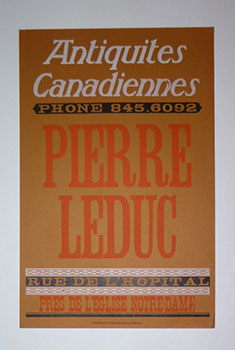
Pierre Luduc. Antiquites Canadiennes. . First edition of the poster.
Publicado por Montreal: Pierre Luduc, circa 1960s, 1960
Librería: Wittenborn Art Books, San Francisco, CA, Estados Unidos de America
Calificación del vendedor: 5 de 5 estrellas
Manuscrito
EUR 132,90
Envío por EUR 8,60
Se envía dentro de Estados Unidos de AmericaCantidad disponible: 1 disponibles
Añadir al carritoCondición: Good. Letterpress and silkscreen on pumpkin color paoer., 48.5 x 31.2 cm. Luduc was located at 222 rue de l'hopital dans le vieux Montreal .Richard Pennington established Redpath Press while he was working at McGill University in Montreal. He started the press 'partly for pleasure and partly to demonstrate the practices of hand-printing to students in the school of librarianship where he annually lectured on the history of the book and printing'.(Source: Peter Biskup 'Richard Pennington, University of Queensland's First James Forsyth Librarian, 1939-1946.' Australian Academic and Research Libraries 27.4 December 1996.)Provenance: from the estate of Raymond Gid who died Sunday November 12, 2000 in Paris. Born on November 25, 1905, Raymond Gid became first known through his posters, after having studied at les Beaux-Arts. As a film enthusiast, he designed many movie posters, for example Vampyr de Dreyer (photomontage, 1932), Le Silence de la mer by Melville (1949), Les Diaboliques by Clouzot (1955). But a meeting with Guy Levis Mano (editions GLM), editor and typographer, soon directed Gid towards the book. In 1935, he publishes, together with the photographer Pierre Jahan Devot Christ de Perpignan and Chats, Chiens by Ylla. It is an intensive period of his life period: he meets Dufy, Corbusier, Hake, Lurcat and receives the gold medal for a poster at the International exhibition of Paris (1937). He reacts to the Civil War in Spain with a poster " Help to the civil populations ". Together With Father Carre, « bete-a-bon-Dieu » of the Resistance, Raymond Gid began to design liturgical texts. Apocalypse Six (an extract of the biblical text of Saint John) appeard after the war. It is one of his major works, composed in the Peignot typeface, which was designed by Cassandre in 1937. He designs several post-war period posters, for example Week of absent, a simple Lorraine cross surrounded by barbed wire on a dark background. Right from the beginning of the symposiums in Lure (Provence) in 1954, Raymond Gid participates in discussions on typography, particularly with Maximilen Vox, Charles Peignot, Roger Excoffon. Raymond Gid puts on page and illustrates the Dialogues of the Carmelite nuns by Bernanos (1954), then some pages in Caractere Noel 1955, dedicated to his friend Jan van Krimpen, the creator of dutch type faces. He plays with the breathing of the text, in the manner of Mallarme, as in his Book of hours (1959) or his Apocalypse (1964), adapting medieval text to present day tastes. He also designs posters like those for the Club Mediterranee (1961), Bally (1976) or, heavier fare, like that of Amnesty International (1973). During his whole life, Raymond Gid remained attached to the typographical arts. He liked to try out new characters in his compositions, mixing them with his very free drawings, as for example in Messidor published by the Imprimerie nationale (1989). Jean-Francois Porchez, type designer; translated from french by Babelfish and cleaned up a bit. Links Art and Poster Bally posters Chicago Center for the Print Bally posters Poster Auctions International, New York Catalogue from the personal exhibition at the Bibliotheque Forney, Paris, in 1992.
-

Pierre Luduc., Pres de l'Eglise Notre Dame. Antiquites Canadiennes. First edition of the poster.
Publicado por Montreal: Pierre Luduc, circa 1960s, 1960
Librería: Wittenborn Art Books, San Francisco, CA, Estados Unidos de America
Calificación del vendedor: 5 de 5 estrellas
Manuscrito
EUR 132,90
Envío por EUR 8,60
Se envía dentro de Estados Unidos de AmericaCantidad disponible: 1 disponibles
Añadir al carritoCondición: Good. Letterpress and silkscreen on green-blue paper. 48.5 x 31.2 cm. Luduc was located at 222 rue de l'hopital dans le vieux Montreal .Richard Pennington established Redpath Press while he was working at McGill University in Montreal. He started the press 'partly for pleasure and partly to demonstrate the practices of hand-printing to students in the school of librarianship where he annually lectured on the history of the book and printing'.(Source: Peter Biskup 'Richard Pennington, University of Queensland's First James Forsyth Librarian, 1939-1946.' Australian Academic and Research Libraries 27.4 December 1996.)Provenance: from the estate of Raymond Gid who died Sunday November 12, 2000 in Paris. Born on November 25, 1905, Raymond Gid became first known through his posters, after having studied at les Beaux-Arts. As a film enthusiast, he designed many movie posters, for example Vampyr de Dreyer (photomontage, 1932), Le Silence de la mer by Melville (1949), Les Diaboliques by Clouzot (1955). But a meeting with Guy Levis Mano (editions GLM), editor and typographer, soon directed Gid towards the book. In 1935, he publishes, together with the photographer Pierre Jahan Devot Christ de Perpignan and Chats, Chiens by Ylla. It is an intensive period of his life period: he meets Dufy, Corbusier, Hake, Lurcat and receives the gold medal for a poster at the International exhibition of Paris (1937). He reacts to the Civil War in Spain with a poster " Help to the civil populations ". Together With Father Carre, « bete-a-bon-Dieu » of the Resistance, Raymond Gid began to design liturgical texts. Apocalypse Six (an extract of the biblical text of Saint John) appeard after the war. It is one of his major works, composed in the Peignot typeface, which was designed by Cassandre in 1937. He designs several post-war period posters, for example Week of absent, a simple Lorraine cross surrounded by barbed wire on a dark background. Right from the beginning of the symposiums in Lure (Provence) in 1954, Raymond Gid participates in discussions on typography, particularly with Maximilen Vox, Charles Peignot, Roger Excoffon. Raymond Gid puts on page and illustrates the Dialogues of the Carmelite nuns by Bernanos (1954), then some pages in Caractere Noel 1955, dedicated to his friend Jan van Krimpen, the creator of dutch type faces. He plays with the breathing of the text, in the manner of Mallarme, as in his Book of hours (1959) or his Apocalypse (1964), adapting medieval text to present day tastes. He also designs posters like those for the Club Mediterranee (1961), Bally (1976) or, heavier fare, like that of Amnesty International (1973). During his whole life, Raymond Gid remained attached to the typographical arts. He liked to try out new characters in his compositions, mixing them with his very free drawings, as for example in Messidor published by the Imprimerie nationale (1989). Jean-Francois Porchez, type designer; translated from french by Babelfish and cleaned up a bit. Links Art and Poster Bally posters Chicago Center for the Print Bally posters Poster Auctions International, New York Catalogue from the personal exhibition at the Bibliotheque Forney, Paris, in 1992.
-
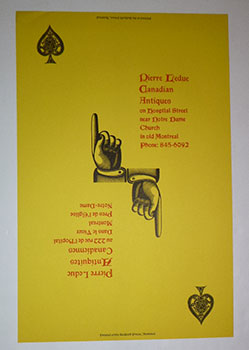
Pierre Luduc Antiquites Canadiennes au 222 rue de l'hopital. Pres de l'Eglise Notre Dame.First edition of the poster.
Publicado por Montreal: Pierre Luduc, circa 1960s, 1960
Librería: Wittenborn Art Books, San Francisco, CA, Estados Unidos de America
Calificación del vendedor: 5 de 5 estrellas
Manuscrito
EUR 132,90
Envío por EUR 8,60
Se envía dentro de Estados Unidos de AmericaCantidad disponible: 1 disponibles
Añadir al carritoCondición: Good. Letterpress and silkscreen on yellow paper. 48.5 x 31.2 cm. Luduc was located at 222 rue de l'hopital dans le vieux Montreal .Richard Pennington established Redpath Press while he was working at McGill University in Montreal. He started the press 'partly for pleasure and partly to demonstrate the practices of hand-printing to students in the school of librarianship where he annually lectured on the history of the book and printing'.(Source: Peter Biskup 'Richard Pennington, University of Queensland's First James Forsyth Librarian, 1939-1946.' Australian Academic and Research Libraries 27.4 December 1996.)Provenance: from the estate of Raymond Gid who died Sunday November 12, 2000 in Paris. Born on November 25, 1905, Raymond Gid became first known through his posters, after having studied at les Beaux-Arts. As a film enthusiast, he designed many movie posters, for example Vampyr de Dreyer (photomontage, 1932), Le Silence de la mer by Melville (1949), Les Diaboliques by Clouzot (1955). But a meeting with Guy Levis Mano (editions GLM), editor and typographer, soon directed Gid towards the book. In 1935, he publishes, together with the photographer Pierre Jahan Devot Christ de Perpignan and Chats, Chiens by Ylla. It is an intensive period of his life period: he meets Dufy, Corbusier, Hake, Lurcat and receives the gold medal for a poster at the International exhibition of Paris (1937). He reacts to the Civil War in Spain with a poster " Help to the civil populations ". Together With Father Carre, « bete-a-bon-Dieu » of the Resistance, Raymond Gid began to design liturgical texts. Apocalypse Six (an extract of the biblical text of Saint John) appeard after the war. It is one of his major works, composed in the Peignot typeface, which was designed by Cassandre in 1937. He designs several post-war period posters, for example Week of absent, a simple Lorraine cross surrounded by barbed wire on a dark background. Right from the beginning of the symposiums in Lure (Provence) in 1954, Raymond Gid participates in discussions on typography, particularly with Maximilen Vox, Charles Peignot, Roger Excoffon. Raymond Gid puts on page and illustrates the Dialogues of the Carmelite nuns by Bernanos (1954), then some pages in Caractere Noel 1955, dedicated to his friend Jan van Krimpen, the creator of dutch type faces. He plays with the breathing of the text, in the manner of Mallarme, as in his Book of hours (1959) or his Apocalypse (1964), adapting medieval text to present day tastes. He also designs posters like those for the Club Mediterranee (1961), Bally (1976) or, heavier fare, like that of Amnesty International (1973). During his whole life, Raymond Gid remained attached to the typographical arts. He liked to try out new characters in his compositions, mixing them with his very free drawings, as for example in Messidor published by the Imprimerie nationale (1989). Jean-Francois Porchez, type designer; translated from french by Babelfish and cleaned up a bit. Links Art and Poster Bally posters Chicago Center for the Print Bally posters Poster Auctions International, New York Catalogue from the personal exhibition at the Bibliotheque Forney, Paris, in 1992.
-
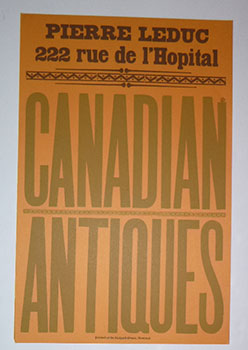
Pierre Luduc. Canadian Antiques.First edition of the poster.
Publicado por Montreal: Pierre Luduc, circa 1960s, 1960
Librería: Wittenborn Art Books, San Francisco, CA, Estados Unidos de America
Calificación del vendedor: 5 de 5 estrellas
Manuscrito
EUR 132,90
Envío por EUR 8,60
Se envía dentro de Estados Unidos de AmericaCantidad disponible: 1 disponibles
Añadir al carritoCondición: Good. Letterpress and silkscreen on orange paper. 48.5 x 31.2 cm. Luduc was located at 222 rue de l'hopital dans le vieux Montreal .Richard Pennington established Redpath Press while he was working at McGill University in Montreal. He started the press 'partly for pleasure and partly to demonstrate the practices of hand-printing to students in the school of librarianship where he annually lectured on the history of the book and printing'.(Source: Peter Biskup 'Richard Pennington, University of Queensland's First James Forsyth Librarian, 1939-1946.' Australian Academic and Research Libraries 27.4 December 1996.)Provenance: from the estate of Raymond Gid who died Sunday November 12, 2000 in Paris. Born on November 25, 1905, Raymond Gid became first known through his posters, after having studied at les Beaux-Arts. As a film enthusiast, he designed many movie posters, for example Vampyr de Dreyer (photomontage, 1932), Le Silence de la mer by Melville (1949), Les Diaboliques by Clouzot (1955). But a meeting with Guy Levis Mano (editions GLM), editor and typographer, soon directed Gid towards the book. In 1935, he publishes, together with the photographer Pierre Jahan Devot Christ de Perpignan and Chats, Chiens by Ylla. It is an intensive period of his life period: he meets Dufy, Corbusier, Hake, Lurcat and receives the gold medal for a poster at the International exhibition of Paris (1937). He reacts to the Civil War in Spain with a poster " Help to the civil populations ". Together With Father Carre, « bete-a-bon-Dieu » of the Resistance, Raymond Gid began to design liturgical texts. Apocalypse Six (an extract of the biblical text of Saint John) appeard after the war. It is one of his major works, composed in the Peignot typeface, which was designed by Cassandre in 1937. He designs several post-war period posters, for example Week of absent, a simple Lorraine cross surrounded by barbed wire on a dark background. Right from the beginning of the symposiums in Lure (Provence) in 1954, Raymond Gid participates in discussions on typography, particularly with Maximilen Vox, Charles Peignot, Roger Excoffon. Raymond Gid puts on page and illustrates the Dialogues of the Carmelite nuns by Bernanos (1954), then some pages in Caractere Noel 1955, dedicated to his friend Jan van Krimpen, the creator of dutch type faces. He plays with the breathing of the text, in the manner of Mallarme, as in his Book of hours (1959) or his Apocalypse (1964), adapting medieval text to present day tastes. He also designs posters like those for the Club Mediterranee (1961), Bally (1976) or, heavier fare, like that of Amnesty International (1973). During his whole life, Raymond Gid remained attached to the typographical arts. He liked to try out new characters in his compositions, mixing them with his very free drawings, as for example in Messidor published by the Imprimerie nationale (1989). Jean-Francois Porchez, type designer; translated from french by Babelfish and cleaned up a bit. Links Art and Poster Bally posters Chicago Center for the Print Bally posters Poster Auctions International, New York Catalogue from the personal exhibition at the Bibliotheque Forney, Paris, in 1992.
