
Importe total (1 artículo artículos):
Destino del pedido:

new revolt (4 resultados)
Ir a los resultados principales
Filtros de búsqueda
Tipo de artículo
- Todos los tipos de productos
- Libros (No hay ningún otro resultado que coincida con este filtro.)
- Revistas y publicaciones (3)
- Cómics (No hay ningún otro resultado que coincida con este filtro.)
- Partituras (No hay ningún otro resultado que coincida con este filtro.)
- Arte, grabados y pósters (No hay ningún otro resultado que coincida con este filtro.)
- Fotografías (No hay ningún otro resultado que coincida con este filtro.)
- Mapas (1)
- Manuscritos y coleccionismo de papel (No hay ningún otro resultado que coincida con este filtro.)
Condición Más información
- Nuevo (No hay ningún otro resultado que coincida con este filtro.)
- Como nuevo, Excelente o Muy bueno (No hay ningún otro resultado que coincida con este filtro.)
- Bueno o Aceptable (3)
- Regular o Pobre (No hay ningún otro resultado que coincida con este filtro.)
- Tal como se indica (1)
Encuadernación
- Todas
- Tapa dura (No hay ningún otro resultado que coincida con este filtro.)
- Tapa blanda (3)
Más atributos
- Primera edición (No hay ningún otro resultado que coincida con este filtro.)
- Firmado (No hay ningún otro resultado que coincida con este filtro.)
- Sobrecubierta (No hay ningún otro resultado que coincida con este filtro.)
- Con imágenes (4)
- No impresión bajo demanda (4)
Idioma (1)
Gastos de envío gratis
- Envío gratis a Estados Unidos de America (No hay ningún otro resultado que coincida con este filtro.)
Ubicación del vendedor
Valoración de los vendedores
-
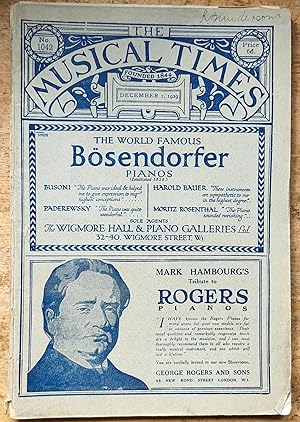
The Musical Times December 1, 1929 No. 1042 / Hubert J Foss "After-Thoughts On Delius" / Rutland Broughton "The Arts In Revolt III" / Paul Landormy "Roland Manuel" / F A Fuller-Maitland's "A Door-keeper of Music" reviewed / Dyneley Hussey "Stages In The History Of Opera: V - Gluck's Theory And Practice" / Ernest Fowles "The Associated Board Pianoforte Examinations For 1930" / Music in the Suburbs" / Music in Wales / Music in Ireland / Musical Notes from Abroad Berlin / Holland / Milan / New York and Vienna
Publicado por Novello and Company, 1929
Librería: Shore Books, London, Reino Unido
Calificación del vendedor: 5 de 5 estrellas

Revista / Publicación
EUR 5,91
Envío por EUR 12,63
Se envía de Reino Unido a Estados Unidos de AmericaCantidad disponible: 1 disponibles
Añadir al carritoSoft cover. Condición: Very Good. 96 pages. Hubert J Foss "After-Thoughts On Delius" / Rutland Broughton "The Arts In Revolt III" / Paul Landormy "Roland Manuel" / F A Fuller-Maitland's "A Door-keeper of Music" reviewed / Dyneley Hussey "Stages In The History Of Opera: V - Gluck's Theory And Practice" / Ernest Fowles "The Associated Board Pianoforte Examinations For 1930" / Music in the Suburbs" / Music in Wales / Music in Ireland / Musical Notes from Abroad Berlin / Holland / Milan / New York and Vienna (M13).
-
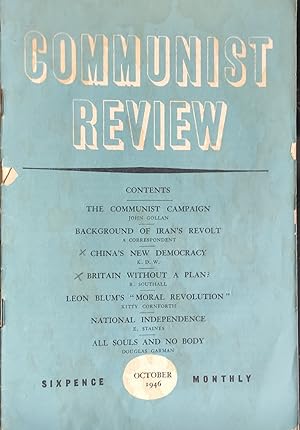
Communist Review October 1946 / John Gollan "The Communist Campaign" / "Background of Iran's Revolt" / K.D.W. "China's New Democracy" / R Southall "Britain Without A Plan?" / Kitty Cornforth "Leon Blum's 'Moral Revolution'" / E Staines "National Independence" / Douglas Garman "All Souls and No Body".
Publicado por The Communist Party / Lawrence & Wishart, 1946
Librería: Shore Books, London, Reino Unido
Calificación del vendedor: 5 de 5 estrellas
Revista / Publicación
EUR 5,91
Envío por EUR 12,63
Se envía de Reino Unido a Estados Unidos de AmericaCantidad disponible: 1 disponibles
Añadir al carritoSoft cover. Condición: Very Good. 32 pages. John Gollan "The Communist Campaign" / "Background of Iran's Revolt" / K.D.W. "China's New Democracy" / R Southall "Britain Without A Plan?" / Kitty Cornforth "Leon Blum's 'Moral Revolution'" / E Staines "National Independence" / Douglas Garman "All Souls and No Body". (SL#125/2).
-

Marxism Today July 1963 / Joan Carritt "Children in a Changing World - New Trends in Child Care" / Alan Bush "What Does Music Express?" / Idris Cox "Monopoly Sharks in India" / William Ash "Philosophical Revisionism" / Mike Down "Satire - The New Revolt?" / Alfred Corum "What is Jazz?"
Publicado por Communist Party of Great Britain, 1963
Librería: Shore Books, London, Reino Unido
Calificación del vendedor: 5 de 5 estrellas
Revista / Publicación
EUR 7,10
Envío por EUR 12,63
Se envía de Reino Unido a Estados Unidos de AmericaCantidad disponible: 1 disponibles
Añadir al carritoSoft cover. Condición: Very Good. 32 pages. Joan Carritt "Children in a Changing World - New Trends in Child Care" / Alan Bush "What Does Music Express?" / Idris Cox "Monopoly Sharks in India" / William Ash "Philosophical Revisionism" / Mike Down "Satire - The New Revolt?" / Alfred Corum "What is Jazz?" (SL#125/5).
-

Sketch accompanying Col. Price's Despatch of 15th Feb. 1847.
Año de publicación: 1847
Librería: Geographicus Rare Antique Maps, Brooklyn, NY, Estados Unidos de America
Miembro de asociación: ABAA ESA ILAB
Calificación del vendedor: 5 de 5 estrellas
Mapa
EUR 294,43
Envío por EUR 14,46
Se envía dentro de Estados Unidos de AmericaCantidad disponible: 1 disponibles
Añadir al carritoVery good. Light foxing. Light wear along original fold lines. Blank on verso. Size 8.75 x 6.5 Inches. This is an 1847 William Hemsley Emory map of the Battle of Embudo Pass, one of the battles during the Taos Revolt in and near Taos, New Mexico, which was part of the Mexican-American War. Oriented to the north, the map depicts a section of Embudo Pass, a canyon not far from Taos. Colonel Sterling Price and the force he was leading to put down the Taos Revolt needed followed the Rio Grande (Rio del Norte) after defeating the insurrectionists at the Battle of Cañada. The column needed to travel along the road from La Joya (Joya) El Embudo (Embudo), which was flanked on both sides by high, rocky terrain, giving the region the look of a canyon. The road and the insurgent's positions are noted and labeled here, along with the Rio Grande and the highlands on either side of the canyon. The Battle of Embudo Pass The battle of Embudo Pass too place on January 29, as Colonel Price and his men marched toward Taos. The road cut through a canyon between the settlements of La Joya and El Embudo, where insurgents hoped to ambush the American soldiers. Price, however, learned of the insurgent's presence before he and his men arrived in the canyon. Price sent an officer and some of his men ahead to scout the terrain, and soon their enemies were discovered and quickly retreated so quickly through the difficult terrain that they defied pursuit by the attacking Americans. Price's force soon regrouped and entered Embudo without a fight. The Taos Revolt The Taos Revolt was a January 1847 popular insurrection by Puebloan and Hispano allies against the U.S. occupation of New Mexico during the Mexican-American War. In every battle between the United States Army and militia and the Hispano and Puebloan rebels, the U.S. forces crushed the rebellion and the rebels soon abandoned open warfare. The rebellion began fermenting in August 1846, when U.S. forces under the command of Stephen Watts Kearny invaded New Mexico and captured Santa Fe without firing a shot. Kearny left for California, and left Colonel Sterling Price in command, who, in turn, appointed Charles Bent as New Mexico's first territorial governor. Many New Mexicans did not believe Governor Manuel Armijo made the right decision in surrendering to U.S. forces without a fight. They also resented how U.S. soldiers treated them, as they chose to act like conquerors. New Mexicans also feared that their land titles would not be recognized by the United States. Thus, when violence ignited on the morning of January 19, 1847, plenty of animosity was felt by the insurrectionists and their supporters. The revolt began in Don Fernando de Taos (present-day Taos, New Mexico) and was led by Pablo Montoya, a Hispano, and Tomás Romero, a Taos Puebloan. A Native American force, led by Romero, broke into Governor Bent's house and shot him with arrows and scalped him in front of his family. Bent survived the attack, and he and his family dug through the walls of their house into the house next door. When the insurrectionists discovered this, they killed Bent, but spared his wife and children. The following day, a force of approximately 500 Hispanos and Puebloans attacked Simeon Turley's mill in Arroyo Hondo, which was located a few miles outside Taos. An employee at the mill saw them coming and immediately left for Santa Fe to seek help from the occupying U.S. forces. Of the ten men left to defend the mill, only two survived by escaping under the cover of darkness on foot. That same day, seven or eight American traders were killed on their way to Missouri. Colonel Price and the U.S. forces moved quickly to crush the revolt. He led a force of 300 U.S. troops, which was accompanied by sixty-five volunteers, some of which were New Mexican. Along the way to Taos, Price and his forces hammered a force of 1,500 Hispanos and Puebloans, before successfully recapturing Taos and the Taos Pueblo. A 'drumhead court-martia.
