

Importe total (1 artículo artículos):
Destino del pedido:

michman marion aptroot (10 resultados)
Ir a los resultados principales
Filtros de búsqueda
Tipo de artículo
- Todos los tipos de productos
- Libros (10)
- Revistas y publicaciones (No hay ningún otro resultado que coincida con este filtro.)
- Cómics (No hay ningún otro resultado que coincida con este filtro.)
- Partituras (No hay ningún otro resultado que coincida con este filtro.)
- Arte, grabados y pósters (No hay ningún otro resultado que coincida con este filtro.)
- Fotografías (No hay ningún otro resultado que coincida con este filtro.)
- Mapas (No hay ningún otro resultado que coincida con este filtro.)
- Manuscritos y coleccionismo de papel (No hay ningún otro resultado que coincida con este filtro.)
Condición Más información
- Nuevo (6)
- Como nuevo, Excelente o Muy bueno (No hay ningún otro resultado que coincida con este filtro.)
- Bueno o Aceptable (No hay ningún otro resultado que coincida con este filtro.)
- Regular o Pobre (No hay ningún otro resultado que coincida con este filtro.)
- Tal como se indica (4)
Encuadernación
- Todas
- Tapa dura (9)
- Tapa blanda (No hay ningún otro resultado que coincida con este filtro.)
Más atributos
- Primera edición (3)
- Firmado (No hay ningún otro resultado que coincida con este filtro.)
- Sobrecubierta (3)
- Con imágenes (2)
- No impresión bajo demanda (10)
Idioma (2)
Precio
- Cualquier precio
- Menos de EUR 20 (No hay ningún otro resultado que coincida con este filtro.)
- EUR 20 a EUR 45
- Más de EUR 45
Gastos de envío gratis
Ubicación del vendedor
Valoración de los vendedores
-

Storm in the Community: Yiddish Polemical Pamphlets of Amsterdam Jewry, 1797-1798
Idioma: Inglés
Publicado por Cinicinnati, OH: Hebrew Union College Press, 2002
ISBN 10: 087820220X ISBN 13: 9780878202201
Librería: Riverow Bookshop, Owego, NY, Estados Unidos de America
Miembro de asociación: ABAA ILAB
Calificación del vendedor: 5 de 5 estrellas

Original o primera edición
EUR 26,50
Envío por EUR 5,57
Se envía dentro de Estados Unidos de AmericaCantidad disponible: 1 disponibles
Añadir al carritoHardcover. Condición: Very Good/Very Good. 1st Edition. Cinicinnati, OH: Hebrew Union College Press. Very Good/Very Good. 2002. 1st Edition. Hardcover. In English and Hebrew. Book is in Very Good Plus condition with a small dent at the edge of the rear cover. Contents clean and tight. Appears unread. The dust jacket is slightly worn at the extremities with an old price sticker abrasion on the rear cover. A nice solid copy of a scarce book. .
-
Storm in the Community
Idioma: Inglés
Publicado por Hebrew Union College Press, 2002
ISBN 10: 087820220X ISBN 13: 9780878202201
Librería: ISD LLC, Bristol, CT, Estados Unidos de America
Calificación del vendedor: 5 de 5 estrellas
Original o primera edición
EUR 44,13
Gastos de envío gratis
Se envía dentro de Estados Unidos de AmericaCantidad disponible: 3 disponibles
Añadir al carritohardcover. Condición: New. 1st.
-

Storm in the Community: Yiddish Polemical Pamphlets of Amsterdam Jewry 1797-1798
Idioma: Inglés
Publicado por Hebrew Union College Press, Cincinnati, 2002
Librería: Library of Religious Thought, Omaha, NE, Estados Unidos de America
Calificación del vendedor: 5 de 5 estrellas
EUR 44,17
Envío por EUR 2,57
Se envía dentro de Estados Unidos de AmericaCantidad disponible: 1 disponibles
Añadir al carritoHardcover. Condición: New. Estado de la sobrecubierta: New. 527pp. In original shrinkwrap.
-
Storm in the Community (Hardcover)
Idioma: Inglés
Publicado por Hebrew Union College Press,U.S., Detroit, MI, 2002
ISBN 10: 087820220X ISBN 13: 9780878202201
Librería: Grand Eagle Retail, Bensenville, IL, Estados Unidos de America
Calificación del vendedor: 5 de 5 estrellas
EUR 51,67
Gastos de envío gratis
Se envía dentro de Estados Unidos de AmericaCantidad disponible: 1 disponibles
Añadir al carritoHardcover. Condición: new. Hardcover. The first in a series of Yiddish polemical pamphlets (Diskursn) appeared one week before the elections to the second National Assembly in the Republic of the Netherlands on August 1, 1797. Inspired by the expanded freedom of the press and the satirical and often vulgar Spectatorial writings which were popular at the time, a small but energetic group of enlightened Jews in Amsterdam decided the previous summer to publish a periodical. These Yiddish polemical pamphlets would serve as an informative and propagandistic vehicle through which members of the new community could anonymously persuade the Jews of Amsterdam to choose the party of progress and enlightenment. The author or authors inveighed strongly against the alleged abuses in the established community and those they held responsible, the parnosim (board of directors) and their officials. In order to reach the Jewish masses in a city with about 20,000 Ashkenazic Jewish inhabitants, the reformers chose to write the Diskursn in Amsterdam Yiddish. Their efforts were so successful that the established community thought it necessary to enter the fray by publishing its own version of a thirteenth installment shortly before the thirteenth installment of the original series was due to appear. From then on, two series of Diskursn competed for public favor. Using criticism, salacious gossip, slander, and accusations, the same three or four main characters and a few secondary ones railed against the excesses and foibles of the other community. Both series ended after the parnosim of the old community were deposed in the early spring of 1798. By then, 24 Diskursn from the new community and 11 from the established community had appeared, together more than 500 printed pages. Of course we cannot judge the two communities fairly based on the texts of the Diskursn. Both sought to discredit their opponents with stories of whores, sexual scandals, illegitimate children, hypocrisy, religious violations, bankruptcy, and fraud. Nevertheless, the pamphlets describe the environment of Amsterdam Jewry and reveal what interested those Jews and how they responded to revolutionary changes. All of this is depicted by inventive authors who came up time and again with different, often humorous settings for their volleys of curses and torrents of abuse. These Yiddish polemical pamphlets are a rare phenomenon, not just in the history of Jewish communities in the period of emancipation, but in the histories of Yiddish literature and satirical/polemical periodicals as well. This is the first-ever bilingual edition of a major portion of this collection of documents and the first time any of them have been published in English translation. A lengthy introduction and five appendices help the reader understand and appreciate these colorful Dutch Jews and their often impassioned arguments. The first in a series of Yiddish polemical pamphlets appeared one week before the elections to the second National Assembly in the Republic of the Netherlands on August 1, 1797. This is the first bilingual edition of a major portion of this collection of documents and the first time any of them have been published in English translation. Shipping may be from multiple locations in the US or from the UK, depending on stock availability.
-
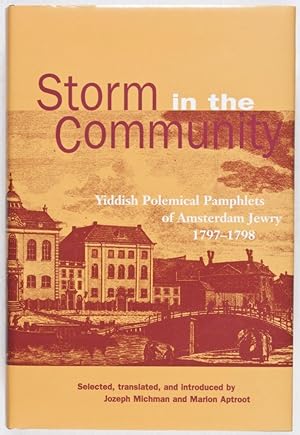
Storm in the Community: Yiddish Polemical Pamphlets of Amsterdam Jewry 1797-1798
Publicado por Hebrew Union College Press, Cincinnati, 2002
Librería: ERIC CHAIM KLINE, BOOKSELLER (ABAA ILAB), Santa Monica, CA, Estados Unidos de America
Miembro de asociación: ABAA ILAB
Calificación del vendedor: 4 de 5 estrellas

Original o primera edición
EUR 39,75
Envío por EUR 4,29
Se envía dentro de Estados Unidos de AmericaCantidad disponible: 1 disponibles
Añadir al carritoHardcover. Condición: New in publisher's shrink wrap. Estado de la sobrecubierta: new. First edition. Quarto. VII, [1], 527, [1]pp. Original pictorial wrappers over cloth with gold lettering on spine. Frontispiece. Written in Amsterdam Yiddish and full of colorful invective, these weekly dialogues in the satirical tradition of the English Spectator and similar periodicals allowed the breakaway community (the naye kille) to expose the inequalities and foibles of the establishment community (alte kille), which was heretofore supported by the government. In the wake of the reforms of the French Revolution, a Dutch Decree of Emancipation in 1796 meant that city governments could no longer intervene in internal affairs of the Jewish communities, and the newer community sought not only fuller civic rights for all Jews, but less community power and privileges for the corrupt rich men who dominated the affairs of the old community. Not content to ignore the upstarts, the old community fought back with its own weekly dialogues, using the same format and even the same characters. The resulting thirty-three eighteenth-century Diskursn, selections of which are translated and edited here for the first time, constitute a unique phenomenon in Jewish history and Jewish journalism. Wrappers, binding and interior as new in publishers shrinkwrap.
-
Storm in the Community: Yiddish Political Pamphlets of Amsterdam Jewry, 1797-1798
Idioma: Inglés
Publicado por Hebrew Union College Press, 2002
ISBN 10: 087820220X ISBN 13: 9780878202201
Librería: Kennys Bookshop and Art Galleries Ltd., Galway, GY, Irlanda
Calificación del vendedor: 5 de 5 estrellas
EUR 60,80
Envío por EUR 10,50
Se envía de Irlanda a Estados Unidos de AmericaCantidad disponible: 2 disponibles
Añadir al carritoCondición: New. This text presents satirical dialogues written in Amsterdam Yiddish between members of the established and the breakaway Jewish communities in 18th-century Amsterdam. These dialogues allowed the breakaway community to expose the inequalities and foibles of the establishment community. Editor(s): Michman, Jozeph; Aptroot, Marion. Num Pages: 325 pages. BIC Classification: 1DDN; 2ACY; 3JH; DNF; JFSR1. Category: (P) Professional & Vocational; (UP) Postgraduate, Research & Scholarly; (UU) Undergraduate. Dimension: 229 x 152 x 46. . . 2002. Bilingual. Hardcover. . . . .
-
Storm in the Community: Yiddish Political Pamphlets of Amsterdam Jewry, 1797-1798
Idioma: Inglés
Publicado por Hebrew Union College Press, 2002
ISBN 10: 087820220X ISBN 13: 9780878202201
Librería: Kennys Bookstore, Olney, MD, Estados Unidos de America
Calificación del vendedor: 5 de 5 estrellas
EUR 73,46
Envío por EUR 9,01
Se envía dentro de Estados Unidos de AmericaCantidad disponible: 2 disponibles
Añadir al carritoCondición: New. This text presents satirical dialogues written in Amsterdam Yiddish between members of the established and the breakaway Jewish communities in 18th-century Amsterdam. These dialogues allowed the breakaway community to expose the inequalities and foibles of the establishment community. Editor(s): Michman, Jozeph; Aptroot, Marion. Num Pages: 325 pages. BIC Classification: 1DDN; 2ACY; 3JH; DNF; JFSR1. Category: (P) Professional & Vocational; (UP) Postgraduate, Research & Scholarly; (UU) Undergraduate. Dimension: 229 x 152 x 46. . . 2002. Bilingual. Hardcover. . . . . Books ship from the US and Ireland.
-
Storm in the Community. Yiddish polemical pamphlets of Amsterdam Jewry 1797-1798. Selected, translated and introduced by Jozeph Michman and Marion Aptroot. ISBN 9780878202201
Idioma: Inglés
Publicado por Wayne State University, 2002
ISBN 10: 087820220X ISBN 13: 9780878202201
Librería: Antiquariaat Spinoza, Amsterdam, Holanda
Miembro de asociación: ILAB NVVA
Calificación del vendedor: 5 de 5 estrellas
EUR 72,60
Envío por EUR 16,00
Se envía de Holanda a Estados Unidos de AmericaCantidad disponible: 1 disponibles
Añadir al carritoCincinnati, Hebrew Union College Press, 2002. 527 pp. New. Orig. cloth with dustjacket. Yiddish text and English translation on facing pages.
-
Storm in the Community (Hardcover)
Idioma: Inglés
Publicado por Hebrew Union College Press,U.S., Detroit, MI, 2002
ISBN 10: 087820220X ISBN 13: 9780878202201
Librería: AussieBookSeller, Truganina, VIC, Australia
Calificación del vendedor: 5 de 5 estrellas
EUR 94,29
Envío por EUR 31,73
Se envía de Australia a Estados Unidos de AmericaCantidad disponible: 1 disponibles
Añadir al carritoHardcover. Condición: new. Hardcover. The first in a series of Yiddish polemical pamphlets (Diskursn) appeared one week before the elections to the second National Assembly in the Republic of the Netherlands on August 1, 1797. Inspired by the expanded freedom of the press and the satirical and often vulgar Spectatorial writings which were popular at the time, a small but energetic group of enlightened Jews in Amsterdam decided the previous summer to publish a periodical. These Yiddish polemical pamphlets would serve as an informative and propagandistic vehicle through which members of the new community could anonymously persuade the Jews of Amsterdam to choose the party of progress and enlightenment. The author or authors inveighed strongly against the alleged abuses in the established community and those they held responsible, the parnosim (board of directors) and their officials. In order to reach the Jewish masses in a city with about 20,000 Ashkenazic Jewish inhabitants, the reformers chose to write the Diskursn in Amsterdam Yiddish. Their efforts were so successful that the established community thought it necessary to enter the fray by publishing its own version of a thirteenth installment shortly before the thirteenth installment of the original series was due to appear. From then on, two series of Diskursn competed for public favor. Using criticism, salacious gossip, slander, and accusations, the same three or four main characters and a few secondary ones railed against the excesses and foibles of the other community. Both series ended after the parnosim of the old community were deposed in the early spring of 1798. By then, 24 Diskursn from the new community and 11 from the established community had appeared, together more than 500 printed pages. Of course we cannot judge the two communities fairly based on the texts of the Diskursn. Both sought to discredit their opponents with stories of whores, sexual scandals, illegitimate children, hypocrisy, religious violations, bankruptcy, and fraud. Nevertheless, the pamphlets describe the environment of Amsterdam Jewry and reveal what interested those Jews and how they responded to revolutionary changes. All of this is depicted by inventive authors who came up time and again with different, often humorous settings for their volleys of curses and torrents of abuse. These Yiddish polemical pamphlets are a rare phenomenon, not just in the history of Jewish communities in the period of emancipation, but in the histories of Yiddish literature and satirical/polemical periodicals as well. This is the first-ever bilingual edition of a major portion of this collection of documents and the first time any of them have been published in English translation. A lengthy introduction and five appendices help the reader understand and appreciate these colorful Dutch Jews and their often impassioned arguments. The first in a series of Yiddish polemical pamphlets appeared one week before the elections to the second National Assembly in the Republic of the Netherlands on August 1, 1797. This is the first bilingual edition of a major portion of this collection of documents and the first time any of them have been published in English translation. Shipping may be from our Sydney, NSW warehouse or from our UK or US warehouse, depending on stock availability.
-

Storm in the community. Yiddish polemical pamphlets of Amsterdam Jewry 1797-1798. Selected, translated and introduced.
Librería: Antiquariaat Rashi, Gorinchem, Holanda
Miembro de asociación: ILAB NVVA
Calificación del vendedor: 5 de 5 estrellas
EUR 45,00
Envío por EUR 25,00
Se envía de Holanda a Estados Unidos de AmericaCantidad disponible: 1 disponibles
Añadir al carritoCincinnati, Hebrew Union College Press, 2002. Or.cloth with dustjacket. VII, 527 pp. and 2 plates. Yiddish texts (in Hebrew characters) with parallel English translation. In good condition.


