

Importe total (1 artículo artículos):
Destino del pedido:

manuscript letter (9 resultados)
Ir a los resultados principales
Filtros de búsqueda
Tipo de artículo
- Todos los tipos de productos
- Libros (6)
- Revistas y publicaciones (No hay ningún otro resultado que coincida con este filtro.)
- Cómics (No hay ningún otro resultado que coincida con este filtro.)
- Partituras (No hay ningún otro resultado que coincida con este filtro.)
- Arte, grabados y pósters (No hay ningún otro resultado que coincida con este filtro.)
- Fotografías (No hay ningún otro resultado que coincida con este filtro.)
- Mapas (No hay ningún otro resultado que coincida con este filtro.)
- Manuscritos y coleccionismo de papel (3)
Condición Más información
- Nuevo (No hay ningún otro resultado que coincida con este filtro.)
- Como nuevo, Excelente o Muy bueno (2)
- Bueno o Aceptable (3)
- Regular o Pobre (1)
- Tal como se indica (3)
Encuadernación
Más atributos
- Primera edición (No hay ningún otro resultado que coincida con este filtro.)
- Firmado (No hay ningún otro resultado que coincida con este filtro.)
- Sobrecubierta (No hay ningún otro resultado que coincida con este filtro.)
- Con imágenes (5)
- No impresión bajo demanda (9)
Idioma (2)
Gastos de envío gratis
- Envío gratis a Estados Unidos de America (No hay ningún otro resultado que coincida con este filtro.)
Ubicación del vendedor
Valoración de los vendedores
-

Letter on San Francisco Overland Limited Headed Notepaper
Idioma: Inglés
Publicado por Chicago
Librería: Dublin Bookbrowsers, Dublin, NONE, Irlanda
Calificación del vendedor: 2 de 5 estrellas

EUR 19,46
Envío por EUR 10,40
Se envía de Irlanda a Estados Unidos de AmericaCantidad disponible: 1 disponibles
Añadir al carritoSoft cover. Condición: Good. Letter reads: "Chicago Monday Morning Dear Miss Madden - Shall arive Penn R.R.via Richmond, at 6.55 p.m. Cincinatti t-morrow, Tuesday, evening. Maybe some kind one will meet & direct me. Seamus MacManus." Seumas MacManus (31 December 1867 - 23 October 1960) was an Irish author, dramatist, and poet known for his ability to reinterpret Irish folktales for modern audiences. Born James McManus on 31 December 1867 in Mountcharles, County Donegal, he was the son of Patrick McManus, a merchant, and Mary Molloy. He became a teacher, and in the 1890s began contributing articles and stories to newspapers in the US. On 22 August 1901 he married the Antrim poet, balladeer and publisher Ethna Carbery, daughter of a Fenian and one of the founders of feminist nationalist organisation Inghinidhe na hÉireann, and they moved in together in Revlin House in Donegal. Carbery died the following year of gastritis, aged 37. MacManus published her hugely successful work for many years after her death. On 9 March 1911 in Manhattan, New York, he married Catalina Violante Paez (died 1962), the granddaughter of a former Venezuelan president, General José Antonio Páez- The couple had two daughters: Mariquita Paez MacManus (1912-2011) and Patricia MacManus (1914-2005). MacManus died on 23 October 1960 after falling from the seventh-floor window of the Mary Manning Walsh nursing home in New York City.He was 92.
-

ORIGINAL MANUSCRIPT LETTER FROM P or I (initial is hard to read) RICHARDS ADDRESSED TO CAPT WILLIAM RICHARDS IN PHILADELPHIA
Librería: Xerxes Fine and Rare Books and Documents, Glen Head, NY, Estados Unidos de America
Calificación del vendedor: 5 de 5 estrellas

EUR 39,75
Envío por EUR 5,10
Se envía dentro de Estados Unidos de AmericaCantidad disponible: 1 disponibles
Añadir al carritoCondición: Good. Richard is writing to My Dear Wife. Letter is dated Thursday May 14th - letter looks late 18th century from paper and style. Richard is aboard ship somewhere. It is a sweet love letter and ends with: my love to my dear children, etc. Easily legible. One 4to page in bold brown ink, folded to 3-1/2 x 4. Good, cracking along some folds.
-
ORIGINAL MANUSCRIPT LETTER FROM JONATHAN THAYER TO JOSEPH INGRAHAM, ESQ. OF EAST THOMASTON DATED 1828
Año de publicación: 1828
Librería: Xerxes Fine and Rare Books and Documents, Glen Head, NY, Estados Unidos de America
Calificación del vendedor: 5 de 5 estrellas
EUR 39,75
Envío por EUR 5,10
Se envía dentro de Estados Unidos de AmericaCantidad disponible: 1 disponibles
Añadir al carritoCondición: Fair. Thayer is writing from Portland, Maine, June 21, 1828. Letter is one 4to page, in ink, folded to 5x 3 inches with wax residue from original postal seal. Letter offers his, Thayer's, legal services, after congratulating Ingraham at his appointment to the position of Justice of the Peace. Fair, legible but some tearing along fold lines.
-
SENT FROM MOUND CITY, LINN COUNTY, KANSAS TERRITORY AUGUST 23, 1859
Idioma: Inglés
Publicado por Kansas Territory, 1859
Librería: Noushin Books & Company, Hamden, CT, Estados Unidos de America
Calificación del vendedor: 5 de 5 estrellas
Manuscrito
EUR 375,39
Envío por EUR 5,96
Se envía dentro de Estados Unidos de AmericaCantidad disponible: 1 disponibles
Añadir al carritoNo Binding. Condición: Very Good. A remarkable letter sent from Mound City, Kansas Territory to Manteno, Kankakee Co. Illinois. The recipient, was Ralston Brainard Palmer (1819-1913), a businessman originally from East Haddam, Conn. His uncle, Robert Ralston Fox (d.1872) owned Fishers Island, NY. The Author was apparently an old friend who shared many mutual friends (including "our old girls") with Palmer. He apologizes for the cut sheet of paper, saying: "Excuse this sheet it is the last I had". 8 x 6 ¼ inches. 4-page letter, final page blank, missing lower third as mentioned above. Creased at folds. Letter with original envelope and 3 cent stamp cancelled in ink. Very good. "Friend Palmer ?As you will perceive I am in Bloody Kansas. Upon the very spot where they fought bled and died for their country in 56 - and at this present time we are expecting trouble from the Missourians. They have lately come over into the territory and kidnaped one of our citizens and taken him about 50 miles into the state and have him confined in a dungeon and I tell you it raising quite an excitement - The citizens of Linn Co. held a meeting yesterday its object to take some steps toward liberating him and resolutions were drawn up and adopted to apply to the governor for aid in quelling the lawless bands of Missourians [if not] the citizens are going to take it into their own hands and are going to march with Montgomery at their head with 3 or 4 hundred men into Missouri and liberate the prisoner and steal all the Niggers they can get? there are a set of d?mn rascals in Kansas as well as Missouri that cares for nothing or nobody, that one termed here Jay Hawkers [i.e. Jayhawkers]. and also claim to be free state men are not a bit better than Border Ruffians? I am one of the returned Pike Peakers - I have seen a great portion of Kansas territory and think it a fine country. I am practicing my profession and am riding every day? The county is sitting up very fast? Moste Respectfully your friend JD Mann?".
-
Manuscript Letter written from Tucumcari, New Mexico, October 25, 1928
Librería: BOOKPRESS LTD., Williamsburg, VA, Estados Unidos de America
Miembro de asociación: ABAA ESA ILAB
Calificación del vendedor: 1 de 5 estrellas

EUR 48,58
Envío por EUR 9,43
Se envía dentro de Estados Unidos de AmericaCantidad disponible: 1 disponibles
Añadir al carrito -
Grundsatz Zu Erhaltung einer graden Linie bey denen in Front Marche vormarschirenden Officirs.
Publicado por Prague 1782-83, 1783
Librería: Hünersdorff Rare Books ABA ILAB, London, Reino Unido
Miembro de asociación: ABA ILAB
Calificación del vendedor: 3 de 5 estrellas

Manuscrito
EUR 2.971,20
Envío por EUR 25,96
Se envía de Reino Unido a Estados Unidos de AmericaCantidad disponible: 1 disponibles
Añadir al carritoHardcover. Condición: Fine. No Jacket. Siskowitz (Siskovics) [Josef (József) von] Count. (1719-1783) Grundsatz Zu Erhaltung einer graden Linie bey denen in Front Marche vormarschirenden Officirs. Prague 1782 83. Calligraphic manuscript in brown ink on Dutch watermarked paper. Folio (320 x 204mm). [84] pages = [13 + 3 blank + 51 + 1 blank + 10 + 2 blank + 12]. Introductory 4- page letter in French in roman letters signed by the author at the end; main text in German penned in a neat gothic hand arranged in half-page columns; with tactical sketches in two of the ample blank margins. also some notes. Leaves with vertical folding marks in centre- page; contents inscription on recto of front blank leaf in a contemporary gothic hand: Grundsätze Ueber die Richtung mit mehreren Batallions von dem F[eld]z[eug]m[ei]ster Grafen von Siskowitz 1782. Contemporary sprinkled brown boards; gilt morocco title label in top of backstrip; ends of spine worn; contemporary armorial bookplate pasted inside frontcover. An unpublished Austrian 18th century treatise on linear tactics and function. The present manuscript interprets the principle of officers and non-commissioned officers having to maintain a straight line consisting of several ranks when advancing in battalion strength. (The Prussians mostly used the oblique order in most of their battles). This was based on the author s experiences during the Seven Years War (1756-63), when Prussian infantry advanced in three lines of battalions with three ranks apiece. Movement in the formation was very slow and a breakdown in cohesion likely unless the battalion was well trained. Described in detail are the various manoeuvers involved for directing marching columns, keeping proper distance, and wheeling at the right moment; two illustrations (one half-page) and 15 commentaries are contained in the ample blank margins. Siskowitz, an Hungarian staff officer from Szeged, made a rapid career in the Imperial Austrian army reaching the rank of lieutenant.general . He distinguished himself at the battle of Kolin in 1757, where he successfully carried out an order by Fieldmarshal von Daun to ambush a Prussian column with a force of 7000 men for which he was decorated and ennobled. The author died in Prague on 18th December 1783. The present manuscript was submitted to the attention of an unnamed military superior by way of an introductory letter in French on the subject. The 4-page extract , dated 12th February 1783, signed C[om]te.Siskovics , has been bound to precede the manuscript in this volume. The letter refers to an imperial order by Joseph II to align flags and marching columns of several battalions before advancing on the enemy; Siskowitz states that he considers it necessary to prescribe his method saying that he has no difficulty whatsoever to submit it to the recipient as an old friend if he wishes to make use of it. However, he stresses that his system should be carefully studied before it is put it into practice. Siskovitz insists the relevant maneuvers be carried out by officers and non-commissioned officers, never by other ranks, that they must be properly exercised before applied, and that it was not sufficient to rely on reading his instructions. He states that he demonstrated his method in 1782 with 13 batallions taking 2000 steps in 8 seconds. Both letter and manuscript are written on the same quality Dutch laid paper showing two different watermarks respectively : a larger with the legend PRO PATRIA surrounding a circular composition and a smaller one wih the the crowned initials GR of the paper maker within a round border of intertwined leaves. The Pro Patria or Maid of Dort watermark shows a seated maid, holding a hat on the point of a spear, and a rampant lion brandishing a sword and holding a bundle of arrows; both are surrounded by a palisade, a symbol of Holland maintaining liberty by force of arms. Reference: Churchill, W.A. Watermarks in Paper in Holland, England, France etc. in XVII and.
-
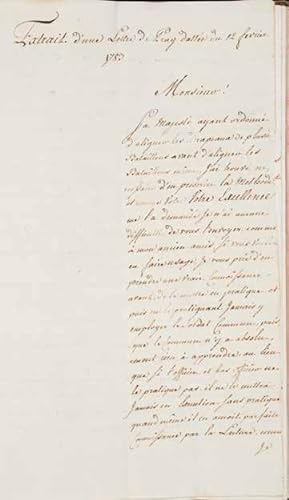
[Contemporary copy of a letter dated 3 January 1699 from Mattheus Schenkenberg to his uncle Harmen van Soelen].
Publicado por [Jaffanapatnam, Ceylon,, 1699
Librería: Antiquariaat FORUM BV, Houten, Holanda
Miembro de asociación: ILAB NVVA
Calificación del vendedor: 5 de 5 estrellas
EUR 1.950,00
Envío por EUR 25,00
Se envía de Holanda a Estados Unidos de AmericaCantidad disponible: 1 disponibles
Añadir al carritoContemporary copy (Copia), perhaps by Schenkenberg himself, or by his secretary, including the address on the first leaf: 'Rotterdam./ Aenden Edelen Heer./ Harmen van Zoelen/ oud burgermeester der stadt,/ en Bewinthebber vande Oostindische/ Comp. ter Camer Aldaar'.Very interesting letter by the Director (commandeur) of the fort and Dutch East India Company (VOC) station Jaffanapatnam on the northern-most coast of Ceylon (now: Sri Lanka) facing the Coromandel coast of India. The fort was captured from the Portuguese by Rycklof van Goens in the 1630s and was an important stronghold for the VOC presence on Ceylon during the late 17th and 18th centuries. The letter offers clear insight in the VOC policy regarding appointments, nominations and commissions, as well as for the required qualifications and salaries for the various functions. The letter also shows how important family ties, recommendations and even favouritism and nepotism were in these matters.Matthaeus Schenkenberg was born in Batavia in 1667 as son of Hendrik Schenkenberg and Henrietta Chasteleyn. He writes that after having been chief-merchant (opperkoopman) for eight years, he had been appointed (by the high command at Batavia (the hooge regeering)) director (commandeur) of the fort Jaffanapatnam (Jaffna) in June 1698 as the successor of Hendrik Swaardecroon, with a monthly salary of 120 guilders for five years. Hardly a year after this appointment he is already dissatisfied - one of his predecessors, Floris Blom who was director from 1669-1693 earned 150 guilders - and he is seeking for a following step in his career. That's why he is writing this letter to his uncle Harmen van Zoelen (or Soelen; ca. 1635-1702) hoping to be helped into a better job: a good move because Van Zoelen was one of the directors of the VOC chamber in Rotterdam and burgomaster of that city.Which is why he asks his uncle to put in a good word for him in order to obtain an appointment as, for instance, Governor of places like Macassar (Celebes), Ambon or Banda (island between Sumatra and Malacca). Indeed, Mattheus Schenkenberg was appointed Governor of Banda where he ultimately died on 14 June 1709 (his tomb is still in existence).With faint folding lines and some pencil annotations on the first and last pages, small wormholes in the left (inner) margins of the leaves, very slightly affecting the text (but not its legibility), the edges are very slightly frayed and the last page is slightly browned. Overall in very good condition.l Bons, Kinderen van de Verenigde Oost-Indische Compagnie (Master scriptie Univ. Leiden 2015), esp. pp. 82-83; Van den Belt, Het VOC bedrijf op Ceylon in de 18e eeuw (Zutphen, 2008); Valentijn, V (1726), p. 564. Folded and kept together by an orange, white and blue piece of string in the left margin (1.5 cm from the edge of the leaves, in the middle). The Dutch letter is written in a neat late 17th-century cursive hand in brown ink. Pages: [5], [3 blank] pp.
-

Manuscript letter in Spanish.
Publicado por Tandil Argentina, 1958
Librería: Chaco 4ever Books, Montevideo, MO, Uruguay
Calificación del vendedor: 5 de 5 estrellas
Manuscrito
EUR 883,27
Envío por EUR 27,01
Se envía de Uruguay a Estados Unidos de AmericaCantidad disponible: 1 disponibles
Añadir al carritoSin Encuadernar. Condición: Muy bien. 16,5 cm (2.0 in) x 22.3 cm (1.2 in) . A very fine manuscript letter with his original envelope with postage stamp and date on December the 28th of 1958 from Witold Gombrowicz to Alicia de Giangrande in which he tells that Kot Jelenski talked with Julian Gorkin, director of Cuadernos, about Ferdydurke and that he wanted to publish an article about this work written by an Argentine writer (Gombrowicz thinks in Emilio Soto, H. Rodriguez Tomeu, Cesar Fernandez Moreno and Sabato). He also mentions an article written by Francois Bondy in the newspapers Neue Zurcher Zeitung, Der Monat and .Partisan Review; and another by Bloch Michel in the Gazette de Laussane. Finally he writes about his life in Tandil and asks about his friend's family. Very good condition.
-
COLLECTION OF 32 LETTERS, 11 POSTCARDS, 6 ORIGINAL PHOTOGRAPHS OF TORDAY FAMILY OF BUDAPEST, HUNGARY AND WANTAGH, NEW YORK (mid 20thc)
Año de publicación: 1943
Librería: Xerxes Fine and Rare Books and Documents, Glen Head, NY, Estados Unidos de America
Calificación del vendedor: 5 de 5 estrellas
EUR 220,82
Envío por EUR 5,10
Se envía dentro de Estados Unidos de AmericaCantidad disponible: 1 disponibles
Añadir al carritoOriginal ephemera. All items are written in Hungarian except one letter and a few postcards in English. All but three letters are written from addresses in Hungary (almost all Budapest, a few from Komarom. Mid 20th century. One letter is from Stockholm) to residents of Budapest from 1943 to 1945 . Most in original envelopes but almost all stamps removed. One 1960 letter is from Vera Rohonyi, daughter of Dr. Oscar Rohonyi, who has apparently immigrated to California (her letter is written in Hungarian with 3 original photographs of her family enclosed with the letter.) One other later letter is also dated 1960 and is a typed signed letter to Maria Torday detailing her inheritance from her grandmother Josefa Taussig . Majority of letters are addressed to Maria Adler in Budapest and many are from Dr. Barta Gyorgy but also from other people as Dr. Klein Laszlo, Dr. Halberg Gyula and others. Other letters are addressed to Bonta Sandorne or to Nini. The 11 postcards are addressed to Stephen Torday of Wantagh, New York, and are dated 1959-1962. Three additional original photographs are included, clearly taken in Hungary but not identified, one shows 3 young women doing very heavy labor, second a a group of young women eating outdoors and third, the inside of a nice restaurant. Probably ther is some interesting information about life in war torn Budapest at end of WW2 if one can read Hungarian. Collection:



![Imagen del vendedor de [Contemporary copy of a letter dated 3 January 1699 from Mattheus Schenkenberg to his uncle Harmen van Soelen]. a la venta por Antiquariaat FORUM BV](https://pictures.abebooks.com/inventory/md/md31470479331.jpg)