

Importe total (1 artículo artículos):
Destino del pedido:

john vanderlyn after (3 resultados)
Ir a los resultados principales
Filtros de búsqueda
Tipo de artículo
- Todos los tipos de productos
- Libros (No hay ningún otro resultado que coincida con este filtro.)
- Revistas y publicaciones (No hay ningún otro resultado que coincida con este filtro.)
- Cómics (No hay ningún otro resultado que coincida con este filtro.)
- Partituras (No hay ningún otro resultado que coincida con este filtro.)
- Arte, grabados y pósters (3)
- Fotografías (No hay ningún otro resultado que coincida con este filtro.)
- Mapas (No hay ningún otro resultado que coincida con este filtro.)
- Manuscritos y coleccionismo de papel (No hay ningún otro resultado que coincida con este filtro.)
Condición Más información
- Nuevo (No hay ningún otro resultado que coincida con este filtro.)
- Como nuevo, Excelente o Muy bueno (No hay ningún otro resultado que coincida con este filtro.)
- Bueno o Aceptable (2)
- Regular o Pobre (No hay ningún otro resultado que coincida con este filtro.)
- Tal como se indica (1)
Encuadernación
- Todas
- Tapa dura (No hay ningún otro resultado que coincida con este filtro.)
- Tapa blanda (1)
Más atributos
- Primera edición (No hay ningún otro resultado que coincida con este filtro.)
- Firmado (1)
- Sobrecubierta (No hay ningún otro resultado que coincida con este filtro.)
- Con imágenes (3)
- No impresión bajo demanda (3)
Idioma (1)
Precio
- Cualquier precio
- Menos de EUR 20 (No hay ningún otro resultado que coincida con este filtro.)
- EUR 20 a EUR 45 (No hay ningún otro resultado que coincida con este filtro.)
- Más de EUR 45
Gastos de envío gratis
- Envío gratis a Estados Unidos de America (No hay ningún otro resultado que coincida con este filtro.)
Ubicación del vendedor
Valoración de los vendedores
-

Portrait of Robert R. Livingston. (1746-1813, Member of the Editorial Committee of The American Declaration of Independence).
Publicado por [Philadelphia, Pa.: Herring's - The National Portrait Gallery of Distinguished Americans, circa 1834]., 1834
Librería: Wittenborn Art Books, San Francisco, CA, Estados Unidos de America
Calificación del vendedor: 4 de 5 estrellas

Arte / Grabado / Póster
EUR 67,61
Envío por EUR 8,75
Se envía dentro de Estados Unidos de AmericaCantidad disponible: 1 disponibles
Añadir al carritoCondición: Good. Stipple and steel engraving. 28 x 19 cm (sheet). With the blindstamp of Teachers College, Bryson Library, New York, in upper right sheet corner. With facsimile signature. Very Good, sheet lightly toned.
-

Portrait of William Richardson Davie. (1756-1820, American Statesman).
Publicado por [Philadelphia, Pa.: Herring's - The National Portrait Gallery of Distinguished Americans, circa 1834]., 1834
Librería: Wittenborn Art Books, San Francisco, CA, Estados Unidos de America
Calificación del vendedor: 5 de 5 estrellas

Arte / Grabado / Póster
EUR 67,61
Envío por EUR 8,75
Se envía dentro de Estados Unidos de AmericaCantidad disponible: 1 disponibles
Añadir al carritoCondición: Good. Stipple and steel engraving. 28 x 19 cm (sheet). With the blindstamp of Teachers College, Bryson Library, New York, in upper right sheet corner. With facsimile signature. Very Good, sheet lightly toned.
-
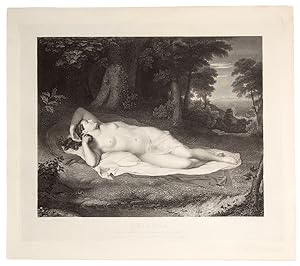
Ariadne
Publicado por New York, London and Paris, 1835
Librería: Donald A. Heald Rare Books (ABAA), New York, NY, Estados Unidos de America
Miembro de asociación: ABAA ILAB
Calificación del vendedor: 5 de 5 estrellas
Arte / Grabado / Póster Ejemplar firmado
EUR 2.028,17
Envío por EUR 21,88
Se envía dentro de Estados Unidos de AmericaCantidad disponible: 1 disponibles
Añadir al carritoEngraving, open letter mounted India paper proof, pencil signed by Durand at the lower right on the mount. Plate size: 17 1/8 x 20 5/8 inches. Sheet size: 20 x 22 1/2 inches. India paper proof of Durand's most acclaimed and most controversial work. Asher Durand was hailed as "the most famous engraver in America" and "the father of American landscape painting". His bold clean style was an immediate success, and he consequently produced some of the most important engravings in American print history. "The most noted achievements of Mr. Durand's burin are his two plates of the nude -- Musidora, after his own design, published in 1825, and the Ariadne, after Vanderlyn's masterpiece, published a decade later -- in both of which the rendering of the flesh is particularly successful. There was not only a boldness in essaying such works at that time . but there was a nobility of purpose, that carried the artist successfully through to their completion, that must win our admiration" (The Grolier Club). "Ariadne was a Cretan princess briefly loved by Theseus. He abandoned her, however, on the island of Naxos, and she is shown here in her desolation. Durand modified Vanderlyns crisp Neoclassicism, infusing it with a romantic softness and compensating for prudish American tastes by rendering the drapery opaque" (The Metropolitan Museum of Art, 97.29.2). The work was praised by the New York Spectator (October 15, 1835) as "decidedly, the finest example of line engraving ever produced in this country." But while critically acclaimed, the work was a commercial failure as the art buying public did not accept the nude figure as appropriate art. According to his son in his biography of his father, Durand engraved Ariadne purely as a labor of love. The Grolier Club, Catalogue of the Engraved Work of Asher B. Durand (New York: 1895), 237 State viii/viii; Stauffer 682, state iii/iii; Asher B. Durand: An Engraver's and a Farmer's Art (Hudson River Museum: 1983) 65.

