

Importe total (1 artículo artículos):
Destino del pedido:

hambden (4 resultados)
Ir a los resultados principales
Filtros de búsqueda
Tipo de artículo
- Todos los tipos de productos
- Libros (4)
- Revistas y publicaciones (No hay ningún otro resultado que coincida con este filtro.)
- Cómics (No hay ningún otro resultado que coincida con este filtro.)
- Partituras (No hay ningún otro resultado que coincida con este filtro.)
- Arte, grabados y pósters (No hay ningún otro resultado que coincida con este filtro.)
- Fotografías (No hay ningún otro resultado que coincida con este filtro.)
- Mapas (No hay ningún otro resultado que coincida con este filtro.)
- Manuscritos y coleccionismo de papel (No hay ningún otro resultado que coincida con este filtro.)
Condición Más información
- Nuevo (No hay ningún otro resultado que coincida con este filtro.)
- Como nuevo, Excelente o Muy bueno (No hay ningún otro resultado que coincida con este filtro.)
- Bueno o Aceptable (2)
- Regular o Pobre (No hay ningún otro resultado que coincida con este filtro.)
- Tal como se indica (2)
Encuadernación
- Todas
- Tapa dura (No hay ningún otro resultado que coincida con este filtro.)
- Tapa blanda (1)
Más atributos
- Primera edición (2)
- Firmado (No hay ningún otro resultado que coincida con este filtro.)
- Sobrecubierta (No hay ningún otro resultado que coincida con este filtro.)
- Con imágenes (1)
- No impresión bajo demanda (4)
Idioma (2)
Precio
- Cualquier precio
- Menos de EUR 20 (No hay ningún otro resultado que coincida con este filtro.)
- EUR 20 a EUR 45
- Más de EUR 45
Gastos de envío gratis
- Envío gratis a Estados Unidos de America (No hay ningún otro resultado que coincida con este filtro.)
Ubicación del vendedor
Valoración de los vendedores
-

STRICTURES OF MR. LEE'S EXPOSITION OF EVIDENCE ON THE SUGAR DUTY: IN BEHALF OF THE COMMITTEE APPOINTED BY THE FREE-TRADE CONVENTION.
Publicado por Np, circa 1832., 1832
Librería: Steve Finer - Rare Books, Greenfield, MA, Estados Unidos de America
Miembro de asociación: SNEAB
Calificación del vendedor: 3 de 5 estrellas

Original o primera edición
EUR 31,03
Envío por EUR 10,29
Se envía dentro de Estados Unidos de AmericaCantidad disponible: 1 disponibles
Añadir al carritoSoft cover. Condición: Good. No Jacket. 1st Edition. 8vo, 18pp. Disbound. Lightly foxed. Pertaining to the effect of the existing tariff of the sugar duty on the South, this text first having appeared in the National Intelligencer during February and March, 1832. The pseudonym "Hambden" appears in print at the end. A Good+ copy.
-
Hambden , John - Parliamentarian - an Original Antique Portrait
Idioma: Inglés
Año de publicación: 1797
Librería: K Books Ltd ABA ILAB, York, YORKS, Reino Unido
Miembro de asociación: ABA ILAB PBFA
Calificación del vendedor: 5 de 5 estrellas

EUR 29,77
Envío por EUR 22,54
Se envía de Reino Unido a Estados Unidos de AmericaCantidad disponible: 1 disponibles
Añadir al carritoNo Binding. Condición: Very Good. A splendid antique engraved portrait. Mounted/matted and ready to frame. Attractive and decorative.
-
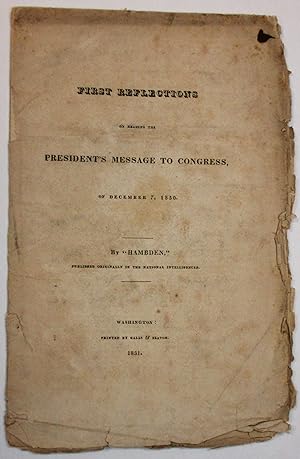
FIRST REFLECTIONS ON READING THE PRESIDENT'S MESSAGE TO CONGRESS, OF DECEMBER 7, 1830. PUBLISHED ORIGINALLY IN THE NATIONAL INTELLIGENCER
Publicado por Washington, 1831
Librería: David M. Lesser, ABAA, Woodbridge, CT, Estados Unidos de America
Miembro de asociación: ABAA ESA ILAB SNEAB
Calificación del vendedor: 5 de 5 estrellas
EUR 88,66
Envío por EUR 8,61
Se envía dentro de Estados Unidos de AmericaCantidad disponible: 1 disponibles
Añadir al carrito15pp, uncut and untrimmed, partly loosened. Tanned, some dampstaining to top corner, light scattered foxing. Good. The anonymous Hambden lends qualified support to President Jackson's assertion that Congress may constitutionally levy a protective tariff in order to foster the development of domestic industry. He scolds the South's devotion to free trade, "which can no more exist as a general principle than universal and perpetual peace." He counsels that we "adhere to the Union as the rock of our safety," a warning unheeded by South Carolina when, soon thereafter, it sought to nullify the operation of the tariff within its borders. Sabin 29932. 136 Eberstadt 330. AI 7419 [4].
-
THE TRYAL AND CONVICTION OF JOHN HAMBDEN, ESQ.; upon an indictment of High Misdemeanour, for contriving and practicing to disturb the peace of our Soveraign Lord the KING, and stirring up Sedition in this Kingdom. Before the Right Honourable Sir. George Jeffreys, Knight and Baronet, Lord Chief Justice of Kings-Bench, and the rest of the Reverend Judges of that Court, holden at Westminster, the 6th Day of February, 1683
Publicado por Benjamin Tooke, London, 1684
Librería: Second Life Books, Inc., Lanesborough, MA, Estados Unidos de America
Miembro de asociación: ABAA ILAB SNEAB
Calificación del vendedor: 4 de 5 estrellas

Original o primera edición
EUR 992,94
Envío por EUR 6,46
Se envía dentro de Estados Unidos de AmericaCantidad disponible: 1 disponibles
Añadir al carritoFirst Edition. Folio, pp. 56. Bound in rubbed later calf backed cloth with new endpapers. from Wikipedia: "John Hampden (ca. 1595 1643) was an English politician who was one of the leading parliamentarians involved in challenging the authority of Charles I of England in the run-up to the English Civil War. He became a national figure when he stood trial in 1637 for his refusal to be taxed for ship money, and was one of the Five Members whose attempted unconstitutional arrest by King Charles I in the House of Commons of England in 1642 sparked the Civil War.Hampden died of wounds received on Chalgrove Field during the war and was lionized as a great patriot. The wars established the constitutional precedent that the monarch cannot govern without Parliament's consent, a concept legally established as part of the Glorious Revolution in 1688 and the subsequent Bill of Rights 1689. A statue of Hampden was selected by the Victorians as a symbol to take its place at the entrance to the Central Lobby in the Palace of Westminster as the noblest type of the parliamentary opposition, sword at his side, ready to defend the rights of Parliament. As one of the Five Members of the House of Commons, Hampden is commemorated at the State Opening of Parliament by the British monarch each year when the doors of the Commons Chamber are slammed in the face of the monarch's messenger, symbolising the rights of Parliament and its independence from the monarch.


