Importe total (1 artículo artículos):
Destino del pedido:

gergely papp (14 resultados)
Ir a los resultados principales
Filtros de búsqueda
Tipo de artículo
- Todos los tipos de productos
- Libros (14)
- Revistas y publicaciones (No hay ningún otro resultado que coincida con este filtro.)
- Cómics (No hay ningún otro resultado que coincida con este filtro.)
- Partituras (No hay ningún otro resultado que coincida con este filtro.)
- Arte, grabados y pósters (No hay ningún otro resultado que coincida con este filtro.)
- Fotografías (No hay ningún otro resultado que coincida con este filtro.)
- Mapas (No hay ningún otro resultado que coincida con este filtro.)
- Manuscritos y coleccionismo de papel (No hay ningún otro resultado que coincida con este filtro.)
Condición Más información
- Nuevo (10)
- Como nuevo, Excelente o Muy bueno (3)
- Bueno o Aceptable (1)
- Regular o Pobre (No hay ningún otro resultado que coincida con este filtro.)
- Tal como se indica (No hay ningún otro resultado que coincida con este filtro.)
Encuadernación
- Todas
- Tapa dura (No hay ningún otro resultado que coincida con este filtro.)
- Tapa blanda (14)
Más atributos
- Primera edición (1)
- Firmado (No hay ningún otro resultado que coincida con este filtro.)
- Sobrecubierta (No hay ningún otro resultado que coincida con este filtro.)
- Con imágenes (3)
- No impresión bajo demanda (14)
Idioma (2)
Precio
- Cualquier precio
- Menos de EUR 20 (No hay ningún otro resultado que coincida con este filtro.)
- EUR 20 a EUR 45
- Más de EUR 45
Gastos de envío gratis
Ubicación del vendedor
Valoración de los vendedores
-

1938 - 1963 Ecsegfalva, Hungary
Librería: Rarewaves.com USA, London, LONDO, Reino Unido
Calificación del vendedor: 5 de 5 estrellas

EUR 27,92
Gastos de envío gratis
Se envía de Reino Unido a Estados Unidos de AmericaCantidad disponible: 5 disponibles
Añadir al carritoPaperback. Condición: New. Enigmatic Hungarian photographer Gergely Papp (1922-2000) was born into a peasant family, on a farmstead in Pusztaecseg (now Ecsegfalva) in Eastern Hungary. He would live there for the rest of his life. In 1938, Papp learned the mechanics of photography from his brother and took to depicting life in the village: christenings, harvests, hunting, weddings, funerals and much more. Papp documented provincial life in Hungary before and throughout World War II, the communist regime and failed 1956 revolution. He eventually stopped taking photographs in early 1963. Distressed by the forced nationalization of the family's land, Papp went out, cut down his fruit trees and took a final self-portrait in the remains. The life and work of Gergely Papp was little known until his images were encountered by Hungarian art historian Tibor Miltenyi in the 1990s, shortly before Papp's death. While much of Papp's archive was destroyed by local vandals, the Archive of Modern Conflict has acquired the few surviving photographs; many appear here, published for the first time.
-

Gergely Papp : 1938?1963 Ecsegfalva, Hungary
Librería: GreatBookPrices, Columbia, MD, Estados Unidos de America
Calificación del vendedor: 5 de 5 estrellas
EUR 25,59
Envío por EUR 2,27
Se envía dentro de Estados Unidos de AmericaCantidad disponible: Más de 20 disponibles
Añadir al carritoCondición: New.
-
Gergely Papp : 1938?1963 Ecsegfalva, Hungary
Librería: GreatBookPrices, Columbia, MD, Estados Unidos de America
Calificación del vendedor: 5 de 5 estrellas
EUR 27,92
Envío por EUR 2,27
Se envía dentro de Estados Unidos de AmericaCantidad disponible: Más de 20 disponibles
Añadir al carritoCondición: As New. Unread book in perfect condition.
-
1938 - 1963 Ecsegfalva, Hungary
Librería: PBShop.store US, Wood Dale, IL, Estados Unidos de America
Calificación del vendedor: 5 de 5 estrellas
EUR 30,35
Gastos de envío gratis
Se envía dentro de Estados Unidos de AmericaCantidad disponible: 15 disponibles
Añadir al carritoPAP. Condición: New. New Book. Shipped from UK. Established seller since 2000.
-
1938 - 1963 Ecsegfalva, Hungary
Librería: PBShop.store UK, Fairford, GLOS, Reino Unido
Calificación del vendedor: 4 de 5 estrellas

EUR 28,24
Envío por EUR 4,80
Se envía de Reino Unido a Estados Unidos de AmericaCantidad disponible: 15 disponibles
Añadir al carritoPAP. Condición: New. New Book. Shipped from UK. Established seller since 2000.
-
1938 - 1963 Ecsegfalva, Hungary (Paperback)
Librería: Grand Eagle Retail, Bensenville, IL, Estados Unidos de America
Calificación del vendedor: 5 de 5 estrellas
EUR 35,17
Gastos de envío gratis
Se envía dentro de Estados Unidos de AmericaCantidad disponible: 1 disponibles
Añadir al carritoPaperback. Condición: new. Paperback. Enigmatic Hungarian photographer Gergely Papp (19222000) was born into a peasant family, on a farmstead in Pusztaecseg (now Ecsegfalva) in Eastern Hungary. He would live there for the rest of his life. In 1938, Papp learned the mechanics of photography from his brother and took to depicting life in the village: christenings, harvests, hunting, weddings, funerals and much more. Papp documented provincial life in Hungary before and throughout World War II, the communist regime and failed 1956 revolution. He eventually stopped taking photographs in early 1963. Distressed by the forced nationalization of the familys land, Papp went out, cut down his fruit trees and took a final self-portrait in the remains. The life and work of Gergely Papp was little known until his images were encountered by Hungarian art historian Tibor Miltenyi in the 1990s, shortly before Papps death. While much of Papps archive was destroyed by local vandals, the Archive of Modern Conflict has acquired the few surviving photographs; many appear here, published for the first time. Shipping may be from multiple locations in the US or from the UK, depending on stock availability.
-
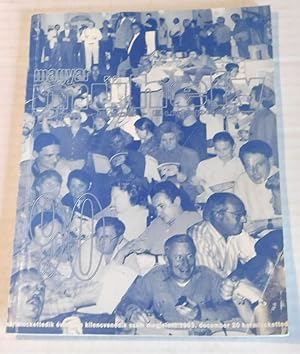
MAGYAR MUHELY: A Magyar Muhely Munkakozossege es a Magyar Muhely Barati Kor irodalmi es kritikai folyolrata: Parizs, Becs, Budapest.
Publicado por Budapest: 1993., 1993
Librería: Blue Mountain Books & Manuscripts, Ltd., Cadyville, NY, Estados Unidos de America
Calificación del vendedor: 5 de 5 estrellas
EUR 22,10
Envío por EUR 4,94
Se envía dentro de Estados Unidos de AmericaCantidad disponible: 1 disponibles
Añadir al carritoCondición: Very good. - Small quarto [9-1/2 inches high by 7 inches wide], softcover bound in pictorial blue & white wraps. The wraps are lightly rubbed & their bottom corners are creased with soiling to the bottom corner of the rear wrap. 64 pages. Black-and-white illustrations. The bottom corners of the pages are creased. Very good. Inscribed to Dick Higgins of Something Else Press by Istvan Kilian at the head of his article on page 43. Kilian, an expert on Hungarian pattern poetry is here writing about the visual poems [called "Roses" because of their form] by an eighteenth century Protestant minister Mihaly Kozma.This issue also includes a short portrait of the Canadian sound poet Paul Dutton. The text is in Hungarian. A summary of the contents is printed in French and English on the inside rear wrap.
-
Gergely Papp: Selection of Photographs, 1930s-1960s
Librería: Revaluation Books, Exeter, Reino Unido
Calificación del vendedor: 5 de 5 estrellas
EUR 31,18
Envío por EUR 11,55
Se envía de Reino Unido a Estados Unidos de AmericaCantidad disponible: 2 disponibles
Añadir al carritoPaperback. Condición: Brand New. 120 pages. 9.00x6.00x0.25 inches. In Stock.
-
Gergely Papp: Selection of Photographs 1930s-1960s
Librería: THE SAINT BOOKSTORE, Southport, Reino Unido
Calificación del vendedor: 5 de 5 estrellas
EUR 28,68
Envío por EUR 16,80
Se envía de Reino Unido a Estados Unidos de AmericaCantidad disponible: 10 disponibles
Añadir al carritoPaperback / softback. Condición: New. New copy - Usually dispatched within 4 working days.
-
Gergely Papp : 1938?1963 Ecsegfalva, Hungary
Librería: GreatBookPricesUK, Woodford Green, Reino Unido
Calificación del vendedor: 5 de 5 estrellas
EUR 28,23
Envío por EUR 17,32
Se envía de Reino Unido a Estados Unidos de AmericaCantidad disponible: Más de 20 disponibles
Añadir al carritoCondición: New.
-
Gergely Papp : 1938?1963 Ecsegfalva, Hungary
Librería: GreatBookPricesUK, Woodford Green, Reino Unido
Calificación del vendedor: 5 de 5 estrellas
EUR 30,99
Envío por EUR 17,32
Se envía de Reino Unido a Estados Unidos de AmericaCantidad disponible: Más de 20 disponibles
Añadir al carritoCondición: As New. Unread book in perfect condition.
-

Eyeamzing, Issue 2 - 2011
Idioma: Inglés
Publicado por Picture Booklets, Amsterdam, 2011
Librería: Clayton Fine Books, Shepherdstown, WV, Estados Unidos de America
Calificación del vendedor: 4 de 5 estrellas
Original o primera edición
EUR 48,63
Envío por EUR 5,15
Se envía dentro de Estados Unidos de AmericaCantidad disponible: 1 disponibles
Añadir al carritoSoft cover. Condición: Near Fine. Cover photograph by Julia Fullerton-Batten Ilustrador. First Edition. Near fine in original wrappers with light wear.
-
1938 - 1963 Ecsegfalva, Hungary (Paperback)
Librería: AussieBookSeller, Truganina, VIC, Australia
Calificación del vendedor: 5 de 5 estrellas
EUR 55,48
Envío por EUR 31,76
Se envía de Australia a Estados Unidos de AmericaCantidad disponible: 1 disponibles
Añadir al carritoPaperback. Condición: new. Paperback. Enigmatic Hungarian photographer Gergely Papp (19222000) was born into a peasant family, on a farmstead in Pusztaecseg (now Ecsegfalva) in Eastern Hungary. He would live there for the rest of his life. In 1938, Papp learned the mechanics of photography from his brother and took to depicting life in the village: christenings, harvests, hunting, weddings, funerals and much more. Papp documented provincial life in Hungary before and throughout World War II, the communist regime and failed 1956 revolution. He eventually stopped taking photographs in early 1963. Distressed by the forced nationalization of the familys land, Papp went out, cut down his fruit trees and took a final self-portrait in the remains. The life and work of Gergely Papp was little known until his images were encountered by Hungarian art historian Tibor Miltenyi in the 1990s, shortly before Papps death. While much of Papps archive was destroyed by local vandals, the Archive of Modern Conflict has acquired the few surviving photographs; many appear here, published for the first time. Shipping may be from our Sydney, NSW warehouse or from our UK or US warehouse, depending on stock availability.
-

1938 - 1963 Ecsegfalva, Hungary
Librería: Rarewaves.com UK, London, Reino Unido
Calificación del vendedor: 5 de 5 estrellas
EUR 24,95
Envío por EUR 75,06
Se envía de Reino Unido a Estados Unidos de AmericaCantidad disponible: 5 disponibles
Añadir al carritoPaperback. Condición: New. Enigmatic Hungarian photographer Gergely Papp (1922-2000) was born into a peasant family, on a farmstead in Pusztaecseg (now Ecsegfalva) in Eastern Hungary. He would live there for the rest of his life. In 1938, Papp learned the mechanics of photography from his brother and took to depicting life in the village: christenings, harvests, hunting, weddings, funerals and much more. Papp documented provincial life in Hungary before and throughout World War II, the communist regime and failed 1956 revolution. He eventually stopped taking photographs in early 1963. Distressed by the forced nationalization of the family's land, Papp went out, cut down his fruit trees and took a final self-portrait in the remains. The life and work of Gergely Papp was little known until his images were encountered by Hungarian art historian Tibor Miltenyi in the 1990s, shortly before Papp's death. While much of Papp's archive was destroyed by local vandals, the Archive of Modern Conflict has acquired the few surviving photographs; many appear here, published for the first time.