

Importe total (1 artículo artículos):
Destino del pedido:

fresco jacque (8 resultados)
Ir a los resultados principales
Filtros de búsqueda
Tipo de artículo
- Todos los tipos de productos
- Libros (6)
- Revistas y publicaciones (No hay ningún otro resultado que coincida con este filtro.)
- Cómics (No hay ningún otro resultado que coincida con este filtro.)
- Partituras (No hay ningún otro resultado que coincida con este filtro.)
- Arte, grabados y pósters (No hay ningún otro resultado que coincida con este filtro.)
- Fotografías (2)
- Mapas (No hay ningún otro resultado que coincida con este filtro.)
- Manuscritos y coleccionismo de papel (No hay ningún otro resultado que coincida con este filtro.)
Condición Más información
- Nuevo (1)
- Como nuevo, Excelente o Muy bueno (4)
- Bueno o Aceptable (3)
- Regular o Pobre (No hay ningún otro resultado que coincida con este filtro.)
- Tal como se indica (No hay ningún otro resultado que coincida con este filtro.)
Encuadernación
Más atributos
Idioma (2)
Gastos de envío gratis
Ubicación del vendedor
Valoración de los vendedores
-

Transforming The Global Biosphere: Twelve Futuristic Strategies, Revised Edition
Idioma: Inglés
Publicado por Personal JAZ Publishing, 2009
ISBN 10: 0972171320 ISBN 13: 9780972171328
Librería: Sunny Day Books, Mayer, AZ, Estados Unidos de America
Calificación del vendedor: 5 de 5 estrellas

Ejemplar firmado
EUR 17,70
Envío por EUR 4,30
Se envía dentro de Estados Unidos de AmericaCantidad disponible: 1 disponibles
Añadir al carritoPaperback. Condición: Like New. A beautiful copy SIGNED and inscribed by author. Text in mint/unmarked condition. Cover has minor shelf rubbings. Binding is tight. Your Satisfaction Guaranteed. We ship daily. Expedited shipping available. Signed by Author.
-

The Best That Money Can't Buy: Beyond Politics, Poverty, & War
Librería: CML Books on The Mall, Boise, ID, Estados Unidos de America
Calificación del vendedor: 5 de 5 estrellas
EUR 31,94
Envío por EUR 5,17
Se envía dentro de Estados Unidos de AmericaCantidad disponible: 1 disponibles
Añadir al carritoSoft cover. Condición: Near Fine. No Jacket. Magazine Size, Glossy cardstock covers, hard to find, clean copy with crease at front and back spine line. Global Cyber Visions, 2002, 150 pg.
-
The Best That Money Can't Buy: Beyond Politics, Poverty, & War
Idioma: Inglés
Publicado por Global Cyber-Visions, 2018
Librería: Court Street Books LLC, Florence, AL, Estados Unidos de America
Calificación del vendedor: 5 de 5 estrellas
EUR 66,55
Envío por EUR 4,31
Se envía dentro de Estados Unidos de AmericaCantidad disponible: 1 disponibles
Añadir al carritoHardcover. Condición: New. Estado de la sobrecubierta: New. Very scarce in hardcover.
-
The Best That Money Can't Buy: Beyond Politics, Poverty, & War
Librería: London Bridge Books, London, Reino Unido
Calificación del vendedor: 5 de 5 estrellas
EUR 61,15
Envío por EUR 52,10
Se envía de Reino Unido a Estados Unidos de AmericaCantidad disponible: 1 disponibles
Añadir al carritoPaperback. Condición: Good.
-
Looking Forward
Idioma: Inglés
Publicado por A. S. Barnes and Company/Thomas Yoseloff Ltd, NY/London, 1969
Librería: Dividing Line Books, Ridgewood, NY, Estados Unidos de America
Miembro de asociación: ESA IOBA
Calificación del vendedor: 5 de 5 estrellas
Original o primera edición
EUR 221,82
Gastos de envío gratis
Se envía dentro de Estados Unidos de AmericaCantidad disponible: 1 disponibles
Añadir al carritoHardcover. Condición: Very Good. Estado de la sobrecubierta: Very Good. 1st Edition. 204pp; [8] b&w plates at center. Black cloth; dust jacket. Soiling to textblock base, one spot to fore-edge; offsetting to endleaves; former owner's bookplate to front pastedown; neat ink underlining to 17 pages at front of volume. Very good in unclipped jacket, with toning and small edge chips, some foxing/toning to interior. Scarce first edition of this co-authored work of speculative futurism; an analysis of factors that drive social and technological development, followed by a lengthy description of a hypothetical, science-fiction inflected Utopian society of the 21st century (including the "cybernator," a "seemingly magical computer device" responsible for regulating the daily lives of human beings). Keyes Jr. (1921-1995) was a personal growth author and founder of the self-help movement Living Love; Fresco (1916-2017) a noted futurist and social engineer, who with his wife founded The Venus Project in 1985.
-
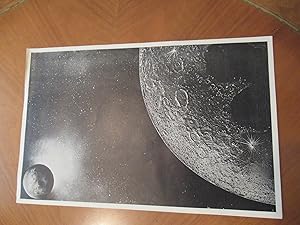
(Science Fiction Art) Concept Design For Moon In Film "Project Moonbase"
Idioma: Inglés
Publicado por Galaxy Pictures, Los Angeles, 1953
Librería: Arroyo Seco Books, Pasadena, Member IOBA, Pasadena, CA, Estados Unidos de America
Miembro de asociación: IOBA
Calificación del vendedor: 4 de 5 estrellas

Fotografía Original o primera edición
EUR 135,32
Envío por EUR 6,89
Se envía dentro de Estados Unidos de AmericaCantidad disponible: 1 disponibles
Añadir al carritoNo Binding. Condición: Fine. 1st Edition. Reproduction Of Photograph Montage Used For Central Concept In "Project Moonbase", Written By Seaman And Heinlein. The Film Was Made In Ten Days, Including Use Of Same Sets For Another Film Shot Simultaneously. Often Criticized As A Film, But Mostly By People Who Couldn't Build A Radio Today Let Alone A Space Station In 1953. From The Forrest Ackerman Collection. 17" X 11". Jacque Fresco (1916 - 2017) Was An American Futurist And Self-Described Social Engineer. Self-Taught, He Worked In A Variety Of Positions Related To Industrial Design. Fresco Worked At Douglas Aircraft Company In California During The Late 1930S. He Presented Designs Including A Flying Wing] And A Disk-Shaped Aircraft. Fresco Was Commissioned By Earl "Madman" Muntz, To Design Low Cost Housing. Muntz Invested $500,000 Seed Money In The Project. Fresco, 32 Years Old At The Time, Along With His Associates Harry Giaretto And Eli Catran Conceived, Designed And Engineered A Project House Called The Trend Home. Built Mostly Of Aluminum And Glass, It Was On Prominent Display At Stage 8 Of The Warner Bros. Sunset Lot In Hollywood For Three Months. Without Federal Or Further Private Funding The Project Did Not Go Into Mass Production. This Experience Led Fresco To The Conclusion That Society Would Have To Be Changed For His Inventions To Reach Their Potential.In The Late 1940S, Fresco Created And Was Director Of Scientific Research Laboratories In Los Angeles. Here He Also Gave Lectures, And Taught Technical Design, Meanwhile Researching And Working On Inventions As A Freelance Inventor And Scientific Consultant. During This Period, Fresco Struggled To Get His Research Funded And Faced Setbacks And Financial Difficulties. In 1955, Fresco Left California After His Laboratory Was Removed To Build The Golden State Freeway.In 1955 Fresco Moved To Miami, Florida. In Miami Fresco Presented Designs Of A Circular City. Fresco Made His Living Working As An Industrial Designer For Various Companies Such As Alcoa And The Major Realty Corporation. In 1961, With Pietro Belluschi And C. Frederick Wise, Fresco Collaborated On A Project, Known As The Sandwich House. Consisting Of Mostly Prefabricated Components, Partitions, And Aluminum, It Sold For $2,950, Or $7,500 With Foundation And All Internal Installations. During This Period, Fresco Supported His Projects By Designing Prefabricated Aluminum Devices Through Jacque Fresco Enterprises Inc. From 1955 To 1969 Fresco Named His Social Ideas "Project Americana". Looking Forward Was Published In 1969. Author Ken Keyes Jr., And Jacque Fresco Coauthored The Book, A Speculative Look At The Future. The Authors Picture An Ideal 'Cybernetic Society In Which Want Has Been Banished And Work And Personal Possessions No Longer Exist; Individual Gratification Is The Total Concern' .Fresco Formed "Sociocyberneering", A Membership Organization Claiming 250 Members.] He Hosted Lectures In Miami Beach And Coral Gables. Fresco Promoted His Organization By Lecturing At Universities And Appearing On Radio And Television. Fresco's "Sociocyberneering" As A Membership Group Was Discontinued And Land Was Purchased At Another Location In Rural Venus, Florida. He Established His Home And Research Center There.Fresco, With Meadows, Supported The Project In The 1990S Through Freelance Inventing, Industrial Engineering, Conventional Architectural Modeling, And Invention Consultations. In 2002, Fresco Published His Main Work The Best That Money Can't Buy. In 2006, William Gazecki Directed The Semi-Biographical Film About Fresco, Future By Design.In 2008, Peter Joseph Featured Fresco In The Film Zeitgeist Addendum Where His Ideas Of The Future Were Given As Possible Alternatives. Peter Joseph, Founder Of The Zeitgeist Movement Began Advocating Fresco's Approach. In April 2012, The Two Groups Disassociated Due To Disagreements Regarding Goals And Objectives.
-
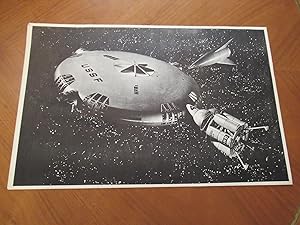
(Science Fiction Art) Concept Design For Space Station In Film "Project Moonbase"
Idioma: Inglés
Publicado por Galaxy Pictures, Los Angeles, 1953
Librería: Arroyo Seco Books, Pasadena, Member IOBA, Pasadena, CA, Estados Unidos de America
Miembro de asociación: IOBA
Calificación del vendedor: 4 de 5 estrellas
Fotografía Original o primera edición
EUR 135,32
Envío por EUR 6,89
Se envía dentro de Estados Unidos de AmericaCantidad disponible: 1 disponibles
Añadir al carritoNo Binding. Condición: Fine. 1st Edition. 17" X 1". Reproduction Of Photograph Montage Used For Central Concept In "Project Moonbase", Written By Seaman And Heinlein. The Film Was Made In Ten Days, Including Use Of Same Sets For Another Film Shot Simultaneously. Often Criticized As A Film, But Mostly By People Who Couldn't Build A Radio Today Let Alone A Space Station In 1953. From The Forrest Ackerman Collection. Jacque Fresco (1916 - 2017) Was An American Futurist And Self-Described Social Engineer. Self-Taught, He Worked In A Variety Of Positions Related To Industrial Design. Fresco Worked At Douglas Aircraft Company In California During The Late 1930S. He Presented Designs Including A Flying Wing] And A Disk-Shaped Aircraft. Fresco Was Commissioned By Earl "Madman" Muntz, To Design Low Cost Housing. Muntz Invested $500,000 Seed Money In The Project. Fresco, 32 Years Old At The Time, Along With His Associates Harry Giaretto And Eli Catran Conceived, Designed And Engineered A Project House Called The Trend Home. Built Mostly Of Aluminum And Glass, It Was On Prominent Display At Stage 8 Of The Warner Bros. Sunset Lot In Hollywood For Three Months. Without Federal Or Further Private Funding The Project Did Not Go Into Mass Production. This Experience Led Fresco To The Conclusion That Society Would Have To Be Changed For His Inventions To Reach Their Potential.In The Late 1940S, Fresco Created And Was Director Of Scientific Research Laboratories In Los Angeles. Here He Also Gave Lectures, And Taught Technical Design, Meanwhile Researching And Working On Inventions As A Freelance Inventor And Scientific Consultant. During This Period, Fresco Struggled To Get His Research Funded And Faced Setbacks And Financial Difficulties. In 1955, Fresco Left California After His Laboratory Was Removed To Build The Golden State Freeway.In 1955 Fresco Moved To Miami, Florida. In Miami Fresco Presented Designs Of A Circular City. Fresco Made His Living Working As An Industrial Designer For Various Companies Such As Alcoa And The Major Realty Corporation. In 1961, With Pietro Belluschi And C. Frederick Wise, Fresco Collaborated On A Project, Known As The Sandwich House. Consisting Of Mostly Prefabricated Components, Partitions, And Aluminum, It Sold For $2,950, Or $7,500 With Foundation And All Internal Installations. During This Period, Fresco Supported His Projects By Designing Prefabricated Aluminum Devices Through Jacque Fresco Enterprises Inc. From 1955 To 1969 Fresco Named His Social Ideas "Project Americana". Looking Forward Was Published In 1969. Author Ken Keyes Jr., And Jacque Fresco Coauthored The Book, A Speculative Look At The Future. The Authors Picture An Ideal 'Cybernetic Society In Which Want Has Been Banished And Work And Personal Possessions No Longer Exist; Individual Gratification Is The Total Concern' .Fresco Formed "Sociocyberneering", A Membership Organization Claiming 250 Members.] He Hosted Lectures In Miami Beach And Coral Gables. Fresco Promoted His Organization By Lecturing At Universities And Appearing On Radio And Television. Fresco's "Sociocyberneering" As A Membership Group Was Discontinued And Land Was Purchased At Another Location In Rural Venus, Florida. He Established His Home And Research Center There.Fresco, With Meadows, Supported The Project In The 1990S Through Freelance Inventing, Industrial Engineering, Conventional Architectural Modeling, And Invention Consultations. In 2002, Fresco Published His Main Work The Best That Money Can't Buy. In 2006, William Gazecki Directed The Semi-Biographical Film About Fresco, Future By Design.In 2008, Peter Joseph Featured Fresco In The Film Zeitgeist Addendum Where His Ideas Of The Future Were Given As Possible Alternatives. Peter Joseph, Founder Of The Zeitgeist Movement Began Advocating Fresco's Approach. In April 2012, The Two Groups Disassociated Due To Disagreements Regarding Goals And Objectives.
-

Sociocyberneering, Inc.: Introduction To Sociocyberneering
Publicado por D. Van Nostrand Company, Princeton, 1960
Librería: MostlyAcademic, Berrima, NSW, Australia
Calificación del vendedor: 5 de 5 estrellas
EUR 601,38
Envío por EUR 30,11
Se envía de Australia a Estados Unidos de AmericaCantidad disponible: 1 disponibles
Añadir al carritoSoft cover. Condición: Very Good. 15 Pp + 5 Plates (Two Of Which On Recto And Verso Of Rear Cover). 17" X 11", Plastic Comb Binding. Laid In Loosely Are The "Book List" And The Form For Application And Orders. Jacque Fresco (1916 ? 2017) Was An American Futurist And Self-Described Social Engineer. Self-Taught, He Worked In A Variety Of Positions Related To Industrial Design. Fresco Worked At Douglas Aircraft Company In California During The Late 1930S. He Presented Designs Including A Flying Wing] And A Disk-Shaped Aircraft. Fresco Was Commissioned By Earl "Madman" Muntz, To Design Low Cost Housing. Muntz Invested $500,000 Seed Money In The Project. Fresco, 32 Years Old At The Time, Along With His Associates Harry Giaretto And Eli Catran Conceived, Designed And Engineered A Project House Called The Trend Home. Built Mostly Of Aluminum And Glass, It Was On Prominent Display At Stage 8 Of The Warner Bros. Sunset Lot In Hollywood For Three Months. Without Federal Or Further Private Funding The Project Did Not Go Into Mass Production. This Experience Led Fresco To The Conclusion That Society Would Have To Be Changed For His Inventions To Reach Their Potential.In The Late 1940S, Fresco Created And Was Director Of Scientific Research Laboratories In Los Angeles. Here He Also Gave Lectures, And Taught Technical Design, Meanwhile Researching And Working On Inventions As A Freelance Inventor And Scientific Consultant. During This Period, Fresco Struggled To Get His Research Funded And Faced Setbacks And Financial Difficulties. In 1955, Fresco Left California After His Laboratory Was Removed To Build The Golden State Freeway.In 1955 Fresco Moved To Miami, Florida. In Miami Fresco Presented Designs Of A Circular City. Fresco Made His Living Working As An Industrial Designer For Various Companies Such As Alcoa And The Major Realty Corporation. In 1961, With Pietro Belluschi And C. Frederick Wise, Fresco Collaborated On A Project, Known As The Sandwich House. Consisting Of Mostly Prefabricated Components, Partitions, And Aluminum, It Sold For $2,950, Or $7,500 With Foundation And All Internal Installations. During This Period, Fresco Supported His Projects By Designing Prefabricated Aluminum Devices Through Jacque Fresco Enterprises Inc. From 1955 To 1969 Fresco Named His Social Ideas "Project Americana". Looking Forward Was Published In 1969. Author Ken Keyes Jr., And Jacque Fresco Coauthored The Book, A Speculative Look At The Future. The Authors Picture An Ideal 'Cybernetic Society In Which Want Has Been Banished And Work And Personal Possessions No Longer Exist; Individual Gratification Is The Total Concern' .Fresco Formed "Sociocyberneering", A Membership Organization Claiming 250 Members.] He Hosted Lectures In Miami Beach And Coral Gables. Fresco Promoted His Organization By Lecturing At Universities And Appearing On Radio And Television. Fresco's "Sociocyberneering" As A Membership Group Was Discontinued And Land Was Purchased At Another Location In Rural Venus, Florida. He Established His Home And Research Center There.Fresco, With Meadows, Supported The Project In The 1990S Through Freelance Inventing, Industrial Engineering, Conventional Architectural Modeling, And Invention Consultations. In 2002, Fresco Published His Main Work The Best That Money Can't Buy. In 2006, William Gazecki Directed The Semi-Biographical Film About Fresco, Future By Design.In 2008, Peter Joseph Featured Fresco In The Film Zeitgeist Addendum Where His Ideas Of The Future Were Given As Possible Alternatives. Peter Joseph, Founder Of The Zeitgeist Movement Began Advocating Fresco's Approach. In April 2012, The Two Groups Disassociated Due To Disagreements Regarding Goals And Objectives.


