

Importe total (1 artículo artículos):
Destino del pedido:

fouser beth (7 resultados)
Ir a los resultados principales
Filtros de búsqueda
Tipo de artículo
- Todos los tipos de productos
- Libros (7)
- Revistas y publicaciones (No hay ningún otro resultado que coincida con este filtro.)
- Cómics (No hay ningún otro resultado que coincida con este filtro.)
- Partituras (No hay ningún otro resultado que coincida con este filtro.)
- Arte, grabados y pósters (No hay ningún otro resultado que coincida con este filtro.)
- Fotografías (No hay ningún otro resultado que coincida con este filtro.)
- Mapas (No hay ningún otro resultado que coincida con este filtro.)
- Manuscritos y coleccionismo de papel (No hay ningún otro resultado que coincida con este filtro.)
Condición Más información
- Nuevo (5)
- Como nuevo, Excelente o Muy bueno (No hay ningún otro resultado que coincida con este filtro.)
- Bueno o Aceptable (2)
- Regular o Pobre (No hay ningún otro resultado que coincida con este filtro.)
- Tal como se indica (No hay ningún otro resultado que coincida con este filtro.)
Encuadernación
- Todas
- Tapa dura (No hay ningún otro resultado que coincida con este filtro.)
- Tapa blanda (7)
Más atributos
- Primera edición (1)
- Firmado (No hay ningún otro resultado que coincida con este filtro.)
- Sobrecubierta (No hay ningún otro resultado que coincida con este filtro.)
- Con imágenes (4)
- No impresión bajo demanda (7)
Idioma (1)
Gastos de envío gratis
- Envío gratis a Estados Unidos de America (No hay ningún otro resultado que coincida con este filtro.)
Ubicación del vendedor
Valoración de los vendedores
-

The Lord of the Golden Tower
Idioma: Inglés
Publicado por White Lotus Company, Limited, 1996
ISBN 10: 9748496597 ISBN 13: 9789748496597
Librería: Majestic Books, Hounslow, Reino Unido
Calificación del vendedor: 4 de 5 estrellas

EUR 20,40
Envío por EUR 7,63
Se envía de Reino Unido a Estados Unidos de AmericaCantidad disponible: 4 disponibles
Añadir al carritoCondición: New. pp. 152.
-
The Lord of the Golden Tower
Idioma: Inglés
Publicado por White Lotus Company, Limited, 1996
ISBN 10: 9748496597 ISBN 13: 9789748496597
Librería: Books Puddle, New York, NY, Estados Unidos de America
Calificación del vendedor: 4 de 5 estrellas
EUR 24,75
Envío por EUR 3,50
Se envía dentro de Estados Unidos de AmericaCantidad disponible: 4 disponibles
Añadir al carritoCondición: New. pp. 152.
-
The Lord of the Golden Tower
Idioma: Inglés
Publicado por White Lotus Company, Limited, 1996
ISBN 10: 9748496597 ISBN 13: 9789748496597
Librería: Biblios, Frankfurt am main, HESSE, Alemania
Calificación del vendedor: 4 de 5 estrellas
EUR 20,54
Envío por EUR 9,95
Se envía de Alemania a Estados Unidos de AmericaCantidad disponible: 4 disponibles
Añadir al carritoCondición: New. pp. 152.
-

The Lord of the Golden Tower: King Prasat Thong and the Building of Wat Chaiwatthanaram
Librería: Orchid Press, Trinity East, NL, Canada
Miembro de asociación: IOBA
Calificación del vendedor: 5 de 5 estrellas

Original o primera edición
EUR 18,06
Envío por EUR 17,54
Se envía de Canada a Estados Unidos de AmericaCantidad disponible: 1 disponibles
Añadir al carritoSoft Cover. Condición: New. First Edition. This book is a study of symbols of power and legitimacy. King Prasat Thong, a usurper, attempted to justify his claim to the throne of Ayutthaya by reviving at Wat Chaiwatthanaram the Khmer-influenced prang in a form that had not been used for two hundred years. The author explores the cultural, historic, political and religious context from which Wat Chaiwatthanaram emerged. She describes its functions on religious and political levels and the interrelationships between Buddhism and kingship and related conceptions of legitimacy. Prasat Thong followed King Ramathibodhi, the venerated founder of Ayutthaya, who had used the prang in his architecture. At Wat Chaiwatthanaram the prang, along with other unusual features, such as the eight conical men (meru), the large crowned Buddha images, and the twelve stucco relief panels, together created a unified visual statement designed to proclaim his ultimate right to reign as King. 152 pp., 20 pp. color illus. Size: 21 x 15 cm.
-

The Lord of the Golden Tower: King Prasat Thong and the Building of Wat Chaiwatthanaram (Studies in Southeast Asian History No. 3)
Librería: Masalai Press, Oakland, CA, Estados Unidos de America
Calificación del vendedor: 5 de 5 estrellas
EUR 45,15
Envío por EUR 4,21
Se envía dentro de Estados Unidos de AmericaCantidad disponible: 1 disponibles
Añadir al carritoSoft cover. Condición: Very Good. 135 pp., illustrations, bibliography. This book is a study of symbols of power and legitimacy. King Prasat Thong, a usurper, attempted to justify his claim to the throne of Ayutthaya by reviving at Wat Chaiwatthanaram the Khmer-influenced prang in a form that had not been used for two hundred years. The author explores the cultural, historic, political and religious context from which Wat Chaiwatthanaram emerged. She describes its functions on religious and political levels and the interrelationships between Buddhism and kingship and related conceptions of legitimacy. Prasat Thong followed King Ramathibodhi, the venerated founder of Ayutthaya, who had used the prang in his architecture. At Wat Chaiwatthanaram the prang, along with other unusual features, such as the eight conical men (meru), the large crowned Buddha images, and the twelve stucco relief panels, together created a unified visual statement designed to proclaim his ultimate right to reign as King. 2 labels inside back cover 0.0.
-
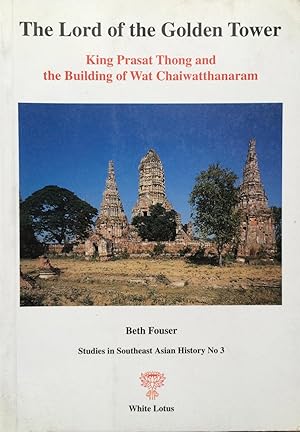
The Lord of the Golden Tower: King Prasat Thong and the Building of Wat Chaiwatthanaram
Idioma: Inglés
Publicado por Bangkok : White Lotus Press, 1996
ISBN 10: 9748496597 ISBN 13: 9789748496597
Librería: Joseph Burridge Books, Dagenham, Reino Unido
Calificación del vendedor: 5 de 5 estrellas
EUR 24,18
Envío por EUR 27,00
Se envía de Reino Unido a Estados Unidos de AmericaCantidad disponible: 1 disponibles
Añadir al carritoSoft cover. Condición: Very Good. xvi, 135 p. : ill. (some col.) ; 22 cm. 'Study chiefly on art and architecture of Wat Chaiwatthanaram at Phra Nakhon Si Ayutthaya, ancient capital of Thailand with reference to its builder King Prasat Thong's relation with Cambodia.'.
-
Lord of the Golden Tower, The
Idioma: Inglés
Publicado por White Lotus Press, Bangkok, 1996
ISBN 10: 9748496597 ISBN 13: 9789748496597
Librería: SEATE BOOKS, APO, AP, Estados Unidos de America
Calificación del vendedor: 5 de 5 estrellas
EUR 46,02
Envío por EUR 17,54
Se envía dentro de Estados Unidos de AmericaCantidad disponible: Más de 20 disponibles
Añadir al carritoPaperback. Condición: New. Estado de la sobrecubierta: no dj. This book is a study of symbols of power and legitimacy. King Prasat Thong, a usurper, attempted to justify his claim to the throne of Ayutthaya by reviving at Wat Chaiwatthanaram the Khmer-influenced prang in a form that had not been used for two hundred years. The author explores the cultural, historic, political and religious context from which Wat Chaiwatthanaram emerged. She describes its functions on religious and political levels and the interrelationships between Buddhism and kingship and related conceptions of legitimacy. Prasat Thong followed King Ramathibodhi, the venerated founder of Ayutthaya, who had used the prang in his architecture. At Wat Chaiwatthanaram the prang, along with other unusual features, such as the eight conical men (meru), the large crowned Buddha images, and the twelve stucco relief panels, together created a unified visual statement designed to proclaim his ultimate right to reign as King. Book.


