

Importe total (1 artículo artículos):
Destino del pedido:

edited hans wysling (2 resultados)
Ir a los resultados principales
Filtros de búsqueda
Tipo de artículo
- Todos los tipos de productos
- Libros (2)
- Revistas y publicaciones (No hay ningún otro resultado que coincida con este filtro.)
- Cómics (No hay ningún otro resultado que coincida con este filtro.)
- Partituras (No hay ningún otro resultado que coincida con este filtro.)
- Arte, grabados y pósters (No hay ningún otro resultado que coincida con este filtro.)
- Fotografías (No hay ningún otro resultado que coincida con este filtro.)
- Mapas (No hay ningún otro resultado que coincida con este filtro.)
- Manuscritos y coleccionismo de papel (No hay ningún otro resultado que coincida con este filtro.)
Condición Más información
- Nuevo (No hay ningún otro resultado que coincida con este filtro.)
- Como nuevo, Excelente o Muy bueno (No hay ningún otro resultado que coincida con este filtro.)
- Bueno o Aceptable (No hay ningún otro resultado que coincida con este filtro.)
- Regular o Pobre (No hay ningún otro resultado que coincida con este filtro.)
- Tal como se indica (2)
Encuadernación
- Todas
- Tapa dura (2)
- Tapa blanda (No hay ningún otro resultado que coincida con este filtro.)
Más atributos
- Primera edición (1)
- Firmado (No hay ningún otro resultado que coincida con este filtro.)
- Sobrecubierta (2)
- Con imágenes (1)
- No impresión bajo demanda (2)
Idioma (1)
Precio
- Cualquier precio
- Menos de EUR 20 (No hay ningún otro resultado que coincida con este filtro.)
- EUR 20 a EUR 45
- Más de EUR 45 (No hay ningún otro resultado que coincida con este filtro.)
Gastos de envío gratis
Ubicación del vendedor
Valoración de los vendedores
-
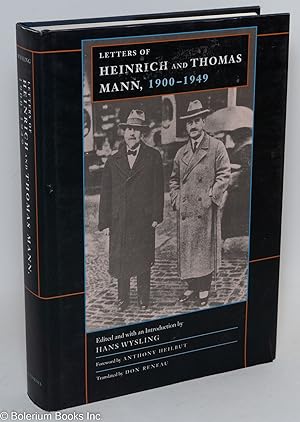
Letters of Heinrich and Thomas Mann, 1900-1949
Idioma: Inglés
Publicado por University of California Press, Berkeley, 1998
ISBN 10: 0520072782 ISBN 13: 9780520072787
Librería: Bolerium Books Inc., San Francisco, CA, Estados Unidos de America
Miembro de asociación: ABAA ILAB
Calificación del vendedor: 5 de 5 estrellas

Original o primera edición
EUR 20,26
Gastos de envío gratis
Se envía dentro de Estados Unidos de AmericaCantidad disponible: 1 disponibles
Añadir al carritoHardcover. xviii, 444p., foreword, introduction, letters, documents, notes, bibliography, index, glossy b&w photo section, very good first edition, first printing stated in blue cloth boards and unclipped dj. Weimar & Now: German Cultural Criticism series #18, edited by Martin Jay & Anton Kaes.
-
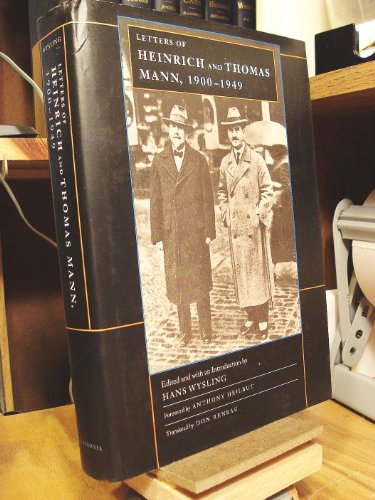
Letters of Heinrich and Thomas Mann, 1900-1949
Idioma: Inglés
Publicado por University of California Press, 1998
ISBN 10: 0520072782 ISBN 13: 9780520072787
Librería: Eureka Books, Eureka, CA, Estados Unidos de America
Calificación del vendedor: 5 de 5 estrellas
EUR 22,51
Envío por EUR 7,87
Se envía dentro de Estados Unidos de AmericaCantidad disponible: 1 disponibles
Añadir al carritoHardcover. Estado de la sobrecubierta: Near Fine. 7-1/4 by 10-1/4 inches. Volume 12 in the Weimar and Now: German Cultural Criticism series. First edition (first printing). A near fine copy in a near fine dust jacket. Fortunately for us, brothers Heinrich and Thomas Mann remained devoted and eloquent correspondents even while disagreeing passionately on matters literary, political, philosophical, and personal. In their correspondence, set against a shifting backdrop of locations in Europe and America, mundane concerns blend easily with astonishing artistic and critical insights. That these irrepressible siblings were among the giants of twentieth-century letters gives their exchanges unique literary and historical fascination. Beginning in Germany and Italy at the turn of the century, the letters document with disarming immediacy the brothers' views on aesthetics, politics, and the social responsibility of the writer, as well as their mutual jealousy, admiration, rivalry, and loyalty. The devastating rift caused by Thomas's support of Germany during World War I and his brother's utter opposition to the war took many years to mend, but they found their way back to friendship in the 1920s. After Hitler rose to power, both writers ultimately sought refuge in the United States. The letters offer a moving portrayal of their struggle, as novelists and socially engaged intellectuals, to bear witness to the cataclysmic historical changes around them and to their experience of exile, in Europe and then in America. This first complete English translation of their correspondence is a dramatic human dialogue and a major literary event.
