

Importe total (1 artículo artículos):
Destino del pedido:

early students (8 resultados)
Ir a los resultados principales
Filtros de búsqueda
Tipo de artículo
- Todos los tipos de productos
- Libros (7)
- Revistas y publicaciones (No hay ningún otro resultado que coincida con este filtro.)
- Cómics (No hay ningún otro resultado que coincida con este filtro.)
- Partituras (No hay ningún otro resultado que coincida con este filtro.)
- Arte, grabados y pósters (No hay ningún otro resultado que coincida con este filtro.)
- Fotografías (1)
- Mapas (No hay ningún otro resultado que coincida con este filtro.)
- Manuscritos y coleccionismo de papel (No hay ningún otro resultado que coincida con este filtro.)
Condición Más información
- Nuevo (4)
- Como nuevo, Excelente o Muy bueno (1)
- Bueno o Aceptable (1)
- Regular o Pobre (No hay ningún otro resultado que coincida con este filtro.)
- Tal como se indica (2)
Encuadernación
Más atributos
- Primera edición (1)
- Firmado (1)
- Sobrecubierta (No hay ningún otro resultado que coincida con este filtro.)
- Con imágenes (2)
- No impresión bajo demanda (8)
Idioma (2)
Precio
- Cualquier precio
- Menos de EUR 20 (No hay ningún otro resultado que coincida con este filtro.)
- EUR 20 a EUR 45
- Más de EUR 45
Gastos de envío gratis
Ubicación del vendedor
Valoración de los vendedores
-
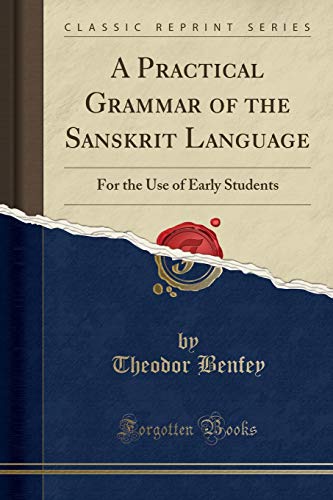
A Practical Grammar of the Sanskrit Language
Librería: PBShop.store US, Wood Dale, IL, Estados Unidos de America
Calificación del vendedor: 5 de 5 estrellas

EUR 28,25
Gastos de envío gratis
Se envía dentro de Estados Unidos de AmericaCantidad disponible: 15 disponibles
Añadir al carritoPAP. Condición: New. New Book. Shipped from UK. Established seller since 2000.
-
A Practical Grammar of the Sanskrit Language
Librería: PBShop.store UK, Fairford, GLOS, Reino Unido
Calificación del vendedor: 5 de 5 estrellas
EUR 28,25
Envío por EUR 4,82
Se envía de Reino Unido a Estados Unidos de AmericaCantidad disponible: 15 disponibles
Añadir al carritoPAP. Condición: New. New Book. Shipped from UK. Established seller since 2000.
-

Miscellaneous Documents Relating to Christian Science and Its Discoverer and Founder Mary Baker Eddy: The Carpenter Collection of Works on Christian Science
Librería: Revaluation Books, Exeter, Reino Unido
Calificación del vendedor: 5 de 5 estrellas
EUR 30,50
Envío por EUR 11,58
Se envía de Reino Unido a Estados Unidos de AmericaCantidad disponible: 1 disponibles
Añadir al carritoPaperback. Condición: Brand New. 232 pages. 7.25x5.25x0.53 inches. In Stock.
-
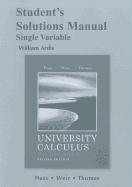
Student's Solutions Manual for University Calculus: Early Transcendentals, Single Variable Hass, Joel R.; Weir, Maurice D. and Thomas Jr., George B.
Librería: Aragon Books Canada, OTTAWA, ON, Canada
Calificación del vendedor: 3 de 5 estrellas

EUR 30,36
Envío por EUR 19,94
Se envía de Canada a Estados Unidos de AmericaCantidad disponible: 1 disponibles
Añadir al carritoCondición: New.
-

Life and Literature Volume 2 volume 2 - volume 9 volume 11 volume 12 volume 3 volume 2 11 books
Publicado por Yuri shuppan, 1956
Librería: Sunny Day Bookstore, SINGAPORE, Singapur
Calificación del vendedor: 4 de 5 estrellas

EUR 109,83
Envío por EUR 13,00
Se envía de Singapur a Estados Unidos de AmericaCantidad disponible: 1 disponibles
Añadir al carritoCondición: Fine. Number of books: 11 books.
-
Gronovius, Laurentius. Bibliotheca regni animalis atque lapidei, seu de recensio auctorum et librorum, qui de regno animali et lapideo . tractant.
Publicado por Leiden, Gronovius, 1760
Librería: Hünersdorff Rare Books ABA ILAB, London, Reino Unido
Miembro de asociación: ABA ILAB
Calificación del vendedor: 3 de 5 estrellas
Original o primera edición Ejemplar firmado
EUR 2.326,54
Envío por EUR 26,06
Se envía de Reino Unido a Estados Unidos de AmericaCantidad disponible: 1 disponibles
Añadir al carritoHardcover. Condición: Very Good. No Jacket. 1st Edition. Gronovius, Laurentius. Bibliotheca regni regni animalis atque lapidei, seu de recensio auctorum et librorum, qui de regno animalis atque lapidei,tracant. Leiden, for the author, 1760. 4to. [4]f + 326p. Contemporary quarter sheep, marbled boards. First edition of this early influential bibliography of the animal (Excluding man}and mineral kingdoms for the use of students of natural history. The catalogue was edited and published by the Dutch physician and naturalist Gronovius (1730-1777) and includes his own well-known works on fish. An interesting association copy, being a presentation from the editor to the English botanist and physician Peter Collinson (1693-1768), with his ownership inscription on title. Collinson devoted much of his life to the introduction of useful plants from Europe to America and from America to Europe. He corresponded with naturalists throughout Europe, many of whom dedicated works to him, and Linnaeus named the genus 'collinsonia' after him. Several of Collinson's own works are included in the bibliography. Very well preserved. Blake 187 (miscollated). BMC Natural History 640. Cole 1652. Wellcome III, 169. Wood 370. Inscribed by Author(s).
-
??????????. Zai yiqie gongzuo zhong tuchu zhengzhi. [Emphasise Politics in All Work].
Publicado por News Exhibition Photos of Xinhua Publishing., 1966
Librería: Asia Bookroom ANZAAB/ILAB, Canberra, ACT, Australia
Miembro de asociación: ANZAAB ILAB
Calificación del vendedor: 5 de 5 estrellas
EUR 249,80
Envío por EUR 17,12
Se envía de Australia a Estados Unidos de AmericaCantidad disponible: 1 disponibles
Añadir al carritoSet of 17 (of 20) black and white numbered photographs of study groups, workers, peasants and soldiers in various locations, missing numbers 6, 9 and 15, 11.5 x 15cm. Library stamp on reverse, offset in small area onto three images, photographs presented in envelope, label laid down on the front providing publication and sales details, such as price, number and date. The whole presented in a Xinhua plastic envelope. Among the many interesting photographs in this group is an image of a cave hospital in what appears to be a Hui minority group area with food drying and people waiting on a bench outside, and an image of people crossing a river with bundles tied to carrying poles. While this group of photographs is incomplete, the inclusion of the envelope with production and sales details is unusual and provides valuable information not commonly found with such sets of photographs.
-
"Co-eds Invade Man's Field" Press and Vernacular Photographs Documenting Female Access to STEM Education in Schools and Colleges, 1884 to 1956
Año de publicación: 1884
Librería: Max Rambod Inc, Woodland Hills, CA, Estados Unidos de America
Miembro de asociación: ABAA ILAB PADA
Calificación del vendedor: 5 de 5 estrellas
Fotografía
EUR 491,11
Envío por EUR 8,67
Se envía dentro de Estados Unidos de AmericaCantidad disponible: 1 disponibles
Añadir al carrito[Women's Education] [Women in Science] Photo archive documenting young women in scientific education across American, British, and European institutions from the 1880s through the mid-twentieth century, capturing the incremental and contested expansion of female access to chemistry, biology, and computing at a time when institutional science was actively considered a facet of only male education. The archive spans seven decades of that struggle, moving from a Victorian-era family portrait in which a woman holds a copy of J.D. Steele's widely used science textbook published in 1884, through early twentieth-century all-female chemistry and biology classrooms, wartime British science education, and coeducational college laboratories, concluding with a 1956 United Press wire photograph of a woman operating an early electronic computer being used by the American Broadcasting Company to predict presidential election returns. The archive constitutes a primary-source record of women's scientific participation at the precise institutional moments when their presence was news worthy, deliberate, and most disputed. Archive of eleven silver gelatin, albumen, and real photo postcard photographs dating from approximately the 1880s to 1956. Eight photos are mounted on cardstock. Subjects include a secondary school chemistry classroom of approximately twenty three girls and their instructor, a coeducational laboratory with bench tables and glass apparatus, an all female science class conducting an electricity experiment, and a classroom with a partially completed periodic table visible on the wall. Additional images show two women working at a microscope with an instructor, a primary school biology setting, and a Victorian era family portrait in which a woman holds a science textbook. Also included is a pre 1907 Latvian real photo postcard depicting a coeducational laboratory with thirteen women among the students. Two photographs carry original press descriptions their versos: one stamped November 27, 1937 and annotated "Colleges-Washington," carries a press clipping captioned "Co-eds invade man's field. Who said chemistry was for men only?" documenting an all-female Washington State College chemistry class; the second is a United Press wire photograph dated October 24, 1956 from the New York Bureau, captioned "Mechanical Crystal Ball," depicting a woman operating an Underwood electronic computer fed with more than 100,000 key election statistics compiled over forty years, with which ABC planned to predict the presidential winner from earliest election returns on November 6th. The archive's chronological and geographic span maps directly onto the decades and regions in which women's access to scientific education was most actively negotiated. The 1937 Washington State College press photographs appeared in the context of expanding land-grant college enrollment for women in STEM fields, at a moment when newspaper framing still treated female chemistry students as curiosities worthy of rhetorical challenge. The 1940 Battersea Polytechnic Institute photographs showing British girls aged seventeen to nineteen studying chemistry to aid the war effort document the wartime acceleration of female scientific recruitment that would reshape postwar expectations of women in technical fields. The 1956 United Press wire photograph places a woman at the center of one of the most publicly visible early deployments of electronic computing in American history, the ABC election-night prediction broadcast, a moment that introduced mass audiences to the concept of computational forecasting. The Latvian real photo postcard, while a single item within the broader grouping, extends the archive's documentary reach into continental Europe and offers a rare pre-1907 visual record of female laboratory participation in a region whose educational history remains underrepresented in anglophone institutional collections. Light silvering and minor edge wear to several smaller prints; press photographs retain original captions and stamps; cabinet photograph shows expected toning; Latvian postcard shows light age toning consistent with pre-1907 production. Overall in very good condition. The images provide a record of women's presence in scientific education and training environments across multiple national contexts.


![Imagen del vendedor de ??????????. Zai yiqie gongzuo zhong tuchu zhengzhi. [Emphasise Politics in All Work]. a la venta por Asia Bookroom ANZAAB/ILAB](https://pictures.abebooks.com/inventory/md/md32035078114.jpg)
