Importe total (1 artículo artículos):
Destino del pedido:

drawn pennington (13 resultados)
Ir a los resultados principales
Filtros de búsqueda
Tipo de artículo
- Todos los tipos de productos
- Libros (No hay ningún otro resultado que coincida con este filtro.)
- Revistas y publicaciones (No hay ningún otro resultado que coincida con este filtro.)
- Cómics (No hay ningún otro resultado que coincida con este filtro.)
- Partituras (No hay ningún otro resultado que coincida con este filtro.)
- Arte, grabados y pósters (13)
- Fotografías (No hay ningún otro resultado que coincida con este filtro.)
- Mapas (No hay ningún otro resultado que coincida con este filtro.)
- Manuscritos y coleccionismo de papel (No hay ningún otro resultado que coincida con este filtro.)
Condición Más información
- Nuevo (No hay ningún otro resultado que coincida con este filtro.)
- Como nuevo, Excelente o Muy bueno (No hay ningún otro resultado que coincida con este filtro.)
- Bueno o Aceptable (No hay ningún otro resultado que coincida con este filtro.)
- Regular o Pobre (No hay ningún otro resultado que coincida con este filtro.)
- Tal como se indica (13)
Encuadernación
- Todas
- Tapa dura (No hay ningún otro resultado que coincida con este filtro.)
- Tapa blanda (No hay ningún otro resultado que coincida con este filtro.)
Más atributos
- Primera edición (No hay ningún otro resultado que coincida con este filtro.)
- Firmado (No hay ningún otro resultado que coincida con este filtro.)
- Sobrecubierta (No hay ningún otro resultado que coincida con este filtro.)
- Con imágenes (13)
- No impresión bajo demanda (13)
Idioma (1)
Precio
- Cualquier precio
- Menos de EUR 20
- EUR 20 a EUR 45 (No hay ningún otro resultado que coincida con este filtro.)
- Más de EUR 45 (No hay ningún otro resultado que coincida con este filtro.)
Gastos de envío gratis
- Envío gratis a Estados Unidos de America (No hay ningún otro resultado que coincida con este filtro.)
Ubicación del vendedor
Valoración de los vendedores
-
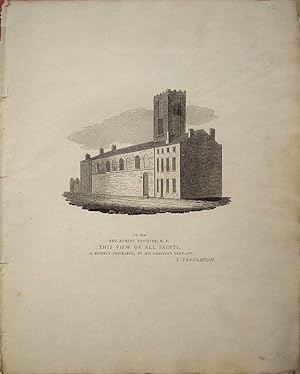
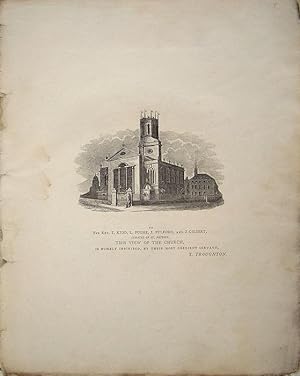
Lancashire. Liverpool. All Saints, Grosvenor Street.
Publicado por 1806-1808, 1806
Librería: theoldmapman, Clevedon, SOMER, Reino Unido
Calificación del vendedor: 5 de 5 estrellas

Arte / Grabado / Póster
EUR 5,93
Envío por EUR 7,49
Se envía de Reino Unido a Estados Unidos de AmericaCantidad disponible: 1 disponibles
Añadir al carritoSingle sheet. RARE. All Saints was, opened in 1798 and was sold to the Roman Catholic Church in 1845 and reopened as St. Joseph's. A new church was built on Great Nelson Street to replace it which opened in 1848. This plate is from a drawing by I. Pen. 22 x 27 cm.
-
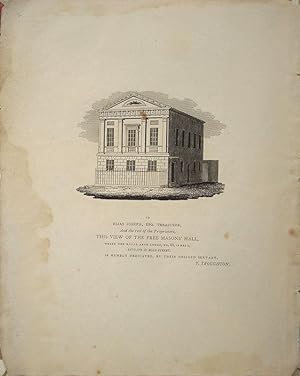
Lancashire. Liverpool. Free Masons' Hall.
Publicado por 1806-1808, 1806
Librería: theoldmapman, Clevedon, SOMER, Reino Unido
Calificación del vendedor: 5 de 5 estrellas
Arte / Grabado / Póster
EUR 5,93
Envío por EUR 7,49
Se envía de Reino Unido a Estados Unidos de AmericaCantidad disponible: 1 disponibles
Añadir al carritoSingle sheet. RARE. Dates from 1800 and situated in Bold Street where the Royal Arch Lodge No. 20 is held. Bought by Liverpool Savings Bank in 1818. In the last few years the interior has been renovated but an impressive cast-iron staircase stretching some 40 feet into the upstairs rooms was observed in situ and the staircase bears a star motif possibly from its days as the Masonic Lodge. Stain in left margin, see images. 22 x 27 cm.
-
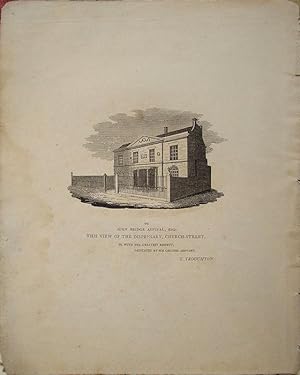
Lancashire. Liverpool. Dispensary, Church Street.
Publicado por 1806-1808, 1806
Librería: theoldmapman, Clevedon, SOMER, Reino Unido
Calificación del vendedor: 5 de 5 estrellas
Arte / Grabado / Póster
EUR 7,12
Envío por EUR 7,49
Se envía de Reino Unido a Estados Unidos de AmericaCantidad disponible: 1 disponibles
Añadir al carritoSingle sheet. RARE. The first dispensary to assist the poor was opened in 1778 and this one in Church Street in 1781. By the 1820s there were two dispensaries (the other in St James' Street) with a paid Apothecary, three surgeons, three physicians and a stipendiary house surgeon who attend six days a week providing their services gratuitously to over 26,000 persons in a year. Stain in left margin, see images. 22 x 27 cm.
-
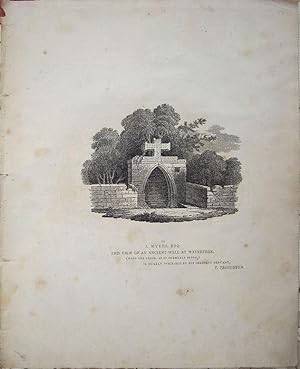
Lancashire. Liverpool. Wavertree, View of an Ancient Well.
Publicado por 1806-1808, 1806
Librería: theoldmapman, Clevedon, SOMER, Reino Unido
Calificación del vendedor: 5 de 5 estrellas
Arte / Grabado / Póster
EUR 7,12
Envío por EUR 7,49
Se envía de Reino Unido a Estados Unidos de AmericaCantidad disponible: 1 disponibles
Añadir al carritoSingle sheet. RARE. The Monks' Well at Wavertree with the cross as it formerly stood. This is a place where charitable contributions were once collected. The base of the cross (added with the cross itself in the late 19th century) bears the inscription Qui non dat quod habet Doemon infra ridet and Anno 1414, roughly meaning The Devil laughs below at he who does not give what he has. The date 1414 may not be an exaggeration. The Pevsner Guide describes the lower stonework including the arch as undoubtedly mediaeval. Moss's Liverpool Guide of 1796 states that a monastic house was once alongside. On the cross itself is the inscription Deus dedit homo bibit or God gives, man drinks. The whole lies on the site of a spring where pure water once bubbled out from the sandstone of Olive Mount. The archway, now bricked up, once led to steps giving access to a stone cistern containing water. 22 x 27 cm.
-
Lancashire. Liverpool. St. Peter's Church and Church Street.
Publicado por 1806-1808, 1806
Librería: theoldmapman, Clevedon, SOMER, Reino Unido
Calificación del vendedor: 5 de 5 estrellas
Arte / Grabado / Póster
EUR 7,12
Envío por EUR 7,49
Se envía de Reino Unido a Estados Unidos de AmericaCantidad disponible: 1 disponibles
Añadir al carritoSingle sheet. RARE. St. Peter's Church was erected in 1700. Church Street used to be cut off from Lord Street by salt water and, until the Pool was closed in 1709, Church Street and the country beyond could only be reached by crossing over the Pool by the bridge at the foot of Lord Street. Church Street remained unpaved until 1760, and was not flagged until 1816, although there were constant complaints of its muddy state, whilst one writer depicts it as a quagmire, for there was a cattle market held there once a week. Faint water stain in left margin. Paper watermarked HS 1806. 22 x 27 cm.
-
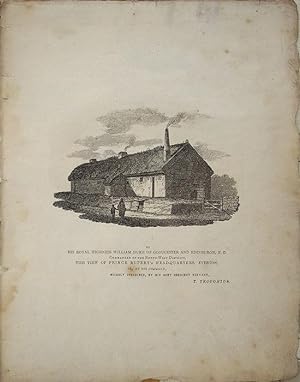
Lancashire. Liverpool. Everton, Prince Rupert's headquarters.
Publicado por 1806-1808, 1806
Librería: theoldmapman, Clevedon, SOMER, Reino Unido
Calificación del vendedor: 5 de 5 estrellas
Arte / Grabado / Póster
EUR 7,12
Envío por EUR 7,49
Se envía de Reino Unido a Estados Unidos de AmericaCantidad disponible: 1 disponibles
Añadir al carritoSingle sheet. RARE. The Royalist Army camped in the area during the English Civil War Siege of Liverpool and the capture of the castle in June 1644. Prince Rupert took up his headquarters in a cottage in Rupert Lane (hard by the barracks of much later date). The cottage stood for 200 years after Rupert's occupancy and was demolished in 1845. Meanwhile, Everton had begun rapidly to lose its sylvan beauties. Paper watermarked HS 1804. This plate was engraved by H. Hole. 22 x 27 cm.
-
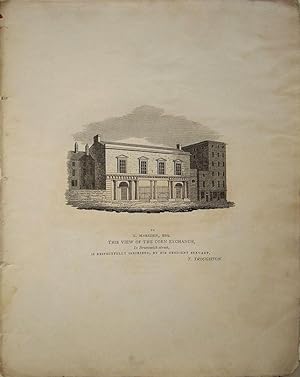
Lancashire. Liverpool. Corn Exchange.
Publicado por 1806-1808, 1806
Librería: theoldmapman, Clevedon, SOMER, Reino Unido
Calificación del vendedor: 5 de 5 estrellas
Arte / Grabado / Póster
EUR 8,31
Envío por EUR 7,49
Se envía de Reino Unido a Estados Unidos de AmericaCantidad disponible: 1 disponibles
Añadir al carritoSingle sheet. RARE. Corn Exchange on the south side of Brunswick Street. It was opened in 1808 and had the advantage over the previous exchange in Mark Lane that being completely covered in those who frequent it are secured from the inclemencies of the weather! 22 x 27 cm.
-
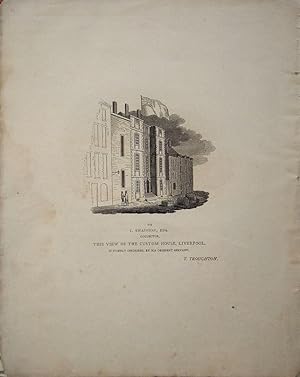
Lancashire. Liverpool. Custom House.
Publicado por 1806-1808, 1806
Librería: theoldmapman, Clevedon, SOMER, Reino Unido
Calificación del vendedor: 5 de 5 estrellas
Arte / Grabado / Póster
EUR 8,31
Envío por EUR 7,49
Se envía de Reino Unido a Estados Unidos de AmericaCantidad disponible: 1 disponibles
Añadir al carritoSingle sheet. RARE. Custom House at the end of the Old Dock. The old docks were built after an Act of Parliament was passed in 1710. The inhabitants and merchants made a large basin or wet dock, at the east end of the town. The custom house was at the east end and on the quays are shops, houses and warehouses. A guide of 1810 comments: many of which have a very old and a very inelegant appearance. In the vicinity of this dock, the streets are in general low and wet, but the rent of the houses high, and they are numerously inhabited. There was a wet dock - where ships were continuously afloat- and a dry dock-which at low tide drained of water and allowed ships to be accessed easily. Numerous vessels used the old docks such as ships from Ireland, the Mediterranean, West Indies and Africa. Faint water stain in left margin. Paper watermarked HS 1807. 22 x 27 cm.
-
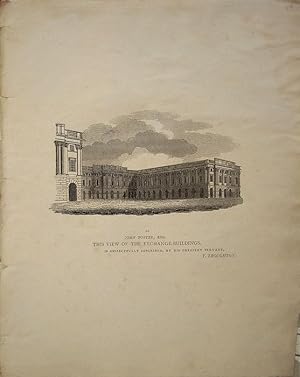
Lancashire. Liverpool. Exchange Buildings.
Publicado por 1806-1808, 1806
Librería: theoldmapman, Clevedon, SOMER, Reino Unido
Calificación del vendedor: 5 de 5 estrellas
Arte / Grabado / Póster
EUR 8,31
Envío por EUR 7,49
Se envía de Reino Unido a Estados Unidos de AmericaCantidad disponible: 1 disponibles
Añadir al carritoSingle sheet. RARE. The first stone was laid on the thirtieth of June, 1803, and the masonry completed in March, 1807. To give the greatest degree of beauty possible to this noble design, stone of a very fine quality has been obtained from the quarries of the Earl of Sefton, in Toxteth-park, near Liverpool; and a sum of eighty thousand pounds has been raised by subscription, in shares of one hundred pounds each. The area of the Liverpool Exchange-buildings, is more than twice the area of the London Exchange; that of the one is 197 feet, from north to south, and 178 feet from east to west; that of the other is 144 feet by 117; the former contains 35,066 square feet; the latter only 16,848 square feet. 22 x 27 cm.
-
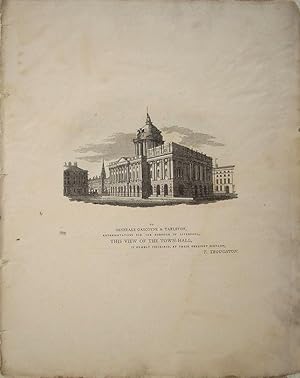
Lancashire. Liverpool. Town Hall.
Publicado por 1806-1808, 1806
Librería: theoldmapman, Clevedon, SOMER, Reino Unido
Calificación del vendedor: 5 de 5 estrellas
Arte / Grabado / Póster
EUR 8,31
Envío por EUR 7,49
Se envía de Reino Unido a Estados Unidos de AmericaCantidad disponible: 1 disponibles
Añadir al carritoSingle sheet. RARE. The Town Hall is situated near the centre of the town, having the New Exchange Buildings on the north, and Castle-street on the south. The first stone was laid in 1748, and the whole was completed in 1754. In 1795 the interior was consumed by fire, but has since been rebuilt. The expenses, including the furniture and internal decorations, were £110,000. The old cupola being thought too heavy, and not harmonizing with the rest of the structure, was removed, and the present one erected. The east and west fronts remain unchanged; but the part on the north side, which comprises the principal ball-room, has been added; and on the south side, a few years since, was built the portico and pediment; an addition that has contributed much to improve the general appearance of this edifice. 22 x 27 cm.
-
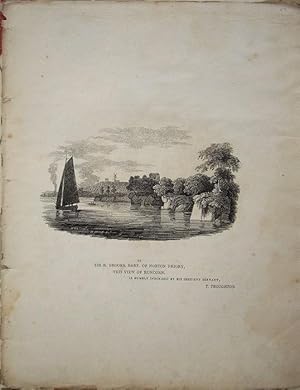
Cheshire. Runcorn.
Publicado por 1806-1808, 1806
Librería: theoldmapman, Clevedon, SOMER, Reino Unido
Calificación del vendedor: 5 de 5 estrellas
Arte / Grabado / Póster
EUR 9,49
Envío por EUR 7,49
Se envía de Reino Unido a Estados Unidos de AmericaCantidad disponible: 1 disponibles
Añadir al carritoSingle sheet. RARE. View of Runcorn from the Mersey with the tower of Holy Trinity church, which is in the old town, emerging from the trees. In the distance is a windmill which is on Windmill Hill! Faint water stain in right margin. This plate is from a drawing by I. Pen and engraved by H. Hole. 22 x 27 cm.
-
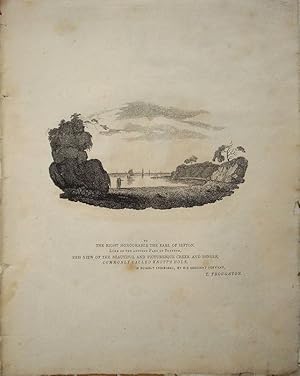
Lancashire. Liverpool. The South Shore Knotts Hole, Dingle, Liverpool 8.
Publicado por 1806-1808, 1806
Librería: theoldmapman, Clevedon, SOMER, Reino Unido
Calificación del vendedor: 5 de 5 estrellas
Arte / Grabado / Póster
EUR 9,49
Envío por EUR 7,49
Se envía de Reino Unido a Estados Unidos de AmericaCantidad disponible: 1 disponibles
Añadir al carritoSingle sheet. RARE. It was still relatively unspoilt in the 1950s and 60s when it was known as the Cast Iron Shore. After The Pool, probably the most famous of Liverpool's lost rivers was the Dingle Brook with its outlet near Knott's Hole. It gave its name to the adjacent district and, along with the surrounding wooded dell (The Dingle), the area was a famous local beauty spot for centuries. Knott's hole also provided an occasional sheltered landing place for crossing the Mersey when rough weather prevented the use of the Pier Head. The Ordnance Survey map of 1893 makes it clear that the area described as Knotts Hole was actually two little rocky coves separated by the headland known as David's Throne. Dingle Brook emptied into the southerly one of these, the other being Knott's Hole proper. Faint spots. 22 x 27 cm.
-
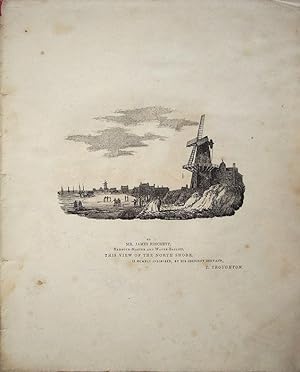
Lancashire. Liverpool. North Shore.
Publicado por 1806-1808, 1806
Librería: theoldmapman, Clevedon, SOMER, Reino Unido
Calificación del vendedor: 5 de 5 estrellas
Arte / Grabado / Póster
EUR 10,68
Envío por EUR 7,49
Se envía de Reino Unido a Estados Unidos de AmericaCantidad disponible: 1 disponibles
Añadir al carritoSingle sheet. RARE. As described in Smith's Strangers Guide to Liverpool in the year 1843: Bootle is a village about three miles distant, much frequented during summer months for sea bathing. The principal objects of attraction are the Church, which has two towers, the Water-works, and the Land-marks on the sands. The bathing and indeed a bathing machine can be seen in this engraving. Engraved by Branston. 22 x 27 cm.