

Importe total (1 artículo artículos):
Destino del pedido:

anna dina joaquin (65 resultados)
Ir a los resultados principales
Filtros de búsqueda
Tipo de artículo
- Todos los tipos de productos
- Libros (65)
- Revistas y publicaciones (No hay ningún otro resultado que coincida con este filtro.)
- Cómics (No hay ningún otro resultado que coincida con este filtro.)
- Partituras (No hay ningún otro resultado que coincida con este filtro.)
- Arte, grabados y pósters (No hay ningún otro resultado que coincida con este filtro.)
- Fotografías (No hay ningún otro resultado que coincida con este filtro.)
- Mapas (No hay ningún otro resultado que coincida con este filtro.)
- Manuscritos y coleccionismo de papel (No hay ningún otro resultado que coincida con este filtro.)
Condición Más información
- Nuevo (53)
- Como nuevo, Excelente o Muy bueno (9)
- Bueno o Aceptable (2)
- Regular o Pobre (No hay ningún otro resultado que coincida con este filtro.)
- Tal como se indica (1)
Encuadernación
Más atributos
- Primera edición (1)
- Firmado (No hay ningún otro resultado que coincida con este filtro.)
- Sobrecubierta (1)
- Con imágenes (16)
- No impresión bajo demanda (48)
Idioma (1)
Gastos de envío gratis
Ubicación del vendedor
Valoración de los vendedores
-

The Interactional Instinct: The Evolution and Acquisition of Language
Idioma: Inglés
Publicado por Oxford University Press, 2009
ISBN 10: 0195384237 ISBN 13: 9780195384239
Librería: savehere619, San Diego, CA, Estados Unidos de America
Calificación del vendedor: 4 de 5 estrellas

EUR 7,96
Gastos de envío gratis
Se envía dentro de Estados Unidos de AmericaCantidad disponible: 1 disponibles
Añadir al carritoCondición: good.
-

Interactional Instinct : The Evolution and Acquisition of Language
Idioma: Inglés
Publicado por Oxford University Press, 2009
ISBN 10: 0195384237 ISBN 13: 9780195384239
Librería: GreatBookPrices, Columbia, MD, Estados Unidos de America
Calificación del vendedor: 5 de 5 estrellas

EUR 40,21
Envío por EUR 2,27
Se envía dentro de Estados Unidos de AmericaCantidad disponible: Más de 20 disponibles
Añadir al carritoCondición: New.
-
The Interactional Instinct
Idioma: Inglés
Publicado por Oxford University Press Inc, US, 2009
ISBN 10: 0195384237 ISBN 13: 9780195384239
Librería: Rarewaves.com USA, London, LONDO, Reino Unido
Calificación del vendedor: 5 de 5 estrellas
EUR 42,56
Gastos de envío gratis
Se envía de Reino Unido a Estados Unidos de AmericaCantidad disponible: Más de 20 disponibles
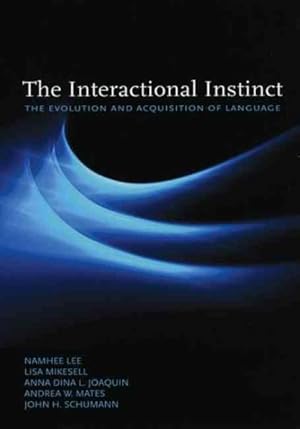
Añadir al carritoPaperback. Condición: New. Illustrated. The Interactional Instinct explores the evolution of language from the theoretical view that language could have emerged without a biologically instantiated Universal Grammar. In the first part of the book, the authors speculate that a hominid group with a lexicon of about 600 words could combine these items to make larger meanings. Combinations that are successfully produced, comprehended, and learned become part of the language. Any combination that is incompatible with human mental capacities is abandoned. The authors argue for the emergence of language structure through interaction constrained by human psychology and physiology. In the second part of the book, the authors argue that language acquisition is based on an "interactional instinct" that emotionally entrains the infant on caregivers. This relationship provides children with a motivational and attentional mechanism that ensures their acquisition of language. In adult second language acquisition, the interactional instinct is no longer operating, but in some individuals with sufficient aptitude and motivation, successful second-language acquisition can be achieved. The Interactional Instinct presents a theory of language based on linguistic, evolutionary, and biological evidence indicating that language is a culturally inherited artifact that requires no a priori hard wiring of linguistic knowledge.
-
Interactional Instinct : The Evolution and Acquisition of Language
Idioma: Inglés
Publicado por Oxford University Press, 2009
ISBN 10: 0195384237 ISBN 13: 9780195384239
Librería: GreatBookPrices, Columbia, MD, Estados Unidos de America
Calificación del vendedor: 5 de 5 estrellas
EUR 40,33
Envío por EUR 2,27
Se envía dentro de Estados Unidos de AmericaCantidad disponible: Más de 20 disponibles
Añadir al carritoCondición: As New. Unread book in perfect condition.
-
The Interactional Instinct: The Evolution and Acquisition of Language
Idioma: Inglés
Publicado por Oxford University Press, 2009
ISBN 10: 0195384237 ISBN 13: 9780195384239
Librería: Ria Christie Collections, Uxbridge, Reino Unido
Calificación del vendedor: 5 de 5 estrellas
EUR 39,77
Envío por EUR 13,86
Se envía de Reino Unido a Estados Unidos de AmericaCantidad disponible: Más de 20 disponibles
Añadir al carritoCondición: New. In.
-
The Interactional Instinct: The Evolution and Acquisition of Language
Idioma: Inglés
Publicado por Oxford University Press, USA 2009-05-21, 2009
ISBN 10: 0195384237 ISBN 13: 9780195384239
Librería: Chiron Media, Wallingford, Reino Unido
Calificación del vendedor: 5 de 5 estrellas
EUR 35,73
Envío por EUR 17,92
Se envía de Reino Unido a Estados Unidos de AmericaCantidad disponible: 10 disponibles
Añadir al carritoPaperback. Condición: New.
-
Interactional Instinct : The Evolution and Acquisition of Language
Idioma: Inglés
Publicado por Oxford University Press, 2009
ISBN 10: 0195384237 ISBN 13: 9780195384239
Librería: GreatBookPricesUK, Woodford Green, Reino Unido
Calificación del vendedor: 5 de 5 estrellas
EUR 38,68
Envío por EUR 17,35
Se envía de Reino Unido a Estados Unidos de AmericaCantidad disponible: Más de 20 disponibles
Añadir al carritoCondición: New.
-
The Interactional Instinct. The Evolution and Acquisition of Language.
Idioma: Inglés
Publicado por Oxford University Press Inc, 2009
ISBN 10: 0195384237 ISBN 13: 9780195384239
Librería: Kennys Bookshop and Art Galleries Ltd., Galway, GY, Irlanda
Calificación del vendedor: 5 de 5 estrellas
EUR 45,30
Envío por EUR 10,50
Se envía de Irlanda a Estados Unidos de AmericaCantidad disponible: Más de 20 disponibles
Añadir al carritoCondición: New. The Interactional Instinct presents a theory of language based on linguistic, evolutionary, and biological evidence indicating that language is a culturally inherited artifact that requires no a priori hard wiring of linguistic knowledge. Its structure evolved phylo- genetically from interaction among speakers and is acquired through emotionally entrained interaction with conspecifics. Num Pages: 248 pages, 11 black and white half tone, 7 line illustrations. BIC Classification: CF; JMR. Category: (U) Tertiary Education (US: College). Dimension: 232 x 157 x 15. Weight in Grams: 362. . 2009. Paperback. . . . .
-

Exploring the Interactional Instinct
Libro 1 de 15: FOUNDATIONS OF HUMAN INTERACTIONIdioma: Inglés
Publicado por Oxford University Press, New York, 2013
ISBN 10: 0199927006 ISBN 13: 9780199927005
Librería: Row By Row Bookshop, Sugar Grove, NC, Estados Unidos de America
Calificación del vendedor: 5 de 5 estrellas
Original o primera edición
EUR 53,23
Envío por EUR 4,31
Se envía dentro de Estados Unidos de AmericaCantidad disponible: 1 disponibles
Añadir al carritoHardcover. Condición: Good. Estado de la sobrecubierta: Good. First Edition. An ex-library copy in black hard covers lettered in silver, in a well-protected dust jacket with a spine label. The usual ex-libris markings (but no card pocket). The binding is sound, the text is clean/unmarked, and there is little cover wear. Book.
-
Interactional Instinct : The Evolution and Acquisition of Language
Idioma: Inglés
Publicado por Oxford University Press, 2009
ISBN 10: 0195384237 ISBN 13: 9780195384239
Librería: GreatBookPricesUK, Woodford Green, Reino Unido
Calificación del vendedor: 5 de 5 estrellas
EUR 43,22
Envío por EUR 17,35
Se envía de Reino Unido a Estados Unidos de AmericaCantidad disponible: Más de 20 disponibles
Añadir al carritoCondición: As New. Unread book in perfect condition.
-
The Interactional Instinct. The Evolution and Acquisition of Language.
Idioma: Inglés
Publicado por Oxford University Press Inc, 2009
ISBN 10: 0195384237 ISBN 13: 9780195384239
Librería: Kennys Bookstore, Olney, MD, Estados Unidos de America
Calificación del vendedor: 5 de 5 estrellas
EUR 55,19
Envío por EUR 9,04
Se envía dentro de Estados Unidos de AmericaCantidad disponible: Más de 20 disponibles
Añadir al carritoCondición: New. The Interactional Instinct presents a theory of language based on linguistic, evolutionary, and biological evidence indicating that language is a culturally inherited artifact that requires no a priori hard wiring of linguistic knowledge. Its structure evolved phylo- genetically from interaction among speakers and is acquired through emotionally entrained interaction with conspecifics. Num Pages: 248 pages, 11 black and white half tone, 7 line illustrations. BIC Classification: CF; JMR. Category: (U) Tertiary Education (US: College). Dimension: 232 x 157 x 15. Weight in Grams: 362. . 2009. Paperback. . . . . Books ship from the US and Ireland.
-

Enculturation Processes in Primary Language Acquisition
Idioma: Inglés
Publicado por Equinox Publishing Ltd, 2013
ISBN 10: 1908049995 ISBN 13: 9781908049995
Librería: WYEMART LIMITED, HEREFORD, Reino Unido
Calificación del vendedor: 5 de 5 estrellas
EUR 62,19
Envío por EUR 13,88
Se envía de Reino Unido a Estados Unidos de AmericaCantidad disponible: 1 disponibles
Añadir al carritohardcover. Condición: New.
-
Enculturation Processes in Primary Language Acquisition
Idioma: Inglés
Publicado por MY - University of Toronto Press, 2013
ISBN 10: 1908049995 ISBN 13: 9781908049995
Librería: PBShop.store UK, Fairford, GLOS, Reino Unido
Calificación del vendedor: 5 de 5 estrellas
EUR 74,07
Envío por EUR 4,81
Se envía de Reino Unido a Estados Unidos de AmericaCantidad disponible: 15 disponibles
Añadir al carritoHRD. Condición: New. New Book. Shipped from UK. Established seller since 2000.
-

Enculturation Processes in Primary Language Acquisition
Idioma: Inglés
Publicado por Equinox Publishing Ltd, GB, 2013
ISBN 10: 1908049995 ISBN 13: 9781908049995
Librería: Rarewaves.com USA, London, LONDO, Reino Unido
Calificación del vendedor: 5 de 5 estrellas
EUR 84,51
Gastos de envío gratis
Se envía de Reino Unido a Estados Unidos de AmericaCantidad disponible: 5 disponibles
Añadir al carritoHardback. Condición: New. This book explores how language is acquired via enculturation. It combines research and perspectives from anthropology, sociology, applied linguistics, developmental psychology and neurobiology to argue for a theory of language acquisition via enculturation. The first part of the book examines the practices by which we are enculturated. Indeed, members of a society are socialized into their culture, and more specifically to use language through language via processes that include eavesdropping, observation, participation, imitation, and language socialization. However, ethnographic accounts also overwhelmingly show that children become enculturated in large part on their own initiative. Thus, the second part of the book argues for a motivation to attune to, seek out, and become like others - or an Interactional Instinct, which facilitates enculturation and the biology that subserves it. The final chapters explore more of our biological readiness and the neurological structures and systems that may have evolved to respond to the input provided by society to facilitate the learning of cultural practices and traditions by its youth.The picture that emerges indicates that biology is nature and culture is nurture, but there is no nurture without nature, and it is nurture that provides for the phylogenetic development of our biological nature. The ontogenesis of language behavior, i.e. its acquisition, cannot occur without its evolved biology or without its evolved cultural practices for socialization.
-
The Interactional Instinct: The Evolution and Acquisition of Language
Librería: Roland Antiquariat UG haftungsbeschränkt, Weinheim, Alemania
Calificación del vendedor: 5 de 5 estrellas
EUR 39,90
Envío por EUR 42,00
Se envía de Alemania a Estados Unidos de AmericaCantidad disponible: 1 disponibles
Añadir al carritoHardcover: 23.6 x 2 x 15.5 cm. New. 248 p. Unread book. Very good condition. Minimum traces of storage. No dust jacket. 9780195384246 Sprache: Englisch Gewicht in Gramm: 454.
-

Exploring the Interactional Instinct
Libro 1 de 15: FOUNDATIONS OF HUMAN INTERACTIONIdioma: Inglés
Publicado por Oxford University Press, 2013
ISBN 10: 0199927006 ISBN 13: 9780199927005
Librería: GreatBookPrices, Columbia, MD, Estados Unidos de America
Calificación del vendedor: 5 de 5 estrellas
EUR 97,64
Envío por EUR 2,27
Se envía dentro de Estados Unidos de AmericaCantidad disponible: Más de 20 disponibles
Añadir al carritoCondición: New.
-
Enculturation Processes in Primary Language Acquisition
Idioma: Inglés
Publicado por University of Toronto Press, 2013
ISBN 10: 1908049995 ISBN 13: 9781908049995
Librería: GreatBookPrices, Columbia, MD, Estados Unidos de America
Calificación del vendedor: 5 de 5 estrellas
EUR 97,73
Envío por EUR 2,27
Se envía dentro de Estados Unidos de AmericaCantidad disponible: Más de 20 disponibles
Añadir al carritoCondición: New.
-
Enculturation Processes in Primary Language Acquisition (Hardcover)
Idioma: Inglés
Publicado por Equinox Publishing Ltd, London, 2013
ISBN 10: 1908049995 ISBN 13: 9781908049995
Librería: Grand Eagle Retail, Bensenville, IL, Estados Unidos de America
Calificación del vendedor: 5 de 5 estrellas
EUR 100,08
Gastos de envío gratis
Se envía dentro de Estados Unidos de AmericaCantidad disponible: 1 disponibles
Añadir al carritoHardcover. Condición: new. Hardcover. This book combines research and perspectives from anthropology, sociology, applied linguistics, developmental psychology and neurobiology to argue for a theory of language acquisition via enculturation.The first part of the book examines the practices by which we are enculturated. Indeed, members of a society are socialized into their culture, and more specifically to use language through language via processes that include eavesdropping, observation, participation, imitation, and language socialization. However, ethnographic accounts also overwhelmingly show that children become enculturated in large part on their own initiative. The second part of the book argues for a motivation to attune to, seek out, and become like others-or an 'interactional instinct', which facilitates enculturation and the biology that subserves it. The closing chapters explore more of our biological readiness and the neurological structures and systems that may have evolved to respond to the input provided by society to facilitate the learning of cultural practices and traditions by its youth. The picture that emerges indicates that biology is nature and culture is nurture, but there is no nurture without nature, and it is nurture that provides for the phylogenetic development of our biological nature. The ontogenesis of language behavior, i.e. its acquisition, cannot occur without its evolved biology or without its evolved cultural practices for socialization. This book explores how language is acquired via enculturation. It combines research and perspectives from anthropology, sociology, applied linguistics, developmental psychology and neurobiology to argue for a theory of language acquisition via enculturation. Shipping may be from multiple locations in the US or from the UK, depending on stock availability.
-
Enculturation Processes in Primary Language Acquisition
Idioma: Inglés
Publicado por Equinox Publishing Ltd, 2013
ISBN 10: 1908049995 ISBN 13: 9781908049995
Librería: THE SAINT BOOKSTORE, Southport, Reino Unido
Calificación del vendedor: 5 de 5 estrellas
EUR 82,73
Envío por EUR 18,55
Se envía de Reino Unido a Estados Unidos de AmericaCantidad disponible: Más de 20 disponibles
Añadir al carritoHardback. Condición: New. New copy - Usually dispatched within 4 working days.
-
The Interactional Instinct: The Evolution and Acquisition of Language
Idioma: Inglés
Publicado por Oxford University Press, 2009
ISBN 10: 0195384245 ISBN 13: 9780195384246
Librería: StainesBook, Weybridge, SURRE, Reino Unido
Calificación del vendedor: 1 de 5 estrellas

EUR 66,57
Envío por EUR 34,70
Se envía de Reino Unido a Estados Unidos de AmericaCantidad disponible: 2 disponibles
Añadir al carritoCondición: New.
-
Enculturation Processes in Primary Language Acquisition
Idioma: Inglés
Publicado por University of Toronto Press, 2013
ISBN 10: 1908049995 ISBN 13: 9781908049995
Librería: GreatBookPrices, Columbia, MD, Estados Unidos de America
Calificación del vendedor: 5 de 5 estrellas
EUR 103,16
Envío por EUR 2,27
Se envía dentro de Estados Unidos de AmericaCantidad disponible: Más de 20 disponibles
Añadir al carritoCondición: As New. Unread book in perfect condition.
-
Exploring the Interactional Instinct
Libro 1 de 15: FOUNDATIONS OF HUMAN INTERACTIONIdioma: Inglés
Publicado por Oxford University Press Inc, 2014
ISBN 10: 0199927006 ISBN 13: 9780199927005
Librería: Asano Bookshop, Nagoya, AICHI, Japon
Calificación del vendedor: 5 de 5 estrellas
EUR 72,75
Envío por EUR 31,87
Se envía de Japon a Estados Unidos de AmericaCantidad disponible: 1 disponibles
Añadir al carritoCondición: Brand New. Examines interaction in second language acquisition, in different cultures, in different species, in observation without participation, in literacy, in schizophrenia, in relation to human physiological responses, and in relation to correlated perspectives on interaction.
-
Enculturation Processes in Primary Language Acquisition
Idioma: Inglés
Publicado por Equinox Publishing Limited, 2013
ISBN 10: 1908049995 ISBN 13: 9781908049995
Librería: Majestic Books, Hounslow, Reino Unido
Calificación del vendedor: 4 de 5 estrellas
EUR 100,48
Envío por EUR 7,52
Se envía de Reino Unido a Estados Unidos de AmericaCantidad disponible: 3 disponibles
Añadir al carritoCondición: New. pp. 240.
-
Exploring the Interactional Instinct (Foundations of Human Interaction)
Libro 1 de 15: FOUNDATIONS OF HUMAN INTERACTIONIdioma: Inglés
Publicado por Oxford University Press, 2013
ISBN 10: 0199927006 ISBN 13: 9780199927005
Librería: Ria Christie Collections, Uxbridge, Reino Unido
Calificación del vendedor: 5 de 5 estrellas
EUR 94,84
Envío por EUR 13,86
Se envía de Reino Unido a Estados Unidos de AmericaCantidad disponible: Más de 20 disponibles
Añadir al carritoCondición: New. In.
-
Enculturation Processes in Primary Language Acquisition (eng)
Idioma: Inglés
Publicado por Equinox Publishing Ltd, 2013
ISBN 10: 1908049995 ISBN 13: 9781908049995
Librería: Brook Bookstore On Demand, Napoli, NA, Italia
Calificación del vendedor: 3 de 5 estrellas

EUR 94,99
Envío por EUR 13,50
Se envía de Italia a Estados Unidos de AmericaCantidad disponible: Más de 20 disponibles
Añadir al carritoCondición: new.
-
Exploring the Interactional Instinct
Libro 1 de 15: FOUNDATIONS OF HUMAN INTERACTIONIdioma: Inglés
Publicado por Oxford University Press, 2013
ISBN 10: 0199927006 ISBN 13: 9780199927005
Librería: GreatBookPricesUK, Woodford Green, Reino Unido
Calificación del vendedor: 5 de 5 estrellas
EUR 94,83
Envío por EUR 17,35
Se envía de Reino Unido a Estados Unidos de AmericaCantidad disponible: Más de 20 disponibles
Añadir al carritoCondición: New.
-
The Interactional Instinct
Idioma: Inglés
Publicado por Oxford University Press Inc, US, 2009
ISBN 10: 0195384237 ISBN 13: 9780195384239
Librería: Rarewaves.com UK, London, Reino Unido
Calificación del vendedor: 5 de 5 estrellas
EUR 38,91
Envío por EUR 75,18
Se envía de Reino Unido a Estados Unidos de AmericaCantidad disponible: Más de 20 disponibles
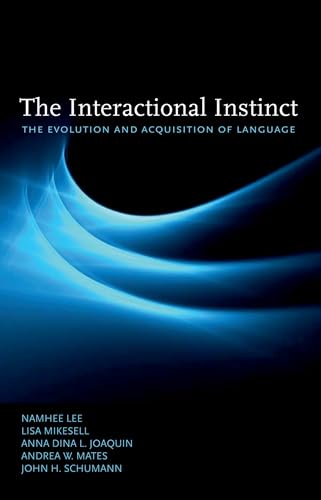
Añadir al carritoPaperback. Condición: New. Illustrated. The Interactional Instinct explores the evolution of language from the theoretical view that language could have emerged without a biologically instantiated Universal Grammar. In the first part of the book, the authors speculate that a hominid group with a lexicon of about 600 words could combine these items to make larger meanings. Combinations that are successfully produced, comprehended, and learned become part of the language. Any combination that is incompatible with human mental capacities is abandoned. The authors argue for the emergence of language structure through interaction constrained by human psychology and physiology. In the second part of the book, the authors argue that language acquisition is based on an "interactional instinct" that emotionally entrains the infant on caregivers. This relationship provides children with a motivational and attentional mechanism that ensures their acquisition of language. In adult second language acquisition, the interactional instinct is no longer operating, but in some individuals with sufficient aptitude and motivation, successful second-language acquisition can be achieved. The Interactional Instinct presents a theory of language based on linguistic, evolutionary, and biological evidence indicating that language is a culturally inherited artifact that requires no a priori hard wiring of linguistic knowledge.
-
Enculturation Processes in Primary Language Acquisition
Idioma: Inglés
Publicado por Equinox Publishing Limited, 2013
ISBN 10: 1908049995 ISBN 13: 9781908049995
Librería: Books Puddle, New York, NY, Estados Unidos de America
Calificación del vendedor: 4 de 5 estrellas
EUR 114,48
Envío por EUR 3,44
Se envía dentro de Estados Unidos de AmericaCantidad disponible: 3 disponibles
Añadir al carritoCondición: New. pp. 240.
-
Enculturation Processes in Primary Language Acquis ition
Librería: Revaluation Books, Exeter, Reino Unido
Calificación del vendedor: 5 de 5 estrellas
EUR 106,97
Envío por EUR 11,57
Se envía de Reino Unido a Estados Unidos de AmericaCantidad disponible: 2 disponibles
Añadir al carritoHardcover. Condición: Brand New. 240 pages. 9.30x6.40x0.80 inches. In Stock.
-

Exploring the Interactional Instinct
Libro 1 de 15: FOUNDATIONS OF HUMAN INTERACTIONIdioma: Inglés
Publicado por Oxford University Press Inc, US, 2014
ISBN 10: 0199927006 ISBN 13: 9780199927005
Librería: Rarewaves.com USA, London, LONDO, Reino Unido
Calificación del vendedor: 5 de 5 estrellas
EUR 121,05
Gastos de envío gratis
Se envía de Reino Unido a Estados Unidos de AmericaCantidad disponible: Más de 20 disponibles
Añadir al carritoHardback. Condición: New. The Interactional Instinct (Oxford University Press, 2009) argued that the ubiquitous acquisition of language by all normal children was the result of a biologically-based drive for infants and children to attach, bond, and affiliate with conspecifics in an attempt to become like them. This instinct leads children to seek out verbal interaction with caregivers and allows them to become competent language speakers by about age 8. In Exploring the Interactional Instinct, scholars in applied linguistics expand the theory by examining interaction in second language acquisition; in different cultures and species; in observation without participation; in literacy; in schizophrenia; in relation to human physiological responses; and in relation to correlated perspectives on interaction. This book, like its predecessor, offers a radical view of language acquisition: language is not acquired as a result of a Language Acquisition Device in the brain, but is rather a cultural artifact universally acquired by all normal children.


