
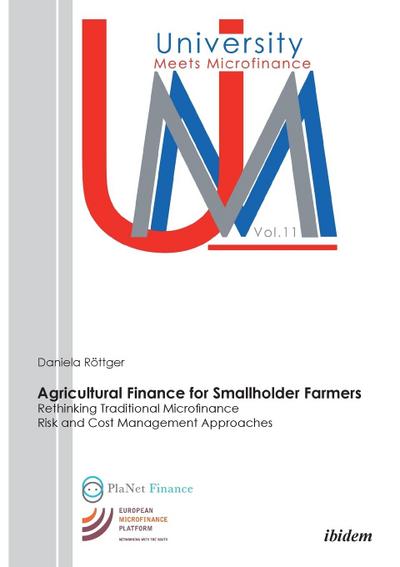

Agricultural Finance for Smallholder Farmers. Rethinking Traditional Microfinance Risk and Cost Management Approaches
Daniela Röttger
ISBN 10: 3838207459 ISBN 13: 9783838207452
Editorial: Ibidem, Ibidem-Verlag, 2015
Nuevos
Taschenbuch
Librería:
AHA-BUCH GmbH, Einbeck, Alemania
Calificación del vendedor: 5 de 5 estrellas

Vendedor de AbeBooks desde 14 de agosto de 2006
Este artículo en concreto ya no está disponible.
Descripción
Descripción:
nach der Bestellung gedruckt Neuware - Printed after ordering - Even though traditional microfinance has successfully paved the way for offering financial services to low-income populations without traditional collateral, many microfinance institutions (MFIs) are still reluctant to move into rural areas and agricultural finance, due to the perceived high risks and costs. Daniela Röttger`s research demonstrates how MFIs can mitigate risks and costs of lending to smallholder farmers by using a combination of proven traditional microfinance mechanisms while adapting specific loan features and lending mechanisms to the particularities of smallholder agriculture. She systematically compares traditional microfinance risk management mechanisms with agricultural microfinance approaches and identifies successful strategies. For this purpose, eight MFIs providing agricultural finance to smallholder farmers in four countries in East and West Africa (Uganda, Kenya, Benin, Cameroon) were interviewed and their loan features and agricultural lending mechanism were analyzed. The study shows that MFIs can successfully serve smallholder farmers in rural areas. However, the extent of adaptations is reason enough not to commit to such an endeavor lightly. A strong commitment combined with sound in-house knowledge of agricultural value chains and the flexibility to adapt loan terms and lending procedures to the particularities of agriculture are needed to successfully develop and sustain agricultural microfinance. N° de ref. del artículo 9783838207452
Sinopsis:
Even though traditional microfinance has successfully paved the way for offering financial services to low-income populations without traditional collateral, many microfinance institutions (Mfis) are still reluctant to move into rural areas and agricultural finance, due to the perceived high risks and costs.
Daniela Röttger`s research demonstrates how Mfis can mitigate risks and costs of lending to smallholder farmers by using a combination of proven traditional microfinance mechanisms while adapting specific loan features and lending mechanisms to the particularities of smallholder agriculture. She systematically compares traditional microfinance risk management mechanisms with agricultural microfinance approaches and identifies successful strategies. For this purpose, eight Mfis providing agricultural finance to smallholder farmers in four countries in East and West Africa (Uganda, Kenya, Benin, Cameroon) were interviewed and their loan features and agricultural lending mechanism were analyzed.
The study shows that Mfis can successfully serve smallholder farmers in rural areas. However, the extent of adaptations is reason enough not to commit to such an endeavor lightly. A strong commitment combined with sound in-house knowledge of agricultural value chains and the flexibility to adapt loan terms and lending procedures to the particularities of agriculture are needed to successfully develop and sustain agricultural microfinance.
Acerca del autor: Daniela R�ttger, M.A., won the 2013 University Meets Microfinance (UMM) award. She works as an independent consultant for microfinance and monitoring & evaluation, amongst others for the Competitive African Cotton Initiative (COMPACI).
"Sobre este título" puede pertenecer a otra edición de este libro.
Detalles bibliográficos
Título: Agricultural Finance for Smallholder Farmers...
Editorial: Ibidem, Ibidem-Verlag
Año de publicación: 2015
Encuadernación: Taschenbuch
Condición: Neu