
Artículos relacionados a How Many Languages Do We Need?: The Economics of Linguistic...
Sinopsis
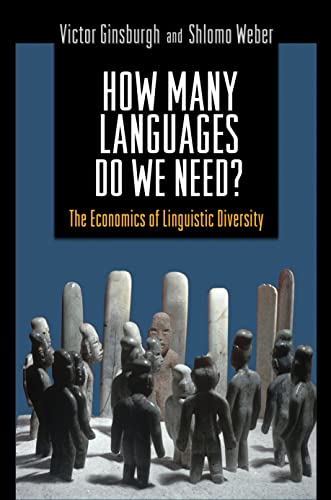
In the global economy, linguistic diversity influences economic and political development as well as public policies in positive and negative ways. It leads to financial costs, communication barriers, divisions in national unity, and, in some extreme cases, conflicts and war--but it also produces benefits related to group and individual identity. What are the specific advantages and disadvantages of linguistic diversity and how does it influence social and economic progress? This book examines linguistic diversity as a global social phenomenon and considers what degree of linguistic variety might result in the greatest economic good. Victor Ginsburgh and Shlomo Weber look at linguistic proximity between groups and between languages. They describe and use simple economic, linguistic, and statistical tools to measure diversity's impact on growth, development, trade, the quality of institutions, translation issues, voting patterns in multinational competitions, and the likelihood and intensity of civil conflicts. They address the choosing of core languages in a multilingual community, such as the European Union, and argue that although too many official languages might harm cohesiveness, efficiency, and communication, reducing their number brings about alienation and disenfranchisement of groups. Demonstrating that the value and drawbacks of linguistic diversity are universal, How Many Languages Do We Need? suggests ways for designing appropriate linguistic policies for today's multilingual world.
"Sinopsis" puede pertenecer a otra edición de este libro.
Acerca del autor
Victor Ginsburgh is professor of economics emeritus, member of the European Center for Advanced Research in Economics and Statistics, Brussels, and member of the Center of Operations Research and Econometrics, Louvain-la-Neuve, Belgium. Shlomo Weber is the Robert H. and Nancy Dedman Trustee Professor of Economics at Southern Methodist University and professor of economics at the New Economic School, Moscow.
De la contraportada
"A language is both a means of communication and a repository of culture. By limiting the number of languages, we make it easier for people to understand one another, but we leave the world a less interesting place. Victor Ginsburgh and Shlomo Weber explore this trade-off and much else in their rich and fascinating book."--Eric S. Maskin, Nobel Laureate in Economics
"The authors succeed brilliantly in laying out a coherent framework that explains the critical and substantive issues for the economics of linguistic diversity."--Antonio Merlo, University of Pennsylvania
"Language is what unifies people. It is also what divides them. This paradox was first observed in the Biblical story of the Tower of Babel, and the contradiction continues to plague modern times. Ginsburgh and Weber provide a brilliant analysis of this persistent and urgent problem, and they explore this vital question: given that linguistic diversity has costs, how much diversity can we afford in today's world?"--Dean Keith Simonton, University of California, Davis
"This book's argument is straightforward, the volume of literature assembled is impressive, and the econometric contribution is excellent. The authors prove that econometric methods can be expanded into a field as challenging as linguistic diversity."--Michael Hutter, Technische Universität Berlin
"While there has been a great deal of work on linguistic diversity in economics over the last twenty years, no book has emerged on the topic to date. Examining matters from ethnography to labor, political, cultural, and trade issues, this accessible and important book fills the void."--Jacques Melitz, Heriot-Watt University
"There are few subjects as complex and sensitive as the use of languages in a society. The affection of an individual for his language reflects on the whole social group and the language becomes the property of the clan, tribe, territory, and nation. This book describes the range of issues that this raises and the complexities of the trade-off between protecting languages and the possible gains that would result from a reduction of their number."--Michel Vanden Abeele, former director general, Directorate-General for Translation of the European Commission
Fragmento. © Reproducción autorizada. Todos los derechos reservados.
HOW MANY LANGUAGES DO WE NEED?
THE ECONOMICS OF LINGUISTIC DIVERSITYBy Victor Ginsburgh Shlomo WeberPRINCETON UNIVERSITY PRESS
Copyright © 2011 Princeton University PressAll right reserved.
ISBN: 978-0-691-13689-9
Contents
Acknowledgments................................................................................ixIntroduction...................................................................................11 My Language Is My Homeland...................................................................72 Linguistic Policies, Disenfranchisement, and Standardization.................................163 Linguistic, Genetic, and Cultural Distances: How Far Is Nostratic?...........................294 Distances Matter.............................................................................565 Individual Communicative Benefits............................................................846 Diversity and Disenfranchisement Indices.....................................................1087 Diversity and Disenfranchisement: Applications...............................................1428 Multilingualism in the European Union: A Case Study in Linguistic Policy.....................162Conclusions....................................................................................201Bibliography...................................................................................205Index..........................................................................................223
Chapter One
MY LANGUAGE IS MY HOMELANDMinha pátria é minha lengua. —Fernando Pessoa
Russian and Swahili. The authors of this book have two different native languages, Swahili and Russian. A few years ago, the Russian native speaker accompanied the Swahili native speaker on a trip to Belarus in search of traces of the latter's father, born in Vitebsk (as was Marc Chagall, at approximately the same time). The hotel receptionist was totally confused by the fact that the traveler with a Russian–Jewish name (the Swahili speaker) could not utter a word of Russian, while the other, with a German name, spoke fluent Russian. This was without the receptionist's knowing that the visitor with whom she was unable to communicate was a native Swahili speaker. The fruits of globalization, as we say. We live in a world where individuals, families, and communities often uproot themselves, voluntarily or involuntary, and move to another place, country, or even continent. In fact, both of the authors have gone through this experience at different stages of their lives. One of us was given less than a week to collect his belongings before leaving his native country. What does one take on a journey to a distant, unfamiliar land? Books,memories, records? A verymoving response to that dilemma is given by Ariel Dorfman, whose work was mentioned in the introduction. Dorfman (2002, 89) recalls Gabriel García Márquez's story of entire Colombian villages that migrated:
Fleeing from catastrophes, plagues perhaps, or recurrent floods, or merely the desolation of being caught in the middle of civil wars, inhabitants of these villages decided, at some point in history, to uproot themselves, moving to a remote location in search of peace. As they packed every belonging that could be transported, they did not forget what was most important to them: their dead. According to García Márquez, these villagers, on the verge of becoming nomads, dug up the bones in the cemetery and, in effect, carried their ancestors into the unknown, probably animated by the need to defy the fluctuations of time and geography with the illusion that something from the past permeates the present, forming a hard physical link to memory at a time of devastating change.
Even though the desire to sustain links with the past is not always expressed in such a dramatic form, an important part of cultural history and heritage is invariably linked with language. The sensitivity of linguistic identity is forcefully underlined by Henry Bretton (1976, 447):
Language then may indeed be the most explosive issue universally and over time. This mainly because language alone, unlike all other concerns associated with nationalism and ethnocentrism ... is so closely tied to the individual self. Fear of being deprived of communicating skills seems to raise political passions to a fever pitch.
When moving to distant lands, migrants take with them their language and begin a never-ending romance with it. Dorfman (2002, 90) continues:
That language, which contains the seeds of their most intimate identity, will be put to the test when the voyage is over, especially if the migrants are moving to a foreign land. This is because those who await them at the new location have their own dead, their own ceremonies and cemeteries, and, of course, their own tongue.
The voyage, even if accomplished successfully (whatever this means), leaves deep marks and scars. We learn different languages, assume different linguistic identities that may confuse others and sometimes ourselves.
The threat to the survival of values, practices, and history that is posed by migrations is not limited to individuals and communities. History is full of examples (and we discuss some of them in subsequent chapters) of linguistic groups and regions whose experiences include language conflict, inherent incompatibilities between language communities, reluctance of the majority group to concede linguistic rights to minorities, the power of civil servants to protect their linguistic privileges, and the important and unpredictable material and symbolic consequences of linguistic choices (Pool 1991).
Even entire countries can feel insecure about their linguistic survival under threats coming from outside. Consider Iceland, one of the few monolingual countries in the world and practically the only surviving example in Europe of a linguistically homogeneous nation-state. Almost every Icelander speaks Icelandic as a first language and uses it as the dominant language in all spheres of life (Vikor 2000). Even without an internal linguistic issue, however, the country still felt compelled to protect its own identity, closely linked with its language. For about four hundred years there were numerous attempts to purge the Icelandic language of foreign, mostly Danish, influence. More recently, the dominance of English has become a serious threat to Icelandic identity, which developed through centuries of isolation, literary works, and the fostering of independent cultural values. The protection of their language included the successful attempt by Icelanders to persuade Microsoft to add Icelandic to the list of languages supported by Windows. It took more than six years of persistent lobbying by Icelandic authorities to overturn an initial refusal by Microsoft, but in 2004 the company produced an Icelandic version of Windows XP and the Office Packet of associated programs (Corgan 2004). In the beginning of the twenty-first century Iceland was still spending about 3 percent of its gross domestic product on activities related to the promotion and defense of its language, including translating and printing an astonishing number of foreign textbooks and fiction. Recently, Iceland engaged in serious attempts to become a member of the EU. While the survival of the language is not usually listed as a reason for the European shift in the country's foreign policy, one can notice, nevertheless, that the language's protection would receive a tremendous boost from the EU's multilingualism policy.
Iceland notwithstanding, almost all countries are multilingual. Indeed, the 2009 edition of Ethnologue lists 6,909 distinct living languages spoken all over the world, and since there are only 271 nations, dependencies, and other entities, the issue of linguistic diversity appears almost everywhere. Even though many of these nearly seven thousand languages are spoken in small and often remote and isolated communities, ethnic and linguistic heterogeneity is not an exclusively Third World phenomenon. Despite a long tradition of nation-states in Western Europe, most countries there are multilingual, with a plethora of indigenous regional languages such as Welsh in the United Kingdom, Catalan, Basque, and Galician in Spain, Provençal, Breton, and Occitan in France, and Frisian in the Netherlands. Obviously, in the study of societies that consist of several groups of citizens, one has to take into account various aspects of diversity, including wealth, geography, history, religion, and ethnicity. Each of these factors has an effect on the strength of the country's economic and political institutions, its growth, its stability, and its patterns of wealth redistribution.
The preservation of linguistic diversity and respect for the cultural heritage of members of a society is an important and much-needed task. However, in making policy and operational decisions, one has to recognize two caveats in protecting an excessive degree of diversity:
There is no free lunch for diversity. Sustaining a high degree of societal diversity could require allocating substantial resources to creating educational institutions and developing communication and coordination between groups. The financial cost and communication barriers may have a negative impact on national unity and, in general, may heavily burden the proper functioning of the society's institutions. It is difficult to assign a precise cost to sustaining diversity, but this cost nevertheless exists and is, in some cases, far from negligible. As Harvard economist Martin Weitzman (1992, 363) points out:
Often there is an implicit injunction to preserve diversity because it represents a higher value than other things, which by comparison are "only money." Yet laws of economics apply to diversity also. We cannot preserve everything. There are no free lunches for diversity. Given our limited resources, preservation of diversity in one context can only be accomplished at some real opportunity cost in terms of well-being forgone in other spheres of life, including, possibly, a loss of diversity somewhere else in the system.
When is the meal too salty? How much salt dowe want in our meal? No salt is not good at all for most customers, but by gradually increasing the amount of salt, we may quickly move from tasteless to uneatable. Shouldn't there be an optimal amount of salt, not too little, not too much? Also, how many spoons of sugar are needed for our morning coffee or tea? Some do not use sugar at all, Russians put three or four spoonfuls in their tea and drink the tea with the spoon in the cup, continually stirring their sticky beverage. Again, an optimum has to be found somewhere between zero and four, five, or six. Some art lovers may find black-and-white paintings rather dull, but adding an excessive number of colors does not necessarily make a painting more attractive. In all these examples—salt, sugar, colors—there exists an optimal degree of diversity that ensures a tasty meal, a pleasant cup of coffee, or sometimes a beautiful painting.
A study of diverse societies may suggest that there is an upper bound to the degree of heterogeneity that still guarantees proper and sustainable functioning. If it is too diverse, the society may fail to develop and implement policies acceptable for large groups of its citizens, and even the basis of societal existence could be questioned and threatened. The challenges of making everybody happy or even obedient are tremendous, and the eventual collapse of the Macedonian, Roman, Ottoman, and Mongolian empires was in large part caused by the inability of their rulers to keep all diverse and distant parts of their kingdoms under a unified rule. This happened not that long ago with the Russian empire, and it is happening now in China with Tibet and Xinjiang. One can wonder (as many do) whether the potential inclusion of countries such as Turkey and Ukraine in the EU would increase diversity within the EU to a degree that would rule out a reasonable compromise among its members.
Naturally, the determination of linguistic policies that reflect an "optimal" degree of diversity is a very challenging and delicate task. After all, language, like religion, "does not lend itself easily to compromise" (Laponce 1992, 599). Since language is an intimate part of individual and group identity, restricting linguistic rights may alienate and disenfranchise groups of individuals whose cultural, societal, and historical values and sensibilities are perceived to be threatened. The long and bloody ethnic conflict in Sri Lanka, the main roots of which lie in the complex relationship between two major linguistic groups, the Sinhalese and the Tamils, shows how emotional and explosive the restriction of linguistic rights may become.
The design of desirable linguistic policies in a multilingual society should also take into account the place of English in our current economic, social, scientific, educational, and cultural environment. As Abram De Swaan (2001, 186) points out, "All societies in the contemporary world are being transformed by the spectacular increase of trade, transport and electronic communication. This 'globalization' proceeds in English." David Crystal (1999, 105) estimates that English is spoken by about one and a half billion people: 400 million use it as a mother tongue, 400 million as a second language, at least 150 million use it fluently as foreign language, and "four or five times this number with some degree of competence." Actually, the current role of English was accurately predicted by Alphonse de Candolle, a prominent Swiss scientist (not a linguist), in an essay written in French and published in 1873. Thus Candolle (1873):
[O]ne has to think why some languages are preferred to others. During the 17th and 18th centuries, there existed good reasons why French succeeded Latin in Europe. At the time, French, a relatively simple and clear language, was spoken by a large proportion of educated people. It had the advantage of being close to Latin, which was well known. An Englishman or a German would know half of French if he knew Latin. A Spaniard or an Italian would know three quarters of it. A discussion or a paper written in French would have been understood by everybody. During the 19th century, civilization has extended to the north [of France] and the population has increased more there than in the south. The use of English tripled as a consequence of the United States. Science is more and more cultivated in Germany, England, Scandinavia, and Russia. The following conditions have to be satisfied for a language to become dominant: (1) it must include enough words, or Germanic and Latin forms, to be understood by both German and Latin populations; (2) it must be spoken by a large number of civilized people. It would also be convenient for such a language to be simple and clear. English is the only language that could, within the next 50 or 100 years, offer all these conditions. The future predominance of the Anglo-American language is obvious.
Crystal (2003, xii) gives an excellent overview of the realities and reasons why English became a global language. It is worth quoting the opening words of the preface to his book, which show that Candolle's conjecture came true in about the length of time he had expected (fifty to one hundred years after 1873):
It all happened so quickly. In 1950, any notion of English as a true world language was but a dim, shadowy, theoretical possibility, surrounded by the political uncertainties of the Cold War, and lacking any clear definition or sense of direction. Fifty years on, and World English exists as a political and cultural reality.
Mario Vargas Llosa (2001), the 2010 Nobel Prize winner for literature, considers all this with more optimism:
There is no doubt that, with globalization, English has become the general language of our time, as was Latin in the Middle Ages. And it will continue to ascend, since it is an indispensable instrument for international transactions and communication. But does this mean that English necessarily develops at the expense of the other great languages? Absolutely not. In fact, the opposite is true. The vanishing of borders and an increasingly interdependent world have created incentives for new generations to learn and assimilate their cultures, not merely as a hobby but also out of necessity, because the ability to speak several languages and navigate comfortably in different cultures has become crucial for professional success.
Nevertheless, the role of English as a potential lingua franca has to be examined very carefully. English is spoken almost everywhere around the world, but it is still far from being spoken by almost everyone. In fact, even in the EU more than half the population does not speak it. Mrinal Pande (2009) offers an interesting account of the dramatic decline in the circulation of English-language newspapers in India. After 1947, English newspapers were considered national outlets. While catering to a small part of the population, for about fifty years they collected the lion's share of advertising revenues. However, at the same time, India experienced the growth of the vernacular press, especially the Hindi press. Already in 1936, the Indian politician Madan Mohan Malviya had prevailed on the owners of the Hindustan Times to launch a Hindi daily to serve the common man. Pande (2009) describes this nicely as follows:
[T]he Hindi journalists underwent a unique expansion of the heart and mind as they began to report and write and absorb the fascinating reality of India beyond its big cities and the party headquarters offices. Their writings may have been less polished, their dailies less well-produced, but it was as though India had at last learnt to speak for itself. It is this aspect of the vernacular media, including in Hindi, which one finds the most beautiful and endearingly human. And with this, the Hindi newspapers, as in the case of their Tamil, Telugu, Kannada or Bengali counterparts, managed to create a republic for the humblest readers sitting far away in Samastipur or Farrukhabad or Almora.
(Continues...)
Excerpted from HOW MANY LANGUAGES DO WE NEED?by Victor Ginsburgh Shlomo Weber Copyright © 2011 by Princeton University Press. Excerpted by permission of PRINCETON UNIVERSITY PRESS. All rights reserved. No part of this excerpt may be reproduced or reprinted without permission in writing from the publisher.
Excerpts are provided by Dial-A-Book Inc. solely for the personal use of visitors to this web site.
"Sobre este título" puede pertenecer a otra edición de este libro.
Resultados de la búsqueda para How Many Languages Do We Need?: The Economics of Linguistic...

Imagen de archivo
How Many Languages Do We Need? The Economics of Linguistic Diversity
Publicado por
Princeton University Press, 2011
ISBN 10: 0691136890
ISBN 13: 9780691136899
Antiguo o usado
Tapa dura
Librería: Mesquite Booksellers, Tucson, AZ, Estados Unidos de America
Calificación del vendedor: 5 de 5 estrellas

Hardcover. Condición: Very Good. Hardcover. With jacket. viii+232pp. Very good condition. This is an ex-library copy, so expect the usual associated markings and stickers (most of which are affixed to the plastic wrap of the jacket). The book itself is in exceptionally good condition, entirely free of markings, with crisp pages. Spine tight, binding sound. Apart from "Allen County Public Library" stamped at the top edge and a small date stamp on the lower left corner of the half-title, you could be entirely free of the library markings were you to remove the jacket's plastic wrap. (If you order this from outside the United States, we are likely to request an additional payment to help cover the postage.) Every order includes tracking and is wrapped and robustly packaged with care in Tucson, AZ. ~Mesquite Booksellers. Nº de ref. del artículo: 74003
Comprar usado
EUR 26,27
Envío por EUR 2,64
Se envía dentro de Estados Unidos de America
Se envía dentro de Estados Unidos de America
Cantidad disponible: 1 disponibles
Imagen del vendedor
How Many Languages Do We Need? : The Economics of Linguistic Diversity
Publicado por
Princeton University Press, 2011
ISBN 10: 0691136890
ISBN 13: 9780691136899
Nuevo
Tapa dura
Librería: GreatBookPrices, Columbia, MD, Estados Unidos de America
Calificación del vendedor: 5 de 5 estrellas
Condición: New. Nº de ref. del artículo: 5421640-n
Comprar nuevo
EUR 52,25
Envío por EUR 2,32
Se envía dentro de Estados Unidos de America
Se envía dentro de Estados Unidos de America
Cantidad disponible: 2 disponibles
Imagen de archivo
How Many Languages Do We Need?
Publicado por
Princeton University Press, 2011
ISBN 10: 0691136890
ISBN 13: 9780691136899
Nuevo
Tapa dura
Librería: PBShop.store US, Wood Dale, IL, Estados Unidos de America
Calificación del vendedor: 5 de 5 estrellas
HRD. Condición: New. New Book. Shipped from UK. Established seller since 2000. Nº de ref. del artículo: WP-9780691136899
Comprar nuevo
EUR 54,65
Gastos de envío gratis
Se envía dentro de Estados Unidos de America
Se envía dentro de Estados Unidos de America
Cantidad disponible: 3 disponibles
Imagen de archivo
How Many Languages Do We Need? : The Economics of Linguistic Diversity
Publicado por
Princeton University Press, 2011
ISBN 10: 0691136890
ISBN 13: 9780691136899
Antiguo o usado
Tapa dura
Librería: GreatBookPrices, Columbia, MD, Estados Unidos de America
Calificación del vendedor: 5 de 5 estrellas
Condición: As New. Unread book in perfect condition. Nº de ref. del artículo: 5421640
Comprar usado
EUR 54,69
Envío por EUR 2,32
Se envía dentro de Estados Unidos de America
Se envía dentro de Estados Unidos de America
Cantidad disponible: 2 disponibles
Imagen de archivo
How Many Languages Make Sense? Economics of Linguistic Diversity The Economics of Linguistic Diversity Format: Hardcover
Publicado por
Princeton University Press, 2011
ISBN 10: 0691136890
ISBN 13: 9780691136899
Antiguo o usado
Tapa dura
Librería: INDOO, Avenel, NJ, Estados Unidos de America
Calificación del vendedor: 5 de 5 estrellas
Condición: As New. Unread copy in mint condition. Nº de ref. del artículo: PG9780691136899
Comprar usado
EUR 57,09
Gastos de envío gratis
Se envía dentro de Estados Unidos de America
Se envía dentro de Estados Unidos de America
Cantidad disponible: Más de 20 disponibles
Imagen de archivo
How Many Languages Make Sense? Economics of Linguistic Diversity The Economics of Linguistic Diversity Format: Hardcover
Publicado por
Princeton University Press, 2011
ISBN 10: 0691136890
ISBN 13: 9780691136899
Nuevo
Tapa dura
Librería: INDOO, Avenel, NJ, Estados Unidos de America
Calificación del vendedor: 5 de 5 estrellas
Condición: New. Brand New. Nº de ref. del artículo: 9780691136899
Comprar nuevo
EUR 57,18
Gastos de envío gratis
Se envía dentro de Estados Unidos de America
Se envía dentro de Estados Unidos de America
Cantidad disponible: Más de 20 disponibles
Imagen del vendedor
How Many Languages Do We Need?
Publicado por
Princeton University Press, US, 2011
ISBN 10: 0691136890
ISBN 13: 9780691136899
Nuevo
Tapa dura
Librería: Rarewaves.com USA, London, LONDO, Reino Unido
Calificación del vendedor: 5 de 5 estrellas
Hardback. Condición: New. In the global economy, linguistic diversity influences economic and political development as well as public policies in positive and negative ways. It leads to financial costs, communication barriers, divisions in national unity, and, in some extreme cases, conflicts and war--but it also produces benefits related to group and individual identity. What are the specific advantages and disadvantages of linguistic diversity and how does it influence social and economic progress? This book examines linguistic diversity as a global social phenomenon and considers what degree of linguistic variety might result in the greatest economic good. Victor Ginsburgh and Shlomo Weber look at linguistic proximity between groups and between languages. They describe and use simple economic, linguistic, and statistical tools to measure diversity's impact on growth, development, trade, the quality of institutions, translation issues, voting patterns in multinational competitions, and the likelihood and intensity of civil conflicts.They address the choosing of core languages in a multilingual community, such as the European Union, and argue that although too many official languages might harm cohesiveness, efficiency, and communication, reducing their number brings about alienation and disenfranchisement of groups. Demonstrating that the value and drawbacks of linguistic diversity are universal, How Many Languages Do We Need? suggests ways for designing appropriate linguistic policies for today's multilingual world. Nº de ref. del artículo: LU-9780691136899
Comprar nuevo
EUR 58,32
Gastos de envío gratis
Se envía de Reino Unido a Estados Unidos de America
Se envía de Reino Unido a Estados Unidos de America
Cantidad disponible: 1 disponibles
Imagen de archivo
How Many Languages Do We Need?: The Economics of Linguistic Diversity
Publicado por
Princeton University Press, 2011
ISBN 10: 0691136890
ISBN 13: 9780691136899
Nuevo
Tapa dura
Librería: Kennys Bookshop and Art Galleries Ltd., Galway, GY, Irlanda
Calificación del vendedor: 5 de 5 estrellas
Condición: New. In the global economy, linguistic diversity influences economic and political development as well as public policies in positive and negative ways. This title examines linguistic diversity as a global social phenomenon and considers what degree of linguistic variety might result in the greatest economic good. Num Pages: 256 pages, 2 line illus. 34 tables. BIC Classification: CF; JFFS; KCA. Category: (P) Professional & Vocational; (U) Tertiary Education (US: College). Dimension: 240 x 163 x 21. Weight in Grams: 484. . 2011. Hardcover. . . . . Nº de ref. del artículo: V9780691136899
Comprar nuevo
EUR 49,91
Envío por EUR 9,50
Se envía de Irlanda a Estados Unidos de America
Se envía de Irlanda a Estados Unidos de America
Cantidad disponible: 1 disponibles
Imagen de archivo
How Many Languages Do We Need?
Publicado por
Princeton University Press, 2011
ISBN 10: 0691136890
ISBN 13: 9780691136899
Nuevo
Tapa dura
Librería: PBShop.store UK, Fairford, GLOS, Reino Unido
Calificación del vendedor: 5 de 5 estrellas
HRD. Condición: New. New Book. Shipped from UK. Established seller since 2000. Nº de ref. del artículo: WP-9780691136899
Comprar nuevo
EUR 54,82
Envío por EUR 5,85
Se envía de Reino Unido a Estados Unidos de America
Se envía de Reino Unido a Estados Unidos de America
Cantidad disponible: 2 disponibles
Imagen de archivo
How many languages do we need? the economics of linguistic diversity
Publicado por
Princeton University Press, New Jersey, 2011
ISBN 10: 0691136890
ISBN 13: 9780691136899
Nuevo
Tapa dura
Librería: MARCIAL PONS LIBRERO, MADRID, M, España
Calificación del vendedor: 4 de 5 estrellas

TAPA DURA. Condición: New. Nº de ref. del artículo: 100886529
Comprar nuevo
EUR 40,76
Envío por EUR 21,00
Se envía de España a Estados Unidos de America
Se envía de España a Estados Unidos de America
Cantidad disponible: 1 disponibles