
Artículos relacionados a Timewalkers: The Prehistory of Global Colonization
Sinopsis
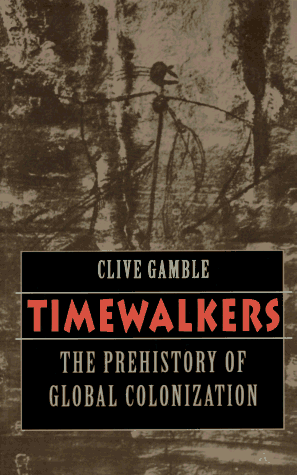
The notion of progress still bedevils our conception of prehistory, with human evolution persistently seen as a movement from inferior to superior, primitive to advanced, simple to complex. Timewalkers extricates prehistory from the myths and distortions created by this view of the past. By focusing on changes in behavior and stressing the deliberate human purpose our ancestors displayed in their migrations, Clive Gamble produces a fresh and frankly provocative synthesis of the archaeology of the last three million years. This new approach to human prehistory proceeds from a detailed study of global colonization rather than a conventional reassessment of fossil remains and stone tools. Gamble reconsiders the remarkable record of geographical expansion that began with the early hominids of sub-Saharan Africa who spread to new continents, to the marginal environments of desert and taiga, and to islands in the oceans and the Mediterranean. Through this astonishing dispersal of humans, which exceeds that of all other mammals, he traces calculated responses to variations in climate and environment. As he interprets these migrations in terms of behavioral change in a social and ecological context, Gamble offers a revealing critique of the attitudes of early European explorers, on which so much of nineteenth- and twentieth-century archaeology unquestioningly rested. Timewalkers makes the latest findings of prehistoric archaeology accessible in a readable, coherent form. Gamble's novel reinterpretation of this evidence, presented with wit and authority, enlarges and enlivens our understanding of human action and motivation in the distant past.
"Sinopsis" puede pertenecer a otra edición de este libro.
Críticas
Why were people everywhere? Gamble offers an innovative look at how archaeologists use artifacts and human biological remains to answer this question and to describe how our human ancestors colonized the earth...[A] unique contribution. Clive Gamble picks up the project of interrogating academic explanations of the past...[His] study is impressive...The material of this book is exciting; Gamble has fruitfully appropriated the metaphors of other disciplines, literary studies in particular, for his own purposes.--Noel Elizabeth Currie "Canadian Literature " Any book by Clive Gamble is good news for those interested in a broader, integrated view of human evolution: it will be thoughtful, provocative, and enlightening. This latest volume is no exception. Written at least in part as a response to some of the hype surrounding the 500th anniversary of Columbus's voyage, it asks the question of why people have turned out to be almost everywhere on the globe...Gamble has set himself a considerable task in seeking to weave a coherent cloth from the threads of a multitude of disciplines and subdisciplines, from archaeology through physical anthropology and paleoenvironmental reconstruction to evolutionary theory...There is much food for thought here, and ["Timewalkers"] represents the kind of effort that must be made to integrate the massive amount of information that we now have about evolution in general and the development, and context of development, of our own species in particular.--Alan Turner "Quarterly Review of Biology "
Reseña del editor
The notion of progress still bedevils our conception of prehistory, with human evolution persistently seen as a movement from inferior to superior, primitive to advanced, simple to complex. Timewalkers extricates prehistory from the myths and distortions created by this view of the past. By focusing on changes in behavior and stressing the deliberate human purpose our ancestors displayed in their migrations, Clive Gamble produces a fresh and frankly provocative synthesis of the archaeology of the last three million years. This new approach to human prehistory proceeds from a detailed study of global colonization rather than a conventional reassessment of fossil remains and stone tools. Gamble reconsiders the remarkable record of geographical expansion that began with the early hominids of sub-Saharan Africa who spread to new continents, to the marginal environments of desert and taiga, and to islands in the oceans and the Mediterranean. Through this astonishing dispersal of humans, which exceeds that of all other mammals, he traces calculated responses to variations in climate and environment. As he interprets these migrations in terms of behavioral change in a social and ecological context, Gamble offers a revealing critique of the attitudes of early European explorers, on which so much of nineteenth- and twentieth-century archaeology unquestioningly rested. Timewalkers makes the latest findings of prehistoric archaeology accessible in a readable, coherent form. Gamble's novel reinterpretation of this evidence, presented with wit and authority, enlarges and enlivens our understanding of human action and motivation in the distant past.
"Sobre este título" puede pertenecer a otra edición de este libro.
Resultados de la búsqueda para Timewalkers: The Prehistory of Global Colonization

Imagen de archivo
Timewalkers: The Prehistory of Global Colonization
Publicado por
Harvard University Press, 1996
ISBN 10: 0674892038
ISBN 13: 9780674892033
Antiguo o usado
Tapa blanda
Librería: Zoom Books Company, Lynden, WA, Estados Unidos de America
Calificación del vendedor: 5 de 5 estrellas

Condición: very_good. Book is in very good condition and may include minimal underlining highlighting. The book can also include "From the library of" labels. May not contain miscellaneous items toys, dvds, etc. . We offer 100% money back guarantee and 24 7 customer service. Nº de ref. del artículo: ZBV.0674892038.VG
Comprar usado
EUR 4,22
Gastos de envío gratis
Se envía dentro de Estados Unidos de America
Se envía dentro de Estados Unidos de America
Cantidad disponible: 1 disponibles
Imagen de archivo
Timewalkers
Publicado por
Harvard University Press, 1996
ISBN 10: 0674892038
ISBN 13: 9780674892033
Antiguo o usado
Tapa dura
Librería: World of Books (was SecondSale), Montgomery, IL, Estados Unidos de America
Calificación del vendedor: 5 de 5 estrellas
Hardback. Condición: Good. Nº de ref. del artículo: 00104538505
Comprar usado
EUR 4,44
Gastos de envío gratis
Se envía dentro de Estados Unidos de America
Se envía dentro de Estados Unidos de America
Cantidad disponible: 1 disponibles
Imagen de archivo
Timewalkers: The Prehistory of Global Colonization
Publicado por
Harvard University Press, 1996
ISBN 10: 0674892038
ISBN 13: 9780674892033
Antiguo o usado
Paperback
Librería: ThriftBooks-Phoenix, Phoenix, AZ, Estados Unidos de America
Calificación del vendedor: 5 de 5 estrellas
Paperback. Condición: Very Good. No Jacket. May have limited writing in cover pages. Pages are unmarked. ~ ThriftBooks: Read More, Spend Less. Nº de ref. del artículo: G0674892038I4N00
Comprar usado
EUR 6,14
Gastos de envío gratis
Se envía dentro de Estados Unidos de America
Se envía dentro de Estados Unidos de America
Cantidad disponible: 1 disponibles
Imagen de archivo
Timewalkers: The Prehistory of Global Colonization
Publicado por
Harvard University Press, 1996
ISBN 10: 0674892038
ISBN 13: 9780674892033
Antiguo o usado
Tapa blanda
Librería: Read&Dream, SAINT LOUIS, MO, Estados Unidos de America
Calificación del vendedor: 4 de 5 estrellas

Condición: Very Good. Nº de ref. del artículo: 4.1M_MV_H0005JKW
Comprar usado
EUR 6,15
Gastos de envío gratis
Se envía dentro de Estados Unidos de America
Se envía dentro de Estados Unidos de America
Cantidad disponible: 1 disponibles
Imagen de archivo
Timewalkers: The Prehistory of Global Colonization
Publicado por
Harvard University Press, 1996
ISBN 10: 0674892038
ISBN 13: 9780674892033
Antiguo o usado
Paperback
Librería: ThriftBooks-Dallas, Dallas, TX, Estados Unidos de America
Calificación del vendedor: 5 de 5 estrellas
Paperback. Condición: Good. No Jacket. Pages can have notes/highlighting. Spine may show signs of wear. ~ ThriftBooks: Read More, Spend Less. Nº de ref. del artículo: G0674892038I3N00
Comprar usado
EUR 6,19
Gastos de envío gratis
Se envía dentro de Estados Unidos de America
Se envía dentro de Estados Unidos de America
Cantidad disponible: 1 disponibles
Imagen de archivo
Timewalkers: The Prehistory of Global Colonization
Publicado por
Harvard University Press, 1996
ISBN 10: 0674892038
ISBN 13: 9780674892033
Antiguo o usado
Paperback
Librería: ThriftBooks-Dallas, Dallas, TX, Estados Unidos de America
Calificación del vendedor: 5 de 5 estrellas
Paperback. Condición: Very Good. No Jacket. May have limited writing in cover pages. Pages are unmarked. ~ ThriftBooks: Read More, Spend Less. Nº de ref. del artículo: G0674892038I4N00
Comprar usado
EUR 6,19
Gastos de envío gratis
Se envía dentro de Estados Unidos de America
Se envía dentro de Estados Unidos de America
Cantidad disponible: 1 disponibles
Imagen de archivo
Timewalkers
Publicado por
Harvard University Press, 1996
ISBN 10: 0674892038
ISBN 13: 9780674892033
Antiguo o usado
Tapa dura
Librería: World of Books Inc, Montgomery, IL, Estados Unidos de America
Calificación del vendedor: 4 de 5 estrellas
Hardback. Condición: Good. Nº de ref. del artículo: CIN0674892038G
Comprar usado
EUR 6,30
Gastos de envío gratis
Se envía dentro de Estados Unidos de America
Se envía dentro de Estados Unidos de America
Cantidad disponible: 1 disponibles
Imagen de archivo
Timewalkers : The Prehistory of Global Colonization
Publicado por
Harvard University Press, 1996
ISBN 10: 0674892038
ISBN 13: 9780674892033
Antiguo o usado
Tapa blanda
Librería: Better World Books, Mishawaka, IN, Estados Unidos de America
Calificación del vendedor: 5 de 5 estrellas
Condición: Good. Pages intact with minimal writing/highlighting. The binding may be loose and creased. Dust jackets/supplements are not included. Stock photo provided. Product includes identifying sticker. Better World Books: Buy Books. Do Good. Nº de ref. del artículo: 16132143-6
Comprar usado
EUR 6,46
Gastos de envío gratis
Se envía dentro de Estados Unidos de America
Se envía dentro de Estados Unidos de America
Cantidad disponible: 2 disponibles
Imagen de archivo
Timewalkers: The Prehistory of Global Colonization
Publicado por
Harvard University Press, 1996
ISBN 10: 0674892038
ISBN 13: 9780674892033
Antiguo o usado
paperback
Librería: HPB Inc., Dallas, TX, Estados Unidos de America
Calificación del vendedor: 5 de 5 estrellas
paperback. Condición: Very Good. Connecting readers with great books since 1972! Used books may not include companion materials, and may have some shelf wear or limited writing. We ship orders daily and Customer Service is our top priority! Nº de ref. del artículo: S_475301221
Comprar usado
EUR 3,74
Envío por EUR 3,40
Se envía dentro de Estados Unidos de America
Se envía dentro de Estados Unidos de America
Cantidad disponible: 1 disponibles
Imagen de archivo
Timewalkers: The Prehistory of Global Colonization.
Publicado por
Harvard University Press, 1996
ISBN 10: 0674892038
ISBN 13: 9780674892033
Antiguo o usado
Tapa blanda
Librería: N. Fagin Books, Chicago, IL, Estados Unidos de America
Calificación del vendedor: 5 de 5 estrellas
1994. Anthropological Theory, Archaeology. Harvard University Press. 309p., very good paperback. Nº de ref. del artículo: 135407
Comprar usado
EUR 4,67
Envío por EUR 5,44
Se envía dentro de Estados Unidos de America
Se envía dentro de Estados Unidos de America
Cantidad disponible: 1 disponibles