
Artículos relacionados a In Search of Safety: Chemicals and Cancer Risk
Sinopsis
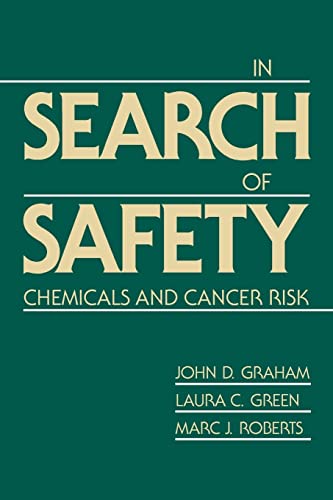
Most public controversies about the effects of chemicals on human health revolve around the risk of cancer―hardly surprising, considering that it is the second leading cause of death in the United States. People are concerned about the dangers of carcinogens in air, water, and food, and they expect their representatives in government to protect them from such hazards. On the other hand, the economic costs of eliminating every suspected carcinogen from the environment would cause tremendous economic hardship. How should policymakers use science to help strike a balance between the benefits of lowering the risk of cancer and the economic costs of regulation?
In this important book the authors squarely address the complex interaction of science and regulatory policy. They begin by clarifying the scientific issues that are central to regulatory decisions, then explain how and why scientists can honestly disagree about these issues. They demonstrate with two cogent case studies: the heated debates about formaldehyde and benzene, both useful but potentially toxic chemicals. By examining how scientists evaluated the risks from these chemicals, and what kinds of legislative, administrative, and judicial decisions emerged from the evaluations, the authors furnish insight into the checks and balances of health-risk regulation.
They point out that overselling science in this context is harmful to both science and democracy. Their final chapter proposes creative methods for constructing a bridge between the scientist and the regulator that will be invaluable to anyone concerned about health risks.
"Sinopsis" puede pertenecer a otra edición de este libro.
Acerca de los autores
John Graham is Professor of Policy and Decision Sciences and Director, Center for Risk Analysis, Harvard School of Public Health.
Marc J. Roberts is Professor of Political Economy and Health Policy at the Harvard School of Public Health.
"Sobre este título" puede pertenecer a otra edición de este libro.
Resultados de la búsqueda para In Search of Safety: Chemicals and Cancer Risk

Imagen de archivo
In Search of Safety: Chemicals and Cancer Risk
Publicado por
Harvard University Press, 1991
ISBN 10: 0674446364
ISBN 13: 9780674446366
Antiguo o usado
Tapa blanda
Librería: Wonder Book, Frederick, MD, Estados Unidos de America
Calificación del vendedor: 5 de 5 estrellas

Condición: Good. Good condition. A copy that has been read but remains intact. May contain markings such as bookplates, stamps, limited notes and highlighting, or a few light stains. Nº de ref. del artículo: E03L-01092
Comprar usado
EUR 6,41
Gastos de envío gratis
Se envía dentro de Estados Unidos de America
Se envía dentro de Estados Unidos de America
Cantidad disponible: 1 disponibles
Imagen de archivo
In Search of Safety Chemicals & Cancer Risk (Paper)
Publicado por
Harvard University Press, 1991
ISBN 10: 0674446364
ISBN 13: 9780674446366
Nuevo
Paperback
Librería: Revaluation Books, Exeter, Reino Unido
Calificación del vendedor: 5 de 5 estrellas
Paperback. Condición: Brand New. reprint edition. 278 pages. 9.25x6.25x1.00 inches. In Stock. Nº de ref. del artículo: x-0674446364
Comprar nuevo
EUR 68,26
Envío por EUR 11,91
Se envía de Reino Unido a Estados Unidos de America
Se envía de Reino Unido a Estados Unidos de America
Cantidad disponible: 2 disponibles
Imagen de archivo
In Search of Safety: Chemicals and Cancer Risk
Publicado por
Harvard University Press, 1991
ISBN 10: 0674446364
ISBN 13: 9780674446366
Nuevo
Tapa blanda
Librería: SHIMEDIA, Brooklyn, NY, Estados Unidos de America
Calificación del vendedor: 4 de 5 estrellas

Condición: New. Satisfaction Guaranteed or your money back. Nº de ref. del artículo: 0674446364
Comprar nuevo
EUR 91,74
Gastos de envío gratis
Se envía dentro de Estados Unidos de America
Se envía dentro de Estados Unidos de America
Cantidad disponible: 1 disponibles
Imagen de archivo
In Search of Safety: Chemicals and Cancer Risk
Publicado por
Harvard University Press, 1991
ISBN 10: 0674446364
ISBN 13: 9780674446366
Nuevo
Tapa blanda
Librería: Books Puddle, Woodside, NY, Estados Unidos de America
Calificación del vendedor: 4 de 5 estrellas
Condición: New. Reprint edition. Nº de ref. del artículo: 264186331
Comprar nuevo
EUR 91,53
Envío por EUR 3,55
Se envía dentro de Estados Unidos de America
Se envía dentro de Estados Unidos de America
Cantidad disponible: 1 disponibles
Imagen de archivo
In Search of Safety: Chemicals and Cancer Risk
Publicado por
Harvard University Press, 1991
ISBN 10: 0674446364
ISBN 13: 9780674446366
Nuevo
Tapa blanda
Librería: Majestic Books, Hounslow, Reino Unido
Calificación del vendedor: 4 de 5 estrellas
Condición: New. Nº de ref. del artículo: 4742916
Comprar nuevo
EUR 92,36
Envío por EUR 7,74
Se envía de Reino Unido a Estados Unidos de America
Se envía de Reino Unido a Estados Unidos de America
Cantidad disponible: 1 disponibles
Imagen del vendedor
IN SEARCH OF SAFETY REV/E
Publicado por
HARVARD UNIV PR, 1991
ISBN 10: 0674446364
ISBN 13: 9780674446366
Nuevo
Kartoniert / Broschiert
Librería: moluna, Greven, Alemania
Calificación del vendedor: 5 de 5 estrellas
Kartoniert / Broschiert. Condición: New. Nº de ref. del artículo: 594875482
Comprar nuevo
EUR 52,63
Envío por EUR 48,99
Se envía de Alemania a Estados Unidos de America
Se envía de Alemania a Estados Unidos de America
Cantidad disponible: Más de 20 disponibles
Imagen del vendedor
In Search of Safety : Chemicals and Cancer Risk
Publicado por
Harvard University Press Apr 1991, 1991
ISBN 10: 0674446364
ISBN 13: 9780674446366
Nuevo
Taschenbuch
Librería: AHA-BUCH GmbH, Einbeck, Alemania
Calificación del vendedor: 5 de 5 estrellas
Taschenbuch. Condición: Neu. Neuware. Nº de ref. del artículo: 9780674446366
Comprar nuevo
EUR 72,04
Envío por EUR 35,00
Se envía de Alemania a Estados Unidos de America
Se envía de Alemania a Estados Unidos de America
Cantidad disponible: 2 disponibles