Sinopsis
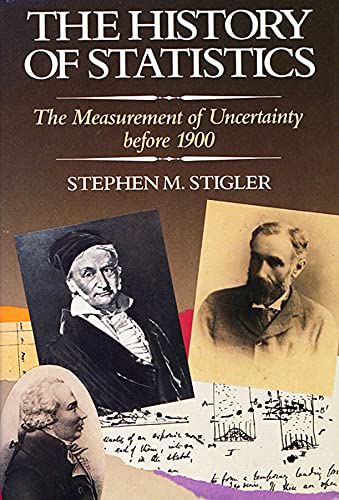
This magnificent book is the first comprehensive history of statistics from its beginnings around 1700 to its emergence as a distinct and mature discipline around 1900. Stephen M. Stigler shows how statistics arose from the interplay of mathematical concepts and the needs of several applied sciences including astronomy, geodesy, experimental psychology, genetics, and sociology. He addresses many intriguing questions: How did scientists learn to combine measurements made under different conditions? And how were they led to use probability theory to measure the accuracy of the result? Why were statistical methods used successfully in astronomy long before they began to play a significant role in the social sciences? How could the introduction of least squares predate the discovery of regression by more than eighty years? On what grounds can the major works of men such as Bernoulli, De Moivre, Bayes, Quetelet, and Lexis be considered partial failures, while those of Laplace, Galton, Edgeworth, Pearson, and Yule are counted as successes? How did Galton’s probability machine (the quincunx) provide him with the key to the major advance of the last half of the nineteenth century?
Stigler’s emphasis is upon how, when, and where the methods of probability theory were developed for measuring uncertainty in experimental and observational science, for reducing uncertainty, and as a conceptual framework for quantitative studies in the social sciences. He describes with care the scientific context in which the different methods evolved and identifies the problems (conceptual or mathematical) that retarded the growth of mathematical statistics and the conceptual developments that permitted major breakthroughs.
Statisticians, historians of science, and social and behavioral scientists will gain from this book a deeper understanding of the use of statistical methods and a better grasp of the promise and limitations of such techniques. The product of ten years of research, The History of Statistics will appeal to all who are interested in the humanistic study of science.
"Sinopsis" puede pertenecer a otra edición de este libro.
Acerca del autor
Stephen M. Stigler is Ernest DeWitt Burton Distinguished Service Professor Emeritus in the Department of Statistics at the University of Chicago.
"Sobre este título" puede pertenecer a otra edición de este libro.
Otras ediciones populares con el mismo título

Resultados de la búsqueda para The History of Statistics: The Measurement of Uncertainty...

Imagen de archivo
The History of Statistics: The Measurement of Uncertainty before 1900
Publicado por
Belknap Press: An Imprint of Har, 1990
ISBN 10: 067440341X
ISBN 13: 9780674403413
Antiguo o usado
Paperback
Librería: HPB-Red, Dallas, TX, Estados Unidos de America
Calificación del vendedor: 5 de 5 estrellas

Paperback. Condición: Good. Connecting readers with great books since 1972! Used textbooks may not include companion materials such as access codes, etc. May have some wear or writing/highlighting. We ship orders daily and Customer Service is our top priority! Nº de ref. del artículo: S_433717490
Comprar usado
EUR 11,06
Gastos de envío:
EUR 3,23
A Estados Unidos de America
Cantidad disponible: 1 disponibles
Imagen de archivo
The History of Statistics : The Measurement of Uncertainty Before 1900
Publicado por
Harvard University Press, 1990
ISBN 10: 067440341X
ISBN 13: 9780674403413
Antiguo o usado
Tapa blanda
Librería: Better World Books, Mishawaka, IN, Estados Unidos de America
Calificación del vendedor: 5 de 5 estrellas
Condición: Very Good. Former library book; may include library markings. Used book that is in excellent condition. May show signs of wear or have minor defects. Nº de ref. del artículo: 9783074-6
Comprar usado
EUR 15,83
Gastos de envío:
GRATIS
A Estados Unidos de America
Cantidad disponible: 1 disponibles
Imagen de archivo
The History of Statistics: The Measurement of Uncertainty before 1900
Librería: thebookforest.com, San Rafael, CA, Estados Unidos de America
Calificación del vendedor: 4 de 5 estrellas

Condición: New. Supporting Bay Area Friends of the Library since 2010. Well packaged and promptly shipped. Nº de ref. del artículo: BAY_17_SH_040939
Comprar nuevo
EUR 29,22
Gastos de envío:
EUR 3,44
A Estados Unidos de America
Cantidad disponible: 1 disponibles
Imagen de archivo
The History of Statistics: The Measurement of Uncertainty Before 1900
Publicado por
Harvard University Press, 1986
ISBN 10: 067440341X
ISBN 13: 9780674403413
Antiguo o usado
Tapa blanda
Librería: Anybook.com, Lincoln, Reino Unido
Calificación del vendedor: 5 de 5 estrellas
Condición: Fair. This is an ex-library book and may have the usual library/used-book markings inside.This book has soft covers. In fair condition, suitable as a study copy. Please note the Image in this listing is a stock photo and may not match the covers of the actual item,700grams, ISBN:9780674403413. Nº de ref. del artículo: 4313184
Comprar usado
EUR 23,52
Gastos de envío:
EUR 14,78
De Reino Unido a Estados Unidos de America
Cantidad disponible: 1 disponibles
Imagen del vendedor
History of Statistics : The Measurement of Uncertainty Before 1900
Librería: GreatBookPrices, Columbia, MD, Estados Unidos de America
Calificación del vendedor: 5 de 5 estrellas
Condición: New. Nº de ref. del artículo: 414871-n
Comprar nuevo
EUR 36,04
Gastos de envío:
EUR 2,28
A Estados Unidos de America
Cantidad disponible: Más de 20 disponibles
Imagen de archivo
The History of Statistics - The Measurement of Uncertainty Before 1900
Librería: PBShop.store US, Wood Dale, IL, Estados Unidos de America
Calificación del vendedor: 5 de 5 estrellas
PAP. Condición: New. New Book. Shipped from UK. Established seller since 2000. Nº de ref. del artículo: WH-9780674403413
Comprar nuevo
EUR 38,40
Gastos de envío:
GRATIS
A Estados Unidos de America
Cantidad disponible: 1 disponibles
Imagen de archivo
The History of Statistics - The Measurement of Uncertainty Before 1900
Librería: PBShop.store UK, Fairford, GLOS, Reino Unido
Calificación del vendedor: 5 de 5 estrellas
PAP. Condición: New. New Book. Shipped from UK. Established seller since 2000. Nº de ref. del artículo: WH-9780674403413
Comprar nuevo
EUR 34,13
Gastos de envío:
EUR 5,73
De Reino Unido a Estados Unidos de America
Cantidad disponible: 1 disponibles
Imagen del vendedor
History of Statistics : The Measurement of Uncertainty Before 1900
Publicado por
Belknap Press, 1990
ISBN 10: 067440341X
ISBN 13: 9780674403413
Antiguo o usado
Tapa blanda
Librería: GreatBookPrices, Columbia, MD, Estados Unidos de America
Calificación del vendedor: 5 de 5 estrellas
Condición: As New. Unread book in perfect condition. Nº de ref. del artículo: 414871
Comprar usado
EUR 40,78
Gastos de envío:
EUR 2,28
A Estados Unidos de America
Cantidad disponible: Más de 20 disponibles
Imagen de archivo
The History of Statistics: The Measurement of Uncertainty before 1900
Librería: Toscana Books, AUSTIN, TX, Estados Unidos de America
Calificación del vendedor: 5 de 5 estrellas
Paperback. Condición: new. Excellent Condition.Excels in customer satisfaction, prompt replies, and quality checks. Nº de ref. del artículo: Scanned067440341X
Comprar nuevo
EUR 40,81
Gastos de envío:
EUR 3,71
A Estados Unidos de America
Cantidad disponible: 1 disponibles
Imagen de archivo
The History of Statistics (Paperback)
Publicado por
Harvard University Press, Cambridge, Mass., 1990
ISBN 10: 067440341X
ISBN 13: 9780674403413
Nuevo
Paperback
Librería: Grand Eagle Retail, Bensenville, IL, Estados Unidos de America
Calificación del vendedor: 5 de 5 estrellas
Paperback. Condición: new. Paperback. This magnificent book is the first comprehensive history of statistics from its beginnings around 1700 to its emergence as a distinct and mature discipline around 1900. Stephen M. Stigler shows how statistics arose from the interplay of mathematical concepts and the needs of several applied sciences including astronomy, geodesy, experimental psychology, genetics, and sociology. He addresses many intriguing questions: How did scientists learn to combine measurements made under different conditions? And how were they led to use probability theory to measure the accuracy of the result? Why were statistical methods used successfully in astronomy long before they began to play a significant role in the social sciences? How could the introduction of least squares predate the discovery of regression by more than eighty years? On what grounds can the major works of men such as Bernoulli, De Moivre, Bayes, Quetelet, and Lexis be considered partial failures, while those of Laplace, Galton, Edgeworth, Pearson, and Yule are counted as successes? How did Galton's probability machine (the quincunx) provide him with the key to the major advance of the last half of the nineteenth century?Stigler's emphasis is upon how, when, and where the methods of probability theory were developed for measuring uncertainty in experimental and observational science, for reducing uncertainty, and as a conceptual framework for quantitative studies in the social sciences. He describes with care the scientific context in which the different methods evolved and identifies the problems (conceptual or mathematical) that retarded the growth of mathematical statistics and the conceptual developments that permitted major breakthroughs.Statisticians, historians of science, and social and behavioral scientists will gain from this book a deeper understanding of the use of statistical methods and a better grasp of the promise and limitations of such techniques. The product of ten years of research, The History of Statistics will appeal to all who are interested in the humanistic study of science. Stigler shows how statistics arose from the interplay of mathematical concepts and the needs of several applied sciences. His emphasis is upon how methods of probability theory were developed for measuring uncertainty, for reducing uncertainty, and as a conceptual framework for quantitative studies in the social sciences. Shipping may be from multiple locations in the US or from the UK, depending on stock availability. Nº de ref. del artículo: 9780674403413
Comprar nuevo
EUR 46,73
Gastos de envío:
GRATIS
A Estados Unidos de America
Cantidad disponible: 1 disponibles