
Artículos relacionados a Creating Public Value: Strategic Management in Government
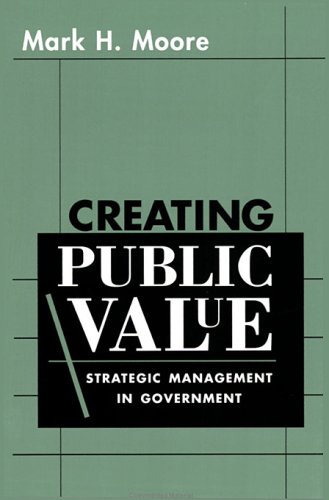
Sinopsis
A seminal figure in the field of public management, Mark Moore presents his summation of 15 years of research, observation and teaching about what public sector executives should do to improve the performance of public enterprises. Useful for both practicing public executives and those who teach them, this book explicates some of the richest of several hundred cases used at Harvard's Kennedy School and illuminates their broader lessons for government managers. Moore addresses four questions that have long bedeviled public administration: What should citizens and their representatives expect and demand from public executives? What sources can public managers consult to learn what is valuable for them to produce? How should public managers cope with inconsistent and fickle political mandates? How can public managers find room to innovate? Moore's answers respond to the well-understood difficulties of managing public enterprises in modern society by recommending specific, concrete changes in the practices of individual public managers: how they envision what is valuable to produce, how they engage their political overseers, and how they deliver services and fulfill obligations to clients. Following Moores cases, we witness dilemmas faced by a cross section of public managers - William Ruckelshaus and the Environmental Protection Agency, Jerome Miller and the Department of Youth Services, Miles Mahoney and the Park Plaza Redevelopment Project, David Sencer and the swine flu scare, Lee Brown and the Houston Police Department, and Harry Spence and the Boston Housing Authority. Their work, together with Moore's analysis, reveals how public managers can achieve their true goal of producing public value.
"Sinopsis" puede pertenecer a otra edición de este libro.
Críticas
Basing extended and thoughtful analyses and comments on a series of cases in managing an assortment of federal, state, and local public agencies (libraries, the EPA, a department of child and youth services, a redevelopment agency, the Center for Disease Control, a housing authority, and a police department), Kennedy School professor Mark Moore seeks to expand the traditional bureaucratic conceptions of public administration. An important argument to counter the image of the rigid bureaucrat, with case studies of youth services, a library, a redevelopment project, a police department, and a housing authority. If you haven't been able to slip out to Harvard University's John F. Kennedy School of Government for the latest in public management training, Mark Moore's book...will bring you up to speed. [An] important argument to counter the image of the rigid bureaucrat, with case studies of youth services, a library, a redevelopment project, a police department, and a housing authority.
Reseña del editor
A seminal figure in the field of public management, Mark Moore presents his summation of 15 years of research, observation and teaching about what public sector executives should do to improve the performance of public enterprises. Useful for both practicing public executives and those who teach them, this book explicates some of the richest of several hundred cases used at Harvard's Kennedy School and illuminates their broader lessons for government managers. Moore addresses four questions that have long bedeviled public administration: What should citizens and their representatives expect and demand from public executives? What sources can public managers consult to learn what is valuable for them to produce? How should public managers cope with inconsistent and fickle political mandates? How can public managers find room to innovate? Moore's answers respond to the well-understood difficulties of managing public enterprises in modern society by recommending specific, concrete changes in the practices of individual public managers: how they envision what is valuable to produce, how they engage their political overseers, and how they deliver services and fulfill obligations to clients. Following Moores cases, we witness dilemmas faced by a cross section of public managers - William Ruckelshaus and the Environmental Protection Agency, Jerome Miller and the Department of Youth Services, Miles Mahoney and the Park Plaza Redevelopment Project, David Sencer and the swine flu scare, Lee Brown and the Houston Police Department, and Harry Spence and the Boston Housing Authority. Their work, together with Moore's analysis, reveals how public managers can achieve their true goal of producing public value.
"Sobre este título" puede pertenecer a otra edición de este libro.
Resultados de la búsqueda para Creating Public Value: Strategic Management in Government

Imagen de archivo
Creating Public Value: Strategic Management in Government
Publicado por
Harvard University Press, 1995
ISBN 10: 0674175573
ISBN 13: 9780674175570
Antiguo o usado
Tapa dura
Librería: HPB-Red, Dallas, TX, Estados Unidos de America
Calificación del vendedor: 5 de 5 estrellas

hardcover. Condición: Acceptable. Connecting readers with great books since 1972. Used textbooks may not include companion materials such as access codes, etc. May have condition issues including wear and notes/highlighting. We ship orders daily and Customer Service is our top priority! Nº de ref. del artículo: S_477444602
Comprar usado
EUR 50,48
Envío por EUR 3,23
Se envía dentro de Estados Unidos de America
Se envía dentro de Estados Unidos de America
Cantidad disponible: 1 disponibles
Imagen de archivo
Creating Public Value: Strategic Management in Government
Publicado por
Harvard University Press, 1995
ISBN 10: 0674175573
ISBN 13: 9780674175570
Antiguo o usado
Tapa dura
Librería: HPB-Red, Dallas, TX, Estados Unidos de America
Calificación del vendedor: 5 de 5 estrellas
hardcover. Condición: Good. Connecting readers with great books since 1972! Used textbooks may not include companion materials such as access codes, etc. May have some wear or writing/highlighting. We ship orders daily and Customer Service is our top priority! Nº de ref. del artículo: S_477537523
Comprar usado
EUR 50,65
Envío por EUR 3,23
Se envía dentro de Estados Unidos de America
Se envía dentro de Estados Unidos de America
Cantidad disponible: 1 disponibles
Imagen de archivo
Creating Public Value: Strategic Management in Government
Publicado por
Harvard University Press, 1995
ISBN 10: 0674175573
ISBN 13: 9780674175570
Nuevo
Tapa dura
Librería: BennettBooksLtd, Los Angeles, CA, Estados Unidos de America
Calificación del vendedor: 5 de 5 estrellas
hardcover. Condición: New. In shrink wrap. Looks like an interesting title! Nº de ref. del artículo: Q-0674175573
Comprar nuevo
EUR 74,79
Envío por EUR 5,99
Se envía dentro de Estados Unidos de America
Se envía dentro de Estados Unidos de America
Cantidad disponible: 1 disponibles
Imagen de archivo
Creating public value : strategic management in government.
Publicado por
Harvard University Press, 1995
ISBN 10: 0674175573
ISBN 13: 9780674175570
Antiguo o usado
Tapa dura
Librería: Kloof Booksellers & Scientia Verlag, Amsterdam, Holanda
Calificación del vendedor: 4 de 5 estrellas

Condición: as new. Beijing : Tsinghua University Press, 2003, 1995. Hardcover. Dustjacket. 402 pp. A seminal figure in the field of public management, Mark Moore presents his summation of fifteen years of research, observation, and teaching about what public sector executives should do to improve the performance of public enterprises. Useful for both practicing public executives and those who teach them, this book explicates some of the richest of several hundred cases used at Harvard's Kennedy School of Government and illuminates their broader lessons for government managers. Moore addresses four questions that have long bedeviled public administration: What should citizens and their representatives expect and demand from public executives? What sources can public managers consult to learn what is valuable for them to produce? How should public managers cope with inconsistent and fickle political mandates? How can public managers find room to innovate? Moore's answers respond to the well-understood difficulties of managing public enterprises in modern society by recommending specific, concrete changes in the practices of individual public managers: how they envision what is valuable to produce, how they engage their political overseers, and how they deliver services and fulfill obligations to clients. Following Moore's cases, we witness dilemmas faced by a cross section of public managers--William Ruckelshaus and the Environmental Protection Agency, Jerome Miller and the Department of Youth Services, Miles Mahoney and the Park Plaza Redevelopment Project, David Sencer and the swine flu scare, Lee Brown and the Houston Police Department, Harry Spence and the Boston Housing Authority. Their work, together with Moore's analysis, reveals how public managers can achieve their true goal of producing public value. Condition : as new copy. ISBN 9780674175570. Keywords : ECONOMICS, Nº de ref. del artículo: 284011
Comprar usado
EUR 60,95
Envío por EUR 30,00
Se envía de Holanda a Estados Unidos de America
Se envía de Holanda a Estados Unidos de America
Cantidad disponible: 1 disponibles
Imagen de archivo
Creating Public Value: Strategic Management in Government
Publicado por
Harvard University Press, 1995
ISBN 10: 0674175573
ISBN 13: 9780674175570
Nuevo
Tapa dura
Librería: GoldBooks, Denver, CO, Estados Unidos de America
Calificación del vendedor: 5 de 5 estrellas
Hardcover. Condición: new. New Copy. Customer Service Guaranteed. Nº de ref. del artículo: 85B44_34_0674175573
Comprar nuevo
EUR 123,09
Envío por EUR 4,74
Se envía dentro de Estados Unidos de America
Se envía dentro de Estados Unidos de America
Cantidad disponible: 1 disponibles
Imagen de archivo
Creating Public Value: Strategic Management in Government
Publicado por
Harvard University Press, 1995
ISBN 10: 0674175573
ISBN 13: 9780674175570
Nuevo
Tapa dura
Librería: SHIMEDIA, Brooklyn, NY, Estados Unidos de America
Calificación del vendedor: 4 de 5 estrellas
Condición: New. Satisfaction Guaranteed or your money back. Nº de ref. del artículo: 0674175573
Comprar nuevo
EUR 177,59
Gastos de envío gratis
Se envía dentro de Estados Unidos de America
Se envía dentro de Estados Unidos de America
Cantidad disponible: 1 disponibles