
Artículos relacionados a Spikes: Exploring the Neural Code (Computational Neuroscienc...
Sinopsis
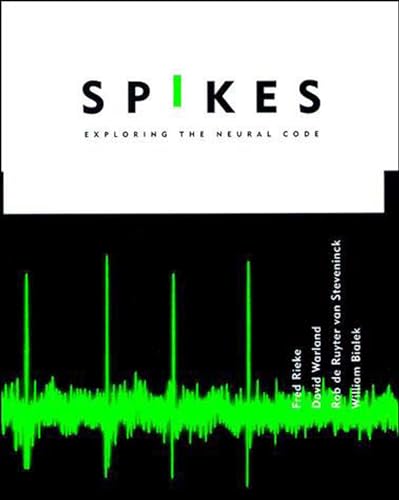
What does it mean to say that a certain set of spikes is the right answer to a computational problem? In what sense does a spike train convey information about the sensory world? Spikes begins by providing precise formulations of these and related questions about the representation of sensory signals in neural spike trains. The answers to these questions are then pursued in experiments on sensory neurons. Intended for neurobiologists with an interest in mathematical analysis of neural data as well as the growing number of physicists and mathematicians interested in information processing by "real" nervous systems, Spikes provides a self-contained review of relevant concepts in information theory and statistical decision theory.
Our perception of the world is driven by input from the sensory nerves. This input arrives encoded as sequences of identical spikes. Much of neural computation involves processing these spike trains. What does it mean to say that a certain set of spikes is the right answer to a computational problem? In what sense does a spike train convey information about the sensory world? Spikes begins by providing precise formulations of these and related questions about the representation of sensory signals in neural spike trains. The answers to these questions are then pursued in experiments on sensory neurons.The authors invite the reader to play the role of a hypothetical observer inside the brain who makes decisions based on the incoming spike trains. Rather than asking how a neuron responds to a given stimulus, the authors ask how the brain could make inferences about an unknown stimulus from a given neural response. The flavor of some problems faced by the organism is captured by analyzing the way in which the observer can make a running reconstruction of the sensory stimulus as it evolves in time. These ideas are illustrated by examples from experiments on several biological systems.
Intended for neurobiologists with an interest in mathematical analysis of neural data as well as the growing number of physicists and mathematicians interested in information processing by "real" nervous systems, Spikes provides a self-contained review of relevant concepts in information theory and statistical decision theory. A quantitative framework is used to pose precise questions about the structure of the neural code. These questions in turn influence both the design and analysis of experiments on sensory neurons.
"Sinopsis" puede pertenecer a otra edición de este libro.
Críticas
A joy to read...This book will undoubtedly become a classic. The ideas presented in it have already begun (in no small part through the work of the authors) to reshape our views of the neural code. This book will make them accessible to a much wider audience. -Anthony Zador
Reseña del editor
What does it mean to say that a certain set of spikes is the right answer to a computational problem? In what sense does a spike train convey information about the sensory world? Spikes begins by providing precise formulations of these and related questions about the representation of sensory signals in neural spike trains. The answers to these questions are then pursued in experiments on sensory neurons. Intended for neurobiologists with an interest in mathematical analysis of neural data as well as the growing number of physicists and mathematicians interested in information processing by "real" nervous systems, Spikes provides a self-contained review of relevant concepts in information theory and statistical decision theory. Our perception of the world is driven by input from the sensory nerves. This input arrives encoded as sequences of identical spikes. Much of neural computation involves processing these spike trains. What does it mean to say that a certain set of spikes is the right answer to a computational problem? In what sense does a spike train convey information about the sensory world? Spikes begins by providing precise formulations of these and related questions about the representation of sensory signals in neural spike trains. The answers to these questions are then pursued in experiments on sensory neurons.The authors invite the reader to play the role of a hypothetical observer inside the brain who makes decisions based on the incoming spike trains. Rather than asking how a neuron responds to a given stimulus, the authors ask how the brain could make inferences about an unknown stimulus from a given neural response. The flavor of some problems faced by the organism is captured by analyzing the way in which the observer can make a running reconstruction of the sensory stimulus as it evolves in time. These ideas are illustrated by examples from experiments on several biological systems. Intended for neurobiologists with an interest in mathematical analysis of neural data as well as the growing number of physicists and mathematicians interested in information processing by "real" nervous systems, Spikes provides a self-contained review of relevant concepts in information theory and statistical decision theory. A quantitative framework is used to pose precise questions about the structure of the neural code. These questions in turn influence both the design and analysis of experiments on sensory neurons.
"Sobre este título" puede pertenecer a otra edición de este libro.
Resultados de la búsqueda para Spikes: Exploring the Neural Code (Computational Neuroscienc...

Imagen del vendedor
Spikes: Exploring the Neural Code (Computational Neuroscience)
Publicado por
Bradford Books, 1999
ISBN 10: 0262681080
ISBN 13: 9780262681087
Antiguo o usado
Soft cover
Librería: Pico Pro, San Francisco, CA, Estados Unidos de America
Calificación del vendedor: 4 de 5 estrellas

Soft cover. Condición: As New. Single owner. Like new. Cover and pages are crisp and clean. Nº de ref. del artículo: B211
Comprar usado
EUR 31,94
Envío por EUR 4,74
Se envía dentro de Estados Unidos de America
Se envía dentro de Estados Unidos de America
Cantidad disponible: 1 disponibles
Imagen de archivo
Spikes: Exploring the Neural Code (Computational Neuroscience)
Publicado por
Bradford Books, 1999
ISBN 10: 0262681080
ISBN 13: 9780262681087
Antiguo o usado
Tapa blanda
Librería: World of Books (was SecondSale), Montgomery, IL, Estados Unidos de America
Calificación del vendedor: 5 de 5 estrellas

Condición: Very Good. Item in very good condition! Textbooks may not include supplemental items i.e. CDs, access codes etc. Nº de ref. del artículo: 00108773684
Comprar usado
EUR 70,62
Gastos de envío gratis
Se envía dentro de Estados Unidos de America
Se envía dentro de Estados Unidos de America
Cantidad disponible: 1 disponibles
Imagen del vendedor
Spikes: Exploring the Neural Code (Computational Neuroscience)
Publicado por
Bradford Books, 1999
ISBN 10: 0262681080
ISBN 13: 9780262681087
Antiguo o usado
Tapa blanda
Librería: Big River Books, Powder Springs, GA, Estados Unidos de America
Calificación del vendedor: 5 de 5 estrellas
Condición: good. This book is in good condition. The cover has minor creases or bends. The binding is tight and pages are intact. Some pages may have writing or highlighting. Nº de ref. del artículo: BRV.0262681080.G
Comprar usado
EUR 74,20
Envío por EUR 3,44
Se envía dentro de Estados Unidos de America
Se envía dentro de Estados Unidos de America
Cantidad disponible: 1 disponibles
Imagen del vendedor
Spikes: Exploring the Neural Code (Computational Neuroscience)
Publicado por
Bradford Books, 1999
ISBN 10: 0262681080
ISBN 13: 9780262681087
Antiguo o usado
Tapa blanda
Librería: Goodwill of Silicon Valley, SAN JOSE, CA, Estados Unidos de America
Calificación del vendedor: 4 de 5 estrellas
Condición: good. Supports Goodwill of Silicon Valley job training programs. The cover and pages are in Good condition! Any other included accessories are also in Good condition showing use. Use can include some highlighting and writing, page and cover creases as well as other types visible wear. Nº de ref. del artículo: GWSVV.0262681080.G
Comprar usado
EUR 74,22
Envío por EUR 3,44
Se envía dentro de Estados Unidos de America
Se envía dentro de Estados Unidos de America
Cantidad disponible: 1 disponibles
Imagen del vendedor
Spikes: Exploring the Neural Code (Computational Neuroscience)
Publicado por
Bradford Books, 1999
ISBN 10: 0262681080
ISBN 13: 9780262681087
Antiguo o usado
Tapa blanda
Librería: MERS Goodwill, Saint Louis, MO, Estados Unidos de America
Calificación del vendedor: 5 de 5 estrellas
Condición: good. Used - Good: All pages and cover are intact including the dust cover, if applicable . Spine may show signs of wear. Pages may include limited notes and highlighting. May include From the library of labels. Shrink wrap, dust covers, or boxed set case may be missing. Item may be missing bundled media. Any access codes or passwords originally included with the book may be expired, used or no longer valid. Image is stock photo and cover art edition may be different than pictured. Nº de ref. del artículo: MERV.0262681080.G
Comprar usado
EUR 74,23
Envío por EUR 3,45
Se envía dentro de Estados Unidos de America
Se envía dentro de Estados Unidos de America
Cantidad disponible: 1 disponibles
Imagen de archivo
Spikes: Exploring the Neural Code (Computational Neuroscience)
Librería: GoldBooks, Denver, CO, Estados Unidos de America
Calificación del vendedor: 5 de 5 estrellas
Paperback. Condición: new. New Copy. Customer Service Guaranteed. Nº de ref. del artículo: 40I11_2_0262681080
Comprar nuevo
EUR 173,15
Envío por EUR 4,74
Se envía dentro de Estados Unidos de America
Se envía dentro de Estados Unidos de America
Cantidad disponible: 1 disponibles
Imagen de archivo
Spikes: Exploring the Neural Code (Computational Neuroscience)
Publicado por
Bradford Books, 1999
ISBN 10: 0262681080
ISBN 13: 9780262681087
Antiguo o usado
paperback
Librería: Mispah books, Redhill, SURRE, Reino Unido
Calificación del vendedor: 4 de 5 estrellas
paperback. Condición: Good. Good .Ships From Multiple Locations. book. Nº de ref. del artículo: ERICA80302626810804
Comprar usado
EUR 207,79
Envío por EUR 29,15
Se envía de Reino Unido a Estados Unidos de America
Se envía de Reino Unido a Estados Unidos de America
Cantidad disponible: 1 disponibles
Imagen de archivo
Spikes: Exploring the Neural Code (Computational Neuroscience)
Librería: GoldBooks, Denver, CO, Estados Unidos de America
Calificación del vendedor: 5 de 5 estrellas
Paperback. Condición: new. New Copy. Customer Service Guaranteed. Nº de ref. del artículo: 55J43_41_0262681080
Comprar nuevo
EUR 309,44
Envío por EUR 4,74
Se envía dentro de Estados Unidos de America
Se envía dentro de Estados Unidos de America
Cantidad disponible: 1 disponibles