
Artículos relacionados a Why We Cooperate (Boston Review Books)
Sinopsis
Understanding cooperation as a distinctly human combination of innate and learned behavior.
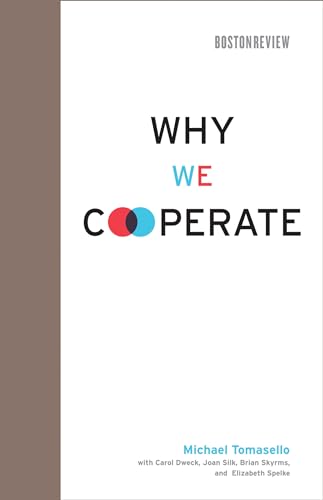
Drop something in front of a two-year-old, and she's likely to pick it up for you. This is not a learned behavior, psychologist Michael Tomasello argues. Through observations of young children in experiments he himself has designed, Tomasello shows that children are naturally—and uniquely—cooperative. Put through similar experiments, for example, apes demonstrate the ability to work together and share, but choose not to. As children grow, their almost reflexive desire to help—without expectation of reward—becomes shaped by culture. They become more aware of being a member of a group. Groups convey mutual expectations, and thus may either encourage or discourage altruism and collaboration. Either way, cooperation emerges as a distinctly human combination of innate and learned behavior. In Why We Cooperate, Tomasello's studies of young children and great apes help identify the underlying psychological processes that very likely supported humans' earliest forms of complex collaboration and, ultimately, our unique forms of cultural organization, from the evolution of tolerance and trust to the creation of such group-level structures as cultural norms and institutions. Scholars Carol Dweck, Joan Silk, Brian Skyrms, and Elizabeth Spelke respond to Tomasello's findings and explore the implications.
"Sinopsis" puede pertenecer a otra edición de este libro.
Acerca del autor
Michael Tomasello is Codirector of the Max Planck Institute for Evolutionary Anthropology, Leipzig. He is the author of The Cultural Origins of Human Cognition and Constructing a Language: A Usage-Based Theory of Language Acquisition.
"Sobre este título" puede pertenecer a otra edición de este libro.
Resultados de la búsqueda para Why We Cooperate (Boston Review Books)

Imagen de archivo
Why We Cooperate
Publicado por
MIT Press Ltd, 2009
ISBN 10: 0262013592
ISBN 13: 9780262013598
Antiguo o usado
Tapa dura
Librería: World of Books (was SecondSale), Montgomery, IL, Estados Unidos de America
Calificación del vendedor: 5 de 5 estrellas

Hardback. Condición: Good. Understanding cooperation as a distinctly human combination of innate and learned behavior. Drop something in front of a two-year-old, and she's likely to pick it up for you. This is not a learned behavior, psychologist Michael Tomasello argues. Through observations of young children in experiments he himself has designed, Tomasello shows that children are naturally--and uniquely--cooperative. Put through similar experiments, for example, apes demonstrate the ability to work together and share, but choose not to. As children grow, their almost reflexive desire to help--without expectation of reward--becomes shaped by culture. They become more aware of being a member of a group. Groups convey mutual expectations, and thus may either encourage or discourage altruism and collaboration. Either way, cooperation emerges as a distinctly human combination of innate and learned behavior. In Why We Cooperate, Tomasello's studies of young children and great apes help identify the underlying psychological processes that very likely supported humans' earliest forms of complex collaboration and, ultimately, our unique forms of cultural organization, from the evolution of tolerance and trust to the creation of such group-level structures as cultural norms and institutions. Scholars Carol Dweck, Joan Silk, Brian Skyrms, and Elizabeth Spelke respond to Tomasello's findings and explore the implications. Nº de ref. del artículo: 00103847751
Comprar usado
EUR 5,87
Gastos de envío gratis
Se envía dentro de Estados Unidos de America
Se envía dentro de Estados Unidos de America
Cantidad disponible: 1 disponibles
Imagen del vendedor
Why We Cooperate (Boston Review Books)
Publicado por
The MIT Press, 2009
ISBN 10: 0262013592
ISBN 13: 9780262013598
Antiguo o usado
Tapa dura
Librería: Bay State Book Company, North Smithfield, RI, Estados Unidos de America
Calificación del vendedor: 5 de 5 estrellas
Condición: good. The book is in good condition with all pages and cover intact, including the dust jacket if originally issued. The spine may show light wear. Pages may contain some notes or highlighting, and there might be a "From the library of" label. Boxed set packaging, shrink wrap, or included media like CDs may be missing. Nº de ref. del artículo: BSM.1D0ZN
Comprar usado
EUR 5,88
Gastos de envío gratis
Se envía dentro de Estados Unidos de America
Se envía dentro de Estados Unidos de America
Cantidad disponible: 1 disponibles
Imagen de archivo
Why We Cooperate
Librería: ThriftBooks-Reno, Reno, NV, Estados Unidos de America
Calificación del vendedor: 5 de 5 estrellas
Hardcover. Condición: Good. No Jacket. Pages can have notes/highlighting. Spine may show signs of wear. ~ ThriftBooks: Read More, Spend Less. Nº de ref. del artículo: G0262013592I3N00
Comprar usado
EUR 6,13
Gastos de envío gratis
Se envía dentro de Estados Unidos de America
Se envía dentro de Estados Unidos de America
Cantidad disponible: 1 disponibles
Imagen de archivo
Why We Cooperate
Librería: ThriftBooks-Dallas, Dallas, TX, Estados Unidos de America
Calificación del vendedor: 5 de 5 estrellas
Hardcover. Condición: Fair. No Jacket. Readable copy. Pages may have considerable notes/highlighting. ~ ThriftBooks: Read More, Spend Less. Nº de ref. del artículo: G0262013592I5N00
Comprar usado
EUR 6,13
Gastos de envío gratis
Se envía dentro de Estados Unidos de America
Se envía dentro de Estados Unidos de America
Cantidad disponible: 1 disponibles
Imagen de archivo
Why We Cooperate
Librería: ThriftBooks-Reno, Reno, NV, Estados Unidos de America
Calificación del vendedor: 5 de 5 estrellas
Hardcover. Condición: Good. No Jacket. Missing dust jacket; Pages can have notes/highlighting. Spine may show signs of wear. ~ ThriftBooks: Read More, Spend Less. Nº de ref. del artículo: G0262013592I3N01
Comprar usado
EUR 6,13
Gastos de envío gratis
Se envía dentro de Estados Unidos de America
Se envía dentro de Estados Unidos de America
Cantidad disponible: 1 disponibles
Imagen de archivo
Why We Cooperate
Librería: ThriftBooks-Atlanta, AUSTELL, GA, Estados Unidos de America
Calificación del vendedor: 5 de 5 estrellas
Hardcover. Condición: Good. No Jacket. Pages can have notes/highlighting. Spine may show signs of wear. ~ ThriftBooks: Read More, Spend Less. Nº de ref. del artículo: G0262013592I3N00
Comprar usado
EUR 6,13
Gastos de envío gratis
Se envía dentro de Estados Unidos de America
Se envía dentro de Estados Unidos de America
Cantidad disponible: 1 disponibles
Imagen de archivo
Why We Cooperate
Librería: ThriftBooks-Dallas, Dallas, TX, Estados Unidos de America
Calificación del vendedor: 5 de 5 estrellas
Hardcover. Condición: Good. No Jacket. Pages can have notes/highlighting. Spine may show signs of wear. ~ ThriftBooks: Read More, Spend Less. Nº de ref. del artículo: G0262013592I3N00
Comprar usado
EUR 6,13
Gastos de envío gratis
Se envía dentro de Estados Unidos de America
Se envía dentro de Estados Unidos de America
Cantidad disponible: 1 disponibles
Imagen de archivo
Why We Cooperate (Boston Review Books)
Publicado por
The MIT Press, 2009
ISBN 10: 0262013592
ISBN 13: 9780262013598
Antiguo o usado
Tapa dura
Librería: Bellwetherbooks, McKeesport, PA, Estados Unidos de America
Calificación del vendedor: 4 de 5 estrellas

hardcover. Condición: Fine. LIKE NEW!!! Has a red or black remainder mark on bottom/exterior edge of pages. Nº de ref. del artículo: 399884
Comprar usado
EUR 3,49
Envío por EUR 3,52
Se envía dentro de Estados Unidos de America
Se envía dentro de Estados Unidos de America
Cantidad disponible: Más de 20 disponibles
Imagen del vendedor
Why We Cooperate (Boston Review Books)
Publicado por
The MIT Press, 2009
ISBN 10: 0262013592
ISBN 13: 9780262013598
Antiguo o usado
Tapa dura
Librería: Greenworld Books, Arlington, TX, Estados Unidos de America
Calificación del vendedor: 5 de 5 estrellas
Condición: very_good. Fast Free Shipping â" Very Good condition book with a firm cover and clean pages. Shows normal use and some light wear or limited notes markings. A solid, nice copy to enjoy. Nº de ref. del artículo: GWV.0262013592.VG
Comprar usado
EUR 7,30
Gastos de envío gratis
Se envía dentro de Estados Unidos de America
Se envía dentro de Estados Unidos de America
Cantidad disponible: 1 disponibles
Imagen de archivo
Why We Cooperate
Publicado por
MIT Press Ltd, 2009
ISBN 10: 0262013592
ISBN 13: 9780262013598
Antiguo o usado
Tapa dura
Librería: World of Books Inc, Montgomery, IL, Estados Unidos de America
Calificación del vendedor: 4 de 5 estrellas
Hardback. Condición: Good. Understanding cooperation as a distinctly human combination of innate and learned behavior. Drop something in front of a two-year-old, and she's likely to pick it up for you. This is not a learned behavior, psychologist Michael Tomasello argues. Through observations of young children in experiments he himself has designed, Tomasello shows that children are naturally--and uniquely--cooperative. Put through similar experiments, for example, apes demonstrate the ability to work together and share, but choose not to. As children grow, their almost reflexive desire to help--without expectation of reward--becomes shaped by culture. They become more aware of being a member of a group. Groups convey mutual expectations, and thus may either encourage or discourage altruism and collaboration. Either way, cooperation emerges as a distinctly human combination of innate and learned behavior. In Why We Cooperate, Tomasello's studies of young children and great apes help identify the underlying psychological processes that very likely supported humans' earliest forms of complex collaboration and, ultimately, our unique forms of cultural organization, from the evolution of tolerance and trust to the creation of such group-level structures as cultural norms and institutions. Scholars Carol Dweck, Joan Silk, Brian Skyrms, and Elizabeth Spelke respond to Tomasello's findings and explore the implications. Nº de ref. del artículo: CIN0262013592G
Comprar usado
EUR 7,71
Gastos de envío gratis
Se envía dentro de Estados Unidos de America
Se envía dentro de Estados Unidos de America
Cantidad disponible: 1 disponibles