
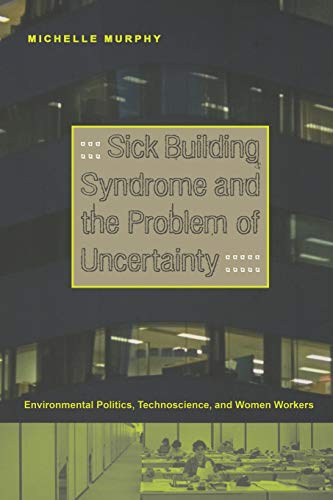
Sick Building Syndrome and the Problem of Uncertainty (Paperback)
M. Murphy
ISBN 10: 0822336715 ISBN 13: 9780822336716
Editorial: Duke University Press, North Carolina, 2006
Nuevos
Paperback
Librería:
Grand Eagle Retail, Bensenville, IL, Estados Unidos de America
Calificación del vendedor: 5 de 5 estrellas

Vendedor de AbeBooks desde 12 de octubre de 2005
Este artículo en concreto ya no está disponible.
Descripción
Descripción:
Paperback. Before 1980, sick building syndrome did not exist. By the 1990s, it was among the most commonly investigated occupational health problems in the United States. Afflicted by headaches, rashes, and immune system disorders, office workers-mostly women-protested that their workplaces were filled with toxic hazards; yet federal investigators could detect no chemical cause. This richly detailed history tells the story of how sick building syndrome came into being: how indoor exposures to chemicals wafting from synthetic carpet, ink, adhesive, solvents, and so on became something that relatively privileged Americans worried over, felt, and ultimately sought to do something about. As Michelle Murphy shows, sick building syndrome provides a window into how environmental politics moved indoors.Sick building syndrome embodied a politics of uncertainty that continues to characterize contemporary American environmental debates. Michelle Murphy explores the production of uncertainty by juxtaposing multiple histories, each of which explains how an expert or lay tradition made chemical exposures perceptible or imperceptible, existent or nonexistent. She shows how uncertainty emerged from a complex confluence of feminist activism, office worker protests, ventilation engineering, toxicology, popular epidemiology, corporate science, and ecology. In an illuminating case study, she reflects on EPA scientists' efforts to have their headquarters recognized as a sick building. Murphy brings all of these histories together in what is not only a thorough account of an environmental health problem but also a much deeper exploration of the relationship between history, materiality, and uncertainty. A detailed history of how sick building syndrome came into being: how indoor exposures to chemicals wafting from synthetic carpet, solvents, and so on became something that office workers felt and protested against Shipping may be from multiple locations in the US or from the UK, depending on stock availability. N° de ref. del artículo 9780822336716
Sinopsis:
Before 1980, sick building syndrome did not exist. By the 1990s, it was among the most commonly investigated occupational health problems in the United States. Afflicted by headaches, rashes, and immune system disorders, office workers-mostly women-protested that their workplaces were filled with toxic hazards; yet federal investigators could detect no chemical cause. This richly detailed history tells the story of how sick building syndrome came into being: how indoor exposures to chemicals wafting from synthetic carpet, ink, adhesive, solvents, and so on became something that relatively privileged Americans worried over, felt, and ultimately sought to do something about. As M. Murphy shows, sick building syndrome provides a window into how environmental politics moved indoors.
Sick building syndrome embodied a politics of uncertainty that continues to characterize contemporary American environmental debates. Murphy explores the production of uncertainty by juxtaposing multiple histories, each of which explains how an expert or lay tradition made chemical exposures perceptible or imperceptible, existent or nonexistent. They show how uncertainty emerged from a complex confluence of feminist activism, office worker protests, ventilation engineering, toxicology, popular epidemiology, corporate science, and ecology. In an illuminating case study, she reflects on EPA scientists’ efforts to have their headquarters recognized as a sick building. Murphy brings all of these histories together in what is not only a thorough account of an environmental health problem but also a much deeper exploration of the relationship between history, materiality, and uncertainty.
Acerca del autor:
M. Murphy is Assistant Professor in the History Department and the Women and Gender Studies Institute at the University of Toronto.
"Sobre este título" puede pertenecer a otra edición de este libro.
Detalles bibliográficos
Título: Sick Building Syndrome and the Problem of ...
Editorial: Duke University Press, North Carolina
Año de publicación: 2006
Encuadernación: Paperback
Condición: new
Edición: 1ª Edición