
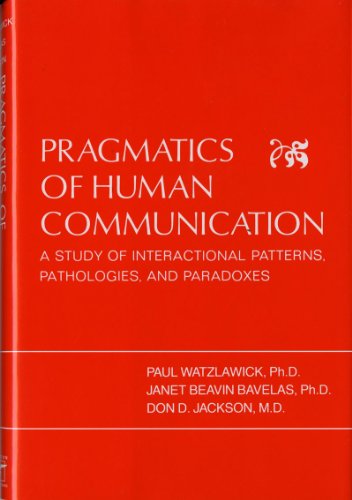
Pragmatics of Human Communication: A Study of Interactional Patterns, Pathologies, and Paradoxes
Paul Watzlawick; Janet Helmick Beavin; Don D. Jackson
ISBN 10: 0393010090 ISBN 13: 9780393010091
Editorial: W. W. Norton & Company (edition First Edition), 1967
Usado
Hardcover
Librería:
BooksRun, Philadelphia, PA, Estados Unidos de America
Calificación del vendedor: 5 de 5 estrellas

Vendedor de AbeBooks desde 2 de febrero de 2016
Este artículo en concreto ya no está disponible.
Descripción
Descripción:
With dust jacket. It's a well-cared-for item that has seen limited use. The item may show minor signs of wear. All the text is legible, with all pages included. It may have slight markings and/or highlighting. N° de ref. del artículo 0393010090-8-1-29
Sinopsis:
Communication is a relationship that is qualitatively different from the "properties" of the individuals involved.
After defining certain general concepts, the authors present basic characteristics of human communication and illustrate their manifestations and potential pathologies. Then the systemic aspects of human interactions that arise from the patterning of specific characteristics of communication are exemplified by the analysis of Albee's Who's Afraid of Virginia Woolf?
They then extend it to psychotherapeutic double binds and the technique of "prescribing the symptom." In conclusion, they postulate about man's communication with reality in the existential sense.
Reseña del editor: After defining certain general concepts, the authors present basic characteristics of human communication and illustrate their manifestations and potential pathologies. Then the systemic aspects of human interactions that arise from the patterning of specific characteristics of communication are exemplified by the analysis of Albee's Who's Afraid of Virginia Woolf? They then extend it to psychotherapeutic double binds and the technique of "prescribing the symptom." In conclusion, they postulate about man's communication with reality in the existential sense.
"Sobre este título" puede pertenecer a otra edición de este libro.
Detalles bibliográficos
Título: Pragmatics of Human Communication: A Study ...
Editorial: W. W. Norton & Company (edition First Edition)
Año de publicación: 1967
Encuadernación: Hardcover
Condición: Very Good
Condición de la sobrecubierta: Sobrecubierta Incluida
Edición: First Edition.