

The Logic Theory Machine. A Complex Information Processing System
Newell, Simon and Shaw
Año de publicación: 1956
Usado
Encuadernación de tapa blanda
Librería:
Jeremy Norman's historyofscience, Novato, CA, Estados Unidos de America
Calificación del vendedor: 4 de 5 estrellas

Honoris Librarius
Miembro de AbeBooks desde 1996
Este libro ya no está disponible. Sin embargo, AbeBooks ofrece millones de libros. Escriba otros términos de búsqueda a continuación para encontrar ejemplares similares.
Descripción
Descripción:
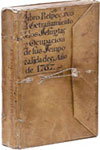
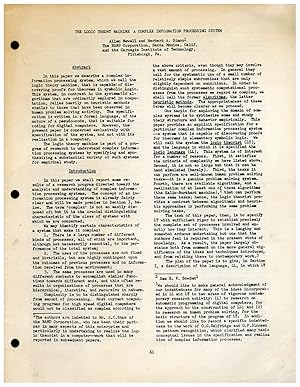
Newell, Allen (1927-92); Herbert Simon (1916-2001). The logic theory machine: A complex information processing system. Reproduced typescript. Offprint from IRE Transactions on Information Theory IT-2 (September 1956). 61-79pp. 278 x 218 mm. Without wrappers as issued. Punched for a 3-ring binder. Boxed. Light toning, slight edgewear and creasing, but very good. First Edition, Offprint Issue. Extremely rare. During 1955 and 1956 computer scientist and cognitive psychologist Allen Newell, political scientist, economist and sociologist Herbert A. Simon and systems programmer John Clifford Shaw, all working at the Rand Corporation in Santa Monica, California, developed the Logic Theorist, the first program deliberately engineered to mimic the problem-solving skills of a human being. They decided to write a program that could prove theorems in the propositional calculus like those in Principia Mathematica by Alfred North Whitehead and Bertrand Russell. As Simon later wrote, "LT was based on the system of Principia mathematica, largely because a copy of that work happened to sit in my bookshelf. There was no intention of making a contribution to symbolic logic, and the system of Principia was sufficiently outmoded by that time as to be inappropriate for that purpose. For us, the important consideration was not the precise task, but its suitability for demonstrating that a computer could discover problem solutions in a complex nonnumerical domain by heuristic search that used humanoid heuristics" (Simon, "Allen Newell: 1927-1992," Annals of the History of Computing 20 [1998]: 68). The collaborators wrote the first version of the program by hand on 3 x 5-inch cards. As Simon recalled: "In January 1956, we assembled my wife and three children together with some graduate students. To each member of the group, we gave one of the cards, so that each one became, in effect, a component of the computer program . . . Here was nature imitating art imitating nature" (quoted in the Wikipedia article on Logic Theorist). The team showed that the program could prove theorems as well as a talented mathematician. Eventually Shaw was able to run the program on the computer at RAND s Santa Monica facility. It proved 38 of the first 52 theorems in Principia Mathematica. For Theorem 2.85 the Logic Theorist surpassed its inventors expectations by finding a new and better proof. This was the "the first foray by artificial intelligence research into high-order intellectual processes" (Feigenbaum and Feldman, Computers and Thought [1963]). Newell and Simon first described the Logic Theorist in Rand Corporation report P-868 issued on June 15, 1956, entitled The Logic Theory Machine. A Complex Information Processing System. As far as we know, no copy of that report has ever appeared in commerce. The report was first officially published in September, 1956 under the same title in IRE Transactions on Information Theory IT-2, 61-79. Newell and Simon demonstrated the program at the Dartmouth Summer Session on Artificial Intelligence (August-September 1956) in which AI was formally named Artificial Intelligence. Origins of Cyberspace 815 (journal issue). . N° de ref. del artículo 45290
Detalles bibliográficos
Título: The Logic Theory Machine. A Complex ...
Año de publicación: 1956
Encuadernación: Encuadernación de tapa blanda
Edición: 1ª Edición
IberLibro.com es un mercado online donde puede comprar millones de libros antiguos, nuevos, usados, raros y agotados. Le ponemos en contacto con miles de librerías de todo el mundo. Comprar en IberLibro es fácil y 100% seguro. Busque un libro, realice el pedido a través de nuestra página con toda confianza y recíbalo directamente de la librería.
Busque entre millones de libros de miles de librerías
Libros usados

Bestsellers rebajados, autores destacados y una gran variedad de libros por menos de 5 €. Si su pasatiempo es leer, éste es su espacio.
Libros antiguos y de colección
Compendio vital para el amante del libro antiguo: libros firmados, primeras ediciones, facsímiles, librerías anticuarias o destacados.
Libros con envío gratis

Gastos de envío gratuitos para miles de libros nuevos, antiguos y de ocasión. Sin compra mínima.