

Importe total (1 artículo artículos):
Destino del pedido:

reality unobservable observability unobservability (10 resultados)
Ir a los resultados principales
Filtros de búsqueda
Tipo de artículo
- Todos los tipos de productos
- Libros (10)
- Revistas y publicaciones (No hay ningún otro resultado que coincida con este filtro.)
- Cómics (No hay ningún otro resultado que coincida con este filtro.)
- Partituras (No hay ningún otro resultado que coincida con este filtro.)
- Arte, grabados y pósters (No hay ningún otro resultado que coincida con este filtro.)
- Fotografías (No hay ningún otro resultado que coincida con este filtro.)
- Mapas (No hay ningún otro resultado que coincida con este filtro.)
- Manuscritos y coleccionismo de papel (No hay ningún otro resultado que coincida con este filtro.)
Condición Más información
- Nuevo (8)
- Como nuevo, Excelente o Muy bueno (2)
- Bueno o Aceptable (No hay ningún otro resultado que coincida con este filtro.)
- Regular o Pobre (No hay ningún otro resultado que coincida con este filtro.)
- Tal como se indica (No hay ningún otro resultado que coincida con este filtro.)
Encuadernación
Más atributos
- Primera edición (No hay ningún otro resultado que coincida con este filtro.)
- Firmado (No hay ningún otro resultado que coincida con este filtro.)
- Sobrecubierta (No hay ningún otro resultado que coincida con este filtro.)
- Con imágenes (4)
- No impresión bajo demanda (9)
Idioma (1)
Precio
- Cualquier precio
- Menos de EUR 20 (No hay ningún otro resultado que coincida con este filtro.)
- EUR 20 a EUR 45 (No hay ningún otro resultado que coincida con este filtro.)
- Más de EUR 45
Gastos de envío gratis
- Envío gratis a Estados Unidos de America (No hay ningún otro resultado que coincida con este filtro.)
Ubicación del vendedor
Valoración de los vendedores
-

The Reality of the Unobservable: Observability, Unobservability and Their Impact on the Issue of Scientific Realism (Boston Studies in the Philosophy and History of Science)
Librería: Ria Christie Collections, Uxbridge, Reino Unido
Calificación del vendedor: 5 de 5 estrellas

EUR 163,59
Envío por EUR 13,80
Se envía de Reino Unido a Estados Unidos de AmericaCantidad disponible: Más de 20 disponibles
Añadir al carritoCondición: New. In.
-

The Reality of the Unobservable: Observability, Unobservability and Their Impact on the Issue of Scientific Realism (Boston Studies in the Philosophy and History of Science, 215)
Librería: Ria Christie Collections, Uxbridge, Reino Unido
Calificación del vendedor: 5 de 5 estrellas
EUR 163,59
Envío por EUR 13,80
Se envía de Reino Unido a Estados Unidos de AmericaCantidad disponible: Más de 20 disponibles
Añadir al carritoCondición: New. In.
-
The Reality of the Unobservable: Observability, Unobservability and Their Impact on the Issue of Scientific Realism (Boston Studies in the Philosophy and History of Science, 215)
Librería: BennettBooksLtd, Los Angeles, CA, Estados Unidos de America
Calificación del vendedor: 5 de 5 estrellas
EUR 203,99
Envío por EUR 6,06
Se envía dentro de Estados Unidos de AmericaCantidad disponible: 1 disponibles
Añadir al carritoHardcover. Condición: New. In shrink wrap. Looks like an interesting title!
-
The Reality of the Unobservable | Observability, Unobservability and Their Impact on the Issue of Scientific Realism
Librería: preigu, Osnabrück, Alemania
Calificación del vendedor: 5 de 5 estrellas
EUR 140,00
Envío por EUR 70,00
Se envía de Alemania a Estados Unidos de AmericaCantidad disponible: 5 disponibles
Añadir al carritoTaschenbuch. Condición: Neu. The Reality of the Unobservable | Observability, Unobservability and Their Impact on the Issue of Scientific Realism | E. Agazzi (u. a.) | Taschenbuch | Boston Studies in the Philosophy and History of Science | viii | Englisch | 2010 | Springer | EAN 9789048154586 | Verantwortliche Person für die EU: Springer Verlag GmbH, Tiergartenstr. 17, 69121 Heidelberg, juergen[dot]hartmann[at]springer[dot]com | Anbieter: preigu.
-

The Reality of the Unobservable : Observability, Unobservability and Their Impact on the Issue of Scientific Realism
Librería: AHA-BUCH GmbH, Einbeck, Alemania
Calificación del vendedor: 5 de 5 estrellas
EUR 168,73
Envío por EUR 62,94
Se envía de Alemania a Estados Unidos de AmericaCantidad disponible: 1 disponibles
Añadir al carritoTaschenbuch. Condición: Neu. Druck auf Anfrage Neuware - Printed after ordering - Observability and Scientific Realism It is commonly thought that the birth of modern natural science was made possible by an intellectual shift from a mainly abstract and specuJative conception of the world to a carefully elaborated image based on observations. There is some grain of truth in this claim, but this grain depends very much on what one takes observation to be. In the philosophy of science of our century, observation has been practically equated with sense perception. This is understandable if we think of the attitude of radical empiricism that inspired Ernst Mach and the philosophers of the Vienna Circle, who powerfully influenced our century's philosophy of science. However, this was not the atti tude of the f ounders of modern science: Galileo, f or example, expressed in a f amous passage of the Assayer the conviction that perceptual features of the world are merely subjective, and are produced in the 'anima!' by the motion and impacts of unobservable particles that are endowed uniquely with mathematically expressible properties, and which are therefore the real features of the world. Moreover, on other occasions, when defending the Copernican theory, he explicitly remarked that in admitting that the Sun is static and the Earth turns on its own axis, 'reason must do violence to the sense' , and that it is thanks to this violence that one can know the tme constitution of the universe.
-
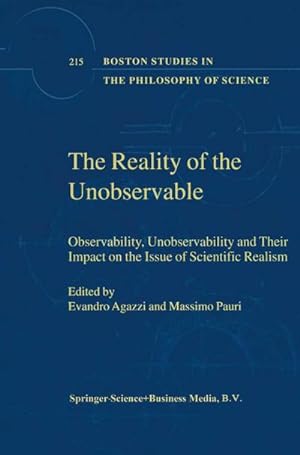
The Reality of the Unobservable : Observability, Unobservability and Their Impact on the Issue of Scientific Realism
Librería: AHA-BUCH GmbH, Einbeck, Alemania
Calificación del vendedor: 5 de 5 estrellas
EUR 168,73
Envío por EUR 63,73
Se envía de Alemania a Estados Unidos de AmericaCantidad disponible: 1 disponibles
Añadir al carritoBuch. Condición: Neu. Druck auf Anfrage Neuware - Printed after ordering - Observability and Scientific Realism It is commonly thought that the birth of modern natural science was made possible by an intellectual shift from a mainly abstract and specuJative conception of the world to a carefully elaborated image based on observations. There is some grain of truth in this claim, but this grain depends very much on what one takes observation to be. In the philosophy of science of our century, observation has been practically equated with sense perception. This is understandable if we think of the attitude of radical empiricism that inspired Ernst Mach and the philosophers of the Vienna Circle, who powerfully influenced our century's philosophy of science. However, this was not the atti tude of the f ounders of modern science: Galileo, f or example, expressed in a f amous passage of the Assayer the conviction that perceptual features of the world are merely subjective, and are produced in the 'anima!' by the motion and impacts of unobservable particles that are endowed uniquely with mathematically expressible properties, and which are therefore the real features of the world. Moreover, on other occasions, when defending the Copernican theory, he explicitly remarked that in admitting that the Sun is static and the Earth turns on its own axis, 'reason must do violence to the sense' , and that it is thanks to this violence that one can know the tme constitution of the universe.
-
The Reality of the Unobservable: Observability, Unobservability and Their Impact on the Issue of Scientific Realism (Boston Studies in the Philosophy of Science)
Librería: Revaluation Books, Exeter, Reino Unido
Calificación del vendedor: 5 de 5 estrellas
EUR 236,92
Envío por EUR 14,40
Se envía de Reino Unido a Estados Unidos de AmericaCantidad disponible: 2 disponibles
Añadir al carritoPaperback. Condición: Brand New. 388 pages. 9.25x6.25x0.88 inches. In Stock.
-
The Reality of the Unobservable: Observability, Unobservability and Their Impact on the Issue of Scientific Realism (Boston Studies in the Philosophy and History of Science, 215)
Librería: Mispah books, Redhill, SURRE, Reino Unido
Calificación del vendedor: 4 de 5 estrellas

EUR 245,67
Envío por EUR 28,81
Se envía de Reino Unido a Estados Unidos de AmericaCantidad disponible: 1 disponibles
Añadir al carritoPaperback. Condición: Like New. Like New. book.
-
The Reality of the Unobservable: Observability, Unobservability and Their Impact on the Issue of Scientific Realism (Boston Studies in the Philosophy and History of Science, 215)
Librería: Mispah books, Redhill, SURRE, Reino Unido
Calificación del vendedor: 4 de 5 estrellas
EUR 259,91
Envío por EUR 28,81
Se envía de Reino Unido a Estados Unidos de AmericaCantidad disponible: 1 disponibles
Añadir al carritoHardcover. Condición: Like New. Like New. book.
-
The Reality of the Unobservable | Observability, Unobservability and Their Impact on the Issue of Scientific Realism
Librería: preigu, Osnabrück, Alemania
Calificación del vendedor: 5 de 5 estrellas
EUR 141,20
Envío por EUR 70,00
Se envía de Alemania a Estados Unidos de AmericaCantidad disponible: 5 disponibles
Añadir al carritoBuch. Condición: Neu. The Reality of the Unobservable | Observability, Unobservability and Their Impact on the Issue of Scientific Realism | E. Agazzi (u. a.) | Buch | Boston Studies in the Philosophy and History of Science | viii | Englisch | 2000 | Springer | EAN 9780792363118 | Verantwortliche Person für die EU: Springer Verlag GmbH, Tiergartenstr. 17, 69121 Heidelberg, juergen[dot]hartmann[at]springer[dot]com | Anbieter: preigu Print on Demand.


