
Importe total (1 artículo artículos):
Destino del pedido:

protein structure function bioinformatics (26 resultados)
Ir a los resultados principales
Filtros de búsqueda
Tipo de artículo
- Todos los tipos de productos
- Libros (26)
- Revistas y publicaciones (No hay ningún otro resultado que coincida con este filtro.)
- Cómics (No hay ningún otro resultado que coincida con este filtro.)
- Partituras (No hay ningún otro resultado que coincida con este filtro.)
- Arte, grabados y pósters (No hay ningún otro resultado que coincida con este filtro.)
- Fotografías (No hay ningún otro resultado que coincida con este filtro.)
- Mapas (No hay ningún otro resultado que coincida con este filtro.)
- Manuscritos y coleccionismo de papel (No hay ningún otro resultado que coincida con este filtro.)
Condición Más información
- Nuevo (23)
- Como nuevo, Excelente o Muy bueno (3)
- Bueno o Aceptable (No hay ningún otro resultado que coincida con este filtro.)
- Regular o Pobre (No hay ningún otro resultado que coincida con este filtro.)
- Tal como se indica (No hay ningún otro resultado que coincida con este filtro.)
Encuadernación
Más atributos
- Primera edición (No hay ningún otro resultado que coincida con este filtro.)
- Firmado (No hay ningún otro resultado que coincida con este filtro.)
- Sobrecubierta (No hay ningún otro resultado que coincida con este filtro.)
- Con imágenes (15)
- No impresión bajo demanda (12)
Idioma (1)
Precio
- Cualquier precio
- Menos de EUR 20 (No hay ningún otro resultado que coincida con este filtro.)
- EUR 20 a EUR 40 (No hay ningún otro resultado que coincida con este filtro.)
- Más de EUR 40
Gastos de envío gratis
- Envío gratis a Estados Unidos de America (No hay ningún otro resultado que coincida con este filtro.)
Ubicación del vendedor
Valoración de los vendedores
-

Protein Bioinformatics Structure Folding: From Sequence to Function
Librería: Revaluation Books, Exeter, Reino Unido
Calificación del vendedor: 5 de 5 estrellas

EUR 68,51
EUR 14,34 shipping
Se envía de Reino Unido a Estados Unidos de AmericaCantidad disponible: 2 disponibles
Añadir al carritoPaperback. Condición: Brand New. 1st edition. 339 pages. 9.53x7.32x0.63 inches. In Stock.
-

From Protein Structure to Function with Bioinformatics
Librería: Anis Press, Walnut Creek, CA, Estados Unidos de America
Calificación del vendedor: 5 de 5 estrellas
EUR 96,20
EUR 8,49 shipping
Se envía dentro de Estados Unidos de AmericaCantidad disponible: 1 disponibles
Añadir al carritoHardcover. Condición: Fine.
-

From Protein Structure to Function with Bioinformatics
Librería: Books Puddle, New York, NY, Estados Unidos de America
Calificación del vendedor: 4 de 5 estrellas

EUR 170,05
EUR 3,39 shipping
Se envía dentro de Estados Unidos de AmericaCantidad disponible: 4 disponibles
Añadir al carritoCondición: New. pp. xvi + 328 1st Edition.
-
From Protein Structure to Function with Bioinformatics
Librería: Revaluation Books, Exeter, Reino Unido
Calificación del vendedor: 5 de 5 estrellas
EUR 179,31
EUR 14,34 shipping
Se envía de Reino Unido a Estados Unidos de AmericaCantidad disponible: 1 disponibles
Añadir al carritoPaperback. Condición: Brand New. 344 pages. 9.00x6.00x0.81 inches. In Stock.
-
From Protein Structure to Function with Bioinformatics
Idioma: Inglés
Publicado por Springer Netherlands, Springer Netherlands, 2010
ISBN 10: 9048180589 ISBN 13: 9789048180585
Librería: AHA-BUCH GmbH, Einbeck, Alemania
Calificación del vendedor: 5 de 5 estrellas
EUR 134,29
EUR 62,61 shipping
Se envía de Alemania a Estados Unidos de AmericaCantidad disponible: 1 disponibles
Añadir al carritoTaschenbuch. Condición: Neu. Druck auf Anfrage Neuware - Printed after ordering - Proteins lie at the heart of almost all biological processes and have an incredibly wide range of activities. Central to the function of all proteins is their ability to adopt, stably or sometimes transiently, structures that allow for interaction with other molecules. An understanding of the structure of a protein can therefore lead us to a much improved picture of its molecular function. This realisation has been a prime motivation of recent Structural Genomics projects, involving large-scale experimental determination of protein structures, often those of proteins about which little is known of function. These initiatives have, in turn, stimulated the massive development of novel methods for prediction of protein function from structure. Since model structures may also take advantage of new function prediction algorithms, the first part of the book deals with the various ways in which protein structures may be predicted or inferred, including specific treatment of membrane and intrinsically disordered proteins. A detailed consideration of current structure-based function prediction methodologies forms the second part of this book, which concludes with two chapters, focusing specifically on case studies, designed to illustrate the real-world application of these methods. With bang up-to-date texts from world experts, and abundant links to publicly available resources, this book will be invaluable to anyone who studies proteins and the endlessly fascinating relationship between their structure and function.
-
From Protein Structure to Function with Bioinformatics
Librería: Buchpark, Trebbin, Alemania
Calificación del vendedor: 5 de 5 estrellas
EUR 90,05
EUR 105,00 shipping
Se envía de Alemania a Estados Unidos de AmericaCantidad disponible: 1 disponibles
Añadir al carritoCondición: Sehr gut. Zustand: Sehr gut | Seiten: 328 | Sprache: Englisch | Produktart: Bücher | Keine Beschreibung verfügbar.
-

From Protein Structure to Function with Bioinformatics
Librería: Books Puddle, New York, NY, Estados Unidos de America
Calificación del vendedor: 4 de 5 estrellas
EUR 202,18
EUR 3,39 shipping
Se envía dentro de Estados Unidos de AmericaCantidad disponible: 4 disponibles
Añadir al carritoCondición: New. pp. 518.
-
From Protein Structure to Function with Bioinformatics
Librería: Mispah books, Redhill, SURRE, Reino Unido
Calificación del vendedor: 4 de 5 estrellas
EUR 205,65
EUR 28,69 shipping
Se envía de Reino Unido a Estados Unidos de AmericaCantidad disponible: 1 disponibles
Añadir al carritoPaperback. Condición: Like New. Like New. book.
-

From Protein Structure to Function with Bioinformatics
Idioma: Inglés
Publicado por Springer Netherlands, Springer Netherlands Jul 2018, 2018
ISBN 10: 9402414827 ISBN 13: 9789402414820
Librería: buchversandmimpf2000, Emtmannsberg, BAYE, Alemania
Calificación del vendedor: 5 de 5 estrellas
EUR 320,99
EUR 60,00 shipping
Se envía de Alemania a Estados Unidos de AmericaCantidad disponible: 2 disponibles
Añadir al carritoTaschenbuch. Condición: Neu. Neuware -This book is about protein structural bioinformatics and how it can help understand and predict protein function. It covers structure-based methods that can assign and explain protein function based on overall folds, characteristics of protein surfaces, occurrence of small 3D motifs, protein-protein interactions and on dynamic properties. Such methods help extract maximum value from new experimental structures, but can often be applied to protein models. The book also, therefore, provides comprehensive coverage of methods for predicting or inferring protein structure, covering all structural classes from globular proteins and their membrane-resident counterparts to amyloid structures and intrinsically disordered proteins.The book is split into two broad sections, the first covering methods to generate or infer protein structure, the second dealing with structure-based function annotation. Each chapter is written by world experts in the field. The first section covers methods ranging from traditional homology modelling and fold recognition to fragment-based ab initio methods, and includes a chapter, new for the second edition, on structure prediction using evolutionary covariance. Membrane proteins and intrinsically disordered proteins are each assigned chapters, while two new chapters deal with amyloid structures and means to predict modes of protein-protein interaction. The second section includes chapters covering functional diversity within protein folds and means to assign function based on surface properties and recurring motifs. Further chapters cover the key roles of protein dynamics in protein function and use of automated servers for function inference. The book concludes with two chapters covering case studies of structure prediction, based respectively on crystal structures and protein models, providing numerous examples of real-world usage of the methods mentioned previously.This book is targeted at postgraduate students and academic researchers. It is most obviously of interest to protein bioinformaticians and structural biologists, but should also serve as a guide to biologists more broadly by highlighting the insights that structural bioinformatics can provide into proteins of their interest.Springer Verlag GmbH, Tiergartenstr. 17, 69121 Heidelberg 520 pp. Englisch.
-

From Protein Structure to Function with Bioinformatics
Idioma: Inglés
Publicado por Springer Netherlands, Springer Netherlands Apr 2017, 2017
ISBN 10: 9402410678 ISBN 13: 9789402410679
Librería: buchversandmimpf2000, Emtmannsberg, BAYE, Alemania
Calificación del vendedor: 5 de 5 estrellas
EUR 320,99
EUR 60,00 shipping
Se envía de Alemania a Estados Unidos de AmericaCantidad disponible: 2 disponibles
Añadir al carritoBuch. Condición: Neu. Neuware -This book is about protein structural bioinformatics and how it can help understand and predict protein function. It covers structure-based methods that can assign and explain protein function based on overall folds, characteristics of protein surfaces, occurrence of small 3D motifs, protein-protein interactions and on dynamic properties. Such methods help extract maximum value from new experimental structures, but can often be applied to protein models. The book also, therefore, provides comprehensive coverage of methods for predicting or inferring protein structure, covering all structural classes from globular proteins and their membrane-resident counterparts to amyloid structures and intrinsically disordered proteins.The book is split into two broad sections, the first covering methods to generate or infer protein structure, the second dealing with structure-based function annotation. Each chapter is written by world experts in the field. The first section covers methods ranging from traditional homology modelling and fold recognition to fragment-based ab initio methods, and includes a chapter, new for the second edition, on structure prediction using evolutionary covariance. Membrane proteins and intrinsically disordered proteins are each assigned chapters, while two new chapters deal with amyloid structures and means to predict modes of protein-protein interaction. The second section includes chapters covering functional diversity within protein folds and means to assign function based on surface properties and recurring motifs. Further chapters cover the key roles of protein dynamics in protein function and use of automated servers for function inference. The book concludes with two chapters covering case studies of structure prediction, based respectively on crystal structures and protein models, providing numerous examples of real-world usage of the methods mentioned previously.This book is targeted at postgraduate students and academic researchers. It is most obviously of interest to protein bioinformaticians and structural biologists, but should also serve as a guide to biologists more broadly by highlighting the insights that structural bioinformatics can provide into proteins of their interest.Springer Verlag GmbH, Tiergartenstr. 17, 69121 Heidelberg 520 pp. Englisch.
-

From Protein Structure to Function with Bioinformatics
Idioma: Inglés
Publicado por Springer Netherlands, Springer Netherlands, 2018
ISBN 10: 9402414827 ISBN 13: 9789402414820
Librería: AHA-BUCH GmbH, Einbeck, Alemania
Calificación del vendedor: 5 de 5 estrellas
EUR 324,84
EUR 64,37 shipping
Se envía de Alemania a Estados Unidos de AmericaCantidad disponible: 1 disponibles
Añadir al carritoTaschenbuch. Condición: Neu. Druck auf Anfrage Neuware - Printed after ordering - This book is about protein structural bioinformatics and how it can help understand and predict protein function. It covers structure-based methods that can assign and explain protein function based on overall folds, characteristics of protein surfaces, occurrence of small 3D motifs, protein-protein interactions and on dynamic properties. Such methods help extract maximum value from new experimental structures, but can often be applied to protein models. The book also, therefore, provides comprehensive coverage of methods for predicting or inferring protein structure, covering all structural classes from globular proteins and their membrane-resident counterparts to amyloid structures and intrinsically disordered proteins. The book is split into two broad sections, the first covering methods to generate or infer protein structure, the second dealing with structure-based function annotation. Each chapter is written by world experts in the field. The first section covers methods ranging from traditional homology modelling and fold recognition to fragment-based ab initio methods, and includes a chapter, new for the second edition, on structure prediction using evolutionary covariance. Membrane proteins and intrinsically disordered proteins are each assigned chapters, while two new chapters deal with amyloid structures and means to predict modes of protein-protein interaction. The second section includes chapters covering functional diversity within protein folds and means to assign function based on surface properties and recurring motifs. Further chapters cover the key roles of protein dynamics in protein function and use of automated servers for function inference. The book concludes with two chapters covering case studies of structure prediction, based respectively on crystal structures and protein models, providing numerous examples of real-world usage of the methods mentioned previously.This book is targeted at postgraduate students and academic researchers. It is most obviously of interest to protein bioinformaticians and structural biologists, but should also serve as a guide to biologists more broadly by highlighting the insights that structural bioinformatics can provide into proteins of their interest.
-
From Protein Structure to Function with Bioinformatics
Idioma: Inglés
Publicado por Springer Netherlands, Springer Netherlands, 2017
ISBN 10: 9402410678 ISBN 13: 9789402410679
Librería: AHA-BUCH GmbH, Einbeck, Alemania
Calificación del vendedor: 5 de 5 estrellas
EUR 329,54
EUR 65,17 shipping
Se envía de Alemania a Estados Unidos de AmericaCantidad disponible: 1 disponibles
Añadir al carritoBuch. Condición: Neu. Druck auf Anfrage Neuware - Printed after ordering - This book is about protein structural bioinformatics and how it can help understand and predict protein function. It covers structure-based methods that can assign and explain protein function based on overall folds, characteristics of protein surfaces, occurrence of small 3D motifs, protein-protein interactions and on dynamic properties. Such methods help extract maximum value from new experimental structures, but can often be applied to protein models. The book also, therefore, provides comprehensive coverage of methods for predicting or inferring protein structure, covering all structural classes from globular proteins and their membrane-resident counterparts to amyloid structures and intrinsically disordered proteins. The book is split into two broad sections, the first covering methods to generate or infer protein structure, the second dealing with structure-based function annotation. Each chapter is written by world experts in the field. The first section covers methods ranging from traditional homology modelling and fold recognition to fragment-based ab initio methods, and includes a chapter, new for the second edition, on structure prediction using evolutionary covariance. Membrane proteins and intrinsically disordered proteins are each assigned chapters, while two new chapters deal with amyloid structures and means to predict modes of protein-protein interaction. The second section includes chapters covering functional diversity within protein folds and means to assign function based on surface properties and recurring motifs. Further chapters cover the key roles of protein dynamics in protein function and use of automated servers for function inference. The book concludes with two chapters covering case studies of structure prediction, based respectively on crystal structures and protein models, providing numerous examples of real-world usage of the methods mentioned previously.This book is targeted at postgraduate students and academic researchers. It is most obviously of interest to protein bioinformaticians and structural biologists, but should also serve as a guide to biologists more broadly by highlighting the insights that structural bioinformatics can provide into proteins of their interest.
-
From Protein Structure to Function with Bioinformatics
Idioma: Inglés
Publicado por Springer Netherlands Nov 2010, 2010
ISBN 10: 9048180589 ISBN 13: 9789048180585
Librería: BuchWeltWeit Ludwig Meier e.K., Bergisch Gladbach, Alemania
Calificación del vendedor: 5 de 5 estrellas
EUR 106,99
EUR 23,00 shipping
Se envía de Alemania a Estados Unidos de AmericaCantidad disponible: 2 disponibles
Añadir al carritoTaschenbuch. Condición: Neu. This item is printed on demand - it takes 3-4 days longer - Neuware -Proteins lie at the heart of almost all biological processes and have an incredibly wide range of activities. Central to the function of all proteins is their ability to adopt, stably or sometimes transiently, structures that allow for interaction with other molecules. An understanding of the structure of a protein can therefore lead us to a much improved picture of its molecular function. This realisation has been a prime motivation of recent Structural Genomics projects, involving large-scale experimental determination of protein structures, often those of proteins about which little is known of function. These initiatives have, in turn, stimulated the massive development of novel methods for prediction of protein function from structure. Since model structures may also take advantage of new function prediction algorithms, the first part of the book deals with the various ways in which protein structures may be predicted or inferred, including specific treatment of membrane and intrinsically disordered proteins. A detailed consideration of current structure-based function prediction methodologies forms the second part of this book, which concludes with two chapters, focusing specifically on case studies, designed to illustrate the real-world application of these methods. With bang up-to-date texts from world experts, and abundant links to publicly available resources, this book will be invaluable to anyone who studies proteins and the endlessly fascinating relationship between their structure and function. 344 pp. Englisch.
-
From Protein Structure to Function with Bioinformatics
Librería: moluna, Greven, Alemania
Calificación del vendedor: 4 de 5 estrellas
EUR 111,15
EUR 48,99 shipping
Se envía de Alemania a Estados Unidos de AmericaCantidad disponible: Más de 20 disponibles
Añadir al carritoCondición: New. Dieser Artikel ist ein Print on Demand Artikel und wird nach Ihrer Bestellung fuer Sie gedruckt. Comprehensively covers all recent developments in structure-based function prediction of proteinsContains abundant links to publicly available resourcesGenuinely world class roster of authorsIncludes full coverage of techniques to ge.
-
From Protein Structure to Function with Bioinformatics
Librería: Majestic Books, Hounslow, Reino Unido
Calificación del vendedor: 4 de 5 estrellas
EUR 177,96
EUR 7,46 shipping
Se envía de Reino Unido a Estados Unidos de AmericaCantidad disponible: 4 disponibles
Añadir al carritoCondición: New. Print on Demand pp. xvi + 328.
-

From Protein Structure to Function with Bioinformatics
Librería: preigu, Osnabrück, Alemania
Calificación del vendedor: 5 de 5 estrellas
EUR 115,35
EUR 70,00 shipping
Se envía de Alemania a Estados Unidos de AmericaCantidad disponible: 5 disponibles
Añadir al carritoTaschenbuch. Condición: Neu. From Protein Structure to Function with Bioinformatics | Daniel John Rigden | Taschenbuch | xvi | Englisch | 2010 | Springer | EAN 9789048180585 | Verantwortliche Person für die EU: Springer Verlag GmbH, Tiergartenstr. 17, 69121 Heidelberg, juergen[dot]hartmann[at]springer[dot]com | Anbieter: preigu Print on Demand.
-

From Protein Structure to Function with Bioinformatics
Idioma: Inglés
Publicado por Springer Netherlands, Springer Netherlands Nov 2010, 2010
ISBN 10: 9048180589 ISBN 13: 9789048180585
Librería: buchversandmimpf2000, Emtmannsberg, BAYE, Alemania
Calificación del vendedor: 5 de 5 estrellas
EUR 129,98
EUR 60,00 shipping
Se envía de Alemania a Estados Unidos de AmericaCantidad disponible: 1 disponibles
Añadir al carritoTaschenbuch. Condición: Neu. This item is printed on demand - Print on Demand Titel. Neuware -Proteins lie at the heart of almost all biological processes and have an incredibly wide range of activities. Central to the function of all proteins is their ability to adopt, stably or sometimes transiently, structures that allow for interaction with other molecules. An understanding of the structure of a protein can therefore lead us to a much improved picture of its molecular function. This realisation has been a prime motivation of recent Structural Genomics projects, involving large-scale experimental determination of protein structures, often those of proteins about which little is known of function. These initiatives have, in turn, stimulated the massive development of novel methods for prediction of protein function from structure. Since model structures may also take advantage of new function prediction algorithms, the first part of the book deals with the various ways in which protein structures may be predicted or inferred, including specific treatment of membrane and intrinsically disordered proteins. A detailed consideration of current structure-based function prediction methodologies forms the second part of this book, which concludes with two chapters, focusing specifically on case studies, designed to illustrate the real-world application of these methods. With bang up-to-date texts from world experts, and abundant links to publicly available resources, this book will be invaluable to anyone who studies proteins and the endlessly fascinating relationship between their structure and function.Springer Verlag GmbH, Tiergartenstr. 17, 69121 Heidelberg 344 pp. Englisch.
-
From Protein Structure to Function with Bioinformatics
Librería: Biblios, Frankfurt am main, HESSE, Alemania
Calificación del vendedor: 4 de 5 estrellas
EUR 182,15
EUR 9,95 shipping
Se envía de Alemania a Estados Unidos de AmericaCantidad disponible: 4 disponibles
Añadir al carritoCondición: New. PRINT ON DEMAND pp. xvi + 328.
-
From Protein Structure to Function with Bioinformatics
Librería: Majestic Books, Hounslow, Reino Unido
Calificación del vendedor: 4 de 5 estrellas
EUR 211,79
EUR 7,46 shipping
Se envía de Reino Unido a Estados Unidos de AmericaCantidad disponible: 4 disponibles
Añadir al carritoCondición: New. Print on Demand pp. 518.
-
From Protein Structure to Function with Bioinformatics
Librería: Biblios, Frankfurt am main, HESSE, Alemania
Calificación del vendedor: 4 de 5 estrellas
EUR 215,61
EUR 9,95 shipping
Se envía de Alemania a Estados Unidos de AmericaCantidad disponible: 4 disponibles
Añadir al carritoCondición: New. PRINT ON DEMAND pp. 518.
-

From Protein Structure to Function with Bioinformatics
Librería: moluna, Greven, Alemania
Calificación del vendedor: 4 de 5 estrellas
EUR 267,86
EUR 48,99 shipping
Se envía de Alemania a Estados Unidos de AmericaCantidad disponible: Más de 20 disponibles
Añadir al carritoCondición: New. Dieser Artikel ist ein Print on Demand Artikel und wird nach Ihrer Bestellung fuer Sie gedruckt. Comprehensively covers all recent developments in structure-based function prediction of proteinsContains abundant links to publicly available resourcesGenuinely world class roster of authorsIncludes full coverage of .
-
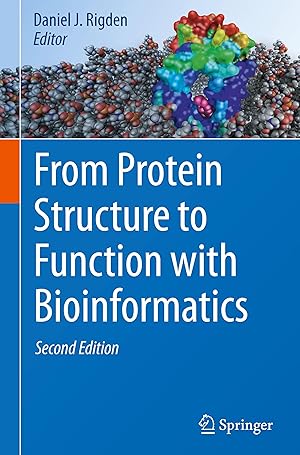
From Protein Structure to Function with Bioinformatics
Librería: moluna, Greven, Alemania
Calificación del vendedor: 4 de 5 estrellas
EUR 267,86
EUR 48,99 shipping
Se envía de Alemania a Estados Unidos de AmericaCantidad disponible: Más de 20 disponibles
Añadir al carritoCondición: New. Dieser Artikel ist ein Print on Demand Artikel und wird nach Ihrer Bestellung fuer Sie gedruckt. Comprehensively covers all recent developments in structure-based function prediction of proteinsContains abundant links to publicly available resourcesGenuinely world class roster of authorsIncludes full coverage of .
-

From Protein Structure to Function with Bioinformatics
Librería: preigu, Osnabrück, Alemania
Calificación del vendedor: 5 de 5 estrellas
EUR 271,00
EUR 70,00 shipping
Se envía de Alemania a Estados Unidos de AmericaCantidad disponible: 5 disponibles
Añadir al carritoTaschenbuch. Condición: Neu. From Protein Structure to Function with Bioinformatics | Daniel J. Rigden | Taschenbuch | xv | Englisch | 2018 | Springer | EAN 9789402414820 | Verantwortliche Person für die EU: Springer Verlag GmbH, Tiergartenstr. 17, 69121 Heidelberg, juergen[dot]hartmann[at]springer[dot]com | Anbieter: preigu Print on Demand.
-

From Protein Structure to Function with Bioinformatics
Idioma: Inglés
Publicado por Springer Netherlands Jul 2018, 2018
ISBN 10: 9402414827 ISBN 13: 9789402414820
Librería: BuchWeltWeit Ludwig Meier e.K., Bergisch Gladbach, Alemania
Calificación del vendedor: 5 de 5 estrellas
EUR 320,99
EUR 23,00 shipping
Se envía de Alemania a Estados Unidos de AmericaCantidad disponible: 2 disponibles
Añadir al carritoTaschenbuch. Condición: Neu. This item is printed on demand - it takes 3-4 days longer - Neuware -This book is about protein structural bioinformatics and how it can help understand and predict protein function. It covers structure-based methods that can assign and explain protein function based on overall folds, characteristics of protein surfaces, occurrence of small 3D motifs, protein-protein interactions and on dynamic properties. Such methods help extract maximum value from new experimental structures, but can often be applied to protein models. The book also, therefore, provides comprehensive coverage of methods for predicting or inferring protein structure, covering all structural classes from globular proteins and their membrane-resident counterparts to amyloid structures and intrinsically disordered proteins. The book is split into two broad sections, the first covering methods to generate or infer protein structure, the second dealing with structure-based function annotation. Each chapter is written by world experts in the field. The first section covers methods ranging from traditional homology modelling and fold recognition to fragment-based ab initio methods, and includes a chapter, new for the second edition, on structure prediction using evolutionary covariance. Membrane proteins and intrinsically disordered proteins are each assigned chapters, while two new chapters deal with amyloid structures and means to predict modes of protein-protein interaction. The second section includes chapters covering functional diversity within protein folds and means to assign function based on surface properties and recurring motifs. Further chapters cover the key roles of protein dynamics in protein function and use of automated servers for function inference. The book concludes with two chapters covering case studies of structure prediction, based respectively on crystal structures and protein models, providing numerous examples of real-world usage of the methods mentioned previously.This book is targeted at postgraduate students and academic researchers. It is most obviously of interest to protein bioinformaticians and structural biologists, but should also serve as a guide to biologists more broadly by highlighting the insights that structural bioinformatics can provide into proteins of their interest. 520 pp. Englisch.
-

From Protein Structure to Function with Bioinformatics
Idioma: Inglés
Publicado por Springer Netherlands Apr 2017, 2017
ISBN 10: 9402410678 ISBN 13: 9789402410679
Librería: BuchWeltWeit Ludwig Meier e.K., Bergisch Gladbach, Alemania
Calificación del vendedor: 5 de 5 estrellas
EUR 320,99
EUR 23,00 shipping
Se envía de Alemania a Estados Unidos de AmericaCantidad disponible: 2 disponibles
Añadir al carritoBuch. Condición: Neu. This item is printed on demand - it takes 3-4 days longer - Neuware -This book is about protein structural bioinformatics and how it can help understand and predict protein function. It covers structure-based methods that can assign and explain protein function based on overall folds, characteristics of protein surfaces, occurrence of small 3D motifs, protein-protein interactions and on dynamic properties. Such methods help extract maximum value from new experimental structures, but can often be applied to protein models. The book also, therefore, provides comprehensive coverage of methods for predicting or inferring protein structure, covering all structural classes from globular proteins and their membrane-resident counterparts to amyloid structures and intrinsically disordered proteins. The book is split into two broad sections, the first covering methods to generate or infer protein structure, the second dealing with structure-based function annotation. Each chapter is written by world experts in the field. The first section covers methods ranging from traditional homology modelling and fold recognition to fragment-based ab initio methods, and includes a chapter, new for the second edition, on structure prediction using evolutionary covariance. Membrane proteins and intrinsically disordered proteins are each assigned chapters, while two new chapters deal with amyloid structures and means to predict modes of protein-protein interaction. The second section includes chapters covering functional diversity within protein folds and means to assign function based on surface properties and recurring motifs. Further chapters cover the key roles of protein dynamics in protein function and use of automated servers for function inference. The book concludes with two chapters covering case studies of structure prediction, based respectively on crystal structures and protein models, providing numerous examples of real-world usage of the methods mentioned previously.This book is targeted at postgraduate students and academic researchers. It is most obviously of interest to protein bioinformaticians and structural biologists, but should also serve as a guide to biologists more broadly by highlighting the insights that structural bioinformatics can provide into proteins of their interest. 520 pp. Englisch.
-

From Protein Structure to Function with Bioinformatics
Librería: preigu, Osnabrück, Alemania
Calificación del vendedor: 5 de 5 estrellas
EUR 277,75
EUR 70,00 shipping
Se envía de Alemania a Estados Unidos de AmericaCantidad disponible: 5 disponibles
Añadir al carritoBuch. Condición: Neu. From Protein Structure to Function with Bioinformatics | Daniel J. Rigden | Buch | xv | Englisch | 2017 | Springer | EAN 9789402410679 | Verantwortliche Person für die EU: Springer Verlag GmbH, Tiergartenstr. 17, 69121 Heidelberg, juergen[dot]hartmann[at]springer[dot]com | Anbieter: preigu Print on Demand.

