

Importe total (1 artículo artículos):
Destino del pedido:

fallout nuclear tests de comar (4 resultados)
Ir a los resultados principales
Filtros de búsqueda
Tipo de artículo
- Todos los tipos de productos
- Libros (4)
- Revistas y publicaciones (No hay ningún otro resultado que coincida con este filtro.)
- Cómics (No hay ningún otro resultado que coincida con este filtro.)
- Partituras (No hay ningún otro resultado que coincida con este filtro.)
- Arte, grabados y pósters (No hay ningún otro resultado que coincida con este filtro.)
- Fotografías (No hay ningún otro resultado que coincida con este filtro.)
- Mapas (No hay ningún otro resultado que coincida con este filtro.)
- Manuscritos y coleccionismo de papel (No hay ningún otro resultado que coincida con este filtro.)
Condición Más información
- Nuevo (No hay ningún otro resultado que coincida con este filtro.)
- Como nuevo, Excelente o Muy bueno (1)
- Bueno o Aceptable (2)
- Regular o Pobre (No hay ningún otro resultado que coincida con este filtro.)
- Tal como se indica (1)
Encuadernación
- Todas
- Tapa dura (No hay ningún otro resultado que coincida con este filtro.)
- Tapa blanda (4)
Más atributos
- Primera edición (1)
- Firmado (No hay ningún otro resultado que coincida con este filtro.)
- Sobrecubierta (No hay ningún otro resultado que coincida con este filtro.)
- Con imágenes (2)
- No impresión bajo demanda (4)
Idioma (2)
Precio
- Cualquier precio
- Menos de EUR 20
- EUR 20 a EUR 45
- Más de EUR 45 (No hay ningún otro resultado que coincida con este filtro.)
Gastos de envío gratis
- Envío gratis a Estados Unidos de America (No hay ningún otro resultado que coincida con este filtro.)
Ubicación del vendedor
Valoración de los vendedores
-
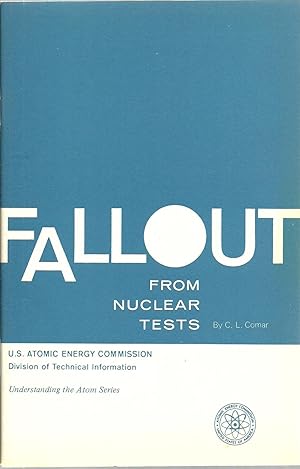
Fallout From Nuclear Tests
Idioma: Inglés
Publicado por U.S. Atomic Energy Commission - Division of Technical Information, Oak Ridge, TN, 1966
Librería: Sabra Books, Naperville, IL, Estados Unidos de America
Calificación del vendedor: 5 de 5 estrellas

EUR 8,99
Envío por EUR 10,27
Se envía dentro de Estados Unidos de AmericaCantidad disponible: 1 disponibles
Añadir al carritoSoft cover. Condición: Near Fine. Booklet. Understanding the Atom series. Very slight discoloration to pages and covers.
-

Fallout from Nuclear Tests
Publicado por U.S. Atomic Energy Commission, Division of Technical Information, 1963
Librería: Firefly Bookstore, Kutztown, PA, Estados Unidos de America
Calificación del vendedor: 5 de 5 estrellas
EUR 12,60
Envío por EUR 5,68
Se envía dentro de Estados Unidos de AmericaCantidad disponible: 1 disponibles
Añadir al carritoTrade Paperback. Condición: Used Good. June 1963 Light wear to cover, slightly bumped corners, pages clean and unmarked. Firefly sells new and used books through our store front. We try to add a detailed description to as many titles as possible. If you have questions regarding this title, please contact us. Photos available on request.
-

Fallout From Nuclear Tests
Publicado por U.S. Atomic Energy Commission, Division of Technical Information, Oak Ridge, TN, 1964
Librería: Ground Zero Books, Ltd., Silver Spring, MD, Estados Unidos de America
Calificación del vendedor: 5 de 5 estrellas
Original o primera edición
EUR 36,01
Envío por EUR 4,37
Se envía dentro de Estados Unidos de AmericaCantidad disponible: 3 disponibles
Añadir al carritoWraps. Condición: Very good. Presumed first edition/first printing. [2], 44, [2] p. 22 cm. Illustrations. Footnotes. Suggested references. Pencil erasure residue on Contents page. One of the Understanding the Atom series. From an obituary posted on-line: "Cyril L. Comar, March 28, 1914- June 11, 1979. Comar retired from Cornell in 1975 as professor emeritus and joined the Electric Power Research Institute in Palo Alto as director of the Environmental Assessment Department. He became director of the University of Tennessee-Atomic Energy Commission Agriculture Research Program at Oak Ridge in 1948, developing a highly regarded research program on the application of radioisotope tracers in biological research and on the effects of radiation (both internal and external) on animals. He then became chief of biomedical research at the Oak Ridge Institute of Nuclear Studies (1954). While in this position, he published the book entitled Radioisotopes in Biology and Agriculture, Principles and Practice, which became an important reference in the field for more than two decades. He and Dr. Felix Bronner edited a five-volume series entitled Mineral Metabolism, An Advanced Treatise, which contains authoritative reports by world experts. In 1957 Comar came to Cornell as professor and director of the Laboratory of Radiation Biology in the Department of Physiology of the New York State Veterinary College. Come was also instrumental in the development and organization of research programs in the nuclear field in Yugoslavia and other foreign countries. He was very much concerned with the potential hazards of radiation and as part of this concern prepared a booklet entitled Fallout for the United States Atomic Energy Commission (1963). He was chairman of the Advisory Committee on the Biological Effects of Ionizing Radiation of the National Academy of Science-National Research Council. Six years of work by the committee culminated in the report entitled The Effects on Populations of Exposure to Low Levels of Ionizing Radiation (1972). Detonating nuclear weapons above ground sends radioactive materials as high as 50 miles into the atmosphere. Large particles fall to the ground near the explosion-site, but lighter particles and gases travel into the upper atmosphere. The particles that are swept up into the atmosphere and fall back down to Earth are called fallout. Fallout can circulate around the world for years until it gradually falls down to Earth or is brought back to the surface by precipitation. The path of the fallout depends on wind and weather patterns. Fallout typically contains hundreds of different radionuclides. Some stay in the environment for a long time because they have long half-lives, like cesium-137, which has a half-life of 30.17 years. Some have very short half-lives and decay away in a few minutes or a few days, like iodine-131, which has a half-life of 8 days. Very little radioactivity from weapons testing in the 1950s and 1960s can still be detected in the environment now. The United States conducted the first above-ground nuclear weapon test in southeastern New Mexico on July 16, 1945. Between 1945 and 1963, hundreds of above-ground blasts took place around the world. Over time the number and size (or yield) of these blasts increased, especially in the late 1950s and early 1960s. After the Limited Test Ban Treaty of 1963 was signed by the United States, the Soviet Union and Great Britain, most above-ground blasts ceased. Some above-ground weapons testing by other countries continued until 1980. Since the end of above-ground nuclear weapons testing, the day-to-day radiation in air readings from monitoring sites has fallen. For many years, analysis of air samples has shown risk levels far below regulatory limits. In fact, results are now generally below-levels that instruments can detect. The EPA maintains a system of radiation monitors throughout the United States. These monitors were originally designed to detect radionuclides that were released after a nuclear weapon detonation. Now, the.
-
Fallout from Nuclear Tests
Publicado por United States Atomic Energy Division, 1969
Librería: Bookcase, Carlisle, Reino Unido
Calificación del vendedor: 5 de 5 estrellas
EUR 18,17
Envío por EUR 29,40
Se envía de Reino Unido a Estados Unidos de AmericaCantidad disponible: 1 disponibles
Añadir al carritowraps. Condición: Very Good.

