Importe total (1 artículo artículos):
Destino del pedido:

error detecting correcting codes de hamming (4 resultados)
Ir a los resultados principales
Filtros de búsqueda
Tipo de artículo
- Todos los tipos de productos
- Libros (4)
- Revistas y publicaciones (No hay ningún otro resultado que coincida con este filtro.)
- Cómics (No hay ningún otro resultado que coincida con este filtro.)
- Partituras (No hay ningún otro resultado que coincida con este filtro.)
- Arte, grabados y pósters (No hay ningún otro resultado que coincida con este filtro.)
- Fotografías (No hay ningún otro resultado que coincida con este filtro.)
- Mapas (No hay ningún otro resultado que coincida con este filtro.)
- Manuscritos y coleccionismo de papel (No hay ningún otro resultado que coincida con este filtro.)
Condición Más información
- Nuevo (No hay ningún otro resultado que coincida con este filtro.)
- Como nuevo, Excelente o Muy bueno (1)
- Bueno o Aceptable (No hay ningún otro resultado que coincida con este filtro.)
- Regular o Pobre (No hay ningún otro resultado que coincida con este filtro.)
- Tal como se indica (3)
Encuadernación
Más atributos
- Primera edición (3)
- Firmado (No hay ningún otro resultado que coincida con este filtro.)
- Sobrecubierta (1)
- Con imágenes (2)
- No impresión bajo demanda (4)
Idioma (1)
Precio
- Cualquier precio
- Menos de EUR 20 (No hay ningún otro resultado que coincida con este filtro.)
- EUR 20 a EUR 45 (No hay ningún otro resultado que coincida con este filtro.)
- Más de EUR 45
Gastos de envío gratis
- Envío gratis a Estados Unidos de America (No hay ningún otro resultado que coincida con este filtro.)
Ubicación del vendedor
Valoración de los vendedores
-

"Error Detecting and Error Correcting Codes" [Bell System Technical Journal] [Vol. 29, No. 2]
Publicado por American Telephone And Telegraph, New York, 1950
Librería: Lux Mentis, Booksellers, ABAA/ILAB, Portland, ME, Estados Unidos de America
Miembro de asociación: ABAA ILAB MABA MBS
Calificación del vendedor: 5 de 5 estrellas

Original o primera edición
EUR 451,13
Envío por EUR 6,57
Se envía dentro de Estados Unidos de AmericaCantidad disponible: 1 disponibles
Añadir al carritoOriginal Wraps. Condición: Very Good in Wraps. Estado de la sobrecubierta: dj. First Edition. First Edition. Original Wraps. "In 1947, frustrated when a failure in one of Bell Lab's relay computers had spoiled a run of data, Hamming began developing the first error-correction codes (now known as Hamming codes), which enabled computers to find and correct single errors in a stretch of data, as well as to discover double errors. Error correction has since been developed into a scientific discipline used in everything from extracting data transmitted from space probes, to recovering jammed communications, to guaranteeing high-quality music from a compact disk (Lee 1995, 361)." [OOC 646] Hamming's paper defined a method for correcting errors in block packages of transmitted data. "He further showed that, in a mathematical sense, these error correcting codes are the best possible codes [known also as 'perfect codes'; there are none shorter" (A. M. Turing Award Portal). Hamming was awarded the A. M. Turing Award in 1968. Before working at Bell, Hamming had been part of the Manhattan Project. "Hamming was the first coding theorist to attract widespread interest in his work" [OOC 646]. "It was an event in 1947 that prompted Hamming to undertake his most famous piece of work. One Friday, while working for Bell Laboratories, he set their pre-computer calculating machines to solving a complex problem and expected the result to be waiting for him when he began work on the following Monday. But when he arrived on Monday, he found that an error had occurred early on in the calculations and the relay-based calculators had been unable to proceed" [Turing Award Portal]. "Hamming began developing the first error-correction codes (now known as Hamming codes), which enabled computers to find and correct single errors. Error correction has since been developed into a scientific discipline used in everything from extracting data transmitted from space probes, to recovering jammed communications, to guaranteeing high-quality music from a compact disk" [OOC]. A fundamental paper defining idea of error correction in communication and computer systems. Light shelf/edge wear, light toning to spine, light wear at head and tail, ownership stamp at bottom of front wrapper and date at top, else tight, bright, and unmarred. 8vo. 147-293pp. Illus. (b/w plates).
-
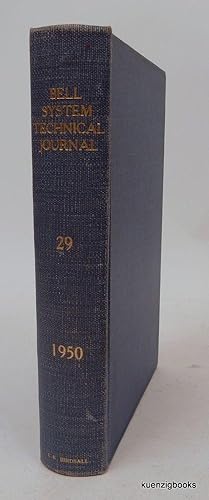
Error Detecting and Error Correcting Codes ; Traveling-Wave Tubes ; Memory Requirements in a Telephone Exchange
Publicado por Bell Telephone Laboratories, New York, 1950
Librería: Kuenzig Books ( ABAA / ILAB ), Topsfield, MA, Estados Unidos de America
Miembro de asociación: ABAA ESA ILAB IOBA SNEAB
Calificación del vendedor: 5 de 5 estrellas
Original o primera edición
EUR 645,12
Envío por EUR 5,25
Se envía dentro de Estados Unidos de AmericaCantidad disponible: 1 disponibles
Añadir al carritoCloth. Condición: Near Fine. First Edition. First Edition. 675 pages. 8vo. Blue cloth with previous owner name (C. K. Birdsall) printed at base of spine panel and signature on front wrapper of January issue. Bound privately from separate issues, this copy does not have a volume title page. The entire Volume XXIX offered, containing 4 quarterly issues of the Bell System Technical Journal (only the January issue still retains it's original wrappers as often the case). The article by Hamming is found on pp. 147-160 in the April 1950 issue. Sound and clean, noting a taped tear on page 496. Cloth. Volume XXIX contains work by some of Bell Lab's great minds. It contains work by Hamming in coding theory, Pierce on traveling wave tubes, Shannon on Memory sizing, 2 articles by Hartley and Bardeen on Germanium Point Contacts. It also includes articles on the transistor and triode as they were being developed. A few of the highlights follow. "Hamming was the first coding theorist to attract widespread interest in his work.frustrated when a failure in one of Bell Lab's relay comptuers had spoiled a run of data, Hamming began developing the first error-correction codes (now known as Hamming codes), which enabled computers to find and correct single errors in a stretch of data, as well as to discover double errors. Error correction has since been developed into a scientific discipline." (Origins of Cyberspace 646) Pierce's massive four installment article on Traveling-Wave Tubes is found in the January, April, July and October issues. Pierce "invented the electron-multiplier tube and electron gun (the basis of television computer monitors, and other visual display equipment), and was instrumental in developing NASA's first communications satellites" (Origins of Cyberspace 836). Issue 3 in this volume includes Shannon's Memory Requirements in a Telephone Exchange. (Origins of Cyberspace 883). "Charles Kennedy ("Ned") Birdsall, Professor Emeritus at the University of California, Berkeley, and a pioneering inventor and educator in microwave tubes and plasma physics.Among numerous awards and honors for his contributions, Ned was selected as the inaugural recipient for the IEEE Marie Sklodowska-Curie Award in 2011. This Technical Field Award is one of the highest awards in the IEEE hierarchy, and recognizes outstanding contributions to the field of Nuclear and Plasma Sciences and Engineering. His citation is "for theoretical investigations and fundamental discoveries involving microwave tubes, electron beam physics and particle-in-cell simulation of plasma physics." (EECS Univ Michigan) Also see Lee,"International Biographical Dictionary of Computer Pioneers", 1995, for more information about Bardeen, Hamming, Hartley, Pierce, Shannon and others. Shannon, Collected Papers, #56.
-
"Error Detecting and Error Correcting Codes." In The Bell System Technical Journal, Volume XXIX, No. 2, pp. 147-60. New York: American Telephone and Telegraph Company, April, 1950.
Librería: Michael R. Thompson Books, A.B.A.A., Los Angeles, CA, Estados Unidos de America
Miembro de asociación: ABAA ILAB
Calificación del vendedor: 1 de 5 estrellas

EUR 451,13
Envío por EUR 13,14
Se envía dentro de Estados Unidos de AmericaCantidad disponible: 1 disponibles
Añadir al carritoThe fundamental paper introducing the idea of error correction in communication and computer systems. A simple version of the Hamming Code in use today is the familiar "parity check" method for detecting memory and transmission errors. Octavo. The complete volume, in original printed wrappers. Spine cocked and a bit stained, library rubberstamp on front cover. Light dampstain at fore-edge of first few leaves. A good copy. Hook and Norman, 646. See Lee, Computer Pioneers, pp. 360-6.
-
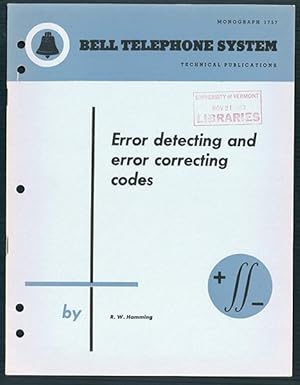
Error detecting and error correcting codes. Offprint
Año de publicación: 1950
Librería: Jeremy Norman's historyofscience, Novato, CA, Estados Unidos de America
Miembro de asociación: ABAA ILAB
Calificación del vendedor: 2 de 5 estrellas

Original o primera edición
EUR 1.353,39
Envío por EUR 8,76
Se envía dentro de Estados Unidos de AmericaCantidad disponible: 1 disponibles
Añadir al carritoHamming, Richard Wesley (1915-98). Error detecting and error codes. Bell System Technical Publications, Monograph 1757. 14pp. New York: Bell Telephone Laboratories, October 1950. 277 x 214 mm. Original printed wrappers, perforated for ring binder as issued. Near fine. Library stamp on front wrapper. First Separate Edition. Hamming was the first coding theorist to attract widespread interest in his work. He received his Ph.D. in mathematics from the University of Illinois in 1942, and after a stint at Los Alamos, where his job was to keep the Manhattan Project's IBM relay computers functioning, he went to work at Bell Telephone Laboratories, joining the recently hired Claude Shannon in the mathematics department. In 1947, frustrated when a failure in one of Bell Lab's relay computers had spoiled a run of data, Hamming began developing the first error-correction codes (now known as Hamming codes), which enabled computers to find and correct single errors in a stretch of data, as well as to discover double errors. Error correction has since been developed into a scientific discipline. Hammond's paper first appeared in Vol. 29 of the Bell System Technical Journal, issued in April 1950; the separate monograph version was published six months later. Origins of Cyberspace 646. .