Importe total (1 artículo artículos):
Destino del pedido:

bruges great square (4 resultados)
Ir a los resultados principales
Filtros de búsqueda
Tipo de artículo
- Todos los tipos de productos
- Libros (3)
- Revistas y publicaciones (No hay ningún otro resultado que coincida con este filtro.)
- Cómics (No hay ningún otro resultado que coincida con este filtro.)
- Partituras (No hay ningún otro resultado que coincida con este filtro.)
- Arte, grabados y pósters (1)
- Fotografías (No hay ningún otro resultado que coincida con este filtro.)
- Mapas (No hay ningún otro resultado que coincida con este filtro.)
- Manuscritos y coleccionismo de papel (No hay ningún otro resultado que coincida con este filtro.)
Condición Más información
- Nuevo (No hay ningún otro resultado que coincida con este filtro.)
- Como nuevo, Excelente o Muy bueno (No hay ningún otro resultado que coincida con este filtro.)
- Bueno o Aceptable (No hay ningún otro resultado que coincida con este filtro.)
- Regular o Pobre (No hay ningún otro resultado que coincida con este filtro.)
- Tal como se indica (4)
Encuadernación
- Todas
- Tapa dura (1)
- Tapa blanda (No hay ningún otro resultado que coincida con este filtro.)
Más atributos
- Primera edición (1)
- Firmado (No hay ningún otro resultado que coincida con este filtro.)
- Sobrecubierta (1)
- Con imágenes (4)
- No impresión bajo demanda (4)
Idioma (2)
Precio
- Cualquier precio
- Menos de EUR 20 (No hay ningún otro resultado que coincida con este filtro.)
- EUR 20 a EUR 45
- Más de EUR 45
Gastos de envío gratis
- Envío gratis a Estados Unidos de America (No hay ningún otro resultado que coincida con este filtro.)
Ubicación del vendedor
Valoración de los vendedores
-

Marktplatz (Great Square at Bruges). Kolorierter Stahlstich von W.R.Smith nach Batty.
Idioma: Inglés
Publicado por 1824., 1824
Librería: Antiquariat Heinz Tessin, Quickborn, Alemania
Calificación del vendedor: 5 de 5 estrellas

Arte / Grabado / Póster
EUR 60,00
Envío por EUR 4,00
Se envía de Alemania a Estados Unidos de AmericaCantidad disponible: 1 disponibles
Añadir al carrito12,6 x 20,7 cm. [SW-Ansicht, Ansichten, Belgien].
-

Bruges, great square at
Publicado por Ldn Jennings, 1824
Librería: Ottmar Müller, Offenburg, Alemania
Calificación del vendedor: 2 de 5 estrellas

EUR 25,00
Envío por EUR 9,95
Se envía de Alemania a Estados Unidos de AmericaCantidad disponible: 1 disponibles
Añadir al carritoStahlstich. Gr.- ca. 27cm x 17cm. -Min. stockfl. 500 gr.
-

Bruges, great square at
Publicado por Ldn Jennings, 1824
Librería: Ottmar Müller, Offenburg, Alemania
Calificación del vendedor: 2 de 5 estrellas
EUR 25,00
Envío por EUR 9,95
Se envía de Alemania a Estados Unidos de AmericaCantidad disponible: 1 disponibles
Añadir al carritoStahlstich. Gr.- ca. 27cm x 17cm. -Min. stockfl. 500 gr.
-
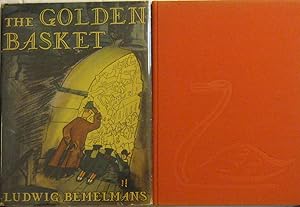
The Golden Basket (Color illustrations) With striking and splendid color illustrations and plates by Ludwig Bemelmans. "The Golden Basket is a good hotel of twenty rooms, which stands below on the great square of the city of Bruges. Ludwig Bemelmans went to Europe and painted the earnest houses, the silent winding canals, their artful bridges, the tall chestnut trees that lean over them, and the many swans on the green waters. "
Publicado por Viking Press, New York, 1936
Librería: Brainerd Phillipson Rare Books, Holliston, MA, Estados Unidos de America
Miembro de asociación: SNEAB
Calificación del vendedor: 4 de 5 estrellas

Original o primera edición
EUR 221,76
Envío por EUR 12,92
Se envía dentro de Estados Unidos de AmericaCantidad disponible: 1 disponibles
Añadir al carritoHardcover. Dust Jacket Included. 1st Edition. Handsomely bound in finely woven rose cloth with a blindstamped swan; and blue lettering along the spine. Very clean and tight throughout. With a touch of sunfading to the top edges. In a crisp, handsome dust jacket with the original price of $2.00 at the top of the front panel. Small chips at the top of the spine ends; touch of wear to the extremities. With ads for Hansi on the rear inside flap, also priced at $2.00. A charming, collectible copy. Ludwig Bemelmans(1898 1962 was an Austro-Hungarian-born American writer and illustrator of children's books. He is known best for the Madeline picture books. Six were published since 1939.[2] Bemelmans was born to the Belgian painter Lambert Bemelmans and the German Frances Fischer in Meran,Austria-Hungary (now Italy). His father owned a hotel. He grew up inGmunden on the Traunsee in Upper Austria. His first language was French and his second German.In 1904, his father left the family for Ludwig's governess, after which his mother took Ludwig and his brother to her native city of Regensburg, Germany. Bemelmans had difficulty in school, as he hated the German style of discipline. He was apprenticed to his uncle Hans Bemelmans at a hotel in Austria. While an apprentice, he was regularly beaten and even whipped by the headwaiter. He finally warned the headwaiter that if he was whipped again he would retaliate with a gun. The headwaiter ignored his warning, whipped him, and Bemelmans reportedly shot and seriously wounded him in retaliation.[3]Given the choice between reform school and emigration to the United States, he chose the latter. He spent the next several years working at hotels and restaurants in the US. In 1917, he joined the U.S. Army but was not sent to Europe because of his German origins. He did become an officer, and was promoted to Second Lieutenant. He writes of his experiences in the Army in the book, My War With the United States. In 1918, he became a US citizen.In the 1920s, Bemelemans tried to become an artist and painter while working at hotels, but had substantial difficulties. His cartoon seriesThe Thrilling Adventures of the Count Bric a Brac was dropped from the New York World after six months. He associated with Ervine Metzl, a commercial artist and illustrator who is variously described as Bemelmans's friend,[5][6] "agent",[6] and "ghost artist".[7]Each Madeline story begins: "In an old house in Paris, that was covered with vines, lived twelve little girls in two straight lines. the smallest one was Madeline." The girls are cared for by Miss Clavel. She is likely a nun, as some French orders called themselves Madames, particularly that of St. Madeleine Sophie Barat,[9] after which this convent school seems to be modeled; and "Mrs." would not be an appropriate equivalent in English. Some have argued that Miss Clavel's apparel looks more like that of a nurse (although why a nurse is working in what appears to be a Paris convent school is not explained). (Wikipedia) First Edition with matching dates of 1936 and "First Published September 1936" on the copyright page.