
Importe total (1 artículo artículos):
Destino del pedido:

analysis sub synchronous resonance doubly fed de santi enrico (15 resultados)
Ir a los resultados principales
Filtros de búsqueda
Tipo de artículo
- Todos los tipos de productos
- Libros (15)
- Revistas y publicaciones (No hay ningún otro resultado que coincida con este filtro.)
- Cómics (No hay ningún otro resultado que coincida con este filtro.)
- Partituras (No hay ningún otro resultado que coincida con este filtro.)
- Arte, grabados y pósters (No hay ningún otro resultado que coincida con este filtro.)
- Fotografías (No hay ningún otro resultado que coincida con este filtro.)
- Mapas (No hay ningún otro resultado que coincida con este filtro.)
- Manuscritos y coleccionismo de papel (No hay ningún otro resultado que coincida con este filtro.)
Condición Más información
- Nuevo (13)
- Como nuevo, Excelente o Muy bueno (2)
- Bueno o Aceptable (No hay ningún otro resultado que coincida con este filtro.)
- Regular o Pobre (No hay ningún otro resultado que coincida con este filtro.)
- Tal como se indica (No hay ningún otro resultado que coincida con este filtro.)
Encuadernación
- Todas
- Tapa dura (No hay ningún otro resultado que coincida con este filtro.)
- Tapa blanda (15)
Más atributos
- Primera edición (No hay ningún otro resultado que coincida con este filtro.)
- Firmado (No hay ningún otro resultado que coincida con este filtro.)
- Sobrecubierta (No hay ningún otro resultado que coincida con este filtro.)
- Con imágenes (9)
- No impresión bajo demanda (10)
Idioma (1)
Precio
- Cualquier precio
- Menos de EUR 20 (No hay ningún otro resultado que coincida con este filtro.)
- EUR 20 a EUR 45
- Más de EUR 45 (No hay ningún otro resultado que coincida con este filtro.)
Gastos de envío gratis
Ubicación del vendedor
Valoración de los vendedores
-

Analysis of Sub-synchronous Resonance in Doubly-fed Induction Generator Based Wind Farms
Librería: GreatBookPrices, Columbia, MD, Estados Unidos de America
Calificación del vendedor: 5 de 5 estrellas

EUR 24,24
EUR 2,27 shipping
Ships within Estados Unidos de AmericaCantidad disponible: Más de 20 disponibles
Añadir al carritoCondición: New.
-

Analysis of Sub-synchronous Resonance (SSR) in Doubly-fed Induction Generator (DFIG)-Based Wind Farms (Synthesis Lectures on Power Electronics)
Librería: Lucky's Textbooks, Dallas, TX, Estados Unidos de America
Calificación del vendedor: 5 de 5 estrellas
EUR 23,05
EUR 3,43 shipping
Ships within Estados Unidos de AmericaCantidad disponible: Más de 20 disponibles
Añadir al carritoCondición: New.
-
Analysis of Sub-synchronous Resonance (SSR) in Doubly-fed Induction Generator (DFIG)-Based Wind Farms (Synthesis Lectures on Power Electronics)
Librería: California Books, Miami, FL, Estados Unidos de America
Calificación del vendedor: 5 de 5 estrellas
EUR 27,42
Gastos de envío gratis
Ships within Estados Unidos de AmericaCantidad disponible: Más de 20 disponibles
Añadir al carritoCondición: New.
-

Analysis of Sub-synchronous Resonance in Doubly-fed Induction Generator Based Wind Farms
Librería: GreatBookPrices, Columbia, MD, Estados Unidos de America
Calificación del vendedor: 5 de 5 estrellas
EUR 25,47
EUR 2,27 shipping
Ships within Estados Unidos de AmericaCantidad disponible: Más de 20 disponibles
Añadir al carritoCondición: As New. Unread book in perfect condition.
-
Analysis of Sub-synchronous Resonance (SSR) in Doubly-fed Induction Generator (DFIG)-Based Wind Farms (Synthesis Lectures on Power Electronics)
Librería: Books Puddle, New York, NY, Estados Unidos de America
Calificación del vendedor: 4 de 5 estrellas

EUR 31,21
EUR 3,43 shipping
Ships within Estados Unidos de AmericaCantidad disponible: 4 disponibles
Añadir al carritoCondición: New. 1st edition NO-PA16APR2015-KAP.
-
Analysis of Sub-synchronous Resonance (SSR) in Doubly-fed Induction Generator (DFIG)-Based Wind Farms (Synthesis Lectures on Power Electronics)
Librería: Ria Christie Collections, Uxbridge, Reino Unido
Calificación del vendedor: 5 de 5 estrellas
EUR 24,74
EUR 13,71 shipping
Ships from Reino Unido to Estados Unidos de AmericaCantidad disponible: Más de 20 disponibles
Añadir al carritoCondición: New. In English.
-

Analysis of Sub-synchronous Resonance in Doubly-fed Induction Generator Based Wind Farms
Librería: GreatBookPricesUK, Woodford Green, Reino Unido
Calificación del vendedor: 5 de 5 estrellas
EUR 24,73
EUR 17,16 shipping
Ships from Reino Unido to Estados Unidos de AmericaCantidad disponible: Más de 20 disponibles
Añadir al carritoCondición: New.
-

Analysis of Sub-synchronous Resonance in Doubly-fed Induction Generator Based Wind Farms
Librería: GreatBookPricesUK, Woodford Green, Reino Unido
Calificación del vendedor: 5 de 5 estrellas
EUR 28,85
EUR 17,16 shipping
Ships from Reino Unido to Estados Unidos de AmericaCantidad disponible: Más de 20 disponibles
Añadir al carritoCondición: As New. Unread book in perfect condition.
-

Analysis of Sub-synchronous Resonance (SSR) in Doubly-fed Induction Generator (DFIG)-Based Wind Farms
Publicado por Springer International Publishing, 2015
ISBN 10: 3031013735 ISBN 13: 9783031013737
Idioma: Inglés
Librería: AHA-BUCH GmbH, Einbeck, Alemania
Calificación del vendedor: 5 de 5 estrellas
EUR 21,39
EUR 60,74 shipping
Ships from Alemania to Estados Unidos de AmericaCantidad disponible: 1 disponibles
Añadir al carritoTaschenbuch. Condición: Neu. Druck auf Anfrage Neuware - Printed after ordering - Wind power penetration is rapidly increasing in today's energy generation industry. In particular, the doubly-fed induction generator (DFIG) has become a very popular option in wind farms, due to its cost advantage compared with fully rated converter-based systems. Wind farms are frequently located in remote areas, far from the bulk of electric power users, and require long transmission lines to connect to the grid. Series capacitive compensation of DFIG-based wind farm is an economical way to increase the power transfer capability of the transmission line connecting the wind farm to the grid. For example, a study performed by ABB reveals that increasing the power transfer capability of an existing transmission line from 1300 MW to 2000 MW using series compensation is 90% less expensive than building a new transmission line. However, a factor hindering the extensive use of series capacitive compensation is the potential risk of subsynchronous resonance (SSR). The SSR is a condition where the wind farm exchanges energy with the electric network, to which it is connected, at one or more natural frequencies of the electric or mechanical part of the combined system, comprising the wind farm and the network, and the frequency of the exchanged energy is below the fundamental frequency of the system. This oscillatory phenomenon may cause severe damage in the wind farm, if not prevented. Therefore, this book studies the SSR phenomenon in a capacitive series compensated wind farm. A DFIG-based wind farm, which is connected to a series compensated transmission line, is considered as a case study. The book consists of two main parts: Small-signal modeling of DFIG for SSR analysis: This part presents a step-by-step tutorial on modal analysis of a DFIG-based series compensated wind farm using Matlab/Simulink. The model of the system includes wind turbine aerodynamics, a 6th order induction generator, a 2nd order two-mass shaft system, a 4th order series compensated transmissionline, a 4th order rotor-side converter (RSC) controller and a 4th order grid-side converter (GSC) controller, and a 1st order DC-link model. The relevant modes are identified using participation factor analysis. Definition of the SSR in DFIG-based wind farms: This part mainly focuses on the identification and definition of the main types of SSR that occur in DFIG wind farms, namely: (1) induction generator effect (SSIGE), (2) torsional interactions (SSTI), and (3) control interactions (SSCI).
-

Analysis of Sub-synchronous Resonance (SSR) in Doubly-fed Induction Generator (DFIG)-Based Wind Farms
Librería: preigu, Osnabrück, Alemania
Calificación del vendedor: 5 de 5 estrellas
EUR 22,30
EUR 70,00 shipping
Ships from Alemania to Estados Unidos de AmericaCantidad disponible: 5 disponibles
Añadir al carritoTaschenbuch. Condición: Neu. Analysis of Sub-synchronous Resonance (SSR) in Doubly-fed Induction Generator (DFIG)-Based Wind Farms | Enrico Santi (u. a.) | Taschenbuch | viii | Englisch | 2015 | Springer | EAN 9783031013737 | Verantwortliche Person für die EU: Springer Verlag GmbH, Tiergartenstr. 17, 69121 Heidelberg, juergen[dot]hartmann[at]springer[dot]com | Anbieter: preigu.
-
Analysis of Sub-synchronous Resonance (SSR) in Doubly-fed Induction Generator (DFIG)-Based Wind Farms (Synthesis Lectures on Power Electronics)
Librería: Majestic Books, Hounslow, Reino Unido
Calificación del vendedor: 4 de 5 estrellas
EUR 30,80
EUR 7,44 shipping
Ships from Reino Unido to Estados Unidos de AmericaCantidad disponible: 4 disponibles
Añadir al carritoCondición: New. Print on Demand.
-
Analysis of Sub-synchronous Resonance (SSR) in Doubly-fed Induction Generator (DFIG)-Based Wind Farms (Synthesis Lectures on Power Electronics)
Librería: Biblios, Frankfurt am main, HESSE, Alemania
Calificación del vendedor: 4 de 5 estrellas
EUR 32,14
EUR 9,95 shipping
Ships from Alemania to Estados Unidos de AmericaCantidad disponible: 4 disponibles
Añadir al carritoCondición: New. PRINT ON DEMAND.
-
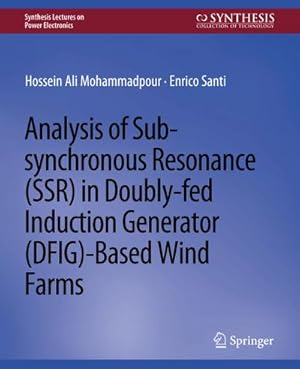
Analysis of Sub-synchronous Resonance (SSR) in Doubly-fed Induction Generator (DFIG)-Based Wind Farms
Publicado por Springer International Publishing Sep 2015, 2015
ISBN 10: 3031013735 ISBN 13: 9783031013737
Idioma: Inglés
Librería: BuchWeltWeit Ludwig Meier e.K., Bergisch Gladbach, Alemania
Calificación del vendedor: 5 de 5 estrellas
EUR 21,39
EUR 23,00 shipping
Ships from Alemania to Estados Unidos de AmericaCantidad disponible: 2 disponibles
Añadir al carritoTaschenbuch. Condición: Neu. This item is printed on demand - it takes 3-4 days longer - Neuware -Wind power penetration is rapidly increasing in today's energy generation industry. In particular, the doubly-fed induction generator (DFIG) has become a very popular option in wind farms, due to its cost advantage compared with fully rated converter-based systems. Wind farms are frequently located in remote areas, far from the bulk of electric power users, and require long transmission lines to connect to the grid. Series capacitive compensation of DFIG-based wind farm is an economical way to increase the power transfer capability of the transmission line connecting the wind farm to the grid. For example, a study performed by ABB reveals that increasing the power transfer capability of an existing transmission line from 1300 MW to 2000 MW using series compensation is 90% less expensive than building a new transmission line. However, a factor hindering the extensive use of series capacitive compensation is the potential risk of subsynchronous resonance (SSR). The SSR is a condition where the wind farm exchanges energy with the electric network, to which it is connected, at one or more natural frequencies of the electric or mechanical part of the combined system, comprising the wind farm and the network, and the frequency of the exchanged energy is below the fundamental frequency of the system. This oscillatory phenomenon may cause severe damage in the wind farm, if not prevented. Therefore, this book studies the SSR phenomenon in a capacitive series compensated wind farm. A DFIG-based wind farm, which is connected to a series compensated transmission line, is considered as a case study. The book consists of two main parts: Small-signal modeling of DFIG for SSR analysis: This part presents a step-by-step tutorial on modal analysis of a DFIG-based series compensated wind farm using Matlab/Simulink. The model of the system includes wind turbine aerodynamics, a 6th order induction generator, a 2nd order two-mass shaft system, a 4th order series compensated transmission line, a 4th order rotor-side converter (RSC) controller and a 4th order grid-side converter (GSC) controller, and a 1st order DC-link model. The relevant modes are identified using participation factor analysis. Definition of the SSR in DFIG-based wind farms: This part mainly focuses on the identification and definition of the main types of SSR that occur in DFIG wind farms, namely: (1) induction generator effect (SSIGE), (2) torsional interactions (SSTI), and (3) control interactions (SSCI). 68 pp. Englisch.
-
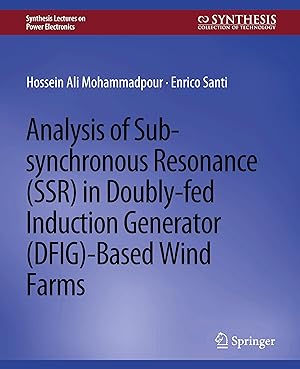
Analysis of Sub-synchronous Resonance (SSR) in Doubly-fed Induction Generator (DFIG)-Based Wind Farms
Publicado por Springer, Berlin|Springer International Publishing|Morgan & Claypool|Springer, 2015
ISBN 10: 3031013735 ISBN 13: 9783031013737
Idioma: Inglés
Librería: moluna, Greven, Alemania
Calificación del vendedor: 4 de 5 estrellas
EUR 21,57
EUR 48,99 shipping
Ships from Alemania to Estados Unidos de AmericaCantidad disponible: Más de 20 disponibles
Añadir al carritoKartoniert / Broschiert. Condición: New. Dieser Artikel ist ein Print on Demand Artikel und wird nach Ihrer Bestellung fuer Sie gedruckt. Wind power penetration is rapidly increasing in today s energy generation industry. In particular, the doubly-fed induction generator (DFIG) has become a very popular option in wind farms, due to its cost advantage compared with fully rated converter-based .
-

Analysis of Sub-synchronous Resonance (SSR) in Doubly-fed Induction Generator (DFIG)-Based Wind Farms
Publicado por Springer International Publishing, Springer Sep 2015, 2015
ISBN 10: 3031013735 ISBN 13: 9783031013737
Idioma: Inglés
Librería: buchversandmimpf2000, Emtmannsberg, BAYE, Alemania
Calificación del vendedor: 5 de 5 estrellas
EUR 21,39
EUR 60,00 shipping
Ships from Alemania to Estados Unidos de AmericaCantidad disponible: 1 disponibles
Añadir al carritoTaschenbuch. Condición: Neu. This item is printed on demand - Print on Demand Titel. Neuware -Wind power penetration is rapidly increasing in today's energy generation industry. In particular, the doubly-fed induction generator (DFIG) has become a very popular option in wind farms, due to its cost advantage compared with fully rated converter-based systems. Wind farms are frequently located in remote areas, far from the bulk of electric power users, and require long transmission lines to connect to the grid. Series capacitive compensation of DFIG-based wind farm is an economical way to increase the power transfer capability of the transmission line connecting the wind farm to the grid. For example, a study performed by ABB reveals that increasing the power transfer capability of an existing transmission line from 1300 MW to 2000 MW using series compensation is 90% less expensive than building a new transmission line. However, a factor hindering the extensive use of series capacitive compensation is the potential risk of subsynchronous resonance (SSR). The SSR is a condition where the wind farm exchanges energy with the electric network, to which it is connected, at one or more natural frequencies of the electric or mechanical part of the combined system, comprising the wind farm and the network, and the frequency of the exchanged energy is below the fundamental frequency of the system. This oscillatory phenomenon may cause severe damage in the wind farm, if not prevented. Therefore, this book studies the SSR phenomenon in a capacitive series compensated wind farm. A DFIG-based wind farm, which is connected to a series compensated transmission line, is considered as a case study. The book consists of two main parts: Small-signal modeling of DFIG for SSR analysis: This part presents a step-by-step tutorial on modal analysis of a DFIG-based series compensated wind farm using Matlab/Simulink. The model of the system includes wind turbine aerodynamics, a 6th order induction generator, a 2nd order two-mass shaft system, a 4th order series compensated transmissionline, a 4th order rotor-side converter (RSC) controller and a 4th order grid-side converter (GSC) controller, and a 1st order DC-link model. The relevant modes are identified using participation factor analysis. Definition of the SSR in DFIG-based wind farms: This part mainly focuses on the identification and definition of the main types of SSR that occur in DFIG wind farms, namely: (1) induction generator effect (SSIGE), (2) torsional interactions (SSTI), and (3) control interactions (SSCI).Springer Nature c/o IBS, Benzstrasse 21, 48619 Heek 68 pp. Englisch.

