

Importe total (1 artículo artículos):
Destino del pedido:

9789971694722 - Love and Dread in Cambodia: Weddings, Births and Ritual Harm Under the Khmer Rouge de NUS Press (3 resultados)
Ir a los resultados principales
Filtros de búsqueda
Tipo de artículo
- Todos los tipos de productos
- Libros (3)
- Revistas y publicaciones (No hay ningún otro resultado que coincida con este filtro.)
- Cómics (No hay ningún otro resultado que coincida con este filtro.)
- Partituras (No hay ningún otro resultado que coincida con este filtro.)
- Arte, grabados y pósters (No hay ningún otro resultado que coincida con este filtro.)
- Fotografías (No hay ningún otro resultado que coincida con este filtro.)
- Mapas (No hay ningún otro resultado que coincida con este filtro.)
- Manuscritos y coleccionismo de papel (No hay ningún otro resultado que coincida con este filtro.)
Condición Más información
- Nuevo (No hay ningún otro resultado que coincida con este filtro.)
- Como nuevo, Excelente o Muy bueno (No hay ningún otro resultado que coincida con este filtro.)
- Bueno o Aceptable (1)
- Regular o Pobre (No hay ningún otro resultado que coincida con este filtro.)
- Tal como se indica (2)
Encuadernación
- Todas
- Tapa dura (No hay ningún otro resultado que coincida con este filtro.)
- Tapa blanda (3)
Más atributos
- Primera edición (No hay ningún otro resultado que coincida con este filtro.)
- Firmado (No hay ningún otro resultado que coincida con este filtro.)
- Sobrecubierta (No hay ningún otro resultado que coincida con este filtro.)
- Con imágenes (2)
- No impresión bajo demanda (3)
Idioma (1)
Precio
- Cualquier precio
- Menos de EUR 20
- EUR 20 a EUR 45
- Más de EUR 45 (No hay ningún otro resultado que coincida con este filtro.)
Gastos de envío gratis
Ubicación del vendedor
Valoración de los vendedores
-

Love and Dread in Cambodia: Weddings, Births and Ritual Harm under the Khmer Rouge
Idioma: Inglés
Publicado por National University of Singapore Press, 2010
ISBN 10: 9971694727 ISBN 13: 9789971694722
Librería: Greenworld Books, Arlington, TX, Estados Unidos de America
Calificación del vendedor: 5 de 5 estrellas

EUR 24,38
Gastos de envío gratis
Se envía dentro de Estados Unidos de AmericaCantidad disponible: 1 disponibles
Añadir al carritoCondición: very_good. Fast Free Shipping â" Very Good condition book with a firm cover and clean pages. Shows normal use and some light wear or limited notes markings. A solid, nice copy to enjoy.
-

LOVE AND DREAD IN CAMBODIA. Weddings, Births, and Ritual Harm under the Khmer Rouge.
Idioma: Inglés
Publicado por National University of Singapore, 2010., 2010
ISBN 10: 9971694727 ISBN 13: 9789971694722
Librería: Sainsbury's Books Pty. Ltd., Camberwell, VIC, Australia
Miembro de asociación: ANZAAB ILAB
Calificación del vendedor: 4 de 5 estrellas

EUR 9,42
Envío por EUR 20,86
Se envía de Australia a Estados Unidos de AmericaCantidad disponible: 1 disponibles
Añadir al carrito8vo, 219pp, black and white illustrations. A very good paperback copy.
-
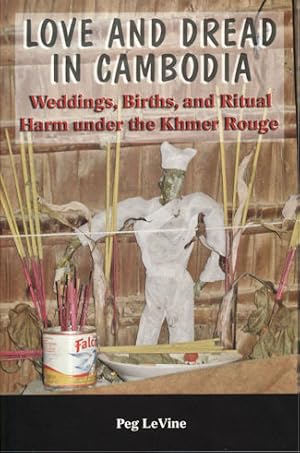
Love and Dread in Cambodia. Weddings, Births and Ritual Harm Under the Khmer Rouge.
Idioma: Inglés
Publicado por NUS Press., Singapore., 2009
ISBN 10: 9971694727 ISBN 13: 9789971694722
Librería: Asia Bookroom ANZAAB/ILAB, Canberra, ACT, Australia
Miembro de asociación: ANZAAB ILAB
Calificación del vendedor: 5 de 5 estrellas
EUR 33,92
Envío por EUR 18,47
Se envía de Australia a Estados Unidos de AmericaCantidad disponible: 1 disponibles
Añadir al carritoColour and black and white illustrations, 219pp, appendices, bibliography, index, paperback. For a decade, the author followed Cambodian men and women to former wedding and birth sites from the Khmer Rouge period (1975-1979), filming their return to these locations. In the process, she uncovered evidence of the way severe dislocation, induced starvation and other murderous activities paved the way for reconstructed communes. Group marriages along with prescriptions for sex, pregnancies and births, were a central feature of the remaking of Cambodia society and contributed to the dissolution of the country's ritual practices. This 'ritualcide' caused a mass loss of spirit-protective places, objects, and arbitrators, and had a traumatic impact on Khmer society. Group marriages did, however, give spouses a reprieve from further dislocation. Approaching the process as an ethno-psychologist, LeVine argues that suffering was intensified by ritual tampering on the part of the Khmer Rouge. Such disruptions did not end in 1979, however, since Euro-American perspectives on trauma and reconciliation have also failed to accept spirit respect as a normative feature.

