

Importe total (1 artículo artículos):
Destino del pedido:

9789401179140 - Pulsars (International Astronomical Union Transactions) de Sieber, W.; Wielebinski, R. (12 resultados)
Ir a los resultados principales
Filtros de búsqueda
Tipo de artículo
- Todos los tipos de productos
- Libros (12)
- Revistas y publicaciones (No hay ningún otro resultado que coincida con este filtro.)
- Cómics (No hay ningún otro resultado que coincida con este filtro.)
- Partituras (No hay ningún otro resultado que coincida con este filtro.)
- Arte, grabados y pósters (No hay ningún otro resultado que coincida con este filtro.)
- Fotografías (No hay ningún otro resultado que coincida con este filtro.)
- Mapas (No hay ningún otro resultado que coincida con este filtro.)
- Manuscritos y coleccionismo de papel (No hay ningún otro resultado que coincida con este filtro.)
Condición Más información
- Nuevo (11)
- Como nuevo, Excelente o Muy bueno (1)
- Bueno o Aceptable (No hay ningún otro resultado que coincida con este filtro.)
- Regular o Pobre (No hay ningún otro resultado que coincida con este filtro.)
- Tal como se indica (No hay ningún otro resultado que coincida con este filtro.)
Encuadernación
- Todas
- Tapa dura (No hay ningún otro resultado que coincida con este filtro.)
- Tapa blanda (12)
Más atributos
- Primera edición (No hay ningún otro resultado que coincida con este filtro.)
- Firmado (No hay ningún otro resultado que coincida con este filtro.)
- Sobrecubierta (No hay ningún otro resultado que coincida con este filtro.)
- Con imágenes (5)
- No impresión bajo demanda (7)
Idioma (1)
Precio
- Cualquier precio
- Menos de EUR 20 (No hay ningún otro resultado que coincida con este filtro.)
- EUR 20 a EUR 45 (No hay ningún otro resultado que coincida con este filtro.)
- Más de EUR 45
Gastos de envío gratis
- Envío gratis a Estados Unidos de America (No hay ningún otro resultado que coincida con este filtro.)
Ubicación del vendedor
Valoración de los vendedores
-

Pulsars (International Astronomical Union Transactions)
Librería: Ria Christie Collections, Uxbridge, Reino Unido
Calificación del vendedor: 5 de 5 estrellas

EUR 60,72
Envío por EUR 13,90
Se envía de Reino Unido a Estados Unidos de AmericaCantidad disponible: Más de 20 disponibles
Añadir al carritoCondición: New. In.
-
Pulsars (International Astronomical Union Transactions)
Librería: Chiron Media, Wallingford, Reino Unido
Calificación del vendedor: 5 de 5 estrellas
EUR 57,40
Envío por EUR 17,98
Se envía de Reino Unido a Estados Unidos de AmericaCantidad disponible: 10 disponibles
Añadir al carritoPaperback. Condición: New.
-
Pulsars
Librería: Books Puddle, New York, NY, Estados Unidos de America
Calificación del vendedor: 4 de 5 estrellas

EUR 83,36
Envío por EUR 3,49
Se envía dentro de Estados Unidos de AmericaCantidad disponible: 4 disponibles
Añadir al carritoCondición: New. pp. 492.
-

EUR 48,37
Envío por EUR 48,99
Se envía de Alemania a Estados Unidos de AmericaCantidad disponible: Más de 20 disponibles
Añadir al carritoCondición: New.
-
EUR 50,25
Envío por EUR 70,00
Se envía de Alemania a Estados Unidos de AmericaCantidad disponible: 5 disponibles
Añadir al carritoTaschenbuch. Condición: Neu. Pulsars | W. Sieber (u. a.) | Taschenbuch | International Astronomical Union Transactions | xvi | Englisch | 2013 | Springer | EAN 9789401179140 | Verantwortliche Person für die EU: Springer Verlag GmbH, Tiergartenstr. 17, 69121 Heidelberg, juergen[dot]hartmann[at]springer[dot]com | Anbieter: preigu.
-

Pulsars
Idioma: Inglés
Publicado por Springer Netherlands, Springer Netherlands, 2013
ISBN 10: 940117914X ISBN 13: 9789401179140
Librería: AHA-BUCH GmbH, Einbeck, Alemania
Calificación del vendedor: 5 de 5 estrellas
EUR 59,97
Envío por EUR 64,21
Se envía de Alemania a Estados Unidos de AmericaCantidad disponible: 1 disponibles
Añadir al carritoTaschenbuch. Condición: Neu. Druck auf Anfrage Neuware - Printed after ordering - More than a decade has passed since pulsars were discovered at Cambridge by J. Bell and A. Hewish. The past 13 years have seen ex tensive and at first rather hectic research, and a considerable amount of observational and theoretical knowledge has been accumulated. Looking back over one decade of pulsar research, it seems worth while to ask what the real impact of the detection was and if our view of the universe has changed as a result of this discovery. The excite ment of the first months and years has ebbed down considerably, with the result that pulsar research has become the task of a few scientists, working in small groups, scattered over many countries. As more and more knowledge was acquired, pulsars changed eventually from the bizarre pUlsing objects -- as they were considered in the beginning -- to more normal stars of astrophysical interest. Still, pulsars are the manifestation of matter in its most extreme form -- neutron star matter -- for which an equivalent can be found on earth only in the very nucleus of an atom. Neutron stars were predicted quite early in the history of modern astrophysics, and although many of their features were already known from theoretical studies, astro physicists were not sure if we had the slightest chance to actually 'see' these objects. It therefore took some time after the historical detection paper of Hewish and coworkers before astronomers became con vinced that pulsars were neutron stars.
-
Pulsars (International Astronomical Union Transactions)
Librería: Mispah books, Redhill, SURRE, Reino Unido
Calificación del vendedor: 4 de 5 estrellas
EUR 100,42
Envío por EUR 29,02
Se envía de Reino Unido a Estados Unidos de AmericaCantidad disponible: 1 disponibles
Añadir al carritoPaperback. Condición: Like New. Like New. book.
-
Pulsars (eng)
Librería: Brook Bookstore On Demand, Napoli, NA, Italia
Calificación del vendedor: 5 de 5 estrellas
EUR 46,22
Envío por EUR 8,00
Se envía de Italia a Estados Unidos de AmericaCantidad disponible: Más de 20 disponibles
Añadir al carritoCondición: new. Questo è un articolo print on demand.
-
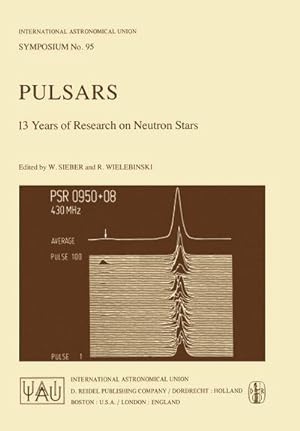
Pulsars
Idioma: Inglés
Publicado por Springer Netherlands Nov 2013, 2013
ISBN 10: 940117914X ISBN 13: 9789401179140
Librería: BuchWeltWeit Ludwig Meier e.K., Bergisch Gladbach, Alemania
Calificación del vendedor: 5 de 5 estrellas
EUR 53,49
Envío por EUR 23,00
Se envía de Alemania a Estados Unidos de AmericaCantidad disponible: 2 disponibles
Añadir al carritoTaschenbuch. Condición: Neu. This item is printed on demand - it takes 3-4 days longer - Neuware -More than a decade has passed since pulsars were discovered at Cambridge by J. Bell and A. Hewish. The past 13 years have seen ex tensive and at first rather hectic research, and a considerable amount of observational and theoretical knowledge has been accumulated. Looking back over one decade of pulsar research, it seems worth while to ask what the real impact of the detection was and if our view of the universe has changed as a result of this discovery. The excite ment of the first months and years has ebbed down considerably, with the result that pulsar research has become the task of a few scientists, working in small groups, scattered over many countries. As more and more knowledge was acquired, pulsars changed eventually from the bizarre pUlsing objects -- as they were considered in the beginning -- to more normal stars of astrophysical interest. Still, pulsars are the manifestation of matter in its most extreme form -- neutron star matter -- for which an equivalent can be found on earth only in the very nucleus of an atom. Neutron stars were predicted quite early in the history of modern astrophysics, and although many of their features were already known from theoretical studies, astro physicists were not sure if we had the slightest chance to actually 'see' these objects. It therefore took some time after the historical detection paper of Hewish and coworkers before astronomers became con vinced that pulsars were neutron stars. 492 pp. Englisch.
-
Pulsars
Librería: Majestic Books, Hounslow, Reino Unido
Calificación del vendedor: 4 de 5 estrellas
EUR 83,47
Envío por EUR 7,54
Se envía de Reino Unido a Estados Unidos de AmericaCantidad disponible: 4 disponibles
Añadir al carritoCondición: New. Print on Demand pp. 492 67:B&W 6.69 x 9.61 in or 244 x 170 mm (Pinched Crown) Perfect Bound on White w/Gloss Lam.
-
Pulsars
Librería: Biblios, Frankfurt am main, HESSE, Alemania
Calificación del vendedor: 4 de 5 estrellas
EUR 82,10
Envío por EUR 9,95
Se envía de Alemania a Estados Unidos de AmericaCantidad disponible: 4 disponibles
Añadir al carritoCondición: New. PRINT ON DEMAND pp. 492.
-

Pulsars
Idioma: Inglés
Publicado por Springer, Springer Netherlands Nov 2013, 2013
ISBN 10: 940117914X ISBN 13: 9789401179140
Librería: buchversandmimpf2000, Emtmannsberg, BAYE, Alemania
Calificación del vendedor: 5 de 5 estrellas
EUR 53,49
Envío por EUR 60,00
Se envía de Alemania a Estados Unidos de AmericaCantidad disponible: 1 disponibles
Añadir al carritoTaschenbuch. Condición: Neu. This item is printed on demand - Print on Demand Titel. Neuware -More than a decade has passed since pulsars were discovered at Cambridge by J. Bell and A. Hewish. The past 13 years have seen ex tensive and at first rather hectic research, and a considerable amount of observational and theoretical knowledge has been accumulated. Looking back over one decade of pulsar research, it seems worth while to ask what the real impact of the detection was and if our view of the universe has changed as a result of this discovery. The excite ment of the first months and years has ebbed down considerably, with the result that pulsar research has become the task of a few scientists, working in small groups, scattered over many countries. As more and more knowledge was acquired, pulsars changed eventually from the bizarre pUlsing objects -- as they were considered in the beginning -- to more normal stars of astrophysical interest. Still, pulsars are the manifestation of matter in its most extreme form -- neutron star matter -- for which an equivalent can be found on earth only in the very nucleus of an atom. Neutron stars were predicted quite early in the history of modern astrophysics, and although many of their features were already known from theoretical studies, astro physicists were not sure if we had the slightest chance to actually 'see' these objects. It therefore took some time after the historical detection paper of Hewish and coworkers before astronomers became con vinced that pulsars were neutron stars.Springer-Verlag KG, Sachsenplatz 4-6, 1201 Wien 492 pp. Englisch.


