

Importe total (1 artículo artículos):
Destino del pedido:

9789401078122 - Modern Modalities: Studies of the History of Modal Theories from Medieval Nominalism to Logical Positivism: 33 (Synthese Historical Library) (9 resultados)
Ir a los resultados principales
Filtros de búsqueda
Tipo de artículo
- Todos los tipos de productos
- Libros (9)
- Revistas y publicaciones (No hay ningún otro resultado que coincida con este filtro.)
- Cómics (No hay ningún otro resultado que coincida con este filtro.)
- Partituras (No hay ningún otro resultado que coincida con este filtro.)
- Arte, grabados y pósters (No hay ningún otro resultado que coincida con este filtro.)
- Fotografías (No hay ningún otro resultado que coincida con este filtro.)
- Mapas (No hay ningún otro resultado que coincida con este filtro.)
- Manuscritos y coleccionismo de papel (No hay ningún otro resultado que coincida con este filtro.)
Condición Más información
- Nuevo (8)
- Como nuevo, Excelente o Muy bueno (1)
- Bueno o Aceptable (No hay ningún otro resultado que coincida con este filtro.)
- Regular o Pobre (No hay ningún otro resultado que coincida con este filtro.)
- Tal como se indica (No hay ningún otro resultado que coincida con este filtro.)
Encuadernación
- Todas
- Tapa dura (No hay ningún otro resultado que coincida con este filtro.)
- Tapa blanda (9)
Más atributos
- Primera edición (No hay ningún otro resultado que coincida con este filtro.)
- Firmado (No hay ningún otro resultado que coincida con este filtro.)
- Sobrecubierta (No hay ningún otro resultado que coincida con este filtro.)
- Con imágenes (6)
- No impresión bajo demanda (6)
Idioma (1)
Precio
- Cualquier precio
- Menos de EUR 20 (No hay ningún otro resultado que coincida con este filtro.)
- EUR 20 a EUR 45 (No hay ningún otro resultado que coincida con este filtro.)
- Más de EUR 45
Gastos de envío gratis
- Envío gratis a Estados Unidos de America (No hay ningún otro resultado que coincida con este filtro.)
Ubicación del vendedor
Valoración de los vendedores
-

Modern Modalities: Studies of the History of Modal Theories from Medieval Nominalism to Logical Positivism (Synthese Historical Library)
Librería: Ria Christie Collections, Uxbridge, Reino Unido
Calificación del vendedor: 5 de 5 estrellas

EUR 273,82
Envío por EUR 13,85
Se envía de Reino Unido a Estados Unidos de AmericaCantidad disponible: Más de 20 disponibles
Añadir al carritoCondición: New. In.
-

Modern Modalities : Studies of the History of Modal Theories from Medieval Nominalism to Logical Positivism
Librería: GreatBookPrices, Columbia, MD, Estados Unidos de America
Calificación del vendedor: 5 de 5 estrellas
EUR 296,51
Envío por EUR 2,29
Se envía dentro de Estados Unidos de AmericaCantidad disponible: 15 disponibles
Añadir al carritoCondición: New.
-

EUR 250,30
Envío por EUR 48,99
Se envía de Alemania a Estados Unidos de AmericaCantidad disponible: Más de 20 disponibles
Añadir al carritoCondición: New.
-
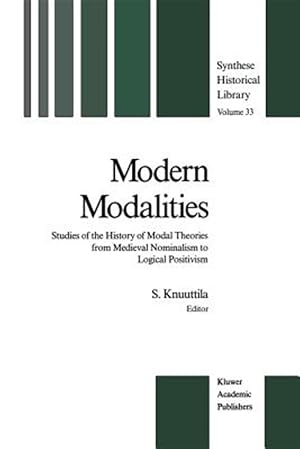
Modern Modalities : Studies of the History of Modal Theories from Medieval Nominalism to Logical Positivism
Librería: GreatBookPrices, Columbia, MD, Estados Unidos de America
Calificación del vendedor: 5 de 5 estrellas
EUR 329,43
Envío por EUR 2,29
Se envía dentro de Estados Unidos de AmericaCantidad disponible: 15 disponibles
Añadir al carritoCondición: As New. Unread book in perfect condition.
-
Modern Modalities : Studies of the History of Modal Theories from Medieval Nominalism to Logical Positivism
Idioma: Inglés
Publicado por Springer Netherlands, Springer Netherlands, 2011
ISBN 10: 9401078122 ISBN 13: 9789401078122
Librería: AHA-BUCH GmbH, Einbeck, Alemania
Calificación del vendedor: 5 de 5 estrellas
EUR 310,11
Envío por EUR 62,76
Se envía de Alemania a Estados Unidos de AmericaCantidad disponible: 1 disponibles
Añadir al carritoTaschenbuch. Condición: Neu. Druck auf Anfrage Neuware - Printed after ordering - The word 'modem' in the title of this book refers primarily to post-medieval discussions, but it also hints at those medieval mo dal theories which were considered modem in contradistinction to ancient conceptions and which in different ways influenced philosophical discussions during the early modem period. The me dieval developments are investigated in the opening paper, 'The Foundations of Modality and Conceivability in Descartes and His Predecessors', by Lilli Alanen and Simo Knuuttila. Boethius's works from the early sixth century belonged to the sources from which early medieval thinkers obtained their knowledge of ancient thought. They offered extensive discus sions of traditional modal conceptions the basic forms of which were: (1) the paradigm of possibility as a potency striving to realize itself; (2) the 'statistical' interpretation of modal no tions where necessity means actuality in all relevant cases or omnitemporal actuality, possibility means actuality in some rel evant cases or sometimes, and impossibility means omnitemporal non-actuality; and (3) the 'logical' definition of possibility as something which, being assumed, results in nothing contradic tory. Boethius accepted the Aristotelian view according to which total possibilities in the first sense must prove their met tle through actualization and possibilities in the third sense are assumed to be realized in our actual history. On these presump tions, all of the above-mentioned ancient paradigms imply the Principle of Plenitude according to which no genuine possibility remains unrealized.
-
Modern Modalities: Studies of the History of Modal Theories from Medieval Nominalism to Logical Positivism
Librería: Revaluation Books, Exeter, Reino Unido
Calificación del vendedor: 5 de 5 estrellas
EUR 408,20
Envío por EUR 14,45
Se envía de Reino Unido a Estados Unidos de AmericaCantidad disponible: 2 disponibles
Añadir al carritoPaperback. Condición: Brand New. 364 pages. 9.25x6.10x0.82 inches. In Stock.
-

Modern Modalities
Idioma: Inglés
Publicado por Springer Netherlands Okt 2011, 2011
ISBN 10: 9401078122 ISBN 13: 9789401078122
Librería: BuchWeltWeit Ludwig Meier e.K., Bergisch Gladbach, Alemania
Calificación del vendedor: 5 de 5 estrellas
EUR 196,88
Envío por EUR 23,00
Se envía de Alemania a Estados Unidos de AmericaCantidad disponible: 2 disponibles
Añadir al carritoTaschenbuch. Condición: Neu. This item is printed on demand - it takes 3-4 days longer - Neuware -The word 'modem' in the title of this book refers primarily to post-medieval discussions, but it also hints at those medieval mo dal theories which were considered modem in contradistinction to ancient conceptions and which in different ways influenced philosophical discussions during the early modem period. The me dieval developments are investigated in the opening paper, 'The Foundations of Modality and Conceivability in Descartes and His Predecessors', by Lilli Alanen and Simo Knuuttila. Boethius's works from the early sixth century belonged to the sources from which early medieval thinkers obtained their knowledge of ancient thought. They offered extensive discus sions of traditional modal conceptions the basic forms of which were: (1) the paradigm of possibility as a potency striving to realize itself; (2) the 'statistical' interpretation of modal no tions where necessity means actuality in all relevant cases or omnitemporal actuality, possibility means actuality in some rel evant cases or sometimes, and impossibility means omnitemporal non-actuality; and (3) the 'logical' definition of possibility as something which, being assumed, results in nothing contradic tory. Boethius accepted the Aristotelian view according to which total possibilities in the first sense must prove their met tle through actualization and possibilities in the third sense are assumed to be realized in our actual history. On these presump tions, all of the above-mentioned ancient paradigms imply the Principle of Plenitude according to which no genuine possibility remains unrealized. 364 pp. Englisch.
-
Modern Modalities (eng)
Librería: Brook Bookstore On Demand, Napoli, NA, Italia
Calificación del vendedor: 3 de 5 estrellas

EUR 230,32
Envío por EUR 6,80
Se envía de Italia a Estados Unidos de AmericaCantidad disponible: Más de 20 disponibles
Añadir al carritoCondición: new. Questo è un articolo print on demand.
-

Modern Modalities
Idioma: Inglés
Publicado por Springer, Springer Okt 2011, 2011
ISBN 10: 9401078122 ISBN 13: 9789401078122
Librería: buchversandmimpf2000, Emtmannsberg, BAYE, Alemania
Calificación del vendedor: 5 de 5 estrellas
EUR 299,59
Envío por EUR 60,00
Se envía de Alemania a Estados Unidos de AmericaCantidad disponible: 1 disponibles
Añadir al carritoTaschenbuch. Condición: Neu. This item is printed on demand - Print on Demand Titel. Neuware -The word 'modem' in the title of this book refers primarily to post-medieval discussions, but it also hints at those medieval mo dal theories which were considered modem in contradistinction to ancient conceptions and which in different ways influenced philosophical discussions during the early modem period. The me dieval developments are investigated in the opening paper, 'The Foundations of Modality and Conceivability in Descartes and His Predecessors', by Lilli Alanen and Simo Knuuttila. Boethius's works from the early sixth century belonged to the sources from which early medieval thinkers obtained their knowledge of ancient thought. They offered extensive discus sions of traditional modal conceptions the basic forms of which were: (1) the paradigm of possibility as a potency striving to realize itself; (2) the 'statistical' interpretation of modal no tions where necessity means actuality in all relevant cases or omnitemporal actuality, possibility means actuality in some rel evant cases or sometimes, and impossibility means omnitemporal non-actuality; and (3) the 'logical' definition of possibility as something which, being assumed, results in nothing contradic tory. Boethius accepted the Aristotelian view according to which total possibilities in the first sense must prove their met tle through actualization and possibilities in the third sense are assumed to be realized in our actual history. On these presump tions, all of the above-mentioned ancient paradigms imply the Principle of Plenitude according to which no genuine possibility remains unrealized.Springer-Verlag KG, Sachsenplatz 4-6, 1201 Wien 364 pp. Englisch.

