

Importe total (1 artículo artículos):
Destino del pedido:

9789048178902 - Ingredients for Successful System Level Design Methodology de Patel, Hiren D.; Shukla, Sandeep Kumar (8 resultados)
Ir a los resultados principales
Filtros de búsqueda
Tipo de artículo
- Todos los tipos de productos
- Libros (8)
- Revistas y publicaciones (No hay ningún otro resultado que coincida con este filtro.)
- Cómics (No hay ningún otro resultado que coincida con este filtro.)
- Partituras (No hay ningún otro resultado que coincida con este filtro.)
- Arte, grabados y pósters (No hay ningún otro resultado que coincida con este filtro.)
- Fotografías (No hay ningún otro resultado que coincida con este filtro.)
- Mapas (No hay ningún otro resultado que coincida con este filtro.)
- Manuscritos y coleccionismo de papel (No hay ningún otro resultado que coincida con este filtro.)
Condición Más información
- Nuevo (8)
- Como nuevo, Excelente o Muy bueno (No hay ningún otro resultado que coincida con este filtro.)
- Bueno o Aceptable (No hay ningún otro resultado que coincida con este filtro.)
- Regular o Pobre (No hay ningún otro resultado que coincida con este filtro.)
- Tal como se indica (No hay ningún otro resultado que coincida con este filtro.)
Encuadernación
- Todas
- Tapa dura (No hay ningún otro resultado que coincida con este filtro.)
- Tapa blanda (8)
Más atributos
- Primera edición (No hay ningún otro resultado que coincida con este filtro.)
- Firmado (No hay ningún otro resultado que coincida con este filtro.)
- Sobrecubierta (No hay ningún otro resultado que coincida con este filtro.)
- Con imágenes (5)
- No impresión bajo demanda (3)
Idioma (1)
Precio
- Cualquier precio
- Menos de EUR 20 (No hay ningún otro resultado que coincida con este filtro.)
- EUR 20 a EUR 40 (No hay ningún otro resultado que coincida con este filtro.)
- Más de EUR 40
Gastos de envío gratis
Ubicación del vendedor
Valoración de los vendedores
-

Ingredients for Successful System Level Design Methodology
Librería: California Books, Miami, FL, Estados Unidos de America
Calificación del vendedor: 5 de 5 estrellas

EUR 125,52
Gastos de envío gratis
Se envía dentro de Estados Unidos de AmericaCantidad disponible: Más de 20 disponibles
Añadir al carritoCondición: New.
-
Ingredients for Successful System Level Design Methodology
Librería: Ria Christie Collections, Uxbridge, Reino Unido
Calificación del vendedor: 5 de 5 estrellas
EUR 146,43
Envío por EUR 13,67
Se envía de Reino Unido a Estados Unidos de AmericaCantidad disponible: Más de 20 disponibles
Añadir al carritoCondición: New. In.
-

Ingredients for Successful System Level Design Methodology
Idioma: Inglés
Publicado por Springer Netherlands, Springer Netherlands, 2010
ISBN 10: 9048178908 ISBN 13: 9789048178902
Librería: AHA-BUCH GmbH, Einbeck, Alemania
Calificación del vendedor: 5 de 5 estrellas
EUR 112,77
Envío por EUR 61,74
Se envía de Alemania a Estados Unidos de AmericaCantidad disponible: 1 disponibles
Añadir al carritoTaschenbuch. Condición: Neu. Druck auf Anfrage Neuware - Printed after ordering - ESL or 'Electronic System Level' is a buzz word these days, in the electronic design automation (EDA) industry, in design houses, and in the academia. Even though numerous trade magazine articles have been written, quite a few books have been published that have attempted to de ne ESL, it is still not clear what exactly it entails. However, what seems clear to every one is that the 'Register Transfer Level' (RTL) languages are not adequate any more to be the design entry point for today's and tomorrow's complex electronic system design. There are multiple reasons for such thoughts. First, the c- tinued progression of the miniaturization of the silicon technology has led to the ability of putting almost a billion transistors on a single chip. Second, applications are becoming more and more complex, and integrated with c- munication, control, ubiquitous and pervasive computing, and hence the need for ever faster, ever more reliable, and more robust electronic systems is pu- ing designers towards a productivity demand that is not sustainable without a fundamental change in the design methodologies. Also, the hardware and software functionalities are getting interchangeable and ability to model and design both in the same manner is gaining importance. Given this context, we assume that any methodology that allows us to model an entire electronic system from a system perspective, rather than just hardware with discrete-event or cycle based semantics is an ESL method- ogy of some kind.
-
Ingredients for Successful System Level Design Methodology (eng)
Librería: Brook Bookstore On Demand, Napoli, NA, Italia
Calificación del vendedor: 4 de 5 estrellas

EUR 86,24
Envío por EUR 5,50
Se envía de Italia a Estados Unidos de AmericaCantidad disponible: Más de 20 disponibles
Añadir al carritoCondición: new. Questo è un articolo print on demand.
-

Ingredients for Successful System Level Design Methodology
Idioma: Inglés
Publicado por Springer Netherlands, Springer Netherlands Okt 2010, 2010
ISBN 10: 9048178908 ISBN 13: 9789048178902
Librería: BuchWeltWeit Ludwig Meier e.K., Bergisch Gladbach, Alemania
Calificación del vendedor: 5 de 5 estrellas
EUR 106,99
Envío por EUR 23,00
Se envía de Alemania a Estados Unidos de AmericaCantidad disponible: 2 disponibles
Añadir al carritoTaschenbuch. Condición: Neu. This item is printed on demand - it takes 3-4 days longer - Neuware -ESL or 'Electronic System Level' is a buzz word these days, in the electronic design automation (EDA) industry, in design houses, and in the academia. Even though numerous trade magazine articles have been written, quite a few books have been published that have attempted to de ne ESL, it is still not clear what exactly it entails. However, what seems clear to every one is that the 'Register Transfer Level' (RTL) languages are not adequate any more to be the design entry point for today's and tomorrow's complex electronic system design. There are multiple reasons for such thoughts. First, the c- tinued progression of the miniaturization of the silicon technology has led to the ability of putting almost a billion transistors on a single chip. Second, applications are becoming more and more complex, and integrated with c- munication, control, ubiquitous and pervasive computing, and hence the need for ever faster, ever more reliable, and more robust electronic systems is pu- ing designers towards a productivity demand that is not sustainable without a fundamental change in the design methodologies. Also, the hardware and software functionalities are getting interchangeable and ability to model and design both in the same manner is gaining importance. Given this context, we assume that any methodology that allows us to model an entire electronic system from a system perspective, rather than just hardware with discrete-event or cycle based semantics is an ESL method- ogy of some kind. 224 pp. Englisch.
-
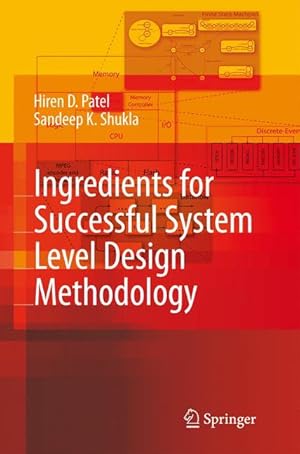
Ingredients for Successful System Level Design Methodology
Librería: moluna, Greven, Alemania
Calificación del vendedor: 4 de 5 estrellas
EUR 92,27
Envío por EUR 48,99
Se envía de Alemania a Estados Unidos de AmericaCantidad disponible: Más de 20 disponibles
Añadir al carritoCondición: New. Dieser Artikel ist ein Print on Demand Artikel und wird nach Ihrer Bestellung fuer Sie gedruckt. A first book to discuss the wish lists for an ESL language and environment in a comprehensive manner and provide solutions that enable the wish list The solutions in this book are all implemented in prototypes available from our website which read.
-
Ingredients for Successful System Level Design Methodology
Librería: preigu, Osnabrück, Alemania
Calificación del vendedor: 5 de 5 estrellas
EUR 95,70
Envío por EUR 70,00
Se envía de Alemania a Estados Unidos de AmericaCantidad disponible: 5 disponibles
Añadir al carritoTaschenbuch. Condición: Neu. Ingredients for Successful System Level Design Methodology | Sandeep Kumar Shukla (u. a.) | Taschenbuch | xvi | Englisch | 2010 | Springer | EAN 9789048178902 | Verantwortliche Person für die EU: Springer Verlag GmbH, Tiergartenstr. 17, 69121 Heidelberg, juergen[dot]hartmann[at]springer[dot]com | Anbieter: preigu Print on Demand.
-

Ingredients for Successful System Level Design Methodology
Idioma: Inglés
Publicado por Springer Netherlands, Springer Netherlands Okt 2010, 2010
ISBN 10: 9048178908 ISBN 13: 9789048178902
Librería: buchversandmimpf2000, Emtmannsberg, BAYE, Alemania
Calificación del vendedor: 5 de 5 estrellas
EUR 106,99
Envío por EUR 60,00
Se envía de Alemania a Estados Unidos de AmericaCantidad disponible: 1 disponibles
Añadir al carritoTaschenbuch. Condición: Neu. This item is printed on demand - Print on Demand Titel. Neuware -ESL or ¿Electronic System Level¿ is a buzz word these days, in the electronic design automation (EDA) industry, in design houses, and in the academia. Even though numerous trade magazine articles have been written, quite a few books have been published that have attempted to de ne ESL, it is still not clear what exactly it entails. However, what seems clear to every one is that the ¿Register Transfer Level¿ (RTL) languages are not adequate any more to be the design entry point for today¿s and tomorrow¿s complex electronic system design. There are multiple reasons for such thoughts. First, the c- tinued progression of the miniaturization of the silicon technology has led to the ability of putting almost a billion transistors on a single chip. Second, applications are becoming more and more complex, and integrated with c- munication, control, ubiquitous and pervasive computing, and hence the need for ever faster, ever more reliable, and more robust electronic systems is pu- ing designers towards a productivity demand that is not sustainable without a fundamental change in the design methodologies. Also, the hardware and software functionalities are getting interchangeable and ability to model and design both in the same manner is gaining importance. Given this context, we assume that any methodology that allows us to model an entire electronic system from a system perspective, rather than just hardware with discrete-event or cycle based semantics is an ESL method- ogy of some kind.Springer Verlag GmbH, Tiergartenstr. 17, 69121 Heidelberg 224 pp. Englisch.


