

Importe total (1 artículo artículos):
Destino del pedido:

9789027728142 - From Metaphysics to Rhetoric: 202 (Synthese Library, 202) (6 resultados)
Ir a los resultados principales
Filtros de búsqueda
Tipo de artículo
- Todos los tipos de productos
- Libros (6)
- Revistas y publicaciones (No hay ningún otro resultado que coincida con este filtro.)
- Cómics (No hay ningún otro resultado que coincida con este filtro.)
- Partituras (No hay ningún otro resultado que coincida con este filtro.)
- Arte, grabados y pósters (No hay ningún otro resultado que coincida con este filtro.)
- Fotografías (No hay ningún otro resultado que coincida con este filtro.)
- Mapas (No hay ningún otro resultado que coincida con este filtro.)
- Manuscritos y coleccionismo de papel (No hay ningún otro resultado que coincida con este filtro.)
Condición Más información
- Nuevo (6)
- Como nuevo, Excelente o Muy bueno (No hay ningún otro resultado que coincida con este filtro.)
- Bueno o Aceptable (No hay ningún otro resultado que coincida con este filtro.)
- Regular o Pobre (No hay ningún otro resultado que coincida con este filtro.)
- Tal como se indica (No hay ningún otro resultado que coincida con este filtro.)
Encuadernación
- Todas
- Tapa dura (6)
- Tapa blanda (No hay ningún otro resultado que coincida con este filtro.)
Más atributos
- Primera edición (No hay ningún otro resultado que coincida con este filtro.)
- Firmado (No hay ningún otro resultado que coincida con este filtro.)
- Sobrecubierta (No hay ningún otro resultado que coincida con este filtro.)
- Con imágenes (5)
- No impresión bajo demanda (3)
Idioma (1)
Precio
- Cualquier precio
- Menos de EUR 20 (No hay ningún otro resultado que coincida con este filtro.)
- EUR 20 a EUR 45 (No hay ningún otro resultado que coincida con este filtro.)
- Más de EUR 45
Gastos de envío gratis
- Envío gratis a Estados Unidos de America (No hay ningún otro resultado que coincida con este filtro.)
Ubicación del vendedor
Valoración de los vendedores
-

From Metaphysics to Rhetoric
Libro 81 de 304: Synthese LibraryLibrería: Books Puddle, New York, NY, Estados Unidos de America
Calificación del vendedor: 4 de 5 estrellas

EUR 139,64
Envío por EUR 3,41
Se envía dentro de Estados Unidos de AmericaCantidad disponible: 4 disponibles
Añadir al carritoCondición: New. pp. 208.
-

From Metaphysics to Rhetoric
Libro 81 de 304: Synthese LibraryIdioma: Inglés
Publicado por Springer Netherlands, Springer Netherlands Jul 1989, 1989
ISBN 10: 9027728143 ISBN 13: 9789027728142
Librería: buchversandmimpf2000, Emtmannsberg, BAYE, Alemania
Calificación del vendedor: 5 de 5 estrellas

EUR 106,99
Envío por EUR 60,00
Se envía de Alemania a Estados Unidos de AmericaCantidad disponible: 2 disponibles
Añadir al carritoBuch. Condición: Neu. Neuware -by the question in its being an answer, if only in a circumstantial (i. e. inessential) manner. One indeed must question oneself in order to remember, says Plato, but the dialectic, which would be scientific, must be something else even if it remains a play of question and answer. This contradiction did not escape Aristotle: he split the scientific from the dialectic and logic from argumentation whose respective theories he was led to conceive in order to clearly define their boundaries and specificities. As for Plato, he found in the famous theory of Ideas what he sought in order to justify knowledge as that which is supposed to hold its truth only from itself. What do Ideas mean within the framework of our approach In what consists the passage from rhetoric to ontology which leads to the denaturation of argumentation When Socrates asked, for example, 'What is virtue ', he thought one could not answer such a question because the answer refers to a single proposition, a single truth, whereas the formulation of the question itself does not indicate this unicity. For any answer, another can be given and thus continuously, if necessary, until eventually one will come across an incompatibility. Now, to a question as to what X, Y, or Z is, one can answer in many ways and nothing in the question itself prohibits multiplicity. Virtue is courage, is justice, and so on.Springer Verlag GmbH, Tiergartenstr. 17, 69121 Heidelberg 208 pp. Englisch.
-

From Metaphysics to Rhetoric
Libro 81 de 304: Synthese LibraryLibrería: AHA-BUCH GmbH, Einbeck, Alemania
Calificación del vendedor: 5 de 5 estrellas
EUR 114,36
Envío por EUR 62,42
Se envía de Alemania a Estados Unidos de AmericaCantidad disponible: 1 disponibles
Añadir al carritoBuch. Condición: Neu. Druck auf Anfrage Neuware - Printed after ordering - by the question in its being an answer, if only in a circumstantial (i. e. inessential) manner. One indeed must question oneself in order to remember, says Plato, but the dialectic, which would be scientific, must be something else even if it remains a play of question and answer. This contradiction did not escape Aristotle: he split the scientific from the dialectic and logic from argumentation whose respective theories he was led to conceive in order to clearly define their boundaries and specificities. As for Plato, he found in the famous theory of Ideas what he sought in order to justify knowledge as that which is supposed to hold its truth only from itself. What do Ideas mean within the framework of our approach In what consists the passage from rhetoric to ontology which leads to the denaturation of argumentation When Socrates asked, for example, 'What is virtue ', he thought one could not answer such a question because the answer refers to a single proposition, a single truth, whereas the formulation of the question itself does not indicate this unicity. For any answer, another can be given and thus continuously, if necessary, until eventually one will come across an incompatibility. Now, to a question as to what X, Y, or Z is, one can answer in many ways and nothing in the question itself prohibits multiplicity. Virtue is courage, is justice, and so on.
-
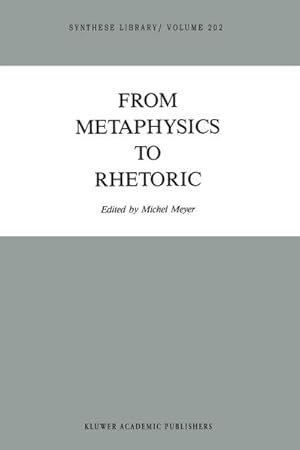
From Metaphysics to Rhetoric
Libro 81 de 304: Synthese LibraryIdioma: Inglés
Publicado por Springer Netherlands Jul 1989, 1989
ISBN 10: 9027728143 ISBN 13: 9789027728142
Librería: BuchWeltWeit Ludwig Meier e.K., Bergisch Gladbach, Alemania
Calificación del vendedor: 5 de 5 estrellas
EUR 106,99
Envío por EUR 23,00
Se envía de Alemania a Estados Unidos de AmericaCantidad disponible: 2 disponibles
Añadir al carritoBuch. Condición: Neu. This item is printed on demand - it takes 3-4 days longer - Neuware -by the question in its being an answer, if only in a circumstantial (i. e. inessential) manner. One indeed must question oneself in order to remember, says Plato, but the dialectic, which would be scientific, must be something else even if it remains a play of question and answer. This contradiction did not escape Aristotle: he split the scientific from the dialectic and logic from argumentation whose respective theories he was led to conceive in order to clearly define their boundaries and specificities. As for Plato, he found in the famous theory of Ideas what he sought in order to justify knowledge as that which is supposed to hold its truth only from itself. What do Ideas mean within the framework of our approach In what consists the passage from rhetoric to ontology which leads to the denaturation of argumentation When Socrates asked, for example, 'What is virtue ', he thought one could not answer such a question because the answer refers to a single proposition, a single truth, whereas the formulation of the question itself does not indicate this unicity. For any answer, another can be given and thus continuously, if necessary, until eventually one will come across an incompatibility. Now, to a question as to what X, Y, or Z is, one can answer in many ways and nothing in the question itself prohibits multiplicity. Virtue is courage, is justice, and so on. 208 pp. Englisch.
-

From Metaphysics to Rhetoric
Libro 81 de 304: Synthese LibraryLibrería: moluna, Greven, Alemania
Calificación del vendedor: 4 de 5 estrellas
EUR 92,27
Envío por EUR 48,99
Se envía de Alemania a Estados Unidos de AmericaCantidad disponible: Más de 20 disponibles
Añadir al carritoCondición: New. Dieser Artikel ist ein Print on Demand Artikel und wird nach Ihrer Bestellung fuer Sie gedruckt. by the question in its being an answer, if only in a circumstantial (i. e. inessential) manner. One indeed must question oneself in order to remember, says Plato, but the dialectic, which would be scientific, must be something else even if it remains a play.
-
From Metaphysics to Rhetoric
Libro 81 de 304: Synthese LibraryLibrería: preigu, Osnabrück, Alemania
Calificación del vendedor: 5 de 5 estrellas
EUR 95,70
Envío por EUR 70,00
Se envía de Alemania a Estados Unidos de AmericaCantidad disponible: 5 disponibles
Añadir al carritoBuch. Condición: Neu. From Metaphysics to Rhetoric | Michel Meyer | Buch | vi | Englisch | 1989 | Springer | EAN 9789027728142 | Verantwortliche Person für die EU: Springer Verlag GmbH, Tiergartenstr. 17, 69121 Heidelberg, juergen[dot]hartmann[at]springer[dot]com | Anbieter: preigu Print on Demand.


