

Importe total (1 artículo artículos):
Destino del pedido:

9789027714749 - Abstract Objects: An Introduction to Axiomatic Metaphysics: 160 (Synthese Library, 160) de Zalta, E. (11 resultados)
Ir a los resultados principales
Filtros de búsqueda
Tipo de artículo
- Todos los tipos de productos
- Libros (11)
- Revistas y publicaciones (No hay ningún otro resultado que coincida con este filtro.)
- Cómics (No hay ningún otro resultado que coincida con este filtro.)
- Partituras (No hay ningún otro resultado que coincida con este filtro.)
- Arte, grabados y pósters (No hay ningún otro resultado que coincida con este filtro.)
- Fotografías (No hay ningún otro resultado que coincida con este filtro.)
- Mapas (No hay ningún otro resultado que coincida con este filtro.)
- Manuscritos y coleccionismo de papel (No hay ningún otro resultado que coincida con este filtro.)
Condición Más información
- Nuevo (8)
- Como nuevo, Excelente o Muy bueno (2)
- Bueno o Aceptable (1)
- Regular o Pobre (No hay ningún otro resultado que coincida con este filtro.)
- Tal como se indica (No hay ningún otro resultado que coincida con este filtro.)
Encuadernación
- Todas
- Tapa dura (11)
- Tapa blanda (No hay ningún otro resultado que coincida con este filtro.)
Más atributos
- Primera edición (No hay ningún otro resultado que coincida con este filtro.)
- Firmado (No hay ningún otro resultado que coincida con este filtro.)
- Sobrecubierta (No hay ningún otro resultado que coincida con este filtro.)
- Con imágenes (9)
- No impresión bajo demanda (8)
Idioma (1)
Precio
- Cualquier precio
- Menos de EUR 20 (No hay ningún otro resultado que coincida con este filtro.)
- EUR 20 a EUR 45 (No hay ningún otro resultado que coincida con este filtro.)
- Más de EUR 45
Gastos de envío gratis
- Envío gratis a Estados Unidos de America (No hay ningún otro resultado que coincida con este filtro.)
Ubicación del vendedor
Valoración de los vendedores
-

Abstract Objects: An Introduction to Axiomatic Metaphysics (Volume 160)
Libro 17 de 304: Synthese LibraryIdioma: Inglés
Publicado por D. Reidel Publishing Company, 1983
ISBN 10: 9027714746 ISBN 13: 9789027714749
Librería: Anybook.com, Lincoln, Reino Unido
Calificación del vendedor: 5 de 5 estrellas

EUR 93,77
Envío por EUR 32,11
Se envía de Reino Unido a Estados Unidos de AmericaCantidad disponible: 1 disponibles
Añadir al carritoCondición: Good. Volume 160. This is an ex-library book and may have the usual library/used-book markings inside.This book has hardback covers. In good all round condition. Please note the Image in this listing is a stock photo and may not match the covers of the actual item,550grams, ISBN:9789027714749.
-
Abstract Objects: An Introduction to Axiomatic Metaphysics (Synthese Library, 160)
Libro 17 de 304: Synthese LibraryLibrería: Ria Christie Collections, Uxbridge, Reino Unido
Calificación del vendedor: 5 de 5 estrellas
EUR 159,42
Envío por EUR 13,81
Se envía de Reino Unido a Estados Unidos de AmericaCantidad disponible: Más de 20 disponibles
Añadir al carritoCondición: New. In.
-

Abstract Objects : An Introduction to Axiomatic Metaphysics
Libro 17 de 304: Synthese LibraryLibrería: GreatBookPricesUK, Woodford Green, Reino Unido
Calificación del vendedor: 5 de 5 estrellas
EUR 159,41
Envío por EUR 17,29
Se envía de Reino Unido a Estados Unidos de AmericaCantidad disponible: Más de 20 disponibles
Añadir al carritoCondición: New.
-

Abstract Objects : An Introduction to Axiomatic Metaphysics
Libro 17 de 304: Synthese LibraryLibrería: GreatBookPrices, Columbia, MD, Estados Unidos de America
Calificación del vendedor: 5 de 5 estrellas
EUR 177,92
Envío por EUR 2,30
Se envía dentro de Estados Unidos de AmericaCantidad disponible: Más de 20 disponibles
Añadir al carritoCondición: New.
-

Abstract Objects : An Introduction to Axiomatic Metaphysics
Libro 17 de 304: Synthese LibraryLibrería: GreatBookPrices, Columbia, MD, Estados Unidos de America
Calificación del vendedor: 5 de 5 estrellas
EUR 180,29
Envío por EUR 2,30
Se envía dentro de Estados Unidos de AmericaCantidad disponible: Más de 20 disponibles
Añadir al carritoCondición: As New. Unread book in perfect condition.
-

Abstract Objects : An Introduction to Axiomatic Metaphysics
Libro 17 de 304: Synthese LibraryLibrería: GreatBookPricesUK, Woodford Green, Reino Unido
Calificación del vendedor: 5 de 5 estrellas
EUR 180,85
Envío por EUR 17,29
Se envía de Reino Unido a Estados Unidos de AmericaCantidad disponible: Más de 20 disponibles
Añadir al carritoCondición: As New. Unread book in perfect condition.
-

Abstract Objects
Libro 17 de 304: Synthese LibraryIdioma: Inglés
Publicado por Springer Netherlands, Springer Netherlands Jun 1983, 1983
ISBN 10: 9027714746 ISBN 13: 9789027714749
Librería: buchversandmimpf2000, Emtmannsberg, BAYE, Alemania
Calificación del vendedor: 5 de 5 estrellas
EUR 160,49
Envío por EUR 60,00
Se envía de Alemania a Estados Unidos de AmericaCantidad disponible: 2 disponibles
Añadir al carritoBuch. Condición: Neu. Neuware -In this book, I attempt to lay the axiomatic foundations of metaphysics by developing and applying a (formal) theory of abstract objects. The cornerstones include a principle which presents precise conditions under which there are abstract objects and a principle which says when apparently distinct such objects are in fact identical. The principles are constructed out of a basic set of primitive notions, which are identified at the end of the Introduction, just before the theorizing begins. The main reason for producing a theory which defines a logical space of abstract objects is that it may have a great deal of explanatory power. It is hoped that the data explained by means of the theory will be of interest to pure and applied metaphysicians, logicians and linguists, and pure and applied epistemologists. The ideas upon which the theory is based are not essentially new. They can be traced back to Alexius Meinong and his student, Ernst Mally, the two most influential members of a school of philosophers and psychologists working in Graz in the early part of the twentieth century. They investigated psychological, abstract and non-existent objects - a realm of objects which weren't being taken seriously by Anglo-American philoso phers in the Russell tradition. I first took the views of Meinong and Mally seriously in a course on metaphysics taught by Terence Parsons at the University of Massachusetts/Amherst in the Fall of 1978. Parsons had developed an axiomatic version of Meinong's naive theory of objects.Springer Verlag GmbH, Tiergartenstr. 17, 69121 Heidelberg 216 pp. Englisch.
-
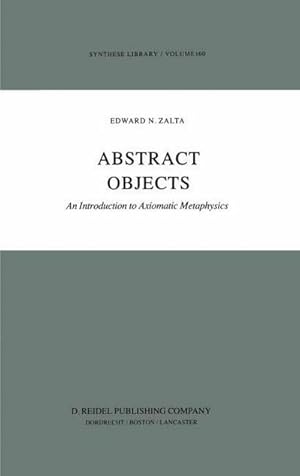
Abstract Objects : An Introduction to Axiomatic Metaphysics
Libro 17 de 304: Synthese LibraryLibrería: AHA-BUCH GmbH, Einbeck, Alemania
Calificación del vendedor: 5 de 5 estrellas
EUR 168,73
Envío por EUR 62,47
Se envía de Alemania a Estados Unidos de AmericaCantidad disponible: 1 disponibles
Añadir al carritoBuch. Condición: Neu. Druck auf Anfrage Neuware - Printed after ordering - In this book, I attempt to lay the axiomatic foundations of metaphysics by developing and applying a (formal) theory of abstract objects. The cornerstones include a principle which presents precise conditions under which there are abstract objects and a principle which says when apparently distinct such objects are in fact identical. The principles are constructed out of a basic set of primitive notions, which are identified at the end of the Introduction, just before the theorizing begins. The main reason for producing a theory which defines a logical space of abstract objects is that it may have a great deal of explanatory power. It is hoped that the data explained by means of the theory will be of interest to pure and applied metaphysicians, logicians and linguists, and pure and applied epistemologists. The ideas upon which the theory is based are not essentially new. They can be traced back to Alexius Meinong and his student, Ernst Mally, the two most influential members of a school of philosophers and psychologists working in Graz in the early part of the twentieth century. They investigated psychological, abstract and non-existent objects - a realm of objects which weren't being taken seriously by Anglo-American philoso phers in the Russell tradition. I first took the views of Meinong and Mally seriously in a course on metaphysics taught by Terence Parsons at the University of Massachusetts/Amherst in the Fall of 1978. Parsons had developed an axiomatic version of Meinong's naive theory of objects.
-
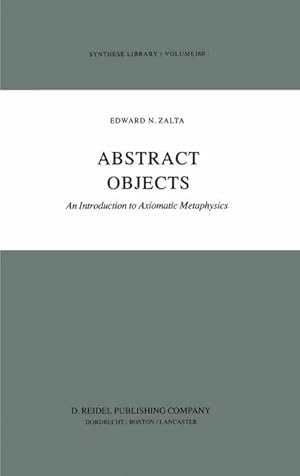
Abstract Objects
Libro 17 de 304: Synthese LibraryIdioma: Inglés
Publicado por Springer Netherlands Jun 1983, 1983
ISBN 10: 9027714746 ISBN 13: 9789027714749
Librería: BuchWeltWeit Ludwig Meier e.K., Bergisch Gladbach, Alemania
Calificación del vendedor: 5 de 5 estrellas
EUR 160,49
Envío por EUR 23,00
Se envía de Alemania a Estados Unidos de AmericaCantidad disponible: 2 disponibles
Añadir al carritoBuch. Condición: Neu. This item is printed on demand - it takes 3-4 days longer - Neuware -In this book, I attempt to lay the axiomatic foundations of metaphysics by developing and applying a (formal) theory of abstract objects. The cornerstones include a principle which presents precise conditions under which there are abstract objects and a principle which says when apparently distinct such objects are in fact identical. The principles are constructed out of a basic set of primitive notions, which are identified at the end of the Introduction, just before the theorizing begins. The main reason for producing a theory which defines a logical space of abstract objects is that it may have a great deal of explanatory power. It is hoped that the data explained by means of the theory will be of interest to pure and applied metaphysicians, logicians and linguists, and pure and applied epistemologists. The ideas upon which the theory is based are not essentially new. They can be traced back to Alexius Meinong and his student, Ernst Mally, the two most influential members of a school of philosophers and psychologists working in Graz in the early part of the twentieth century. They investigated psychological, abstract and non-existent objects - a realm of objects which weren't being taken seriously by Anglo-American philoso phers in the Russell tradition. I first took the views of Meinong and Mally seriously in a course on metaphysics taught by Terence Parsons at the University of Massachusetts/Amherst in the Fall of 1978. Parsons had developed an axiomatic version of Meinong's naive theory of objects. 216 pp. Englisch.
-

Abstract Objects
Libro 17 de 304: Synthese LibraryLibrería: moluna, Greven, Alemania
Calificación del vendedor: 4 de 5 estrellas

EUR 136,16
Envío por EUR 48,99
Se envía de Alemania a Estados Unidos de AmericaCantidad disponible: Más de 20 disponibles
Añadir al carritoGebunden. Condición: New. Dieser Artikel ist ein Print on Demand Artikel und wird nach Ihrer Bestellung fuer Sie gedruckt. In this book, I attempt to lay the axiomatic foundations of metaphysics by developing and applying a (formal) theory of abstract objects. The cornerstones include a principle which presents precise conditions under which there are abstract objects and a pri.
-
Abstract Objects | An Introduction to Axiomatic Metaphysics
Libro 17 de 304: Synthese LibraryLibrería: preigu, Osnabrück, Alemania
Calificación del vendedor: 5 de 5 estrellas
EUR 141,20
Envío por EUR 70,00
Se envía de Alemania a Estados Unidos de AmericaCantidad disponible: 5 disponibles
Añadir al carritoBuch. Condición: Neu. Abstract Objects | An Introduction to Axiomatic Metaphysics | E. Zalta | Buch | 216 S. | Englisch | 1983 | Springer | EAN 9789027714749 | Verantwortliche Person für die EU: Springer Verlag GmbH, Tiergartenstr. 17, 69121 Heidelberg, juergen[dot]hartmann[at]springer[dot]com | Anbieter: preigu Print on Demand.


