

Importe total (1 artículo artículos):
Destino del pedido:

9789024728329 - Science and Technology of Polymer Colloids: Preparation and Reaction Engineering Volume 1 (NATO Science Series E:) de Poehlein, Gary W.; Ottewill, Ronald H.; Goodwi... (7 resultados)
Ir a los resultados principales
Filtros de búsqueda
Tipo de artículo
- Todos los tipos de productos
- Libros (7)
- Revistas y publicaciones (No hay ningún otro resultado que coincida con este filtro.)
- Cómics (No hay ningún otro resultado que coincida con este filtro.)
- Partituras (No hay ningún otro resultado que coincida con este filtro.)
- Arte, grabados y pósters (No hay ningún otro resultado que coincida con este filtro.)
- Fotografías (No hay ningún otro resultado que coincida con este filtro.)
- Mapas (No hay ningún otro resultado que coincida con este filtro.)
- Manuscritos y coleccionismo de papel (No hay ningún otro resultado que coincida con este filtro.)
Condición Más información
- Nuevo (6)
- Como nuevo, Excelente o Muy bueno (1)
- Bueno o Aceptable (No hay ningún otro resultado que coincida con este filtro.)
- Regular o Pobre (No hay ningún otro resultado que coincida con este filtro.)
- Tal como se indica (No hay ningún otro resultado que coincida con este filtro.)
Encuadernación
- Todas
- Tapa dura (No hay ningún otro resultado que coincida con este filtro.)
- Tapa blanda (7)
Más atributos
- Primera edición (No hay ningún otro resultado que coincida con este filtro.)
- Firmado (No hay ningún otro resultado que coincida con este filtro.)
- Sobrecubierta (No hay ningún otro resultado que coincida con este filtro.)
- Con imágenes (5)
- No impresión bajo demanda (4)
Idioma (1)
Precio
- Cualquier precio
- Menos de EUR 20 (No hay ningún otro resultado que coincida con este filtro.)
- EUR 20 a EUR 45
- Más de EUR 45
Gastos de envío gratis
- Envío gratis a Estados Unidos de America (No hay ningún otro resultado que coincida con este filtro.)
Ubicación del vendedor
Valoración de los vendedores
-
Science and Technology of Polymer Colloids vol 1 | Preparation and Reaction Engineering (Nato Science Series E: Applied Sciences no 67)
Librería: *bibliosophy*, Exeter, Reino Unido
Calificación del vendedor: 5 de 5 estrellas

EUR 35,69
Envío por EUR 23,10
Se envía de Reino Unido a Estados Unidos de AmericaCantidad disponible: 1 disponibles
Añadir al carritoSoft cover. Condición: Near Fine. 1983, hardback in printed board covers, 263 pages | sound, clean copy free of notes etc, shows light reading wear, some darkening at spine | carefully packaged and dispatched from UK within two working days.
-

Science and Technology of Polymer Colloids: Preparation and Reaction Engineering Volume 1 (NATO Science Series E:)
Librería: Ria Christie Collections, Uxbridge, Reino Unido
Calificación del vendedor: 5 de 5 estrellas
EUR 59,01
Envío por EUR 13,84
Se envía de Reino Unido a Estados Unidos de AmericaCantidad disponible: Más de 20 disponibles
Añadir al carritoCondición: New. In.
-
Science and Technology of Polymer Colloids: Preparation and Reaction Engineering Volume 1 (Nato Science Series E:)
Librería: Chiron Media, Wallingford, Reino Unido
Calificación del vendedor: 5 de 5 estrellas
EUR 56,83
Envío por EUR 17,89
Se envía de Reino Unido a Estados Unidos de AmericaCantidad disponible: 10 disponibles
Añadir al carritoPaperback. Condición: New.
-

Science and Technology of Polymer Colloids : Preparation and Reaction Engineering Volume 1
Idioma: Inglés
Publicado por Springer Netherlands, Springer, 1983
ISBN 10: 9024728320 ISBN 13: 9789024728329
Librería: AHA-BUCH GmbH, Einbeck, Alemania
Calificación del vendedor: 5 de 5 estrellas
EUR 58,39
Envío por EUR 62,09
Se envía de Alemania a Estados Unidos de AmericaCantidad disponible: 1 disponibles
Añadir al carritoTaschenbuch. Condición: Neu. Druck auf Anfrage Neuware - Printed after ordering - Science and Technology of Polymer Colloids G.W. Poehlein, R.H. Ottewill, J.W. Goodwin (editors) Polymer colloids, more commonly known as latexes, are important in the manufacture of synthetic elastomers, commodity polymers, surface coatings, adhesive and numerous specialty products. The significant growth of the commercial production of polymer latexes during the past decade has been due to a number of factors. First, water-based systems, especially paints and coatings, avoid many of the environ mental problems associated with the solvent-based systems. Second, polymer colloid products can be custom designed to meet a wide range of application requirements. Third, large scale emulsion polymeri zation proceeds smoothly and controllably with a wide range of monomers to produce stable polymer colloids of high molecular weight. Polymer colloids are also important in functional scientific studies. This importance arises from the spherical shape of the particles, range of attainable particle diameters and the uniformity of their size distribution, and the possibility of controlling and character izing the particle surface. Polymer colloids are useful as size standards in microscopy and in instrument calibration, and as carriers in antibody-enzyme diagnostic tests. As suspensions of uniform spherical particles, they are ideal experimental systems to test the series of colloidal phenomena as stability and coagulation, electric kinetic or rheological proper ties, and light scattering. In recent years, polymer colloids have received attention as models for many-body molecular phenomena, including the order-disorder transitions and the mechanics of crystalline phases.
-

Science and Technology of Polymer Colloids
Idioma: Inglés
Publicado por Springer Netherlands, Springer Jan 1983, 1983
ISBN 10: 9024728320 ISBN 13: 9789024728329
Librería: BuchWeltWeit Ludwig Meier e.K., Bergisch Gladbach, Alemania
Calificación del vendedor: 5 de 5 estrellas
EUR 53,49
Envío por EUR 23,00
Se envía de Alemania a Estados Unidos de AmericaCantidad disponible: 2 disponibles
Añadir al carritoTaschenbuch. Condición: Neu. This item is printed on demand - it takes 3-4 days longer - Neuware -Science and Technology of Polymer Colloids G.W. Poehlein, R.H. Ottewill, J.W. Goodwin (editors) Polymer colloids, more commonly known as latexes, are important in the manufacture of synthetic elastomers, commodity polymers, surface coatings, adhesive and numerous specialty products. The significant growth of the commercial production of polymer latexes during the past decade has been due to a number of factors. First, water-based systems, especially paints and coatings, avoid many of the environ mental problems associated with the solvent-based systems. Second, polymer colloid products can be custom designed to meet a wide range of application requirements. Third, large scale emulsion polymeri zation proceeds smoothly and controllably with a wide range of monomers to produce stable polymer colloids of high molecular weight. Polymer colloids are also important in functional scientific studies. This importance arises from the spherical shape of the particles, range of attainable particle diameters and the uniformity of their size distribution, and the possibility of controlling and character izing the particle surface. Polymer colloids are useful as size standards in microscopy and in instrument calibration, and as carriers in antibody-enzyme diagnostic tests. As suspensions of uniform spherical particles, they are ideal experimental systems to test the series of colloidal phenomena as stability and coagulation, electric kinetic or rheological proper ties, and light scattering. In recent years, polymer colloids have received attention as models for many-body molecular phenomena, including the order-disorder transitions and the mechanics of crystalline phases. 272 pp. Englisch.
-
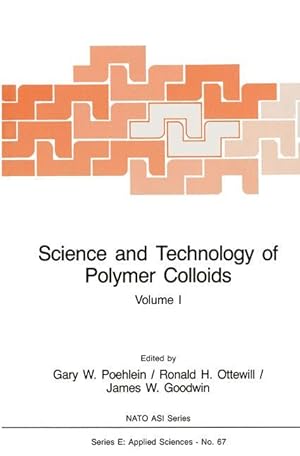
Science and Technology of Polymer Colloids
Librería: moluna, Greven, Alemania
Calificación del vendedor: 4 de 5 estrellas

EUR 48,37
Envío por EUR 48,99
Se envía de Alemania a Estados Unidos de AmericaCantidad disponible: Más de 20 disponibles
Añadir al carritoCondición: New. Dieser Artikel ist ein Print on Demand Artikel und wird nach Ihrer Bestellung fuer Sie gedruckt. Science and Technology of Polymer Colloids G.W. Poehlein, R.H. Ottewill, J.W. Goodwin (editors) Polymer colloids, more commonly known as latexes, are important in the manufacture of synthetic elastomers, commodity polymers, surface coatings, adhesive and nu.
-

Science and Technology of Polymer Colloids
Idioma: Inglés
Publicado por Springer Netherlands, Springer Netherlands Jan 1983, 1983
ISBN 10: 9024728320 ISBN 13: 9789024728329
Librería: buchversandmimpf2000, Emtmannsberg, BAYE, Alemania
Calificación del vendedor: 5 de 5 estrellas
EUR 53,49
Envío por EUR 60,00
Se envía de Alemania a Estados Unidos de AmericaCantidad disponible: 1 disponibles
Añadir al carritoTaschenbuch. Condición: Neu. This item is printed on demand - Print on Demand Titel. Neuware -Science and Technology of Polymer Colloids G.W. Poehlein, R.H. Ottewill, J.W. Goodwin (editors) Polymer colloids, more commonly known as latexes, are important in the manufacture of synthetic elastomers, commodity polymers, surface coatings, adhesive and numerous specialty products. The significant growth of the commercial production of polymer latexes during the past decade has been due to a number of factors. First, water-based systems, especially paints and coatings, avoid many of the environ mental problems associated with the solvent-based systems. Second, polymer colloid products can be custom designed to meet a wide range of application requirements. Third, large scale emulsion polymeri zation proceeds smoothly and controllably with a wide range of monomers to produce stable polymer colloids of high molecular weight. Polymer colloids are also important in functional scientific studies. This importance arises from the spherical shape of the particles, range of attainable particle diameters and the uniformity of their size distribution, and the possibility of controlling and character izing the particle surface. Polymer colloids are useful as size standards in microscopy and in instrument calibration, and as carriers in antibody-enzyme diagnostic tests. As suspensions of uniform spherical particles, they are ideal experimental systems to test the series of colloidal phenomena as stability and coagulation, electric kinetic or rheological proper ties, and light scattering. In recent years, polymer colloids have received attention as models for many-body molecular phenomena, including the order-disorder transitions and the mechanics of crystalline phases.Springer Verlag GmbH, Tiergartenstr. 17, 69121 Heidelberg 272 pp. Englisch.


